
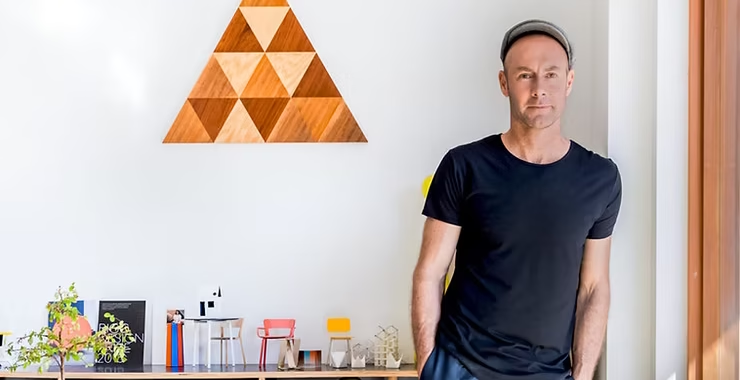
In his Sydney studio, Australian designer Adam Goodrum has spent years asking a single, quietly radical question: Does this piece deserve to exist? Design Diary International’s Shweta put a series of questions to him over email, and what came back was as considered and as precisely worded as the objects themselves.
In the Sydney studio of Adam Goodrum, things get reduced. A piece begins as a concept, gets drawn, modeled, prototyped, and then cut back, over and over, until what remains is only what the object actually needs. He is interested in furniture that expresses how it is made, and that principle runs through everything the studio produces, from the Stitch Chair made by Cappellini to his work for Thonet and Artifort. Pieces that look simple until you understand them become considerably more interesting.
The relationship between structural clarity and visual softness in his work is something he has thought about deeply and describes without overcomplicating it. Structural clarity gives a piece integrity, he says. It lets you understand the object’s logic. But that logic is never meant to feel rigid or cold, because softness comes through proportion, material choice, and subtle curvature. The balance between the two is not imposed from outside but emerges through refinement, through removing what is unnecessary and adjusting what feels too heavy, through a process of reduction that continues until the piece has arrived at exactly itself. It is design as a subtractive discipline, and it is a more honest account of how enduring furniture gets made than the design industry tends to offer.
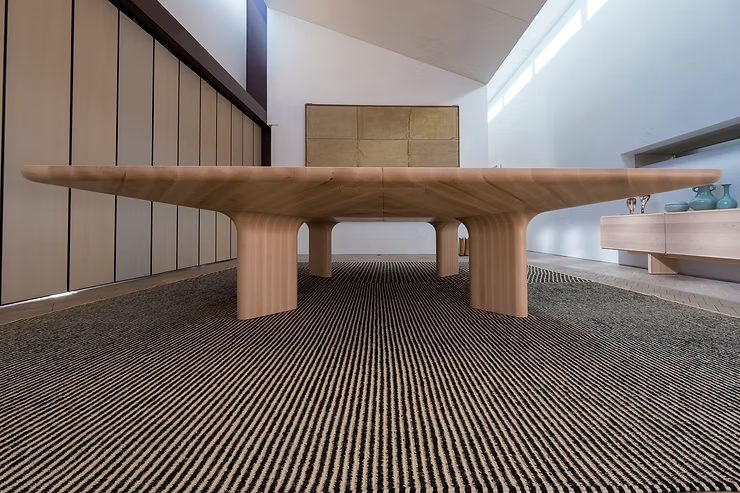
Australia has shaped his thinking in ways that are specific and worth taking seriously. Australia’s geographical distance fosters a pragmatism and resourcefulness in making, unlike the supply chains and manufacturing cultures encountered by European designers. Alongside that pragmatism sits a deep connection to landscape, light, openness, and material honesty, qualities that have shaped his preference for clarity and restraint without his ever having to consciously enforce them. Being removed from global design centers has also allowed him to develop a voice that is not overly trend-driven, and he names this directly, without false modesty, as a form of freedom. The freedom that comes from being outside the room where consensus is forming, from being able to focus on what is right rather than joining or opposing the consensus, and from simply working at a distance that makes the question of what is current feel far less pressing than the question of what is right.
“Being slightly removed from global centers has allowed me to develop a voice that isn’t overly trend-driven. There’s freedom in that distance.”
Collaboration is central to his practice in a way that is structural rather than incidental, and his account of how it actually works is more candid than the version designers usually offer in print. Rather than arriving at a manufacturer with a fixed idea, he tries first to understand what they do exceptionally well and builds from there. The best outcomes happen when there is mutual trust, when engineering and craftsmanship and design thinking push each other forward, and the final piece is better than the initial concept because it has been tested and strengthened through genuine dialogue. That last part is the important one. The willingness to let a manufacturer’s knowledge and capability improve the idea rather than treating the original concept as settled and the maker as simply the means of its execution. It is a collaborative ethic that requires a particular kind of confidence, the kind that does not need to protect the first idea from contact with reality.
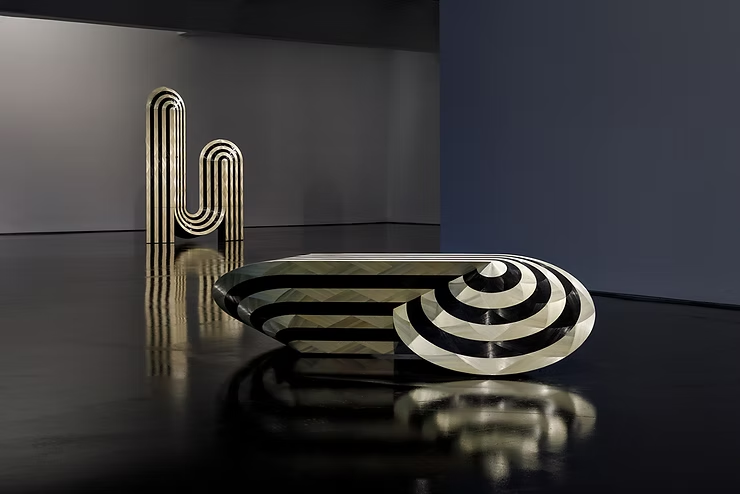
The Stitch Chair, produced by Cappellini and the piece most associated with his name internationally, is where that ethic produced its most visible result. It was an exploration of making construction visible, he explains, using stitching not as decoration but as structure, reducing a chair to its essential components and expressing them honestly. It marked a moment where experimentation met commercial viability, a balance he describes as delicate and clearly meaningful. Working with Cappellini gave him direct insight into Italian design culture, an experience he speaks of with evident respect, and the longevity of the piece, its continued relevance years after it was first made, has been rewarding in the way that only work with genuine structural logic tends to be, because it does not depend on the moment it was born in to remain valid and does not need the year of its production to explain why it still exists.
“The Stitch Chair was an exploration of making construction visible, using stitching not as decoration but as structure.”
On trends, Goodrum is clear without being combative. He does not actively resist them, he says. He simply does not begin with them. The distinction matters because one is a stance and the other is just a way of working. He starts with structure, material, and purpose, and if a piece resolves well in those areas, it tends to feel grounded and lasting without longevity needing to be designed for as a separate objective. Trends, in his account of them, relate primarily to surface and styling, which is not where his interest lies. The question he returns to instead is whether something will feel relevant in ten or twenty years, a standard that most trend-driven work fails to meet.
Drawing remains fundamental to how the studio operates because it is the fastest way to test proportion and structure, and physical prototyping is equally essential in furniture specifically, where comfort and weight and tactility cannot be fully understood on screen regardless of how sophisticated the digital tools become. The studio moves between sketching, digital modeling, and physical mock-ups fluidly, each stage revealing something the others cannot, and it is a process that resists the shortcuts that digital technology makes available because Goodrum understands that shortcuts are where the errors that only become visible after installation tend to quietly hide.
Material, he is clear on this, is never applied at the end. It informs the idea from the very beginning and carries both structural and emotional qualities that shape what a piece can be before a single line has been drawn. Often a concept will emerge directly from understanding how a material behaves under tension or compression, rather than from a resolved form that is then given a material to live in. He is interested in letting materials do what they naturally want to do rather than forcing them into something artificial, and this approach is less a philosophical position than a practical one: the recognition that a material working against its own nature is a material that will eventually make that fact known, and usually at the worst possible moment.
“Material is never applied at the end. It informs the idea from the beginning.”
His understanding of design has shifted considerably since he first established his practice, and the change he identifies is temperamental rather than technical. Early on, he says, there is a desire to prove something, and over time he has grown more comfortable with restraint, more willing to let ideas develop slowly, more rigorous in what he removes. He is now more aware of longevity, both environmentally and culturally, and he applies a standard of simple justification to his own work. A piece should justify its existence. If it cannot meet that requirement, it should not be made. It is a demanding position and an unfashionable one in an industry that produces a considerable amount of furniture whose primary purpose is to be photographed, and Goodrum states it without apparent concern for how it lands.
What continues to interest him most is the intersection of utility and emotion; the challenge of creating something that performs beautifully but resonates on a quieter level as well; and the ongoing question of how construction can be simplified, how more can be achieved with fewer elements, and how the next refinement can be found in work that already appears resolved and complete. There is always another way to refine, he says, and this attitude reads less like ambition than orientation. It describes a mind that does not experience the completion of a piece as the end of a question but as the beginning of the next one—a mind permanently interested in the gap between what something is and what it could still become. This may be the most accurate description of what keeps a practice like his producing work of genuine consequence decade after decade.
Looking ahead, he is increasingly drawn to modularity and adaptability, to how furniture can evolve with people over time rather than being fixed at the moment of purchase, and to the further exploration of material innovation alongside traditional craftsmanship. These are not separate interests but versions of the same one: how an object can remain useful and meaningful not just on the day it arrives but across the years that follow, which has always been the harder and more interesting design problem. The ambition, stated plainly, is to create work that feels both contemporary and enduring, with a clarity that allows it to age well and a structure that continues to make sense long after the context it was made in has shifted and moved on. This is as precise and as honest a description of what Adam Goodrum has been doing all along as anything else in this conversation, and it reflects a kind of ambition that does not need a trend to give it direction because it already has one entirely its own.
“A piece should justify its existence.”
