
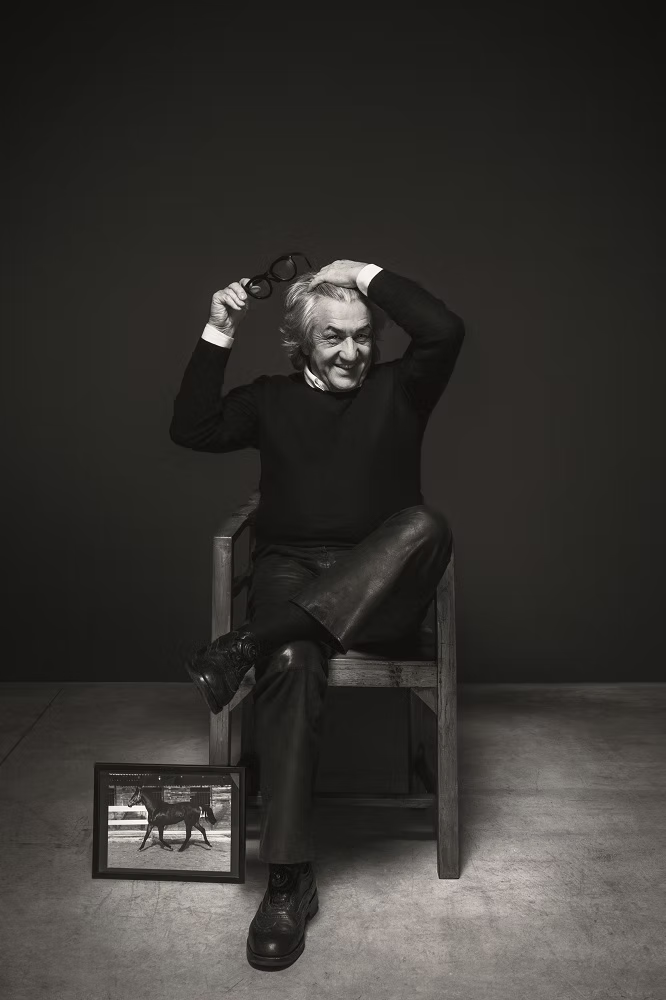
Since 1989, his workshop along the river Serio near Bergamo has been making lamps entirely by hand, one at a time, to order, without an assembly line in sight. Enzo Catellani, founder of Catellani & Smith, speaks to Design Diary International about the miracle that started it all, why small imperfections are a sign of something alive, and what a sphere of aluminum wire made at Palazzo Poli became to the world.
He did not begin with a business plan or a brand strategy or even a clear idea of whether anyone would want what he was making. He began in a small workshop, studying how different materials interacted with light, assembling components, welding, shaping, and building lamps that came out of his hands before they came out of his mind, because the idea, for Catellani, has always needed to take physical form immediately rather than live on paper until someone decides to make it real. He had spent the late 1970s in contact with the lighting world and its key players, absorbing enough to know that what he wanted to make was not quite what anyone else was making, and so he made it himself and waited to see what would happen.
What happened was the Ambiente Fair in Frankfurt, where he presented those first entirely handmade lamps to an international audience and received more than 1,400 orders. It was almost miraculous, he says, and the word is not rhetorical. He had not anticipated it and had not prepared for it, and suddenly he had to enlarge his production and build the infrastructure of an actual company around an instinct that had, until that moment, existed only as a private obsession with material and light. Catellani & Smith was founded in 1989 to fulfill those orders and has been fulfilling orders in essentially the same spirit ever since: handmade, to commission, without stock, without an assembly line, without any of the mechanisms of standardization that would make the operation more efficient and considerably less itself.
The collections that followed those first pieces, which he calls Timeless Objects, carry names that have become genuinely iconic within lighting design globally: Luci d’Oro, Stchu-Moon, Lucenera, Fil de Fer, and PostKrisi. Each one emerged through the same process that produced the originals, not from a drawing but from a prototype, because for Catellani the idea must immediately become an object and must be held and looked at and adjusted with the hands rather than refined on a screen until it is ready to be made. The actual design phase, the feasibility studies, and the technical specifications follow the prototype rather than preceding it. The object comes first, and the documentation of it comes second, which is either an entirely inefficient way to run a lighting company or the only way to make lamps that feel the way his do, and given what the market has confirmed over thirty-five years, the answer is fairly clear.
The creative intention behind all of it is consistent enough that Catellani can describe it in a single sentence: he wants to create illuminating objects capable of producing light that is emotional and engaging and delicate and decorative and relaxing, while at the same time being objects strong enough in their own presence to personalize the room and the space they inhabit. This sounds straightforward until you consider how rarely lighting actually achieves it, how most fixtures either recede entirely into the background or insist so heavily on themselves as designed objects that the light they produce becomes almost incidental. Catellani has been working in the territory between these two failures for his entire career, and the breadth of what he has produced there is considerable: from the minimal and poetic lamps like ID, Light Stick, and For You that emit a delicate glow without drawing attention to their own presence, to the more technically complex Lucenera, to the fully sculptural PostKrisi and Ensō, which cast light in ways that transform the surfaces around them and make a room feel inhabited by something you cannot quite name.
The study of how materials interact with light is where all of this begins and where it continues to generate new work. Brass has been the material that has surprised him most recently, and the list of what it allows reveals why: it can be drawn, milled, turned, laser-cut, engraved, or spun; purchased in bars or tubes or sheets or wires of any cross-section; used to create structures that are either extremely lightweight or very heavy depending on what a piece demands; welded; given galvanic finishes; painted; and it conducts electricity. It is, as Catellani puts it, a material they are still discovering, still finding new possibilities within despite the years of working with it, and that quality of ongoing revelation in a familiar material is something he clearly values as much as the formal properties themselves.
Fil de Fer is the piece most associated with the Catellani & Smith name, and the story of how it came to exist is one of those accounts of creative accident that turns out, on examination, to be less accidental than it first sounds. He was commissioned to design a light fixture for Palazzo Poli near the Trevi Fountain in Rome, the requirement being something lightweight yet voluminous, and among the several prototypes he developed for the project, working with iron wire one day, there was a sphere, born almost spontaneously from the material in his hands. It was not the piece that went into the Dante Room of the Palace, but it was the piece that became Fil de Fer, named after the French for “iron wire,” a lamp made entirely by hand by artisans who bend aluminum wire, weave it into a spherical form, and then insert the small bulbs individually, one by one, into the structure. The original iron wire was replaced early on by aluminum, which is more malleable and more luminous, and the lamp has been in continuous production and continuous evolution ever since: developed into outdoor versions and gold anodized finishes, into the Uomo della Luce, where the sphere is supported by the sculpted arms of an iron silhouette; into Sweet Light, where the sphere in smaller dimensions switches on and off with a touch; into Nuvola and Cascata and Corrimano, each one a variation on the same essential idea of a sphere that holds light the way the night sky holds stars, voluminous and weightless at the same time.
Fil de Fer is now part of the permanent Italian Design collection at the Triennale Design Museum in Milan and the Expo Museum in Shanghai and is among the works held in the Quirinale Contemporaneo collection in the Palazzo of the Presidency of the Italian Republic in Rome. It has been recognized by Italian courts as a work of ingenuity deserving copyright protection for its creative and artistic value, a status that is not commonly extended to lighting design and that speaks to the degree to which the piece functions as something other than, or at least more than, a lamp. Its longevity and its consistent ability to read as at home in both classical and contemporary interiors, in private residences and renowned hotels, in intimate rooms and large public spaces, are what Catellani identifies as the key to whatever he means by “timeless,” and it is not a quality he designed in. It emerged from the particular honesty of the object, from the fact that it does exactly what it looks like it does and is made of exactly what it appears to be made of, and that transparency of means turns out to be as durable as any formal decision could have been.
The question of what handmade means at Catellani & Smith compared to industrial production is one he answers through the particulars of how the workshops actually operate rather than through any abstract argument about craft values. Each lamp is made to order, which means there is no stock and no production that happens in advance of demand, and this allows a flexibility in meeting custom requests from architects and designers that a stockbased model cannot offer. In the workshops along the river Serio, there is no assembly line and no repetitive single-task work, but instead artisans who rotate through the various phases of production in spaces that have parquet floors and wooden furniture and music playing in the background, because Catellani believes in giving each lamp the time it needs and in creating the conditions in which the people making them can bring the quality of attention the work requires. Small imperfections in the finished pieces are not flaws to be corrected before shipping, he says, but characteristics of the handmade, evidence that a specific person’s hands were involved at every stage, and it is precisely this trace of the maker that gives each lamp what he calls a soul, a quality of presence that the absence of imperfection would actually diminish.
The geographic spread of where Catellani & Smith sells reflects the degree to which this approach has found its audience across very different design cultures. Italy accounts for roughly thirty percent of turnover, with the remaining seventy percent coming primarily from European markets, Germany historically being the first country to appreciate the work, followed by France, Switzerland, Belgium, and the Netherlands, and then beyond Europe, with Asia representing the most significant territory, particularly China, Hong Kong, and India. Different markets show preferences for specific collections or finishes, but the bestsellers travel with a consistency that suggests the qualities Catellani is working toward are not culturally specific in the way that more trend-dependent design tends to be.
In the studio at the moment, the work is exploratory in the way that the early stages of a new Catellani collection always are, various possibilities being evaluated, materials being studied, potential solutions being assessed without any predetermined direction. The most recent collection, Pòta!, was presented at Euroluce in Milan in April 2025, and the thinking now turns toward what comes next. Looking back across the body of work, Catellani identifies three recurring generators for new pieces: a new light source, as with the LED-driven collections Atman, Light-Stick, Lederam, Petites Bijoux and Pòta!; the discovery of a new material and its particular interaction with light, which produced Stchu-Moon, Fil de Fer, PostKrisi and Luci d’Oro; or the development of an innovative and patented system for distributing electrical energy through a structure, as in Ensō and Pòta!. New projects will be evaluated against these three areas, which is not a formula but a map of the territory where his curiosity has consistently found something worth making.
Thirty-five years after those first lamps achieved their unexpected success in Frankfurt, the Catellani & Smith workshops are still along the river Serio, the lamps are still entirely handmade, and each one still begins not with a drawing but with a prototype taking shape in someone’s hands. The company has grown, the production has expanded, the technology has advanced considerably, and the global recognition has accumulated in ways that Pietro’s Frankfurt moment could only dimly foreshadow. None of this has changed the essential nature of what happens in those workshops, which is that a person who understands light and material spends the necessary time with both of them, and the result is a lamp that carries that time within it and gives it back to whatever room it finds itself in, evening after evening, for as long as it lasts.
