
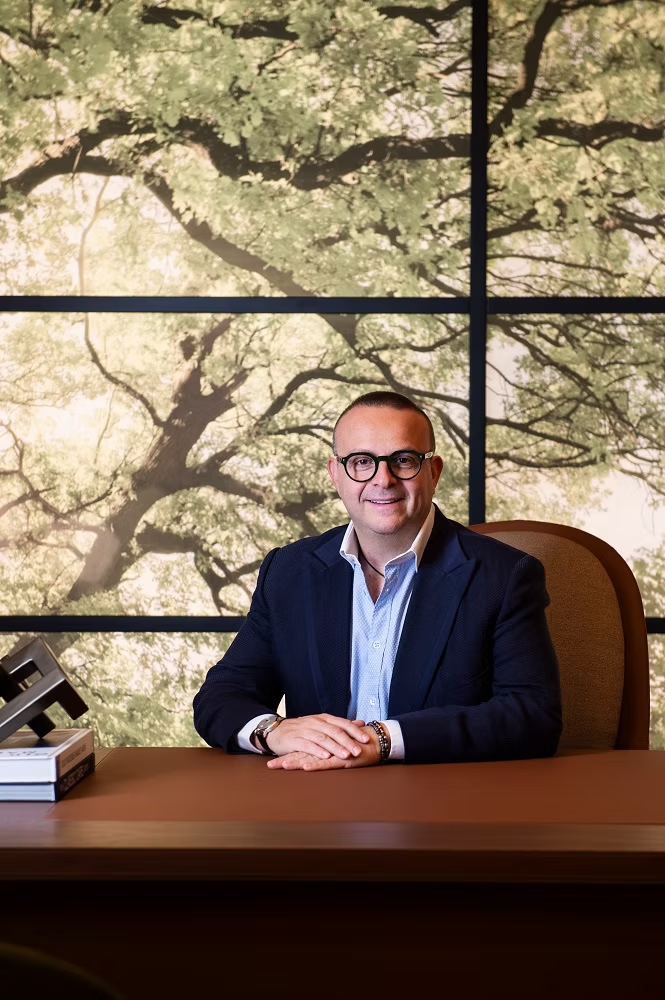
Founded in a small workshop in Brianza in 1925, Turri has spent four generations building furniture that sits somewhere between art and architecture, between heritage and tomorrow. Andrea Turri, CEO and fourth-generation custodian of the brand, discusses the role of wood in Turri’s legacy and why, after a century, luxury is defined by personal expression.
Pietro Turri opened his workshop in Carugo, in the heart of Brianza, in 1925, with wood as his primary material and craftsmanship as his only brief. He was not trying to build a brand in the modern sense of the word. He was making furniture the way people in that part of northern Italy had always made furniture, with the kind of patient, material-deep attention that turns a piece of wood into something that carries the character of the hands that shaped it. What he was building, without quite intending to, was the foundation of something that would last a hundred years and travel to homes on every continent.
The decades that followed shaped the company through a series of decisions that each generation made with a mixture of instinct and necessity. The 1950s brought a significant expansion, a showroom in Milan and a move of production to Briosco, and in 1961 Turri participated in the inaugural Salone del Mobile, a moment that placed the brand formally within the conversation of Italian design at exactly the point when that conversation was beginning to matter to the world. International growth came in the 1980s, with a particular presence in Europe and the Middle East, and by the 1990s and early 2000s, the brand had entered the Chinese market, deepening its reach in a way that made the phrase “Made in Italy” mean something beyond geography. When Andrea Turri took over leadership of the company in 2007, he brought with him a vision he describes as simultaneously rooted in the past and oriented toward the future, a more contemporary and internationally attuned design language that was simpler and more restrained than what had come before, which he named the Modern Luxury era. In 2023, Turri joined Dexelance, the only design organization listed on the Italian public exchange, a relationship that has extended the brand’s visibility in international markets and its capacity to respond to the growing demand for high-quality custom furniture at a pace and precision the previous structure could not have supported.
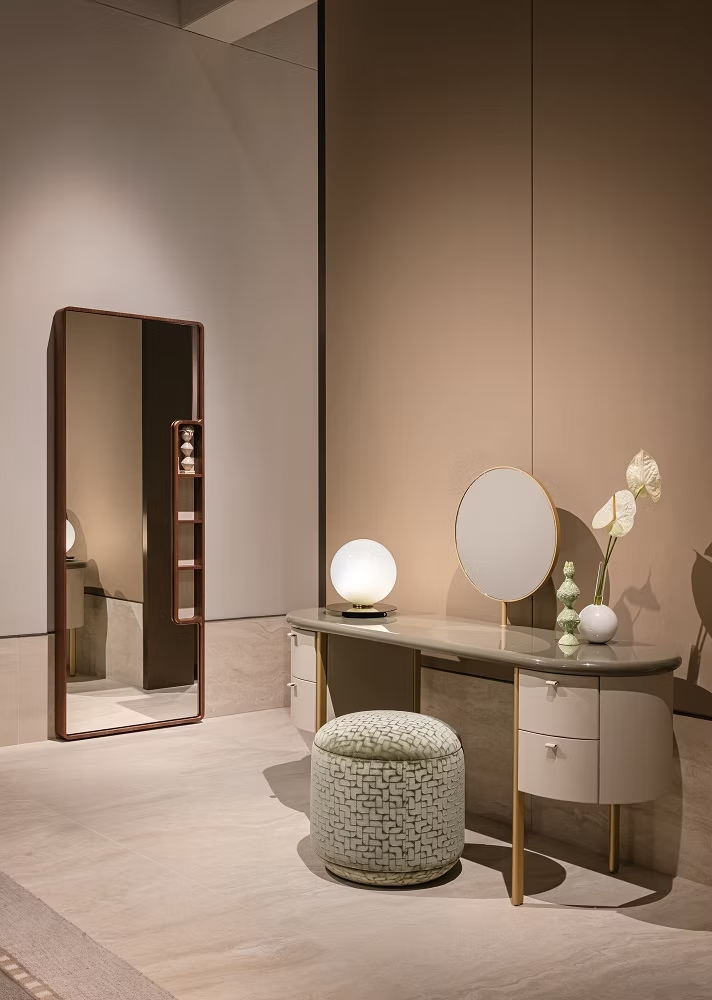
What has remained constant through all of this movement and change is something that Andrea Turri describes not as a policy but as a conviction, the belief that furniture is not simply made but that it reflects how people live, that every piece carries within it an idea of life as it might be lived rather than simply a solution to the problem of where to sit or what surface to place things on. The passion for handcrafted excellence has not shifted across four generations, and the approach to bespoke design has not shifted either, though the vocabulary through which it is expressed has evolved considerably. Custom design at Turri is not, he is careful to say, simply a matter of offering options and letting clients choose among them. It is a genuine creative experience in which the client is involved at every stage of the process, from the first conversation about what a space needs to feel like through to the final finishing of the individual piece, so that what emerges at the end is something that could not have been made for anyone else because it was made in such close conversation with a specific person and a specific life.
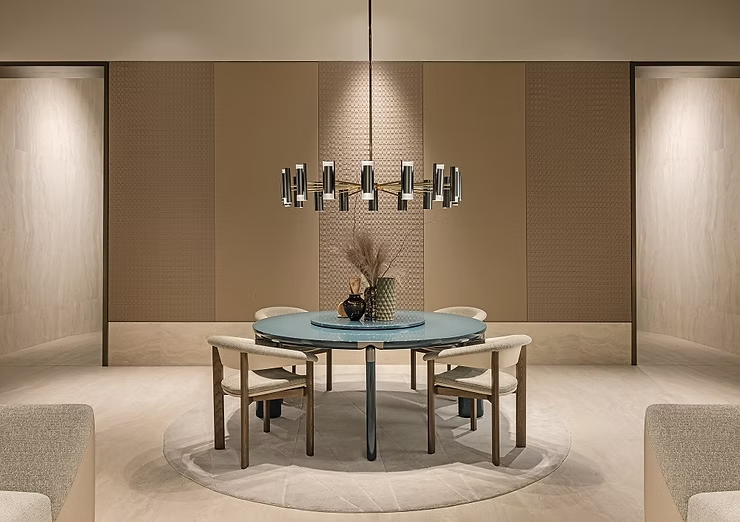
Materials are where this conversation tends to become most concrete and most telling. Wood remains the central character in every Turri piece, chosen by craftsmen who understand individual timbers well enough to hear the particular story each one is capable of telling and worked with the lacquering techniques and polishing methods that have become so distinctively associated with the brand that they function almost as a signature. But wood is never alone. Turri pieces are built from careful combinations of wood and leather and marble and metal, each material chosen for how it relates to the others, for the conversation it creates between textures and finishes, and for the way the whole becomes richer than any of its individual parts would suggest. The finest marbles are selected for their natural beauty and the unrepeatable quality of their veining. Leathers are worked with a precision and care that the brand treats as non-negotiable. The result, in each case, is a piece that feels at once contemporary and permanently itself, never quite dateable to a particular moment because it is grounded in materials and processes that have a longer history than any single collection.
The question of how to honor that history while still speaking to clients and designers who are working in a completely unique present is one that Andrea Turri has thought about carefully and answers with a clarity that suggests it has been genuinely resolved rather than diplomatically hedged. The strategy operates on two tracks simultaneously. The Heritage Collection preserves the more maximalist design vocabulary that the brand developed between 2014 and 2018, keeping it available for clients whose sensibility is aligned with that particular richness. The Turri Collection, developed in collaboration with contemporary designers brought in from around the world, speaks a more current language while being shaped by the same underlying values around material quality and craft depth. The designers who have contributed to this second track include Andrea Bonini, Matteo Nunziati, Giuseppe Viganò, Paola Navone, Monica Armani, Toan Nguyen, Marco Acerbis, and Francesca Lanzavecchia, each one bringing their own perspective while working within a brief that keeps the brand’s character intact. These collaborations have done more than introduce new formal ideas into the collection. They have helped Turri think more precisely about what home means now, about the relationship between residential and contract design, and about how a brand with a century of history can continue to grow its audience without losing the specificity that gives it its reason to exist.
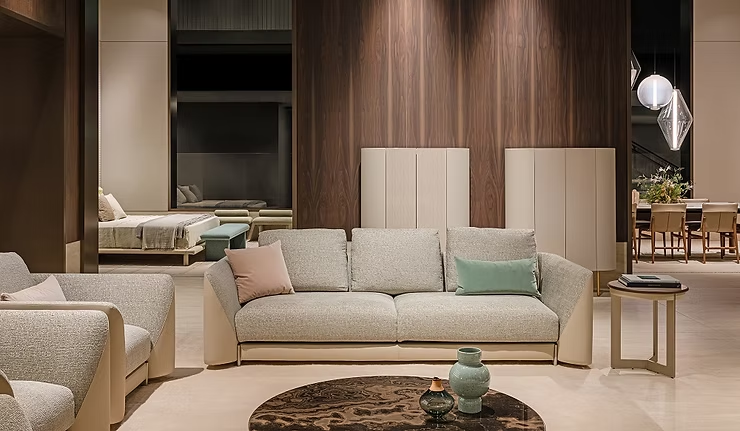
The individual collections carry their own distinct personalities, shaped by the materials and emotional intentions that define them rather than by any single formal gesture. The Vine armchair, designed by Frank Jiang, draws directly from the branched natural wood construction and armrest forms characteristic of 1950s design, a reference that is not nostalgic but genuinely structural, using the logic of a particular moment in design history to produce something that feels both familiar and entirely current. The story behind each collection comes from the balance Andrea Turri describes as the brand’s deepest instinct: between new ideas and inherited ones, and between cultural references that come from many places and a consistent desire to make each piece feel personal and specific to the person it is being made for. The common thread running through all of it, regardless of how different individual collections look from each other, is what he describes as the brand’s savoir-faire, the accumulated knowledge of how to make something with a quality of finish and a depth of material engagement that cannot be replicated through automation or accelerated through efficiency savings, because it depends on the judgement and the sensory intelligence of people who have spent years learning to work with these specific materials in these specific ways.
The role of the artisan’s hand at Turri is not a marketing position. It is a practical reality. New technology and contemporary machinery are used in the production process, and Andrea Turri is entirely clear about the value they bring, but neither can substitute for what the craftsman brings to the finishing of each piece: the care and precision and the quality of attention that comes from a person who understands what they are making and why it matters. The characteristic wood lacquering processes that have become one of the most recognizable elements of Turri’s output, the particular feel of polished wood surfaces, and the detailed leatherwork—these all require a quality of human involvement that a machine can assist with but cannot replace, and the brand’s commitment to maintaining that involvement is not sentimental. It is the reason the furniture looks and feels the way it does and the reason clients who have lived with Turri pieces for ten or twenty years come back.
The demand for customization has grown considerably recently, and in a way that reflects a broader shift in how clients across different markets understand what they are buying when they commission furniture at this level. As the world has become more connected, clients have become more specific about wanting their interiors to reflect their own culture and personality and way of living rather than a generalized idea of luxury that could belong to anyone. Turri has responded to this by expanding not just the customization options available within its collections but the scope of what it offers entirely, providing full bespoke design services for both private residences and high-end contract projects so that a client who wants to work at the level of an individual piece and a client who wants to design an entire interior from wall panels to decorative objects can both be served with the same depth of engagement.
Looking forward, Andrea Turri sees the global design landscape moving in a direction that aligns closely with where Turri has always been positioned, even if the language used to describe that direction is new. The boundaries between different design traditions and material cultures are becoming more porous, creating conditions in which designers can draw from a much wider range of references while still producing work that feels grounded and specific rather than generically international. Luxury interiors, in his reading of where things are heading over the next decade, will become more subtle and more individually calibrated, with a shift away from the kind of declarative richness that characterized an earlier understanding of what a premium interior should look like and toward something more refined and more quietly considered, where comfort and beauty and the quality of craft are the primary registers rather than the immediate visual impact of expensive materials. More minimalist in the sense of being more disciplined rather than more empty. More immersive and more personal rather than more impressive and more universal.
Luxury, for Turri today, is how you live. It is the particular quality of a space that has been made for you specifically, where every surface and finish and detail reflects not a general idea of elegance but a specific understanding of who you are and how you want to inhabit the rooms you spend your life in. It is beauty that does not announce itself but that you feel more clearly each year you live with it, the kind that becomes more itself over time rather than less and rewards sustained attention rather than exhausting it on first encounter. What Turri has been making since Pietro opened his workshop in Carugo a hundred years ago, under many different names and in many different formal languages and for clients on many different continents, is fundamentally this, furni
