
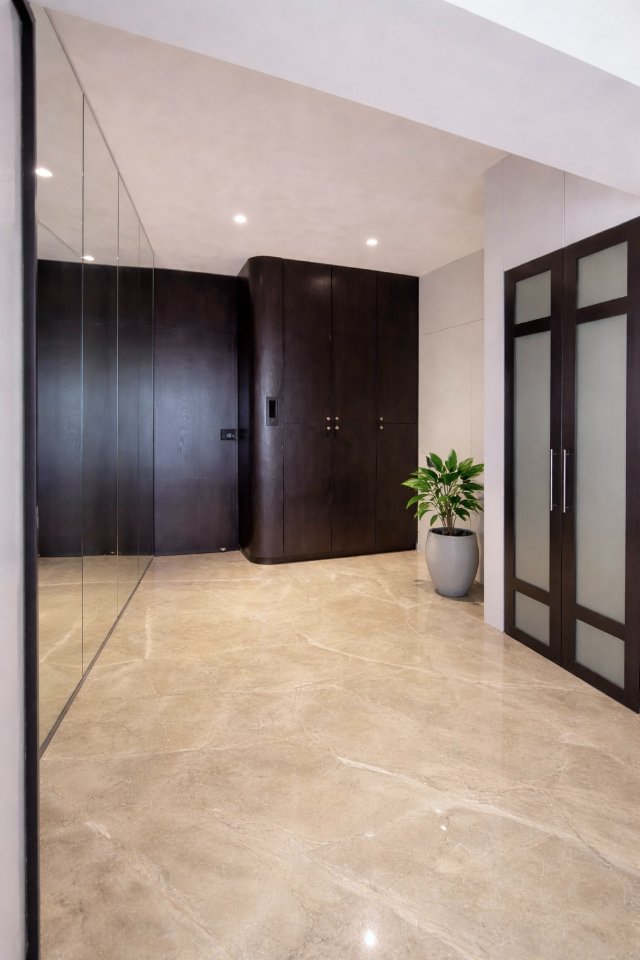
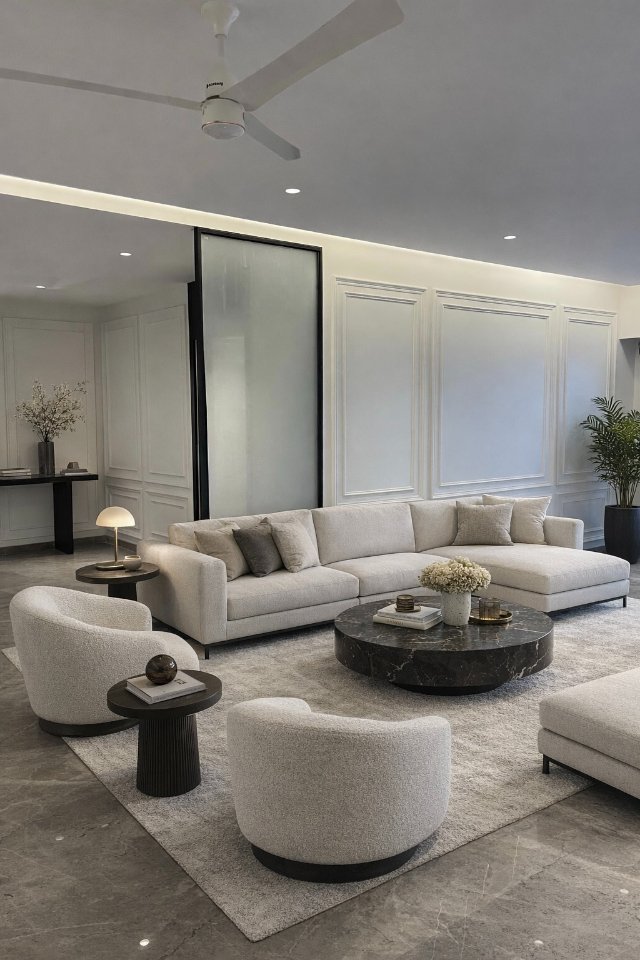
The living room confirms it. White wainscoting panels rise to the ceiling across the main walls, their classical molded grid sitting without comment next to a long off-white linen sectional with a chaise extending to one side, two round boucle swivel chairs placed in front of it, a large circular coffee table in dark marble at the center, a ribbed drum side table in dark wood carrying a small mushroom lamp, and a full-height frosted glass panel in a black steel frame standing between the seating area and the corridor behind, semi-transparent enough that the division reads as a surface rather than a wall. The Italian marble floor runs from the foyer without interruption, its polished surface picking up the warm cove light along the ceiling perimeter, a dark console table against the back wall carrying a small arrangement and a few objects, a potted palm to one side, and across the whole room the palette, cream sofa, white paneling, grey marble floor, and dark marble table, holding in a range narrow enough that the eye finds no particular place to land.
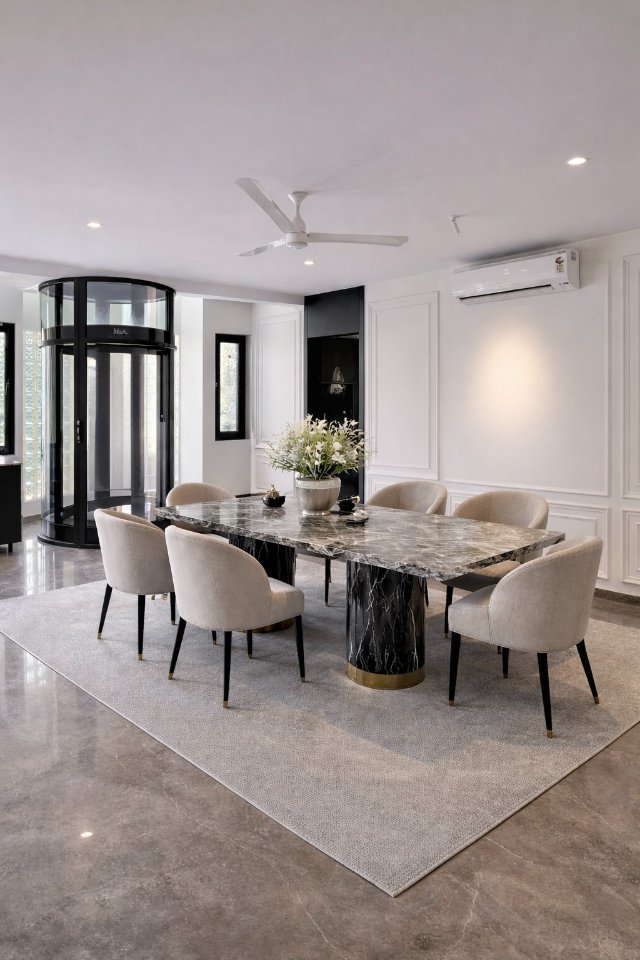
The dining room is where the lower level makes its most direct statement. A large rectangular table in black marble with bold white veining sits at the center, its base two cylindrical columns in the same stone finished at the floor with a brass ring, the top and base reading as a continuous form rather than a slab on a support. Eight barrel chairs in cream upholstery surround it, their backs curved and their black tapered legs each ending in a small brass ferrule that picks up the table’s own brass detail exactly, the same note struck across the room without ever becoming insistent. The wainscoting continues on the wall to one side, its white panels here given more room, and to the other, the cylindrical glass elevator shaft sits in the room’s periphery, its curved glass panels and dark metal frame making it as much an object in the interior as a means of moving between floors. The kitchen, staff quarters, and three bedrooms complete the lower level’s program, the entire floor unified by the Italian marble that flows from the foyer through every room, its surface reflective enough to carry natural light deep into the plan and generous enough in its scale to hold the monochromatic palette together without any single room feeling isolated from the next.
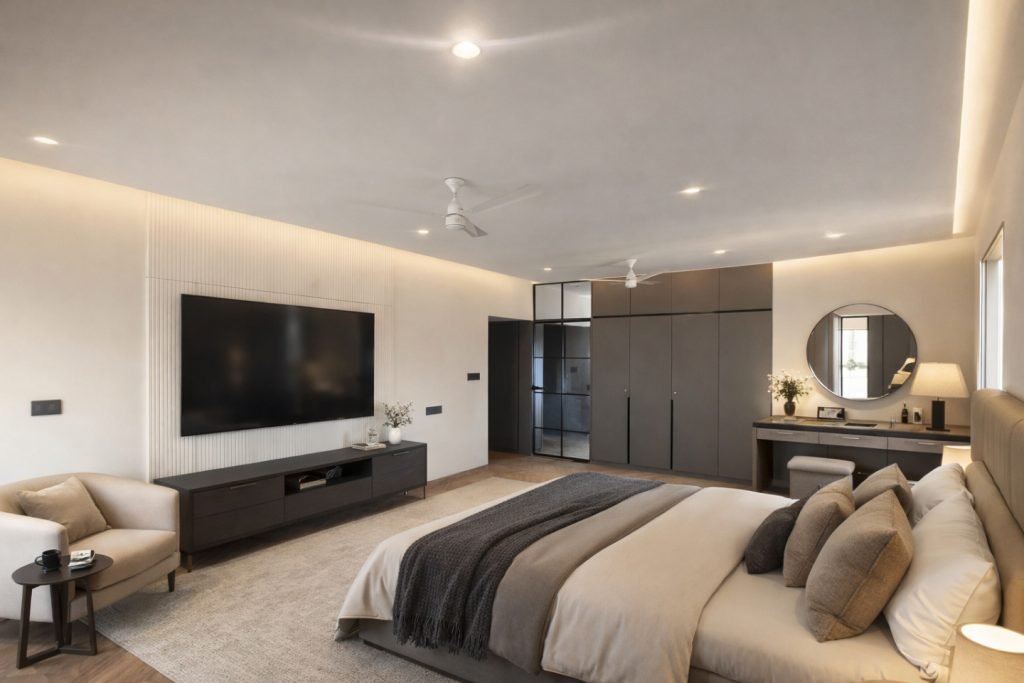
The master bedroom draws that palette to its tightest point. A wall of vertical fluted plaster sits behind the television, its narrow ridges catching the cove light at a low angle so that shadow reads as texture without the surface doing anything beyond being flat, the television centered within it on a dark low console with recessed pulls. Full-height matte dark grey-brown wardrobes with uniform flush doors cover one wall, featuring a steel-and-glass internal door to the bathroom that lets light through its glazed panels. The dressing table is a simple dark timber surface with a round mirror above it and a lamp to one side, a few objects placed on it without ceremony. The bed is upholstered in warm beige, layered with cushions in cream and grey tones and a dark charcoal throw, a cream sofa at its foot and a small round dark side table alongside, and a large area rug in warm grey-beige pulling the furniture together over the timber floor at the room’s edges; the whole room lands in a temperature rather than a color, warm enough that nothing feels clinical and restrained enough that nothing competes.
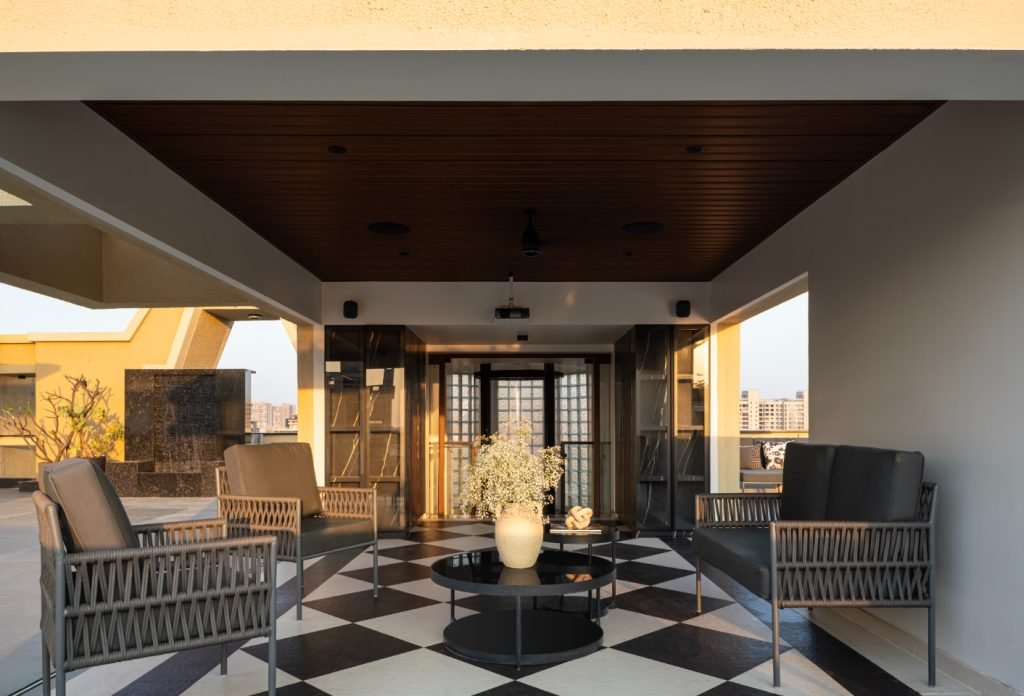
The upper terrace is a different floor in every sense, and it is here that the contrast the lower level has been quietly building toward finally opens up. The terrace contrasts the interior’s monochrome, opening to the sky and city, revealing more varied and demanding spaces. At its heart a central gazebo is anchored by a bold black and white checkerboard floor in large-format tiles, its dark timber-paneled ceiling housing a concealed pull-down screen and speakers set into the corners, woven outdoor chairs around a low round table with a large ceramic vessel of white flowers at the center, and frosted glass doors behind opening to the private lobby and elevator access, the structure sitting precisely at the boundary between inside and outside and using both conditions without committing to either. In the afternoon, the golden light falls across the checkerboard floor, the warm timber ceiling, and the woven furniture, making the gazebo feel embedded in the terrace rather than placed upon it. When the screen drops and the light fades, the same space transforms into something entirely different: an intimate entertainment enclave that the open terrace around it does not indicate.
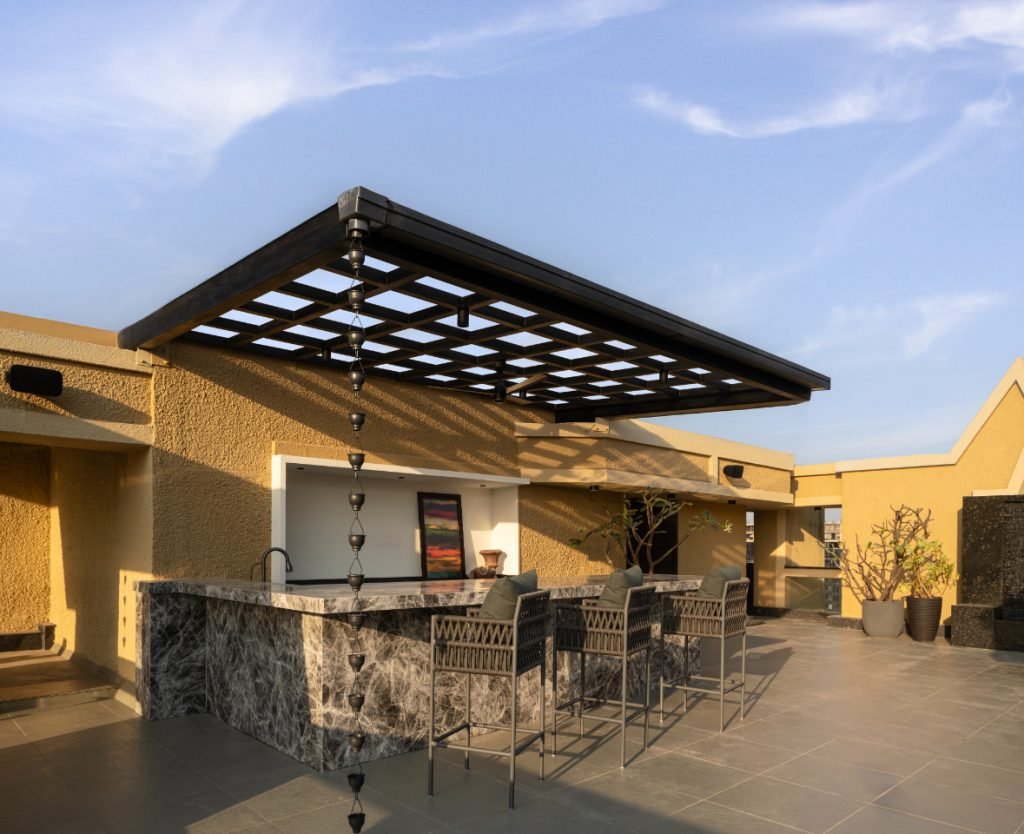
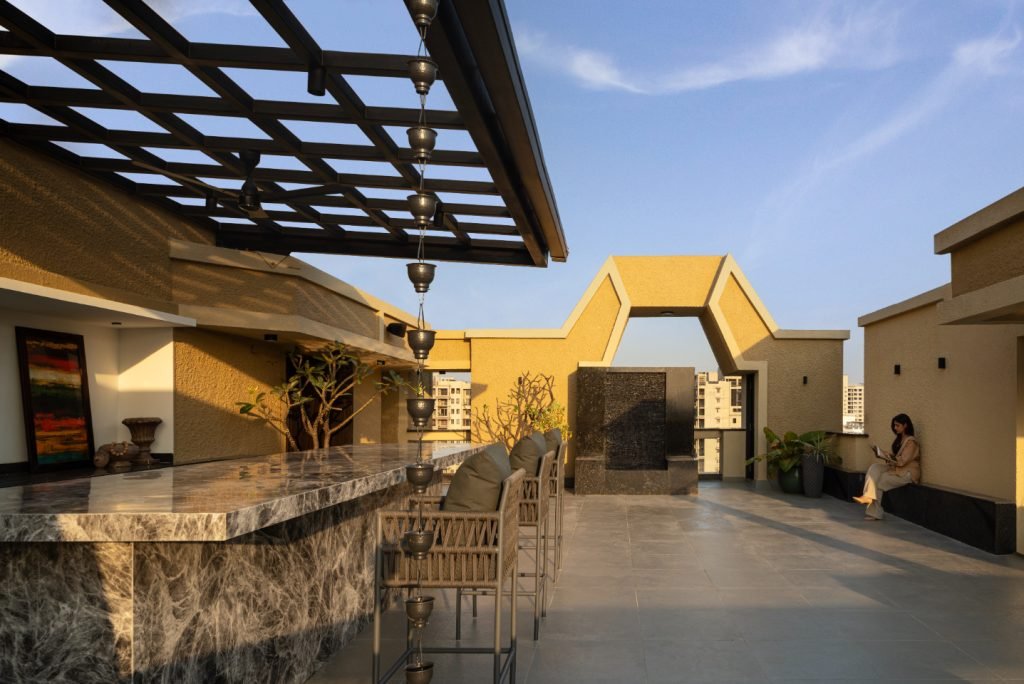
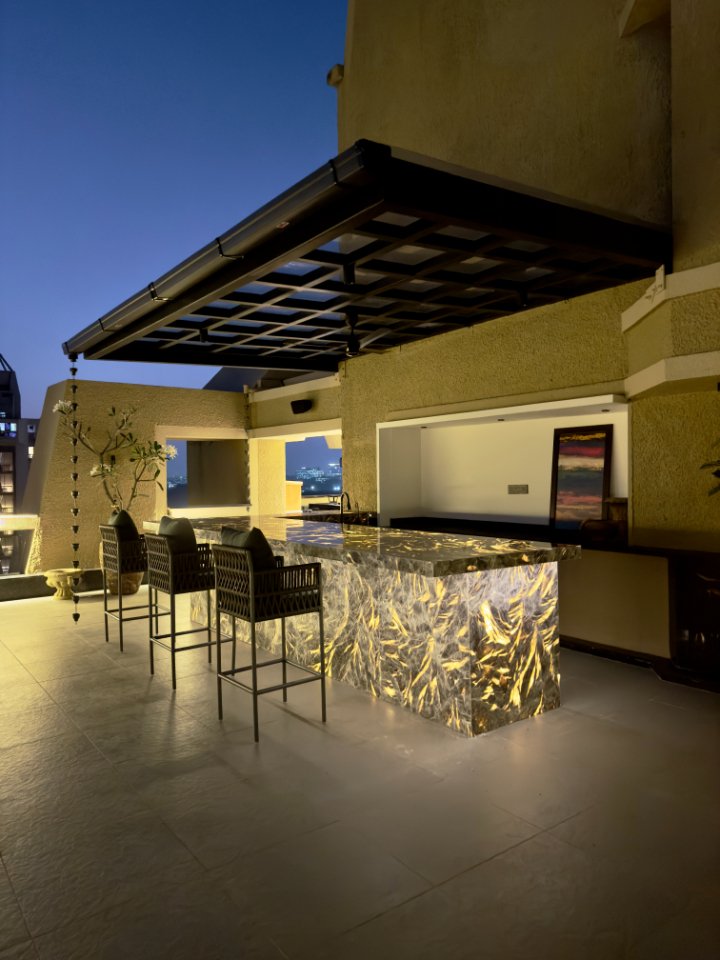
The onyx bar runs along one edge beneath a cantilevered glass canopy whose structure throws a grid of light and shadow across the counter and the woven bar stools through the day, a rain chain descending from the canopy edge in a column of small metal vessels, a plumeria tree at the perimeter, and artwork set into a recessed niche in the wall behind so that it becomes a backdrop the full length of the counter. Under the canopy the bar extends its function, the counter long enough and the overhead cover generous enough that the space transforms into an outdoor dining setting, the stone surface and the structured canopy above it giving the experience a formality that an open terrace rarely achieves. The stone in daylight reads dark grey with heavy veining, cool and horizontal; the woven stools with their rattan backs and grey cushions are pulled up alongside; the sink is set flush into the counter surface.
At night the same bar becomes the terrace’s only light source, the onyx lit from within and pushing warm amber and gold through its own translucent veining; the city is spread in the distance, and the canopy frame overhead has gone dark against it, the stone glowing in a way that has nothing to do with how marble usually behaves in a room.
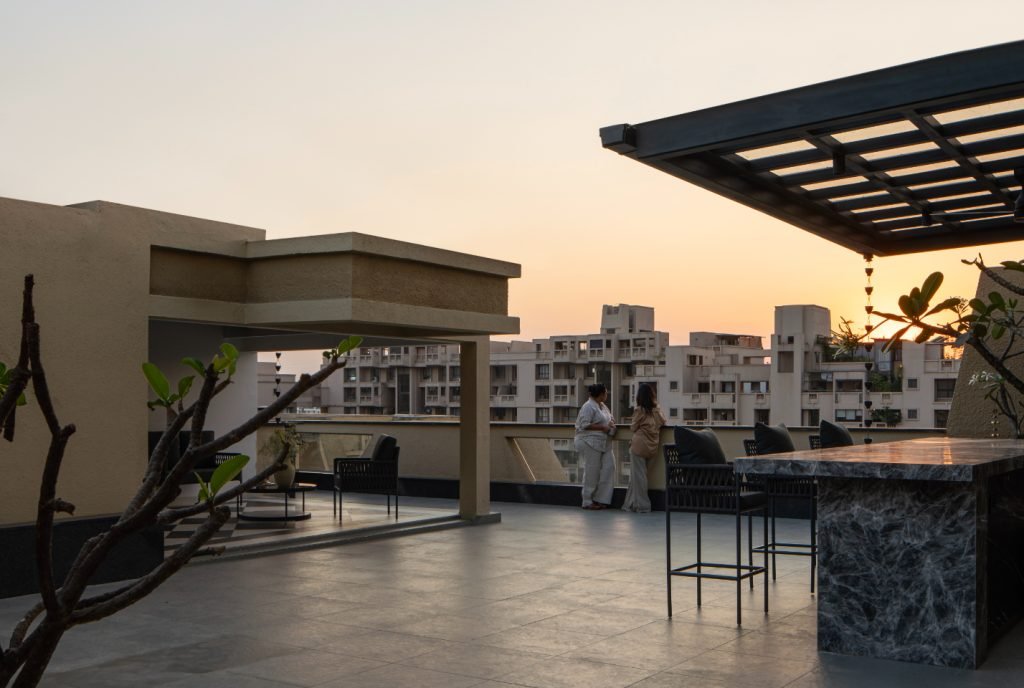
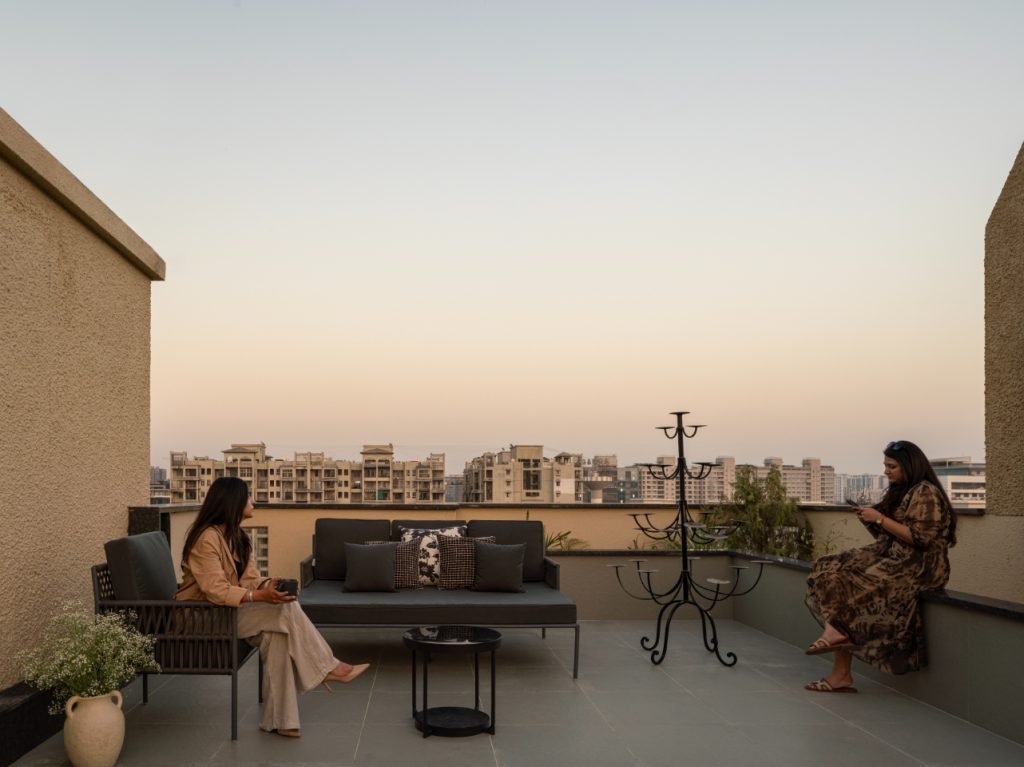
At the terrace’s far edge, away from the bar and the gazebo, the space softens into an open sit-out where a dark grey outdoor sofa with a mix of cushions faces the city beyond the parapet, a woven armchair alongside it, a wrought iron candelabra rising on a single branching stem above the seating, a small round tray table on the floor, and a clay pot of white flowers beside it, the plumeria branches crossing into the frame from the corner and the warm peach of a Pune dusk sitting behind the city’s apartment blocks without being made into a view.
This same zone features a lush planted retreat layered with greenery, a children’s play area that introduces a quieter, more domestic atmosphere against the terrace’s otherwise expansive character, and an open home office along with a discreet pantry, all completing the level. Here, the everyday and the extravagant share the same floor, each given its own place within it.
Fact File
Project Name: The Noir Residence
Location: Koregaon Park, Pune
Project Type: Residential Interior Design
Year Built: February 2026
Built Up: 5,100 sq ft
Design Firm: Aboli Shah Atelier
Principal Architect: Aboli Shah
Design Collaboration: Shalina Barai Team
Design Credits: Vinit Barai, Sameer Sabraj, Ashfaq, Adarsh, Akhil, Ashish & Shruti Marathe
Photograph Courtesy: Manthan Yadav
Videographer Courtesy: Nayan Gayake
