
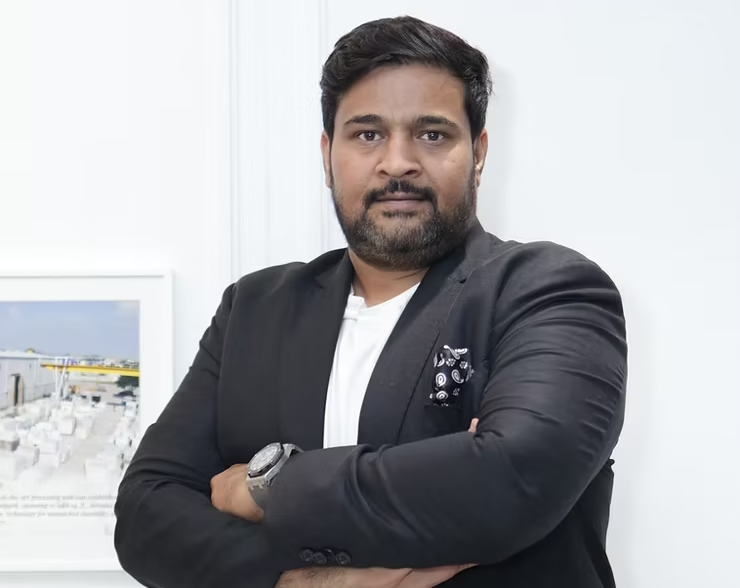
Five decades of sourcing the world’s finest natural stone. Quarries in Africa. Technology that thinks like a geologist. Design Diary International’s Shweta speaks with Rajesh Bhandari, Director of A-Class Marble, on what it truly takes to bring the earth’s rarest surfaces to India’s most discerning spaces.
A-Class Marble has been importing stone into India for more than fifty years, which means it has been doing this longer than most of the architects and designers who specify its material have been alive, longer than the premium residential market that now consumes it in such quantity even existed in its current form, long enough that the company’s institutional memory of the global stone trade, of which quarries produce what and under what conditions and with what consistency, is itself a kind of asset that does not appear on any balance sheet but shapes every decision the business makes. Rajesh Bhandari, its director, speaks about stone with the precision of someone who has never needed to make it sound more interesting than it is, because the material, in his telling, is already interesting enough, unpredictable enough, technically demanding enough, and beautiful enough to sustain a career of fifty years without once requiring embellishment. Design Diary International’s Shweta put a series of questions to him over email, and what came back was a conversation about process and material and the particular discipline required to operate at volume without surrendering the standards that make volume worth anything at all.
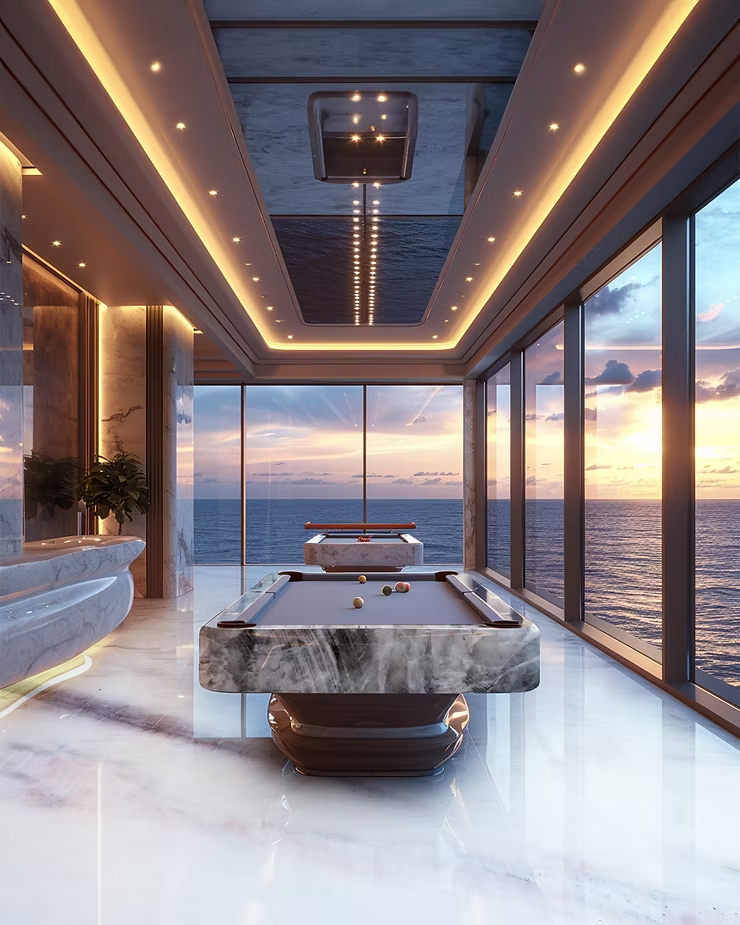
The company is based in New Delhi and today offers more than 550 varieties of marble, stone, granite, and architectural surfaces sourced from quarries and suppliers across more than forty countries, a number that places it among the most comprehensively stocked natural stone operations in the country and arguably the most significant importer of exclusive marble in India by any reasonable measure. But the scale, as Bhandari tells it, was never the objective. The early decisions that defined A-Class Marble were not decisions about how large to grow but about what kind of company to be, and they focused on building systems rather than accumulating volume, on creating clear grading protocols and disciplined sourcing and consistent processing standards and quality checks so that growth, when it came, would be supported by process rather than by intuition alone. Those choices shaped the values the company still operates by today, consistency above everything else, and a commitment to delivering stone that performs as reliably on a large hospitality project as it does in the most considered private residence.
Operating from Kishangarh, globally recognized as one of the world’s most significant marble hubs, has shaped that approach in ways worth understanding carefully. Access to material in that ecosystem is vast, Bhandari notes, but true differentiation in such an environment is earned rather than inherited, and the constant comparison and high expectations of operating at the center of a global stone conversation have pushed A-Class Marble to refine how it sources internationally, processes with precision, and inspects every slab with a rigor that the abundance of the Kishangarh market makes easy to let slip. Being surrounded by stone does not make you good at stone, and Bhandari has built a company that understands the difference between proximity to the material and genuine mastery of it.
“Growth had to be supported by process, not intuition alone.”
The most significant development in A-Class Marble’s recent history is one that shifts its identity from importer to something considerably more invested in the origin of what it sells. The company now owns and operates its own quarries in Tanzania and Zambia, a result of a long, deliberate strategy rather than mere fortune. Charting unexplored territory in Africa and finding there the raw material for three new exclusive white marble varieties that respond to evolving global design demands was an experience that combined the methodical and the genuinely unexpected in the way that the stone business, at its best, always does. Direct quarry ownership changes the nature of A-Class Marble’s relationship with its supply chain in fundamental ways, allowing the company to uphold stringent standards of ethical extraction, maintain full control over quality from the point at which the stone leaves the earth rather than the point at which it arrives in Delhi, and expand its portfolio with material that no other importer in India can offer because no other importer in India owns the ground it comes from.
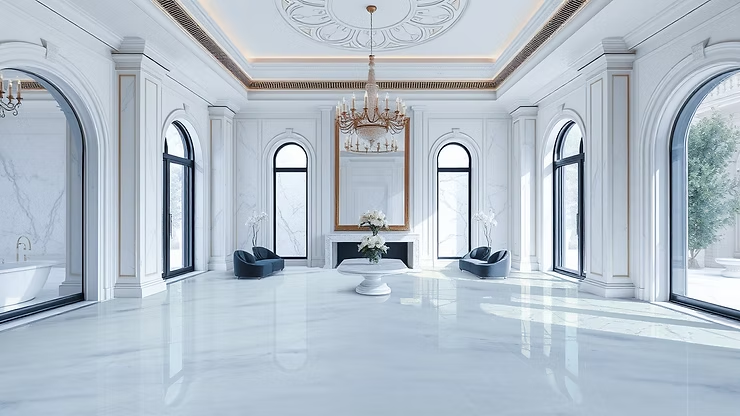
That ownership also changes the nature of the company’s sustainability commitments, moving them from policy to practice in a way that Bhandari is careful to distinguish. Responsible stone processing, in practical terms, is about how decisions are made every day on the factory floor, he says, not about how they are described in a document prepared for a different audience. It involves reducing waste where possible, using energy and water more judiciously, and ensuring that each block is utilized thoughtfully rather than partially processed and abandoned. Sustainability becomes credible, in his account of it, only when it is embedded in routine operations rather than treated as a narrative sitting alongside the real business, and the standard he applies to that word is considerably more demanding than the industry average.
The technology that enables A-Class Marble to meet those standards on the processing side has changed significantly recently, and it is here that Bhandari becomes most technically specific and most clearly engaged, talking about stone cutting with the fluency of someone who has thought carefully about what precision actually costs and what it actually produces. The Innovire, a diamond-coated wire-saw machine, has significantly improved the company’s production capabilities by cutting stone with unmatched accuracy compared to conventional gangsaw systems. The machine places significantly less stress on the stone during cutting, resulting in smoother surfaces, thinner and more accurate cuts, and meaningfully reduced material loss, and its AI-enabled monitoring and data-driven cutting logic optimize each block based on the stone’s own characteristics rather than applying a standardized approach to material that is by nature anything but standardized. For a company dealing with unique premium natural stone, cutting more accurately and minimizing waste is essential, not just an operational refinement. It is a statement of values expressed through machinery.
“Sustainability becomes credible only when it is embedded in routine operations rather than treated as a separate narrative.”
Alongside the Innovire, A-Class Marble has developed StrenInn, a proprietary processing technology whose name compresses the words “strength” and “innovation” into a single term and whose purpose is to ensure that marble retains its durability, finish, and luster even after years of daily use in demanding conditions. The technology addresses directly the questions that increasingly sophisticated clients are now bringing to the material selection stage: questions about how stone will age, how it will perform under the specific pressures of Indian climates, and how it will look in ten years rather than in the first month after installation. That clients are asking these questions at all reflects a maturity in how marble is understood and specified in India today that Bhandari welcomes without reservation, because informed decisions, in his experience, lead to better outcomes for everyone involved, the client, the designer, the supplier, and the material itself.
The change in how designers engage with stone over the past decade is one he has observed closely and describes with the measured satisfaction of someone whose own position has been quietly vindicated by a broader shift in taste and intelligence. There is greater attention now to how a stone will age, how it reacts to light, and how it supports a spatial narrative rather than competes with it, and specifications have become more nuanced as a result, with designers seeking materials that integrate into architecture rather than announce themselves as its point. As luxury interiors move toward restraint, marble is finding what Bhandari calls a more architectural role, its presence increasingly subtle, contributing to atmosphere and depth rather than ornamentation, with softer finishes and calmer patterns and a quality of presence that quietly anchors a space rather than filling it with noise. This direction aligns perfectly with the material’s deepest strengths and A-Class Marble’s position in the market.
The projects the company associates itself with most closely reflect that sensibility: homes and hospitality spaces and cultural projects where material selection is driven by intent rather than excess, where longevity and spatial clarity are valued above the immediate impact of an overtly expensive surface, and where marble becomes part of the architecture rather than a layer applied to it. That preference is not merely aesthetic. It also describes the client relationship that produces the best work and most enduring associations, because the designer or developer who understands stone well enough to use it with that kind of restraint will return, bringing the next project and the one after that, and treating the supplier as a collaborator in the fullest sense rather than a vendor to be managed.
“In such contexts, marble becomes part of the architecture rather than a superficial layer.”
Looking forward, Bhandari sees the Indian luxury materials market moving toward greater discernment, a growing preference for materials that feel authentic and age with dignity, and a shift that will favor suppliers who prioritize substance and long-term value over the appeal of surfaces that look spectacular in a photograph and reveal their limitations over time. It is a forecast that positions A-Class Marble well, which may be why he delivers it without visible satisfaction, as though it is simply the direction things are moving and the company’s job is to be ready rather than to take credit for having anticipated it.
What continues to excite him personally, after everything, is the unpredictability of the material itself. The fact is that no matter how advanced the processes become and how refined the technology grows, each block of stone carries its own character and its own challenges, demands its own conversation between the cutter and the material, and resists the assumption that the previous block tells you anything definitive about the next one. “Experiencing the excitement of discovering new marble in unexplored territories of Africa fills him with genuine wonder, even after fifty years in the industry.” Which is perhaps the most instructive thing about Rajesh Bhandari and about A-Class Marble both: the discipline and the systems and the technology and the rigor are all in service of something that remains, at its core, a dialogue between control and acceptance, between what can be engineered and what must simply be encountered, between the precision of a diamond wire and the irreducible individuality of something that formed over millions of years in conditions no factory will ever replicate.
“Working with marble remains a dialogue between control and acceptance, and that balance is what keeps the industry endlessly engaging.”
