
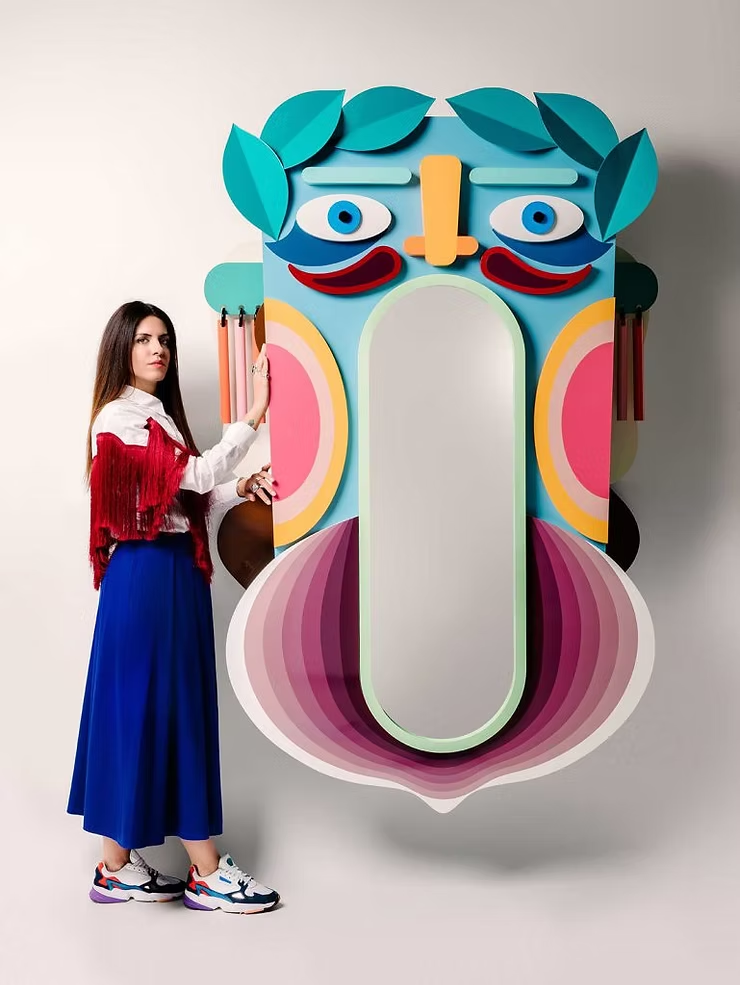
Her studio in Milan moves between product design, art, fashion, and illustration without apology. Her objects feel alive, sometimes mythological, always unmistakably hers. Alisha M. of Design Diary International speaks with Elena Salmistraro about growing up with beauty all around her, why emotion is not the opposite of rigor, and what it means to give imagination a physical form.
Her first memory of an object that moved her was Aldo Rossi’s La Cupola for Alessi. She was a child, watching it sit in the kitchen, and what she felt was not admiration for a well-made thing but something closer to wonder. It looked like a tiny castle, she says, a miniature building with a life of its own, something you could look at for a long time and keep finding. She lacked the language to describe what design was or why this object felt different, but she understood viscerally that it went beyond its function, that it was architecture, play, and sculpture, and that the maker had considered more than just how to boil water. That early recognition, present and fully felt before it could be articulated or explained, shaped everything that came after.
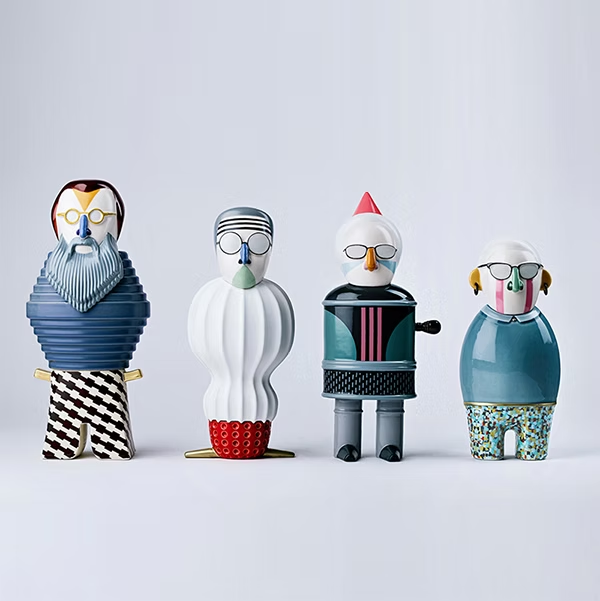
Ceramics arrived next, and with it something even more significant than a new material to work with. Through ceramics, she discovered that she could build worlds herself, that the ideas living only in her imagination could be given weight, surface, and tangible form, and that matter could become the home of thought. It was, as she describes it, the moment she understood that imagination could live inside things, that the gap between what she pictured and what could physically exist in a room was not a fixed distance but something she had the capacity to close.
Growing up in Italy means absorbing a visual education that is never quite formal and never quite finished. It arrives without announcement, accumulating in the light falling across a piazza at a particular hour, in the exact proportions of a doorway, and in the way a centuries-old building holds its corner with a confidence that reads as effortless and required generations of accumulated knowledge to achieve. Salmistraro absorbed all of it without realizing she was being taught, the way children absorb language before they understand grammar, and what it gave her was not simply an eye for beauty but a physical instinct for proportion, a bodily sense of when something is right and when something has gone even slightly wrong. Proportion is not only aesthetic for her, she says; it is emotional. When something is well proportioned, you feel it settle. It gives you a quality of peace that is difficult to explain but immediately recognizable, the way a melody played perfectly in tune gives you something that goes beyond the notes themselves, and when something is off the discomfort arrives just as quickly and just as physically before the mind has had time to diagnose the problem.
When she arrived at Politecnico di Milano, after years at an art institute where expressive freedom was the only rule anyone took seriously, the encounter with structure came as a genuine shock. She had come from a world of color and drawing and pure creative impulse, where the question of whether something was technically correct was always secondary to whether it was felt, and suddenly there were systems and logic and engineering requirements demanding to be met before any of the interesting questions could even be asked. It felt like a cage, she says, and that is not a softened or retrospectively affectionate description. It genuinely felt like one for a while. Through sustained engagement with the discipline rather than resistance, she slowly discovered that it revealed itself as something else entirely. Once she understood the rules properly, she could make real choices about them, could decide with genuine knowledge when to follow them and when and how to depart from them, and that informed choice turned out to be a far deeper and more useful form of freedom than the unconstrained kind she had started with. Knowing what you are doing when you break a rule is completely different from simply not knowing the rule existed.
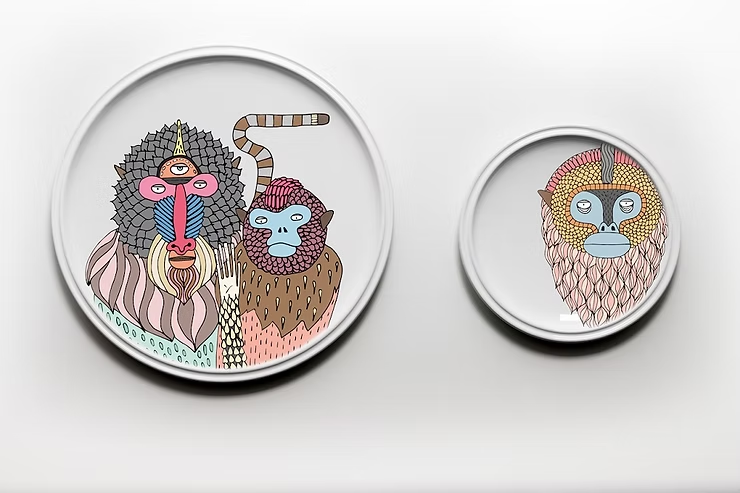
The question of when she first understood that emotion could live inside an object takes her straight back to that kitchen and that coffee maker. What she felt when she looked at it as a child had nothing to do with its function; it was all about something the object was doing beyond its function. It made her dream. Years later, as she worked through her studies and then through the accumulated experience of real practice, she came to understand that capacity as design’s most essential power and its most demanding responsibility: the ability to make someone feel something, to make them smile, to surface a memory they had not thought about in years, or to experience a sudden and unexpected sense of connection to something larger than the object in front of them. When a piece can do that, she says, it has gone beyond its narrowest purpose. It has become something alive in a way that purely functional objects, however beautifully resolved, lack. That aliveness is what she has aimed for in everything the studio makes, across every material, scale, and kind of commission, from the very beginning.
Every project reflects her unique perspective, her passions, and her vulnerabilities. She has never subscribed to the notion of a designer who hides behind their work in the name of neutrality or professional restraint. Every mark, every choice, every decision about color or surface or proportion carries a trace of the person who made it, and for Salmistraro, drawing and color have always been first and foremost ways of communicating feeling rather than simply constructing form. That is where the empathy in her work comes from, she says, from sincerity rather than strategy, from the genuine exposure of a personal perspective rather than the careful calibration of an audience-tested aesthetic. Empathy arrives at the moment when someone looking at what you have made recognizes a part of themselves in it, and that recognition is not accidental or lucky. It is what the work has been aiming for since the very first sketch.
The characters that populate her objects, figures that feel animated and mythological and occasionally unsettling in ways that are more interesting than comfortable, arrive through two routes, and Salmistraro is equally committed to both. Some figures emerge almost on their own while she draws, taking shape before she has fully decided what they are. They seem to arrive from somewhere ahead of the conscious design process and insist on being included. Others come directly from her sustained and serious engagement with mythology, which she considers one of the most powerful and underused creative sources available to contemporary designers. She views it as an ancient language that remains completely alive, dense with symbols that speak about the human condition in all its complexity, contradiction, and shade. For her, mythology is a living conversation about human identity, fears, and desires, with her characters embodying these complexities without needing to declare them. They are not illustrations of mythological figures. They are something stranger and more personal than that, shaped by the stories but not confined to them, recognizable as ancient and simultaneously entirely of her own making.
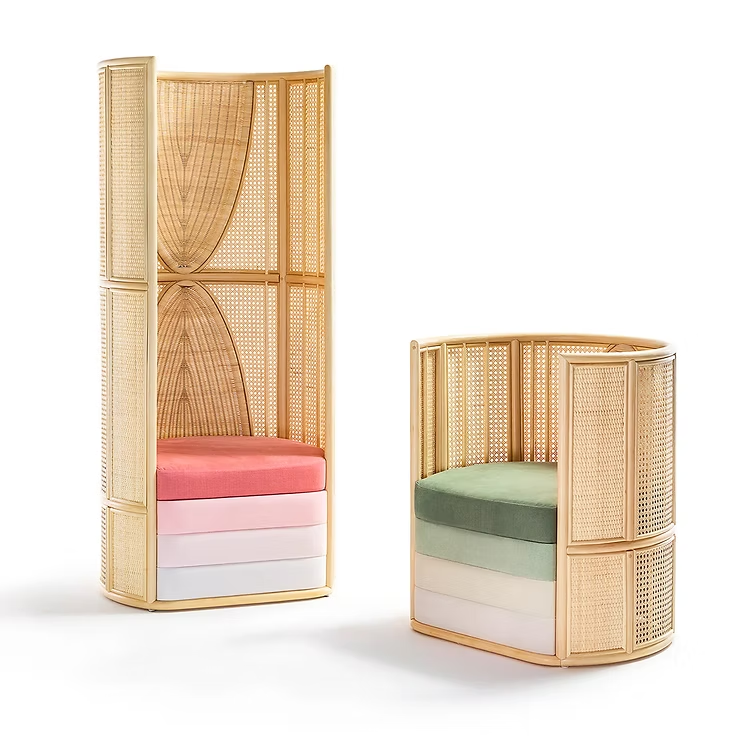
She continually explores ceramics, metal, and glass, thoughtfully considering how discovery persists in materials she has engaged with for decades. Every material has a voice, she says, and knowing a material more deeply does not silence that voice. It teaches you to hear it with greater precision and greater nuance, to understand what it is actually telling you rather than what you have already decided it means. Ceramics in particular are living materials, ones that deform and react and change in the kiln and that resist and yield in ways that are never entirely predictable regardless of how much experience you bring to the process. It insists on a genuine dialogue rather than simply accepting the instructions it is given, and that insistence, which once felt like a frustration, has come over time to feel like the most interesting thing about working with it. Over years of practice she has come to understand that deep familiarity with a material does not exhaust its possibilities but opens them. Once you fully understand what a material can do, you begin to wonder what it has never done and how far you can push it in that direction without distorting its essential nature or asking it to be something other than what it fundamentally is.
Her collaborations with Alessi, Moooi, Bosa, and other global brands have not softened or diluted her signature, and the reason is a principle she applies to every single one of them without exception. She does not work for a company but with one, and the distinction matters at every practical level as much as it does as a statement of professional philosophy. Every brand she has worked with brings its own history and accumulated identity and specific meaning in the world, and her task when she enters that context is to bring her own vision into genuine dialogue with all of that, not to impose it wholesale but not to subordinate it either, to let the two meet and respond and push against each other until something emerges that neither side could have arrived at working alone. When the dialogue is truly sincere, the result carries both voices clearly and distinctly. The company becomes the context, and her authorship remains fully visible within it, and that, she says, is when the work becomes genuinely worth making, when it does something that could not exist without both sides of the conversation being equally present and equally committed.
Holding on to the emotional and spiritual dimension of design against the pressure of commercial constraints and the relentless reality of tight timelines is one of the biggest ongoing challenges of her practice, and she speaks about it with the honesty of someone who has not found a complete solution but has developed a workable relationship with the difficulty. The design industry runs on schedules and budgets and deliverables and the accumulated pressure of clients and production windows and launch dates, and genuine creativity needs a quality of space and silence that those conditions do not naturally generate or protect. What she has learned over years of working within those realities is to keep the emotional thread alive despite the noise, to return at each stage of a project to the essential question of why this particular piece matters and what it is actually trying to say and who it is meant to move and how. When that thread holds, even an object produced entirely within commercial constraints and to a fixed deadline and a fixed budget can carry a soul, can do what she needs it to do, and can reach the person who encounters it. The limits, she says, are not the enemy of the poetic. Sometimes they are precisely where the most poetic solutions are found, because they force a precision of response and a quality of necessity that unconstrained freedom, for all its apparent advantages, very rarely demands of itself.
Her studio’s work across brands and galleries and disciplines and scales reflects a philosophy that has remained fundamentally consistent even as the ambition and the reach of the practice have grown considerably over the years. Design and art and craft are not separate territories requiring separate entry points or separate justifications for her. They are parts of the same ongoing conversation, different ways of approaching the same essential questions about what an object can mean and what it can make a person feel and what it can do to a room and to the life that moves through that room every day. The answer she keeps arriving at, in ceramics and in metal and in glass and in illustration and in everything else the studio makes, is that the feeling was always the point, the structural starting place and the final measure of success both. Rigour and technical knowledge and material intelligence are the means by which that feeling becomes possible. They are not the destination. The destination is the moment when someone picks up something she has made or stands in front of it or simply shares a room with it and feels, without quite being able to say why, that the world has become briefly more alive and more interesting and more worth paying attention to.
That is what Aldo Rossi’s coffee maker did for a child standing in an Italian kitchen a long time ago, looking at something that looked back. It is what Elena Salmistraro has spent her entire career learning, with increasing precision and increasing confidence, to give back.
