
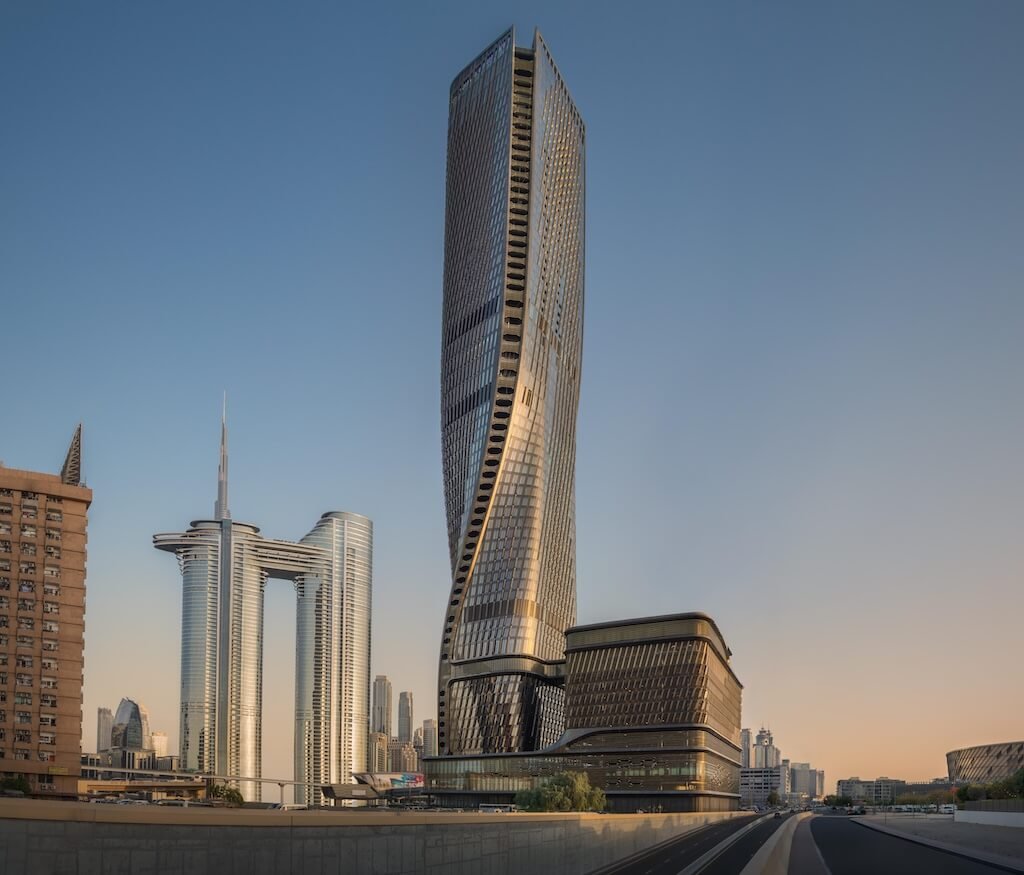
Wasl Tower has been completed in Dubai. Designed by UNS, led by principal architect Ben van Berkel, and delivered in engineering partnership with Werner Sobek, the 302-meter structure stands off Sheikh Zayed Road adjacent to the Burj Khalifa and is the first high-rise of its scale on the west side of that road. Commissioned by Wasl Group and in development since 2013, the building completed construction in late 2025, and with its completion, it becomes the region’s tallest building to carry a ceramic facade—a distinction that is as much technical as it is material, given what the facade is actually required to do in this climate and at this height.
The Tower’s Form and Location
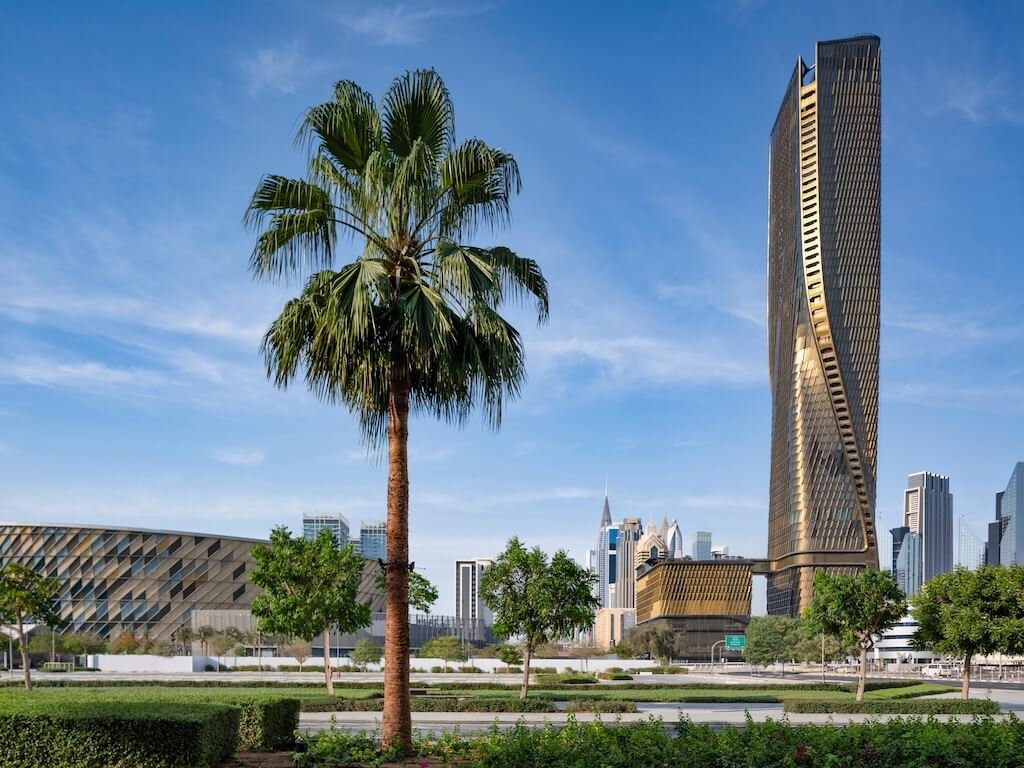
The site places Wasl Tower at the intersection of two distinct urban conditions: the dense commercial cluster that has accumulated around the Burj Khalifa and the more pedestrian-scaled, street-based development of City Walk to the west. The design’s response to this situation is a contrapposto movement—a rotation built into the massing that allows the tower to address both directions simultaneously and to present a continuously changing profile as it is observed from different positions across the city. In the full exterior photograph taken from across the road, with a palm tree in the foreground and the Dubai skyline arrayed behind, the tower’s silhouette reads as a single shifting volume; the vertical reveals between the facade’s fin clusters catching the light differently depending on where the eye enters the building’s surface. In the upper section detail photograph, the twist in the facade is legible through the way the panels shift plane near the top, the bronze and gold metallic glaze of the terracotta catching the sun at an angle that changes with every meter of height.
The Facade
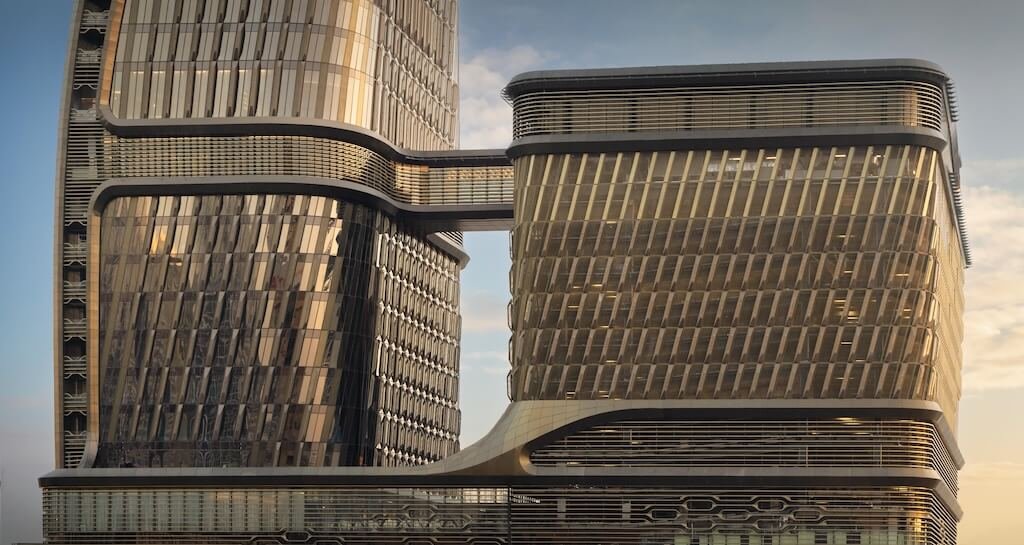
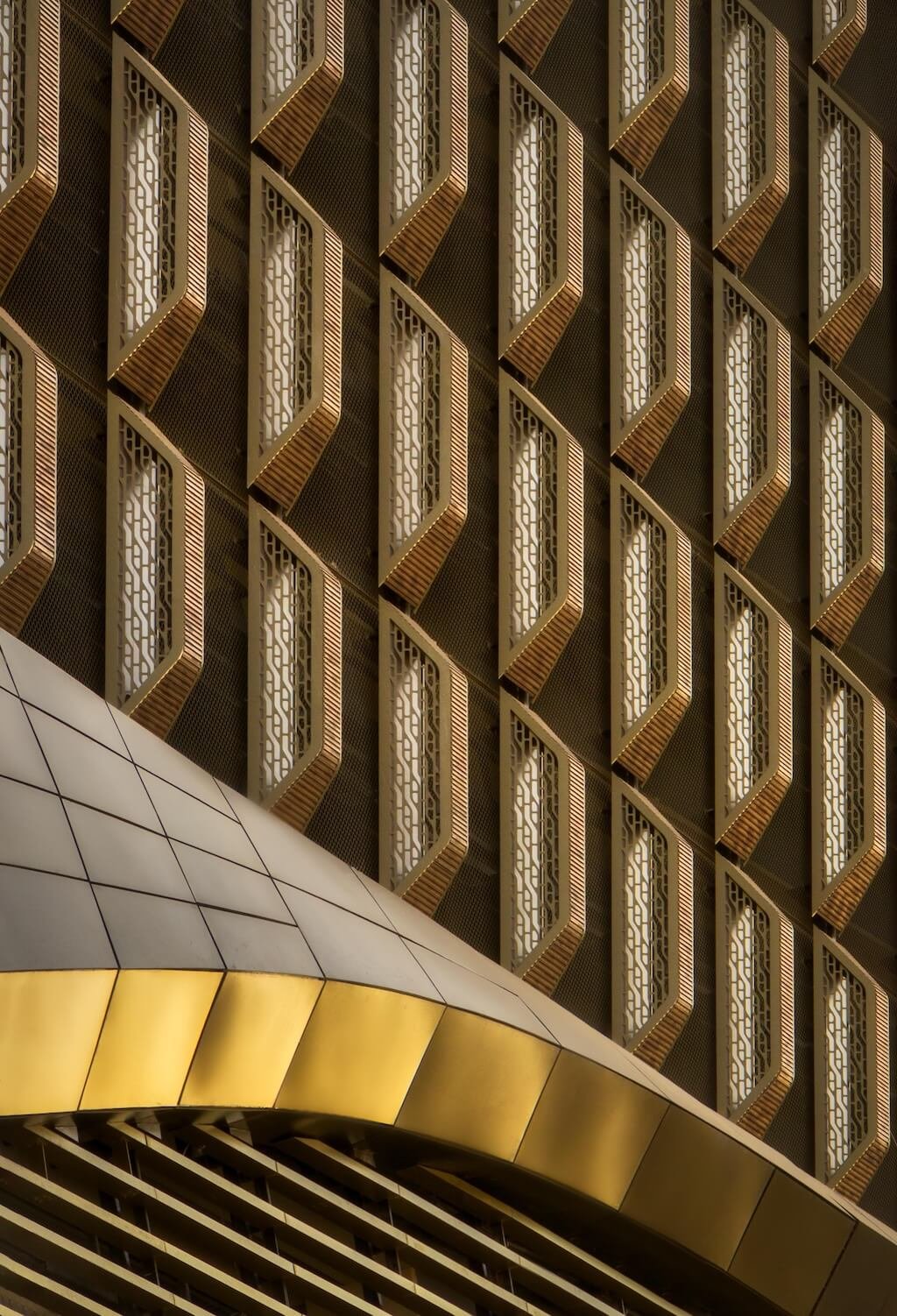
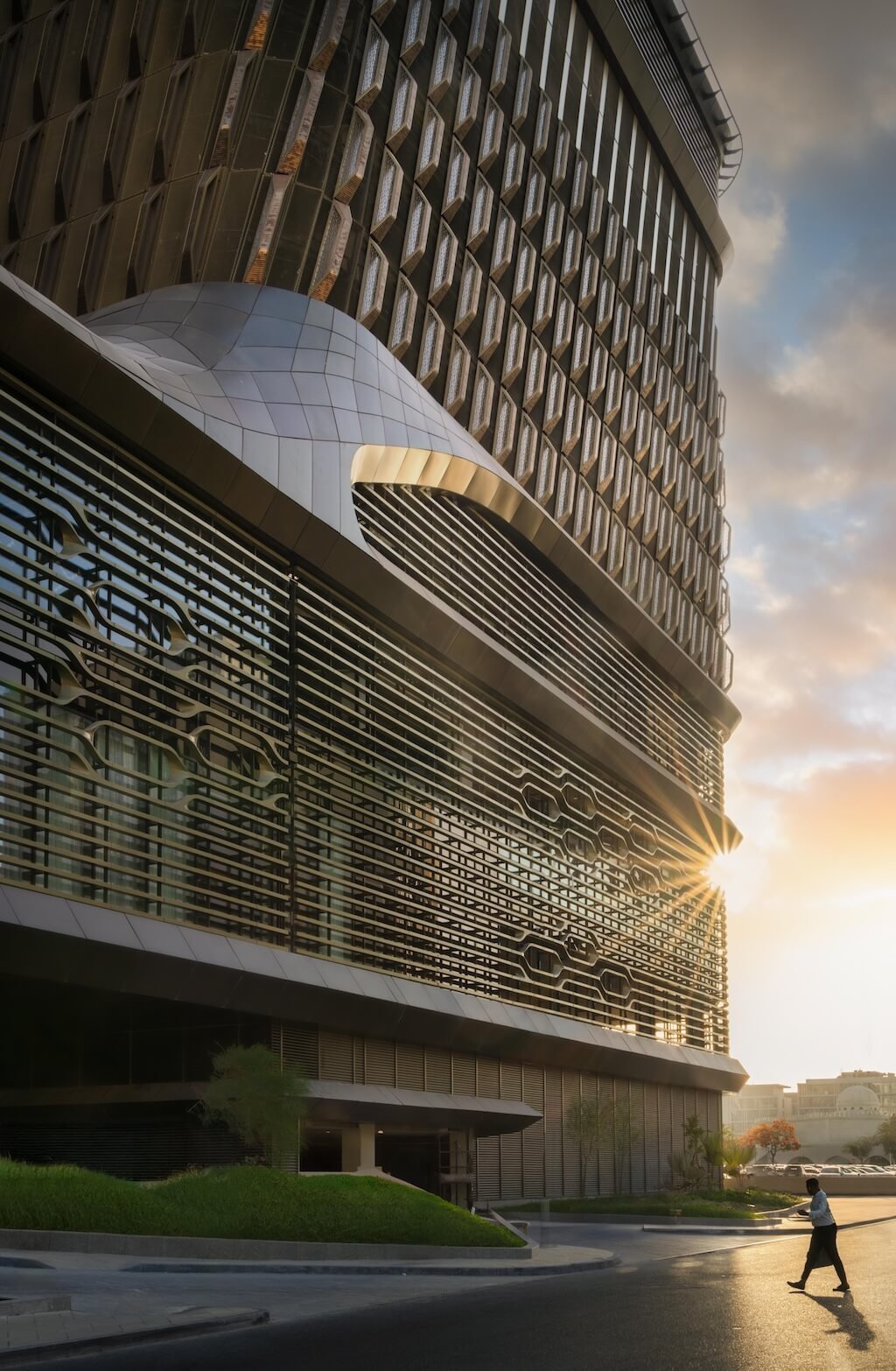
The ceramic fins that cover the building constitute the project’s most technically involved element, and the detail photographs of the facade surface make it possible to read their construction precisely. Each fin is a custom terracotta profile, baked with a metallic glaze that shifts in tone across the day and across the seasons and arranged in a repeating geometric module that, seen close up, carries inner lattice work proportioned and detailed in a way that references the logic of traditional mashrabiya screens without reproducing their form directly. At the base of the building, a curved gold canopy establishes the warm bronze register that the ceramic sustains across the full 302 meters above it, and the relationship between the canopy’s smooth golden surface and the textured fin pattern above it, visible in the facade detail photograph, is where the material continuity of the envelope is most clearly set out.
The fins are not decorative. Their placement and geometry were developed through parametric modeling to respond to the building’s solar orientation across its full circumference, creating a 360-degree passive environmental system rather than a south-facing screen. Each fin is angled to intercept solar heat gain, shade the glazing behind it, and channel wind around the building’s exterior surface. Within the fin assembly, integrated aluminum grilles allow the moving air channeled by the fins to cool the heat absorbed by the ceramic modules. A second stage of passive cooling is provided by the cavity between the fin layer and the inner curtainwall system. Combined, these measures reduce the building’s cooling load by approximately 10 percent compared to older towers in the city — a measurable outcome from a facade that is also the building’s primary architectural statement. UNS reimagined traditional ceramic for high-rises by blending low-tech manufacturing with advanced parametric design, creating bespoke components at unprecedented scale and specification for this height.
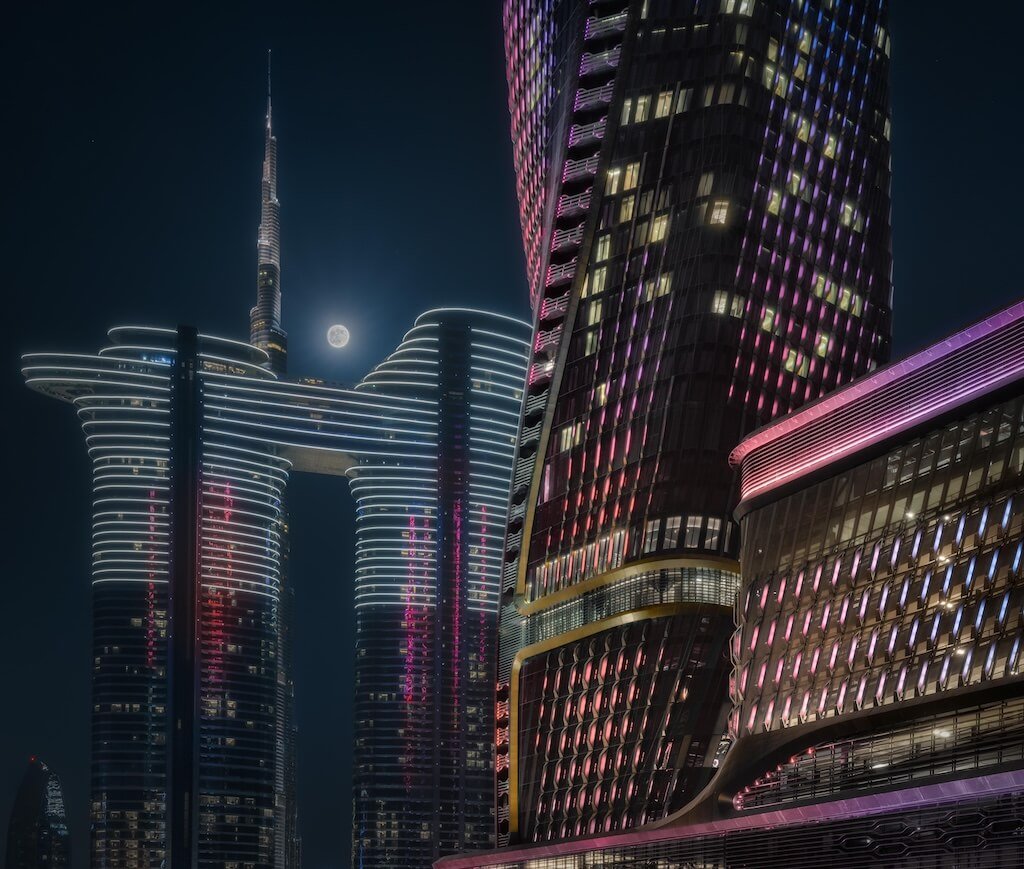
The facade envelope also houses a custom lighting system developed in partnership with Arup Lighting, programmed to produce subtle shifts in tone and intensity across the ceramic surface after dark. The result is a building that reads differently at night from how it reads during the day, without the lighting system imposing a separate aesthetic identity onto the architecture.
The Ground Level and Circulation
Wasl Tower is not designed as a single-use object set apart from the city around it. Its program, covering 167,733 square meters, includes the Mandarin Oriental Downtown Dubai hotel, residential units, offices, a multi-story health and wellness center, a convention hall, and seven restaurants and bars that are accessible to the public without hotel or residential access. The building’s ambition at ground level is to function as an urban node—a place that residents, hotel guests, employees, and the wider public move through and use at different times of day for different reasons.
A central vertical circulation strategy organizes this complexity clearly. Three high-speed express lifts connect four primary lobbies: at ground level, the spa levels on Floors 11 and 12, the sky arrival on Floors 35 to 37, and the rooftop. A shared bank of four office lifts and four guestroom lifts occupies a central shaft; upper-level residences are served by a dedicated group with direct basement access, and 17 lifts operate throughout the building in total, five of which are for service. The parking structure includes a 1,500 square metre column-free ballroom connected to the tower by a bridge, with a green courtyard providing a secondary outdoor space that links the ballroom directly to the ground floor of the tower.
The Hotel Interiors
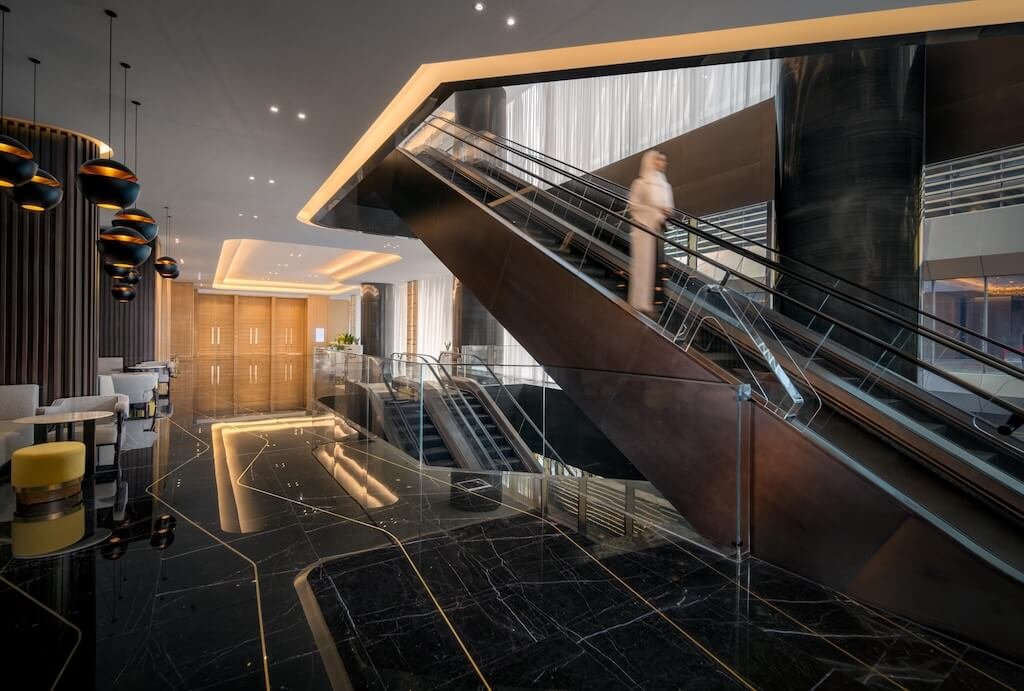
The interior design of the hotel areas was carried out by GA Design, London, working in close collaboration with UNS and the hotel operator to align the architectural concept with the operational and spatial requirements of a Mandarin Oriental property. The material language across the lobby and public floors works within a consistent palette of dark black marble with gold veining, bronze-clad surfaces, warm timber paneling, and patterned carpet in blue and gold tones, with each level organized to reflect its position within the building’s vertical program.
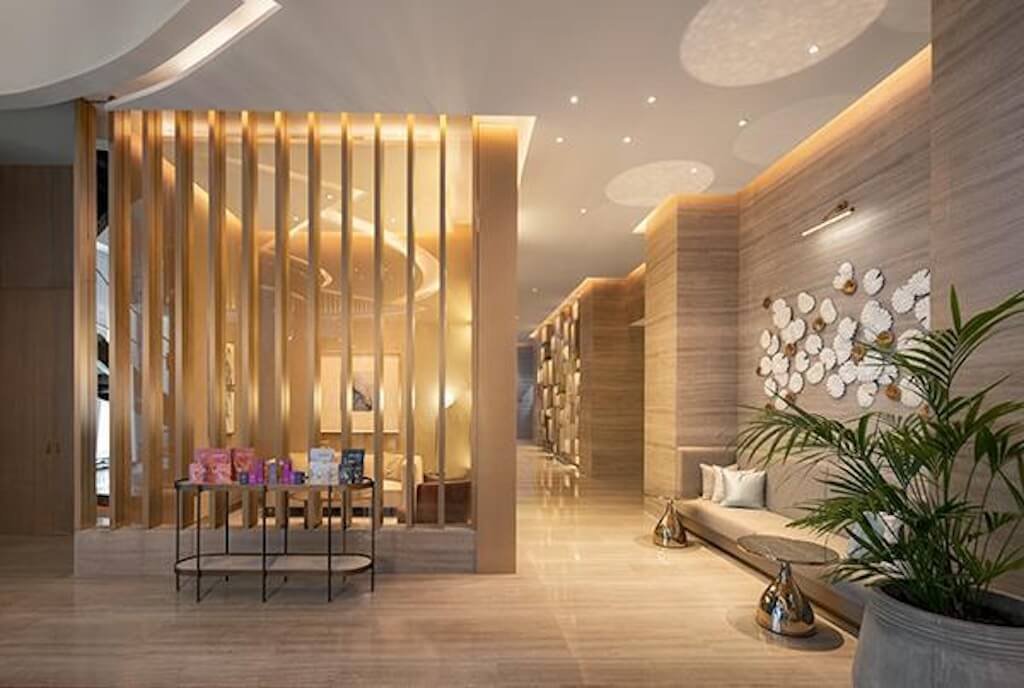
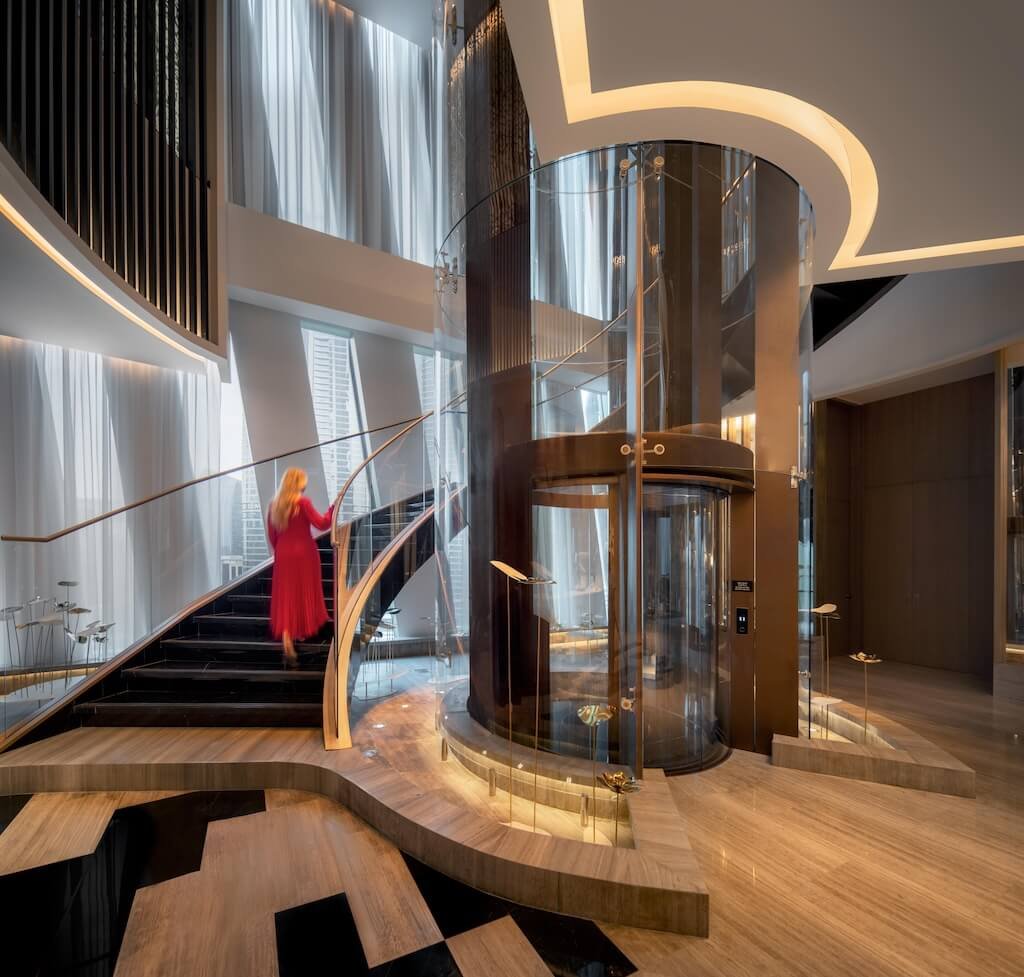
In the escalator and lower lobby level, visible in the interior photographs, dark bronze-clad angular escalator enclosures rise from a polished black marble floor whose gold veining runs in long, continuous lines across the surface. Pendant lights in black with gold interiors hang above a seating area to one side. On the staircase level, a curved black marble stair with a wooden handrail rises alongside a cylindrical glass lift car whose base is clad in bronze, both set on a stepped timber platform with layered edges. The ceiling above the stair carries an illuminated curved detail that follows the plan geometry of the staircase below.
The double-height atrium above is the interior’s most spatially generous moment. Laser-cut bronze wall panels line both sides of the void, their geometric pattern consistent with the facade’s own surface logic, and a suspended installation of gold wing-shaped forms—seen in the overhead atrium photograph distributed across the ceiling and the upper air of the space—reads as a large-scale art piece positioned in dialogue with the patterned bronze walls on either side. A curved dark marble balcony edge separates the atrium void from the upper level, and curtained walls and neutral seating close the space at the far end.
On the sky floors, the lounge opens entirely to floor-to-ceiling glazing with city views on the exterior wall, and the ceiling here carries a hanging installation of suspended glass cloud and organic forms that drops through the full height of the space. The carpet, in the same blue and gold tonal range as the levels below, runs to the base of a curved reception counter on which a glass floral sculpture is placed. The wall opposite the glazing carries a large circular mirror set against dark paneling, with built-in shelving in warm timber on one side.
Structure and Sustainability
The structural system was developed for efficiency and flexibility across a building that combines several different programs and load conditions within a single envelope. Post-tensioned floor slabs, hybrid concrete columns, and mechanical-level outriggers reduced the number of internal columns and produced open floor plates throughout. This structural approach had not been applied in Dubai prior to this project, and its adoption resulted in 3,000 cubic meters less concrete across the total build. Materials specified throughout the building include regionally sourced granite and aluminum, recycled PET acoustic panels, and low-VOC finishes. Ventilation is CO₂-controlled, and LED perimeter lighting reduces energy use in those zones by up to 20 percent. Solar thermal panels, reflective glazing, an integrated heat pump system, and district cooling further reduce the building’s operational carbon output. Outdoor areas across the site incorporate passive cooling and planting designed to produce comfortable microclimates at ground level.
The environmental and sustainability strategy was developed through a framework titled ‘Good for the People, Good for the Environment,’ produced by Werner Sobek Green Technologies, and applied across design, material selection, systems engineering, and construction methodology.
The Mandarin Oriental Downtown Dubai was recognized with the Architecture: Hotel award at the 2025 Identity Design Awards.
Project Details
Project name: Wasl Tower. Architecture firm: UNS. Location: Dubai, United Arab Emirates. Height: 302 Metres. Photography: Ahmad Alnaji — SARAB. Principal architect: Ben van Berkel. Design team: Ben van Berkel, Gerard Loozekoot with Frans van Vuure and Nick Marks, Harlen Miller, Crystal Tang and Derrick Diporedjo, Machiel Wafelbakker, Dana Behrman, Roman Kristesiashvili, Filippo Lodi, Rene Wysk, Hans Kooij, Patrik Noome, Megan Hurford, Elizabeth White, Fernando Herrera and Aleksandra Sliwinska, Pietro Scarpa, Mihai Soltuz, Philip Wilck, Rutger Stefan Oor, Bao An Nguyen Phuoc, Nanang Santoso, Thomas van Bekhoven, Ka Shin Lu, Henk van Schuppen, Matthew Harrison, Jung Jae Suh, Jae Geun Ahn, Pieter Doets, Shankar Ramakrishan, Meng Zhang. Collaborators: Facade Light Design: Arup, Amsterdam. Architect of Record: U+A Architects, Dubai. Structural Engineering Construction Model: DeSimone Consulting Engineering, Dubai. Local MEP Engineering: Seed, Dubai. Landscape Architect: Green4Cities, Vienna / Terra Firma Landscape, Dubai. Cost Consultant: Kulkarni Quantity Surveyors, Dubai. FLS Consultant: Aecom, Dubai. Vertical Transportation: Dunbar & Boardman / TUV Sud, London. AV/IT Consultant: Shen Milson Wilke. Kitchen Consultant: Sefton Horn Winch. Pool Engineering: Barr & Wray, Dubai. Interior Design Hotel: GA Design, London UK. Interior Design F&B: LWD, Dubai. Interior Light Design: DPA, London/Dubai. Wind Engineering: Wacker Ingenieure. Interior design: UNS. Completion year: 2025. Built area: 107,539 m². Landscape: Green4Cities, Terra Firma Landscape. Structural engineer: Werner Sobek AG. Environmental & MEP: Werner Sobek AG. Client: Wasl Group. Status: Completed. Typology: Skyscraper.
