
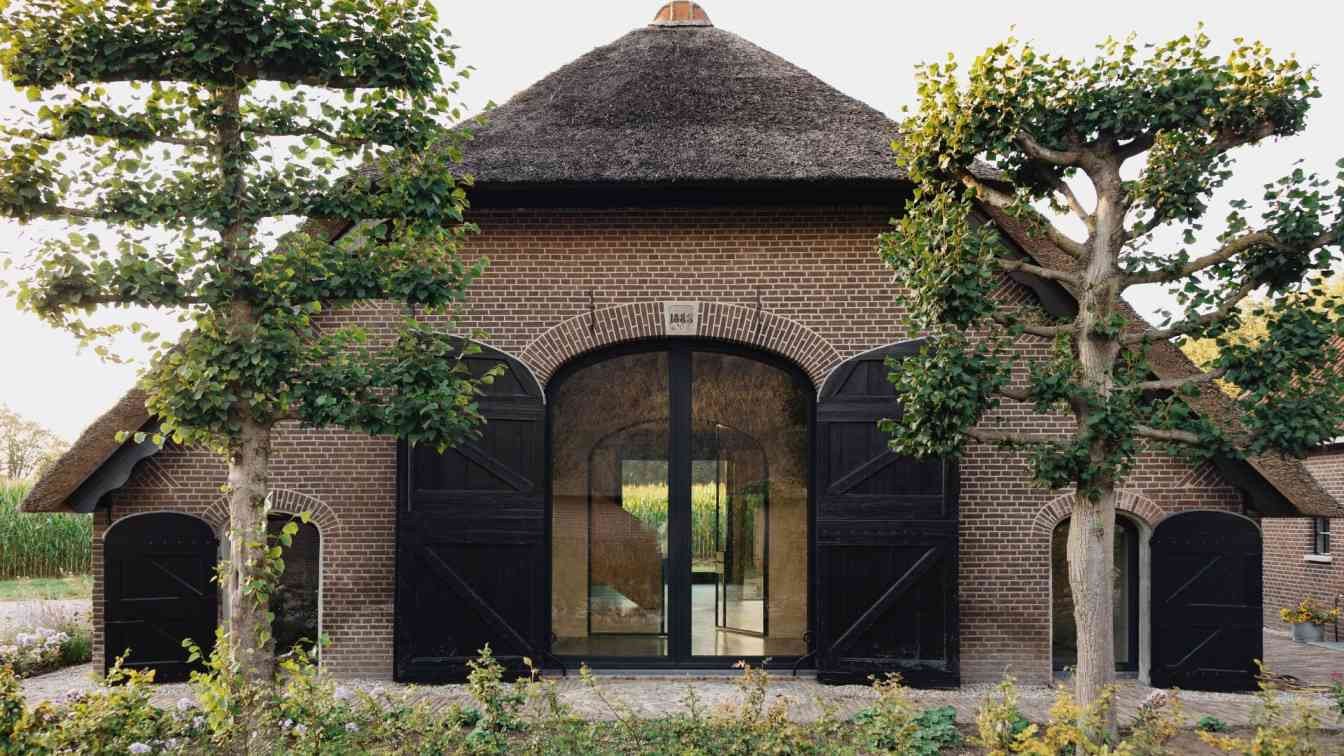
The date 1885 is set in brick above the central arched opening of the Ahof barn in Nijkerk, and that number, visible in every exterior photograph of the building’s main facade, is the clearest statement of what the renovation carried out by Flip Wentink Architecten, with interior architecture by Julia van Beuningen and staircase design and fabrication by EeStairs, was required to negotiate: a listed 19th-century Dutch agricultural building whose character was inseparable from its construction, its materials, and its form, and whose transformation into a 162 square meter contemporary residence completed in 2022 had to be achieved without erasing what makes the building worth preserving in the first place.
The Exterior
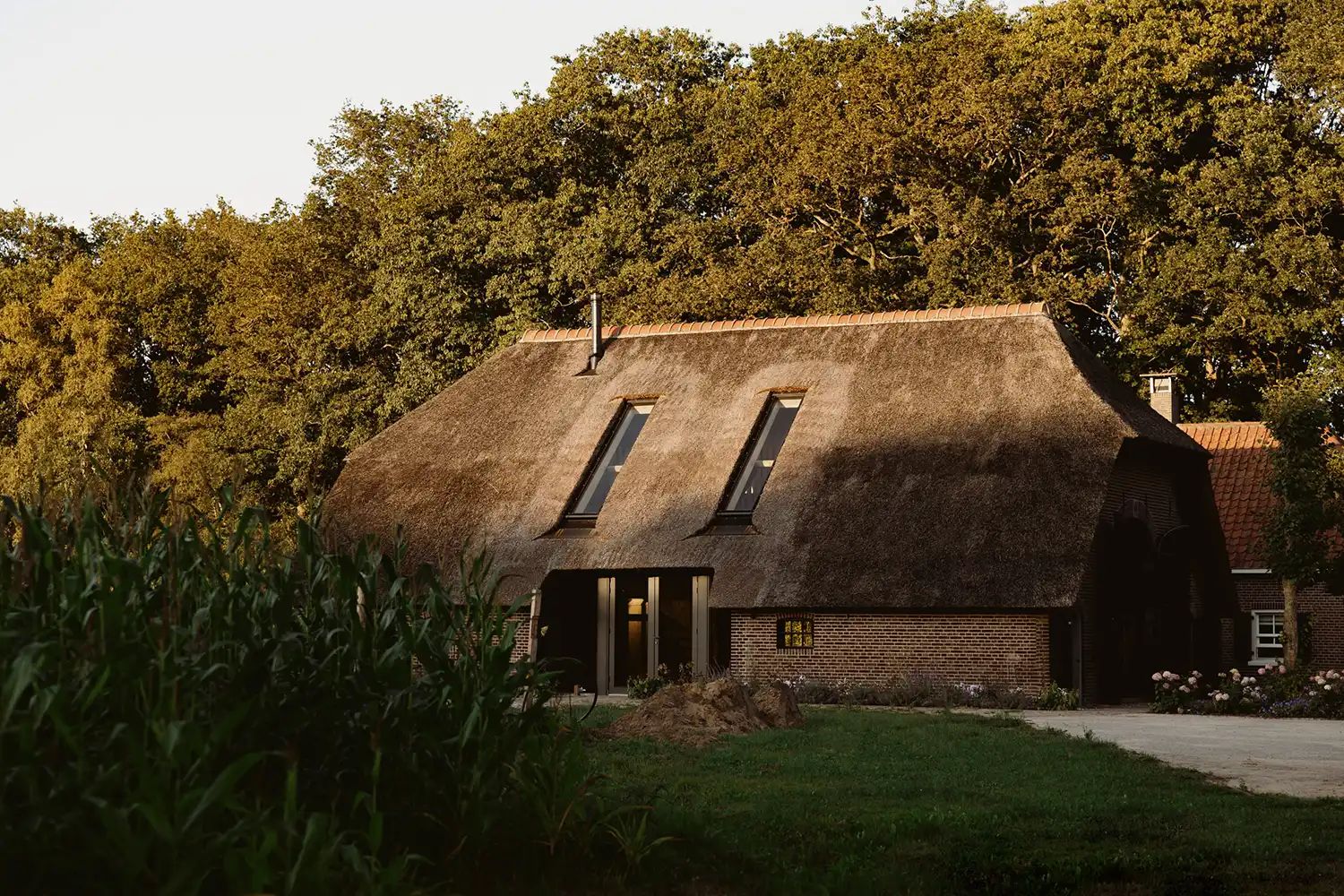
From the front, the Ahof barn presents a facade of warm red and brown brick beneath a thatched roof whose steep pitch and hip form at each end are among the building’s most defining features, and the renovation has left that facade substantially as it was, with the traditional black timber shutters retained at the smaller flanked arched openings on either side of the main entrance and at the larger central arch, where large glazed panels in a black steel frame now replace what were originally solid barn doors, allowing the interior to be seen from outside and light to pass through the full depth of the building. Pleached trees frame the entrance on either side, and the combination of the old brick, the thatch, and the new glazing is managed with enough restraint that the building reads as continuous with its own history rather than interrupted by it. On the opposing gable, the thatched roof sweeps down low at the sides, and two skylight windows have been cut into its surface to bring natural light down into the upper floor that the renovation has introduced into the building’s volume.
The Ground Floor
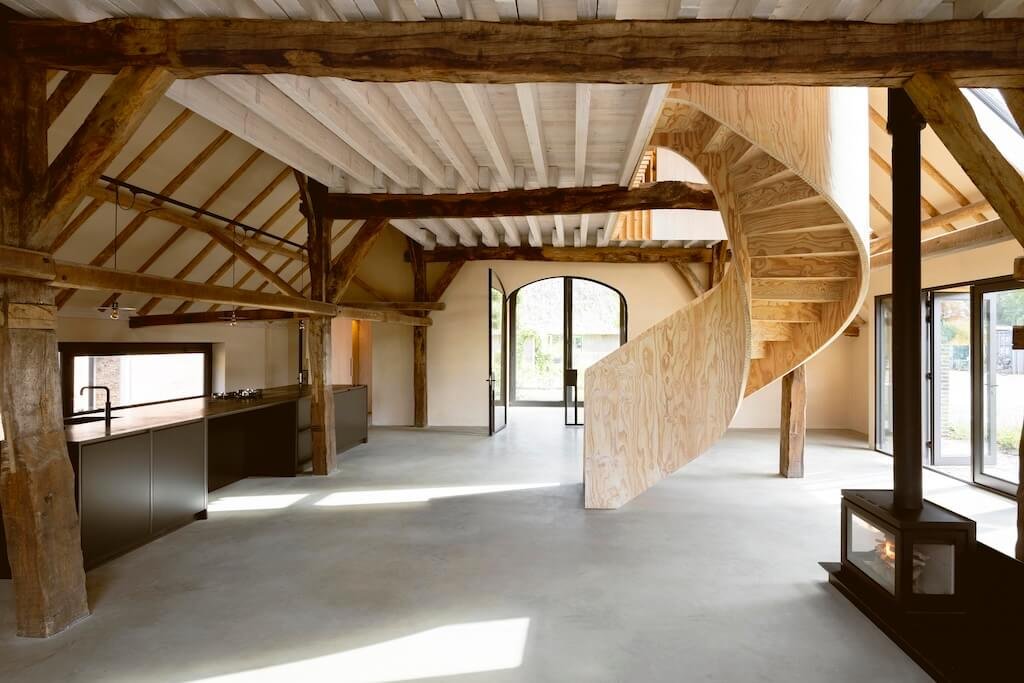
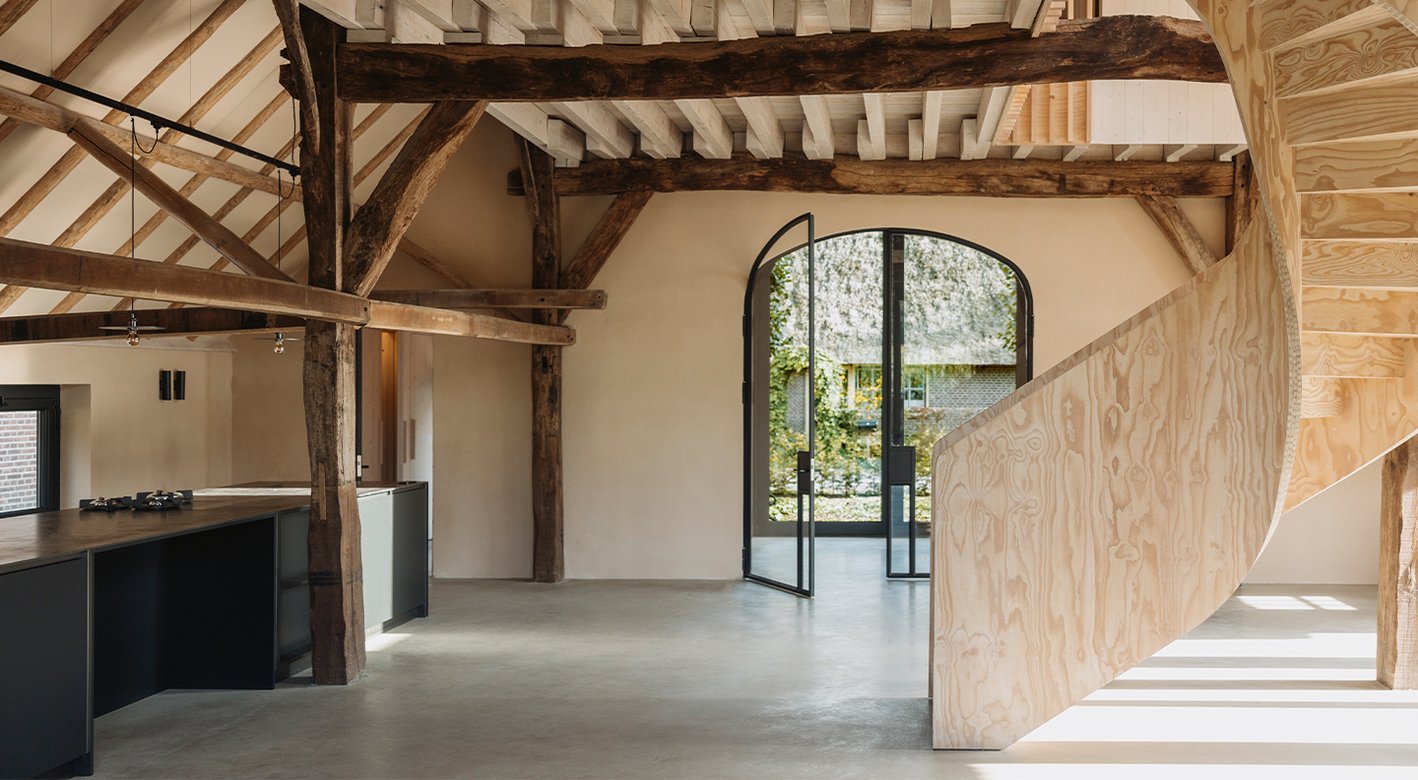
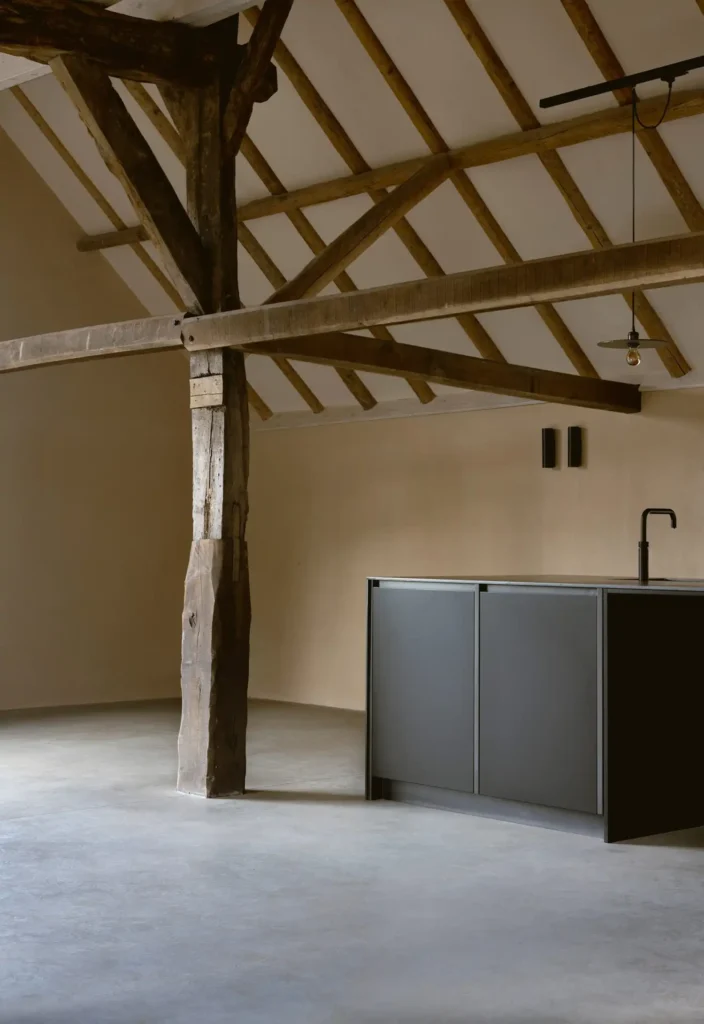
Inside at ground level, the barn reveals the full spatial generosity that made it worth converting in the first place. The polished concrete floor runs continuously across the entire plan, and the lime plaster walls in a warm sand and beige tone provide a quiet, even background against which the original timber structural frame of the building, the large central posts, and the diagonal bracing timbers of the 1885 construction stand in full visibility, their rough-hewn surface and dark weathered color in clear contrast to the smoothness of the plaster and the concrete floor. Directly in from the main arched entrance, the space is open and essentially undivided at ground level, with the kitchen placed to one side as a dark steel island unit with an integrated hob and black tap, its grey-black color sitting deliberately apart from the warm tones of the timber and plaster around it and introducing the lightly industrial note that Julia van Beuningen has used as a counterpoint throughout the interior. A freestanding black steel-framed wood burner with a glass panel sits at the side of the ground floor, adding a domestic point of warmth to a space that is otherwise defined by the architecture of the barn rather than the furnishings introduced into it.
The Staircase
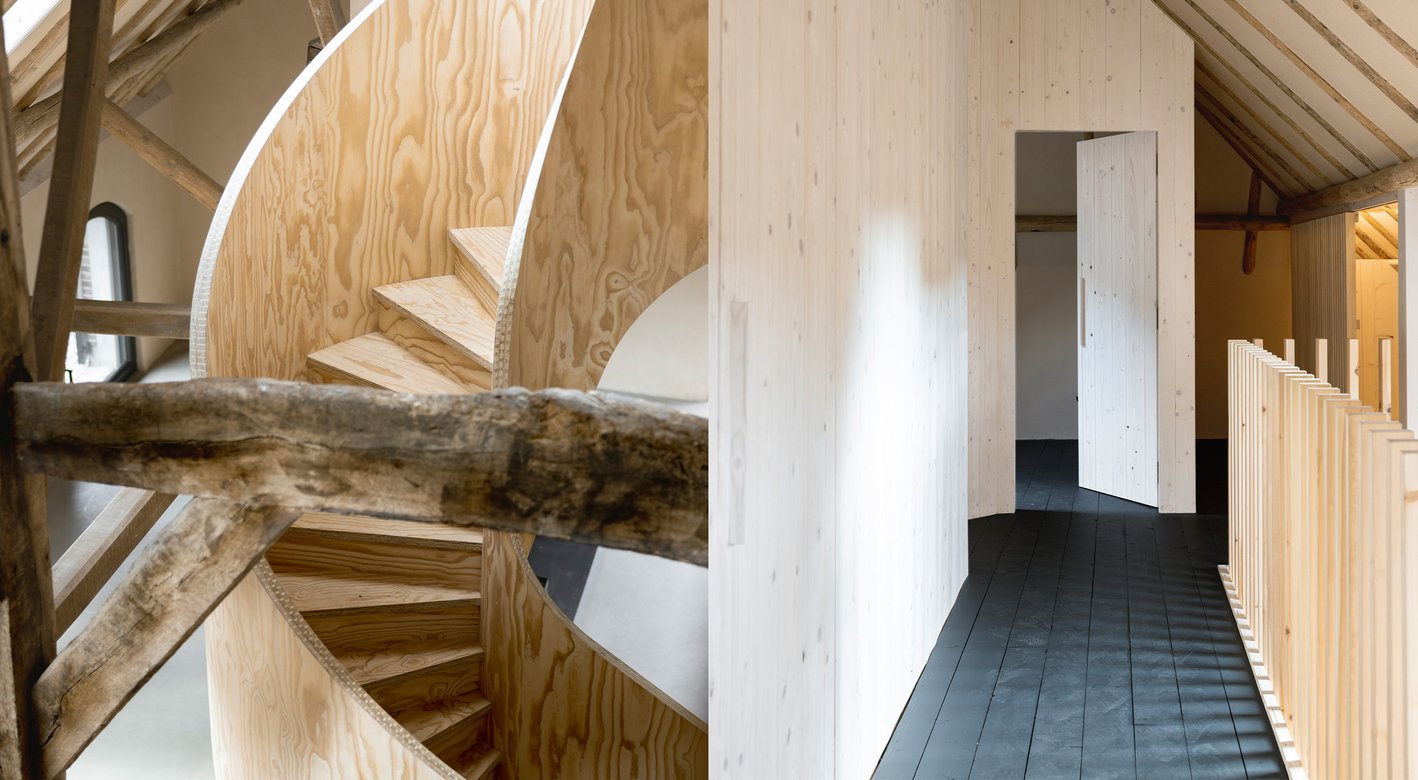
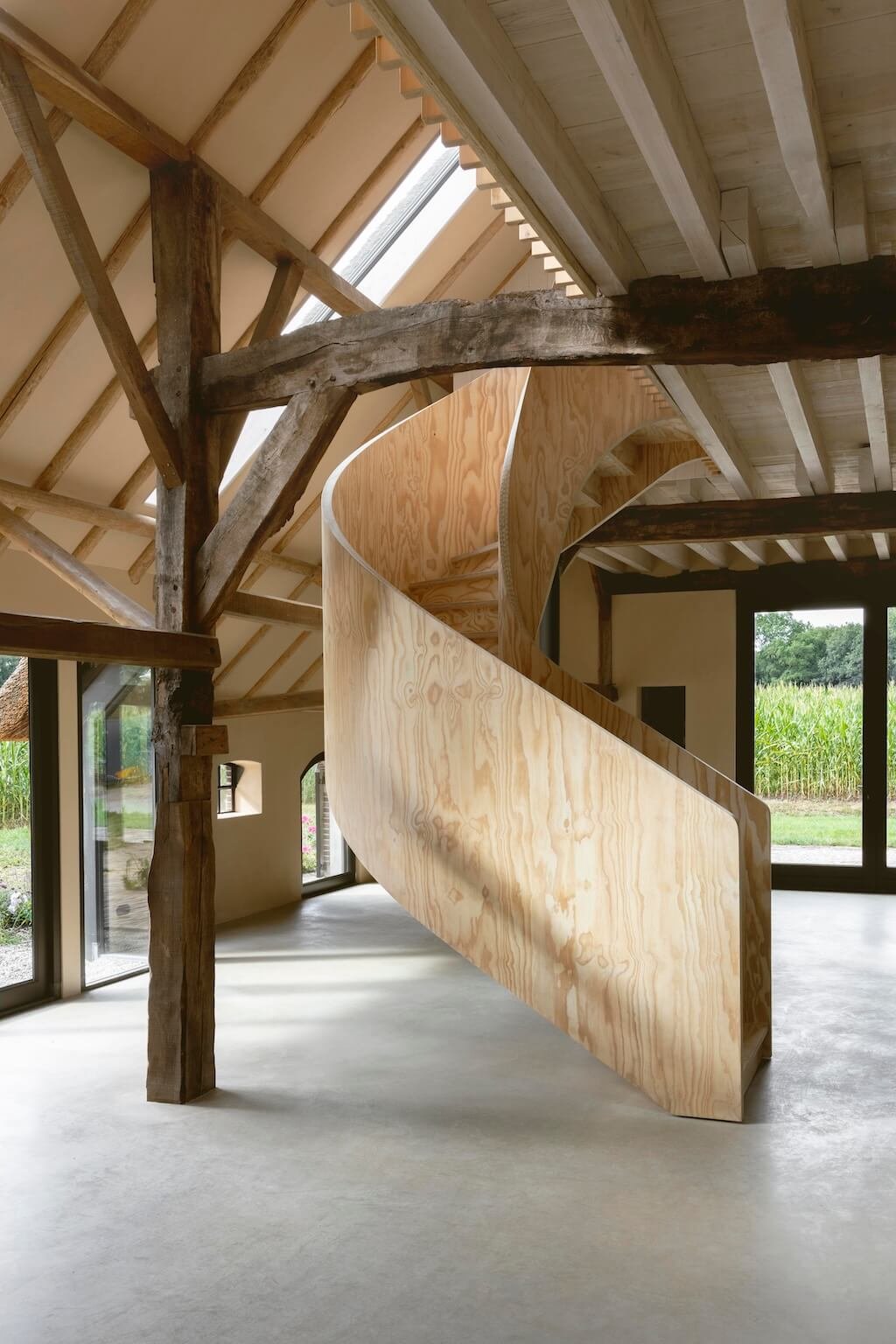
The pine plywood helical staircase designed in collaboration between Julia van Beuningen and EeStairs is the first of its kind that EeStairs has engineered and fabricated, and the full-length photographs of it rising through the barn interior make clear why the project has received the attention it has. The staircase is self-supporting, meaning there is no central column interrupting the sweep of the helix as it rises from the polished concrete of the ground floor to the first-floor level above, and the entire form is executed in raw pine plywood whose grain runs visibly across the curved balustrade surfaces and whose layered edges are exposed and precisely finished at each tread and at every curved profile visible along the balustrade. The material choice, pine plywood rather than the marble, glass, or noble hardwood with which curved and helical staircases are conventionally associated, is the decision that gives the project its particular quality: the staircase is both technically ambitious and materially humble, its industrial frankness matching the barn’s own history of functional use without apology, and the pale warmth of the pine sitting naturally within the lime plaster and original timber environment of the building rather than competing with it.
Seen from the ground floor with the arched glazed entrance door open behind it and the Dutch agricultural landscape visible through the glass, the staircase occupies the interior as a sculptural form that holds its own against the scale of the original structure, and from the upper level looking down, the curved plywood balustrade and the exposed original timber rafters of the thatched roof above frame the same space in a different register, the new and the old in a dialogue that the building’s listed status required and the design has managed with considerable precision.
The First Floor
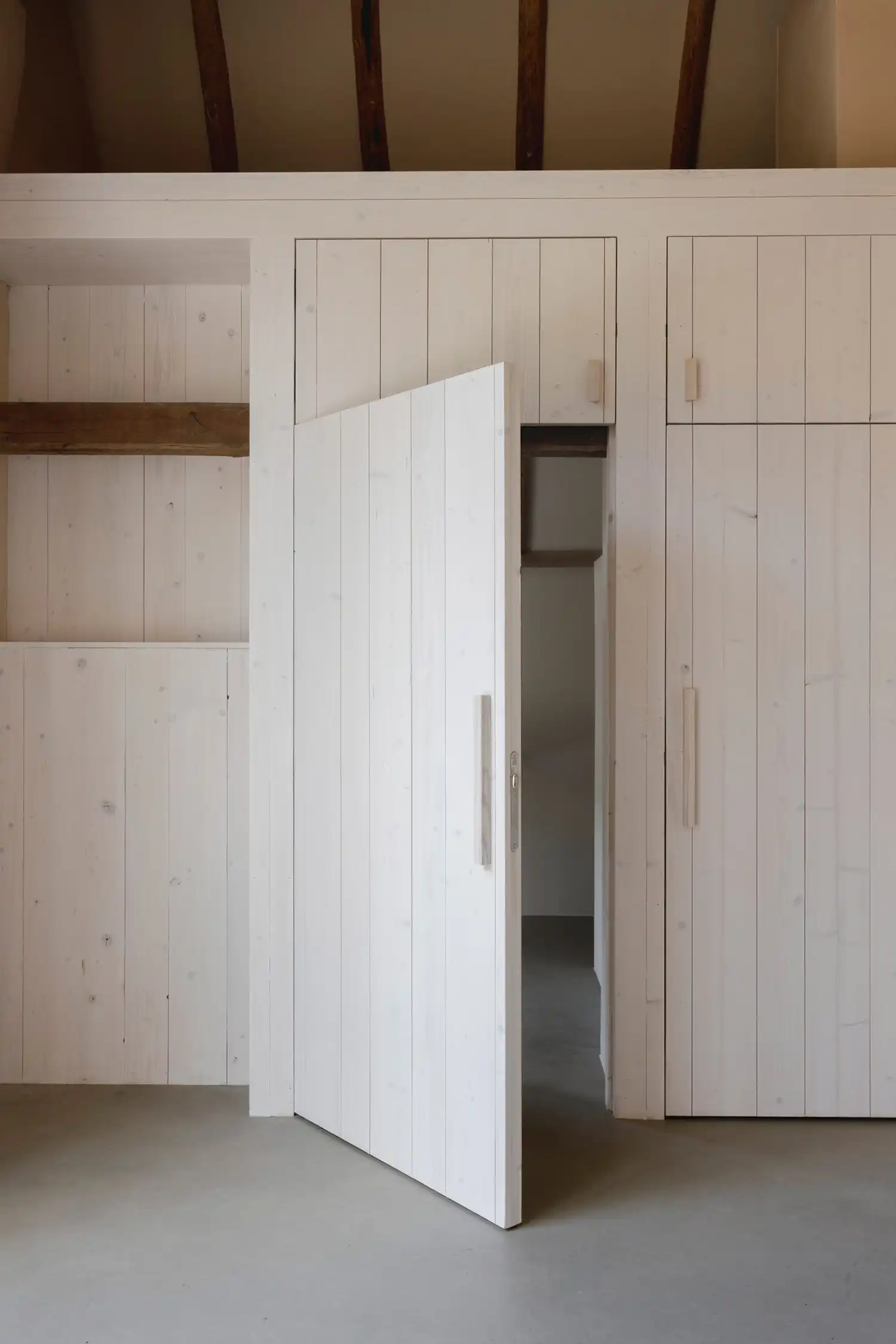
The first floor is where the bathrooms and bedrooms have been integrated into the barn’s volume without disturbing the spatial character of the ground floor below, and the material language here shifts from the warm plaster and raw concrete of the lower level to pale whitewashed pine timber paneling that covers the walls, doors, and built-in storage throughout the upper level. The built-in cabinetry, shelving, and cupboards are all in the same whitewashed pine, with simple timber handles and flush doors that give the upper floor a quiet, domestic character appropriate to its program, and the floor is finished in dark-stained timber planks that contrast with the paleness of the pine paneling and the light falling through the skylight windows cut into the thatched roof above. The exposed original timber rafters and purlins of the 1885 roof structure remain fully visible at the upper level, running above the inserted floor and partitions and connecting the new domestic spaces to the building’s inherited spatial logic, so that even at the bedroom level the occupant is still inside the barn rather than inside a conventional room that happens to be located within one.
Materials and Sustainability
The renovation of the Ahof barn was designed and built using traditional materials, specifically timber, lime, and flax, which together dramatically reduce the environmental impact of the project compared with a renovation carried out using contemporary synthetic construction products, and the absence of unnecessary fixtures or decorative additions on the interior wall surfaces is a direct consequence of the brief to respect the structure and preserve its inherited quality of stillness. The barn was renovated to achieve zero energy consumption, with solar panels and ground source heat pumps producing on-site the same amount of energy the building consumes. EeStairs’ contribution to the project extended this sustainability commitment by using FSC-certified timber, less polluting adhesives and finishes, and minimizing environmental impact at every stage from material sourcing through fabrication and transport.
The Ahof as a Broader Project
The Ahof farmstead in Nijkerk brings together several typical 19th-century Dutch buildings on a 791 square meter site that has been in the current client’s ownership for approximately thirty years, bought with the ambition of creating a renewed environment for the land and its historic buildings. The land has been rewilded, and its ancient wetlands, including Alder swamp groves, have been reinstated, and the team works alongside local farmers to explore regenerative farming practices across the surrounding area. The barn, completed in 2022 from a 2021 design, is the second of five buildings on the site to be completed, and the wider project frames the architectural renovation within a long-term commitment to the land and community it sits within, giving the material restraint of Flip Wentink Architecten’s work here a context that extends well beyond any single building.
Project Details
Project name: Ahof Farmhouse. Architecture firm: Flip Wentink Architecten. Location: Nijkerk, Netherlands. Photography: EeStairs, Alex Baxter. Staircase design and fabrication: EeStairs. Interior design: Julia van Beuningen. Gross internal floor area: 162 m². Site area: 791 m². Design year: 2021. Completion year: 2022. Primary material: Wood. Client: Private.
