
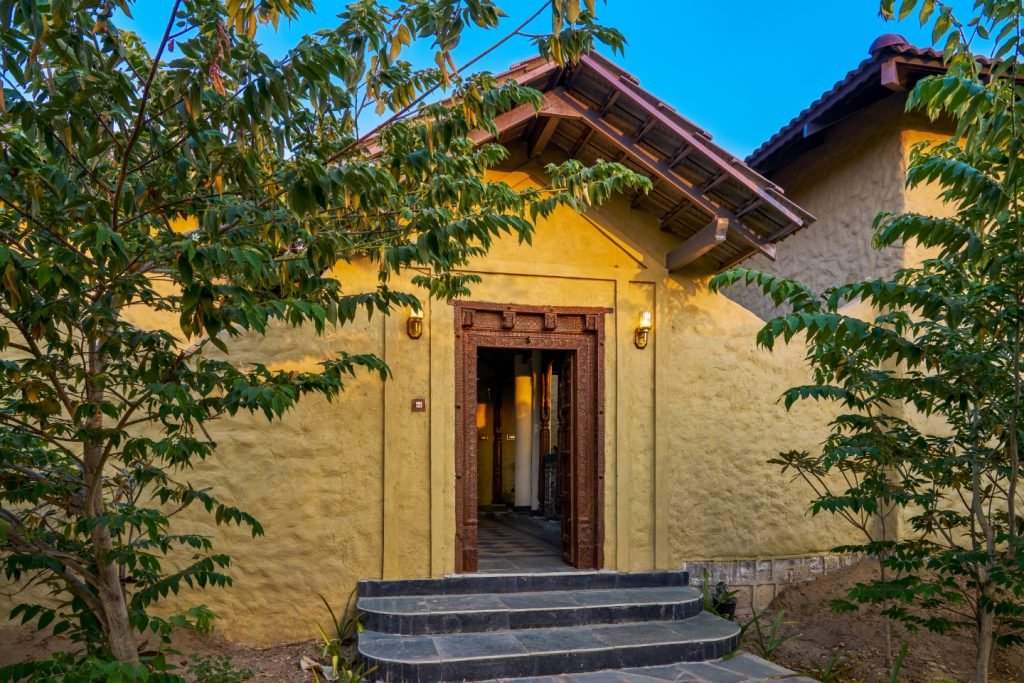
The entrance to Jungle Homes Tadoba is a set of doors that did not originate here. Massive carved wooden panels salvaged from a rundown wada somewhere in Maharashtra, their surface dense with brass fittings and ornate metalwork jali with a green patina on either side, carved columns flanking them, the whole assembly set into a new sandstone wall as though it had always been there, and it is this threshold more than any other point in this 35,000 square foot, 24-room resort adjacent to the Kolara Gate of the Tadoba-Andhari Tiger Reserve that tells you what Ar. Sukumar Nashine and the team at Nashine Architects were working toward, which is that a building can carry real history rather than a simulation of it, and that the doors of abandoned wadas across Maharashtra have more to say about place and time than any new material could manage.
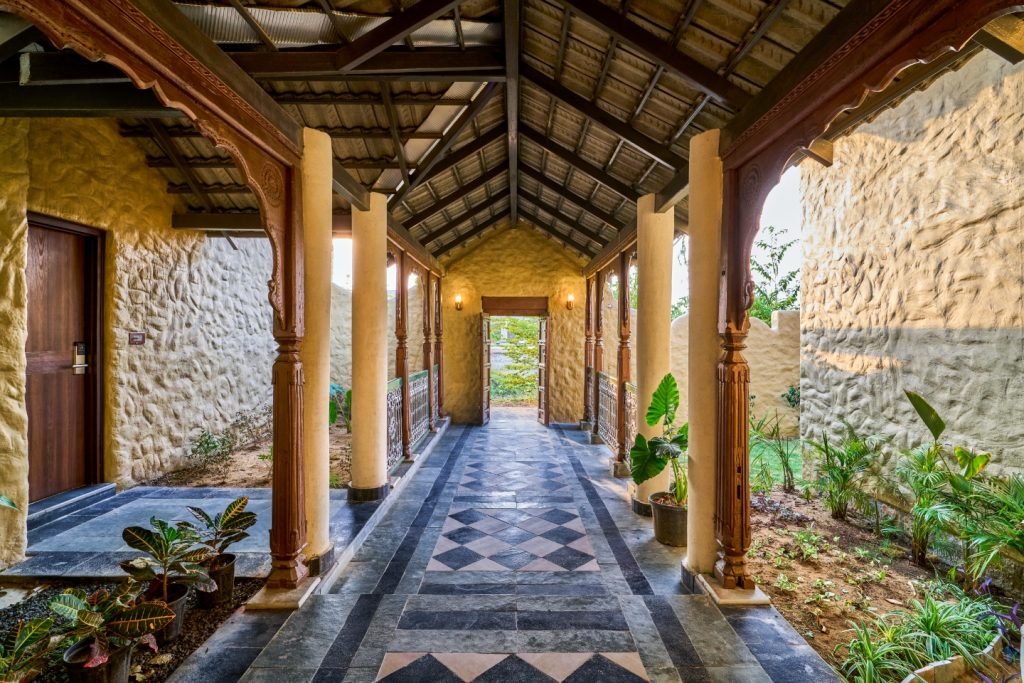
Beyond the doors, a Tandur stone checkerboard corridor leads into the main building, with a dark grey and cream pattern running the full length of the passage between carved wooden columns and lime-plastered walls. This same checkerboard reappears throughout the resort wherever the Wada reference is most explicit: in the central courtyard, on the cottage floors, and at the pool deck. The pattern serves as the resort’s spatial signature, just as sandstone serves as its material one.\
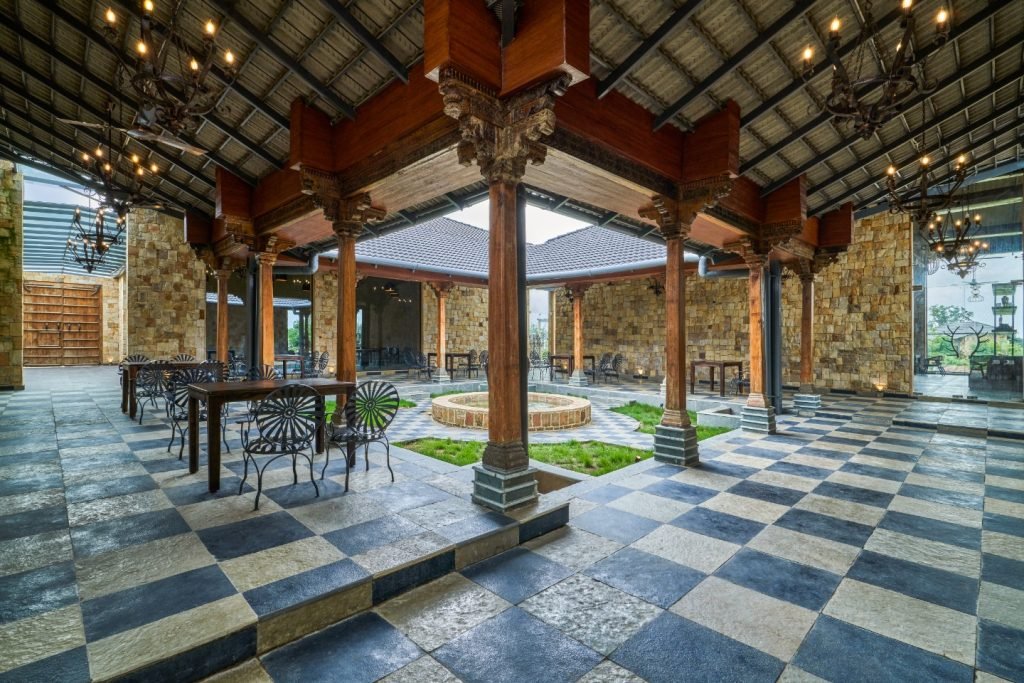
The central courtyard is the heart of the main building and the most direct translation of the Wada typology into a working resort. Sandstone walls of warm golden tones enclose the central courtyard, bordered by a colonnade of salvaged carved wooden columns, each with a patina reflecting its history. At the courtyard’s center, a circular stone platform carries a large dark ceramic urn on a ring of grass, and the checkerboard Tandur paving extends outward from it in all directions.
The semi-open space, sheltered by the colonnade but open to the sky, promotes a cooling cross-breeze and provides shade in Tadoba’s summer heat of 48 degrees. Dining tables and wrought iron wheel-back chairs are arranged under the colonnade on either side, with the cooking, reception, and banquet hall all organized around this space. The courtyard serves the same purpose as in every wada it references, holding the life of the building together at its open center.
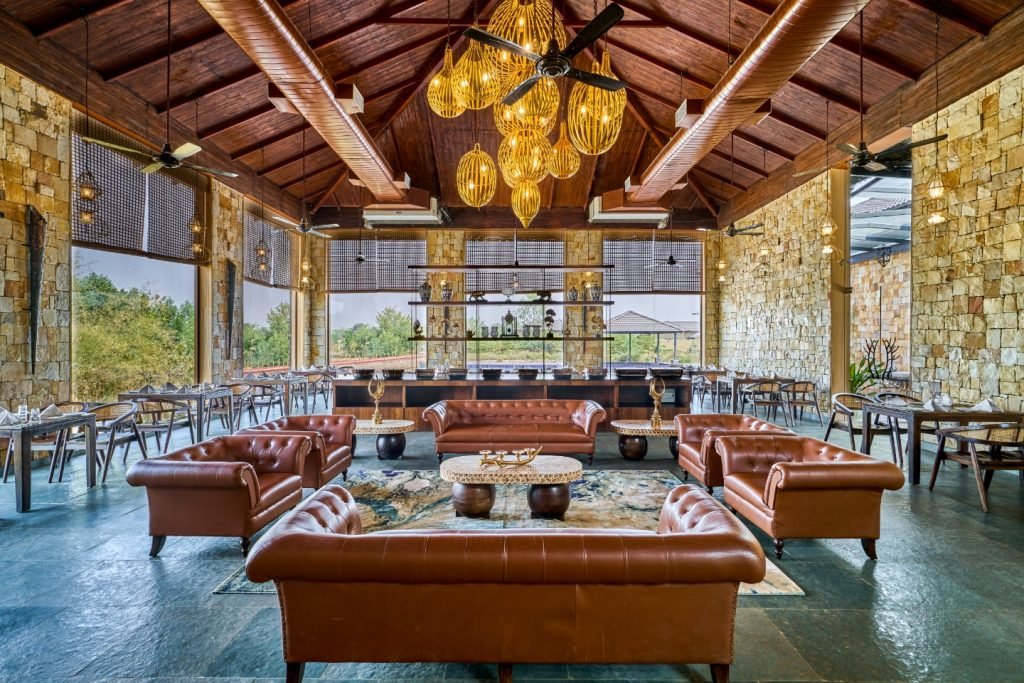
The restaurant occupies one of the largest volumes in the main building, its pitched timber roof rising high above sandstone walls on all sides, large openings between the stone columns letting the forest landscape in on multiple sides with bamboo roller blinds drawn partially against the afternoon light. Brass cage pendant clusters hang from the timber rafters in warm amber, tan leather Chesterfield sofas are arranged in the central lounge zone, round tables on either side for dining, and a long display shelf running through the middle carrying ceramic vessels and objects. The dark slate floor creates a seamless transition between inside and outside, with stone walls and large openings blurring the boundary between the restaurant and the forest.
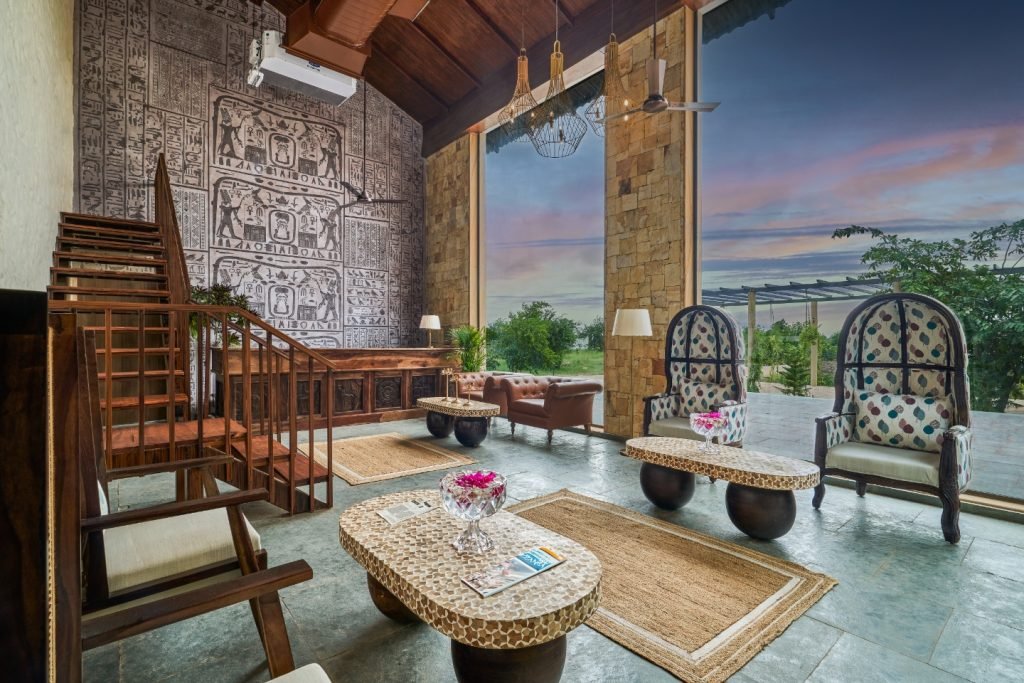
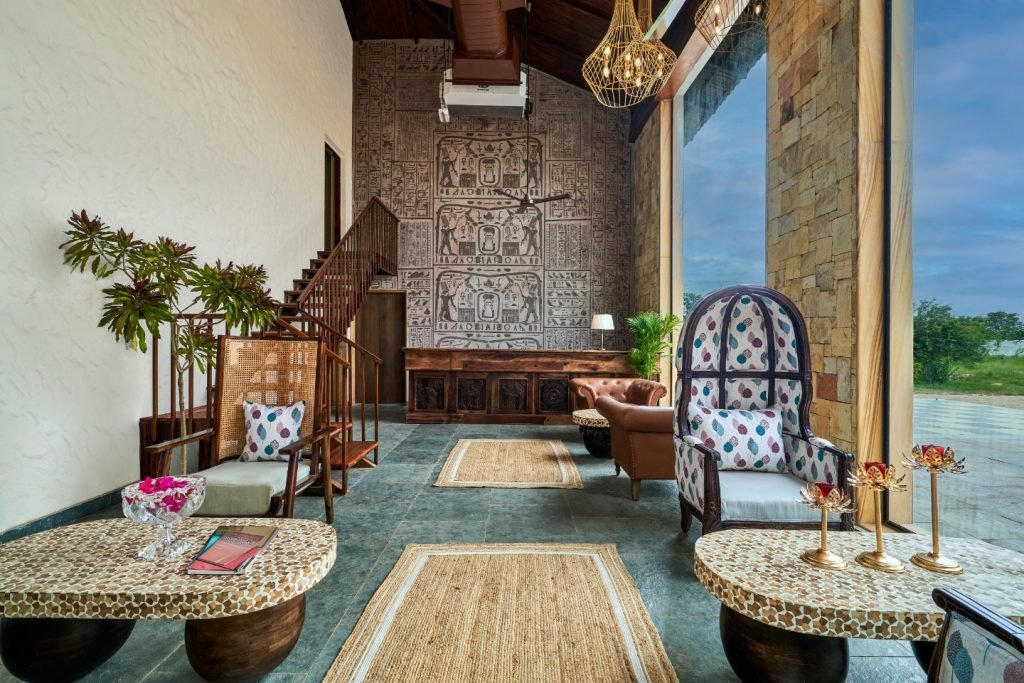
The lobby lounge sits at the double-height space beside the entrance, where a staircase of salvaged heritage wood with rattan panel balustrades rises along one wall, and a full-height mural in grey-brown on the other carries a dense field of hieroglyphic-like script and figural patterns across the entire wall surface, less decorative wallpaper and more an archaeological surface, the marks of something that predates the building around it. Tables with bone-inlay mosaic tops on dark turned-wood globe bases are arranged across jute rugs on the stone floor, dome-shaped high-back chairs in patterned upholstery alongside them, a deeply carved wooden console below the mural wall, the whole space opening through sandstone columns to the landscape and the sky beyond.
The 24 cottages are distributed across the site at a remove from the main building, their separation from the public zones reinforced by the twin lakes created from restored natural channels on the site, the water functioning as a natural boundary between the communal and the private and, as the season allows, as a watering hole drawing wildlife from the reserve beyond.
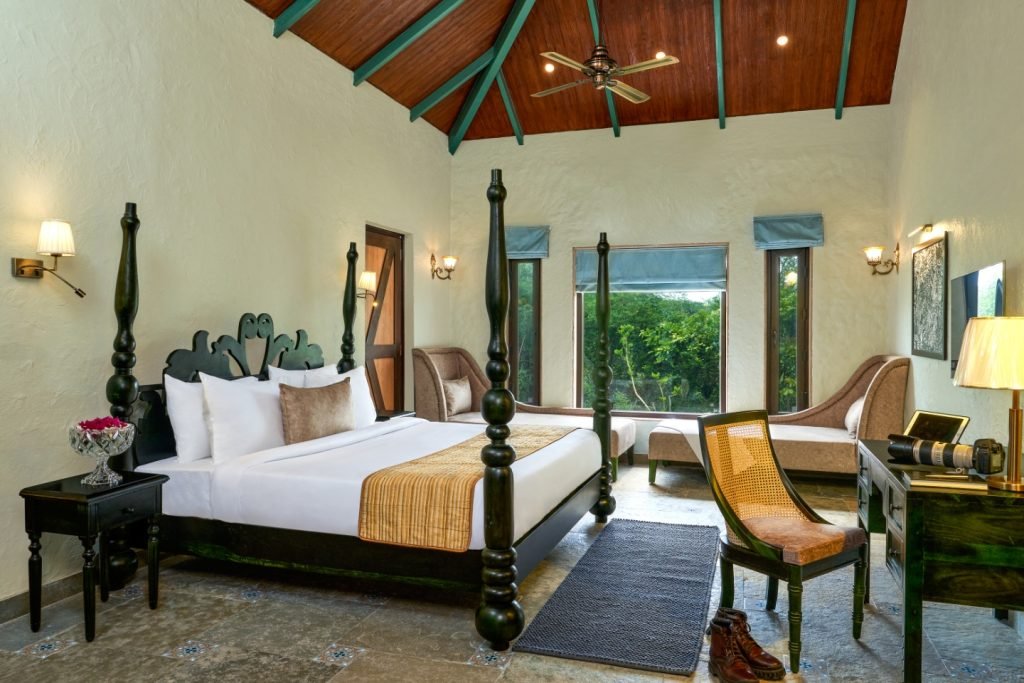
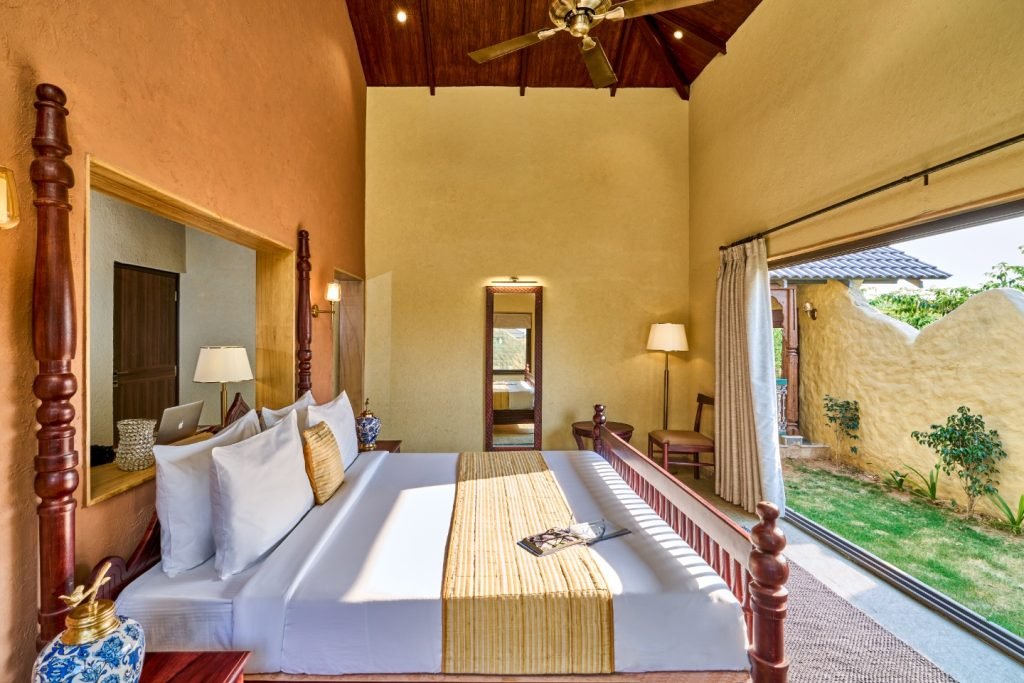
Each cottage carries the same vocabulary as the main building in a reduced register: lime-plastered walls in warm ochre or terracotta tones, high vaulted timber ceilings with exposed rafters and a ceiling fan, four-poster beds in dark rosewood or green-painted wood with turned spindle posts and carved headboards, Tandur stone floors with blue-grey diamond insets, and carved wooden door surrounds salvaged from wadas set into the new construction so that each cottage arrives at its entrance with a piece of inherited architecture already in place.
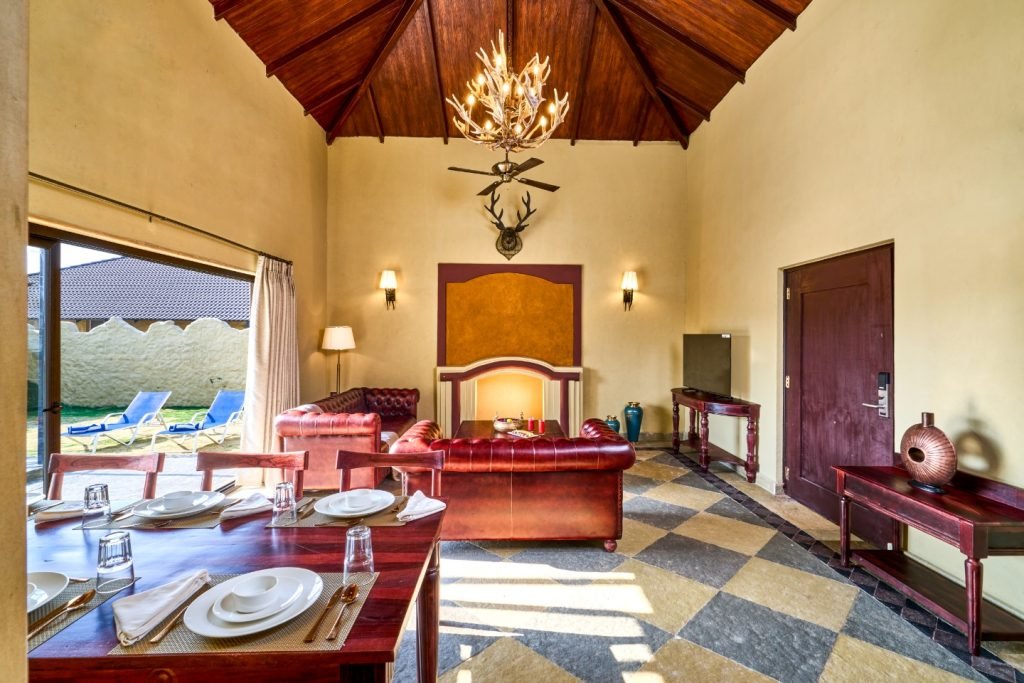
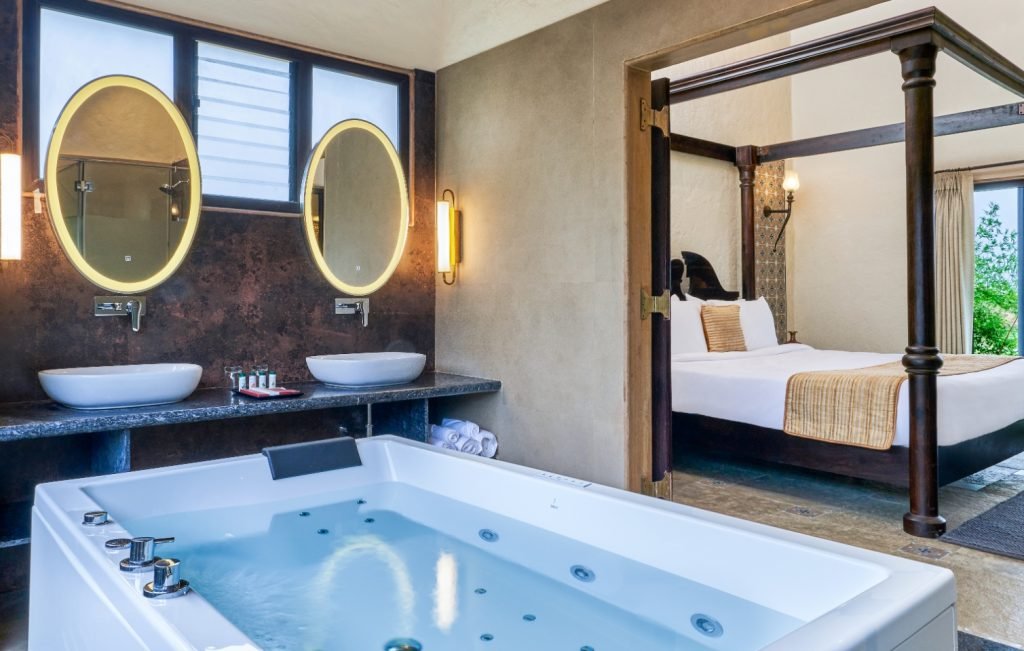
Rattan chairs, handcrafted and light, sit at the desks, and several rooms open fully to enclosed private garden courtyards with grass and sandstone walls; the inward-looking logic of the wada is brought down to the scale of a single guest room. The more expansive villa units carry a living room with red Chesterfield sofas, a stone fireplace with an ochre-painted surround, a dining table under an antler chandelier, and a checkered stone floor, the room reading less like a resort villa and more like a forest bungalow furnished by someone who has been collecting for a long time. In the bathrooms of certain room categories, a jacuzzi bath and double oval backlit mirrors in dark stone and terrazzo sit open to the bedroom through a framed arch, the wet and dry zones continuous rather than divided.
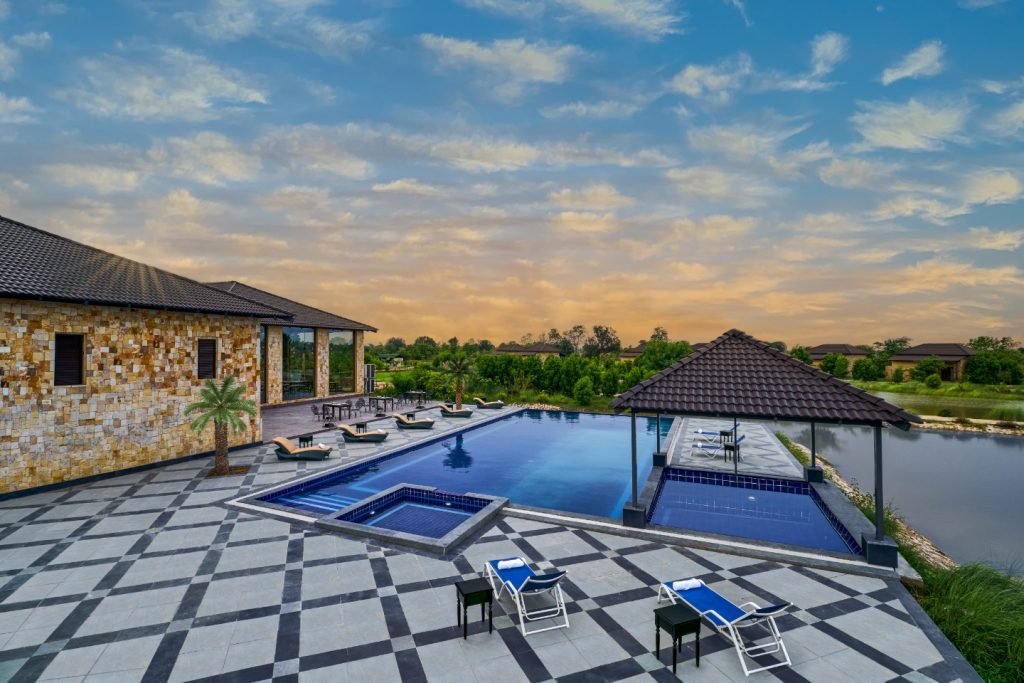
The pool deck continues the checkerboard in stone, sun loungers along the water’s edge, a jacuzzi pool adjacent, and beyond both the twin lakes stretch toward the treeline, the water still in the early morning when the forest at the edge of the reserve begins to move.
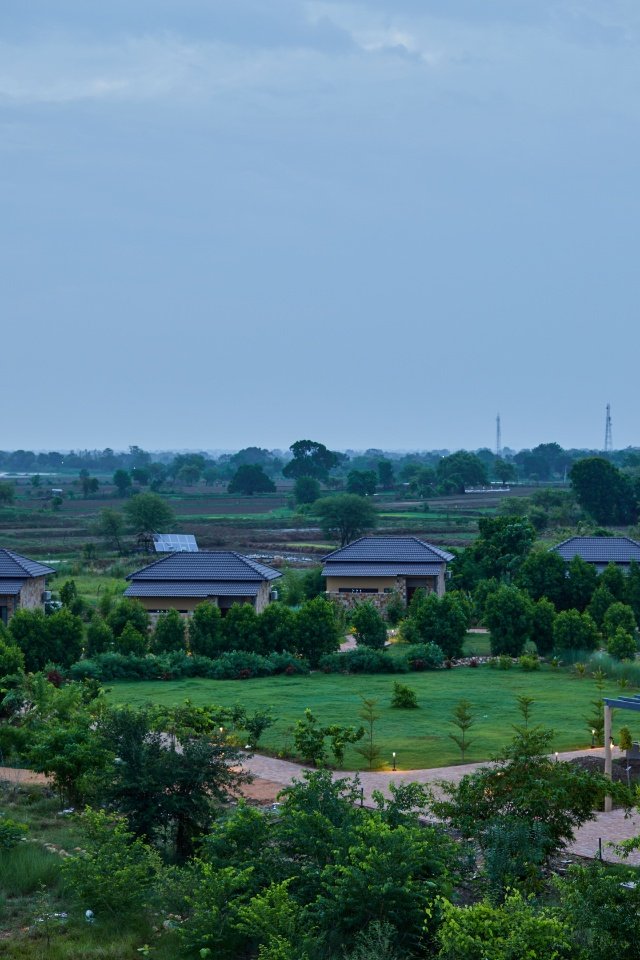
From an elevated point on the site at dusk, the cottages sit low in the landscape, their dark terracotta hip roofs just visible through the trees that have been planted between them, the resort distributed across the ground rather than imposed upon it, the semi-arid land of Tadoba flattening out toward the tiger reserve in the distance.
Fact File
Project Name: Jungle Homes Tadoba
Location: Tadoba, Maharashtra
Project Type: Resort / Hospitality & Leisure
Year Built: 2025
Project Size: 35,000 sq ft
Design Firm: Nashine Architects
Principal Architect: Ar. Sukumar Nashine Team
Design Credits: Ar. Shashank Nashine & Ar. Sonia Nashine
Photograph Courtesy: Vrushasen Mohite
