• Home
  • Project
    • Residential
    • Hospitality
    • Commercial
    • Public & Cultural
  • Interview
    • Architect
    • Interior Designer
    • Founders & Brand
    • Artist
  • Material
  • Product
  • Feature
  • DDI Finds
    • Emerging Studio
    • Rising Designers
    • New Practices
  • About
  • Magazine
  • Contact Us
Design Diary International
Residential

Vaikunth, Chembur, Mumbai Tanisha Bansal Interiors

by DDI Edit Team June 1, 2026
written by DDI Edit Team

The first thing you see at Vaikunth is a lotus, hammered in gold across the ceiling of the entrance passage, its petals pressed and textured and lit from within; a dark crystal chandelier hanging from its center above a pale sand double door flanked by yellow glass candle holders and a carved stone Buddha; the carpet underfoot patterned; and the walls on both sides in dark veined marble, and by the time you have registered all of this, you have not yet stepped inside, which is precisely the point of an entrance designed this deliberately, this completely, in a home that takes its name from the eternal dwelling of Vishnu and intends to live up to it.
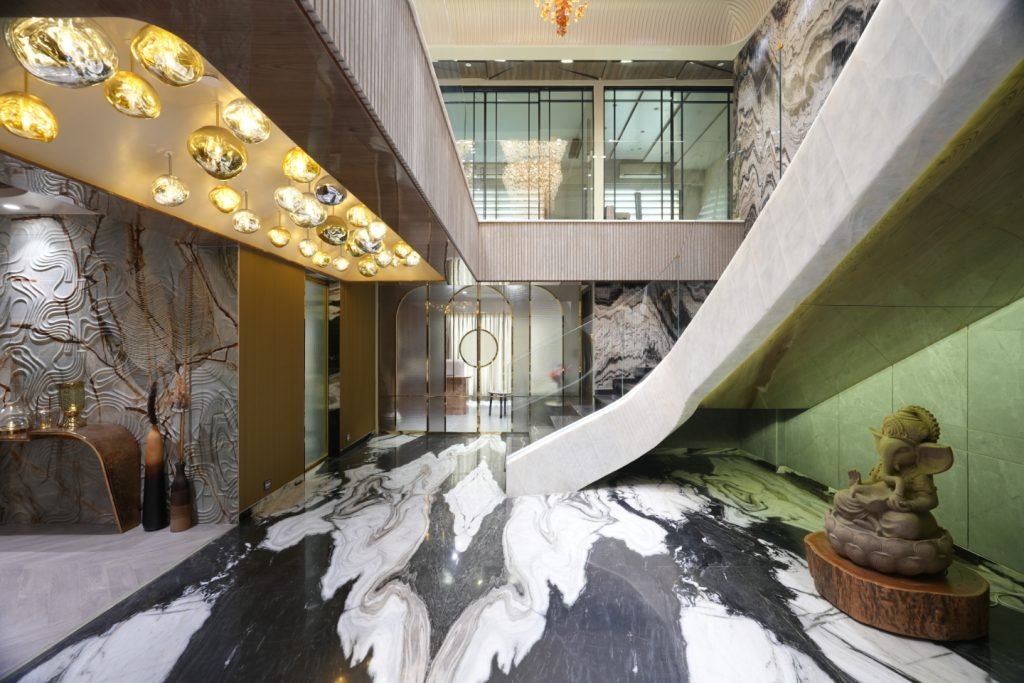
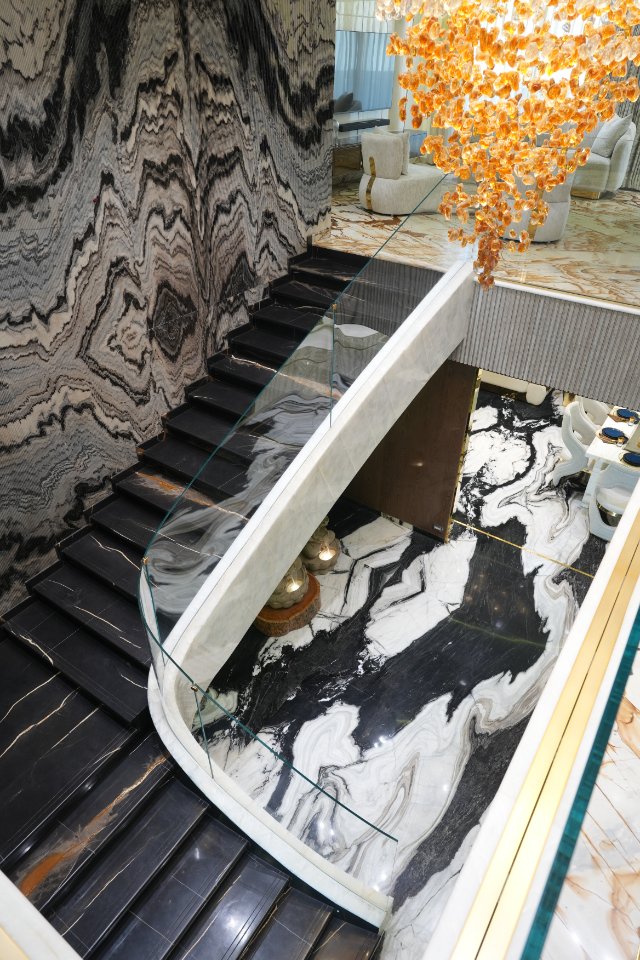
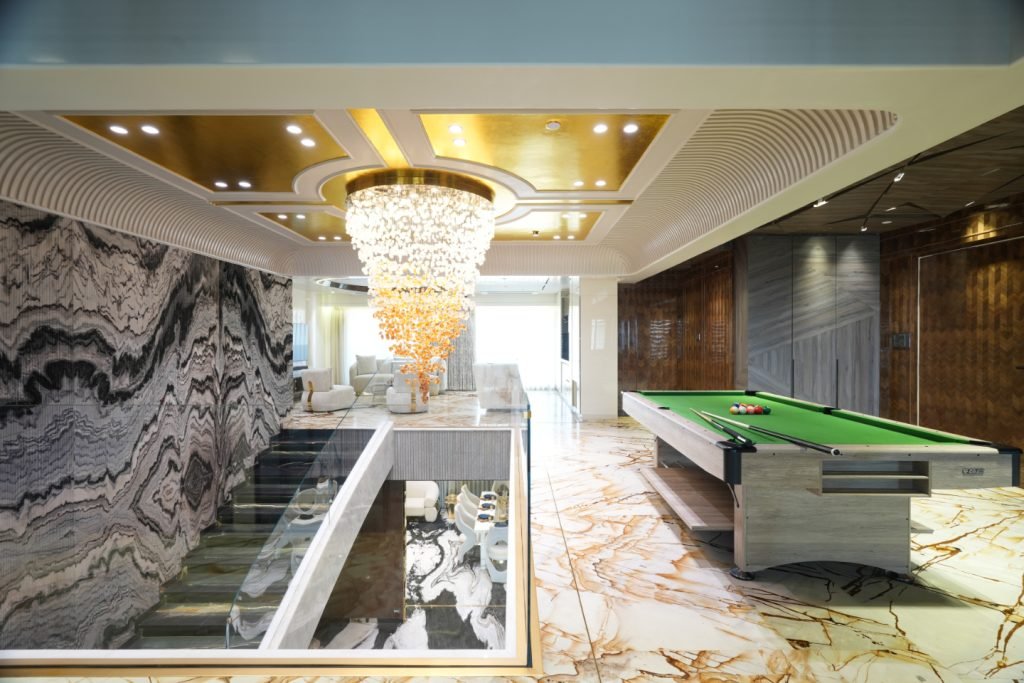
Beyond the door, the foyer is lined in onyx whose cream ground carries rust and grey veining in slow organic patterns that shift as you move past them, the stone so particular it reads as something uncovered rather than specified, and a circular gold textured ceiling recess glows above a dark console holding candles and gold vessels before the passage opens through a curved archway onto the staircase, where the full ambition of the house reveals itself at once: black marble treads descending alongside a full-height wall of dramatically swirling black and white marble, a curved white newel with a glass balustrade, an amber orange chandelier cascading the full height of the double void, and at the base of the stair, on a raw wooden log, a Ganesha sculpture sitting in the black and white marble floor with the ease of something that has always been there and always will be.
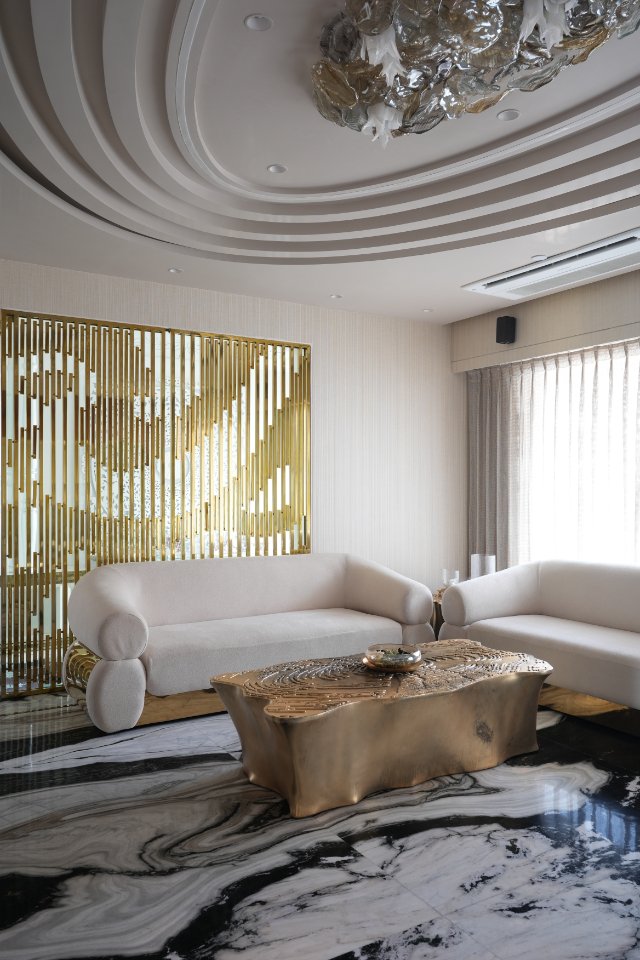
The living and dining floor is built around that same black and white marble, which covers the entire ground floor in vigorous swirling veining that does the compositional work of a large abstract painting and makes the room feel resolved before the furniture enters it, and the furniture that enters it is equal to the task: sculptural white dining chairs with organic cutout voids in their backs and gold bases arranged around a white marble table beneath a concentric oval ceiling of multiple cove-lit rings holding a chandelier of irregular glass and shell-like pieces in pale gold at the centre, and in the living zone a blush rounded sofa before a cast brass coffee table whose entire surface is worked in topographic contour lines as though a geological survey has been frozen in metal, with a large gold brass geometric screen of vertical tubes occupying the wall behind it, the dining room mirror doubling the depth of the space and the chandelier and the ceiling detail within it so that the room exists as itself and simultaneously as its own reflection.
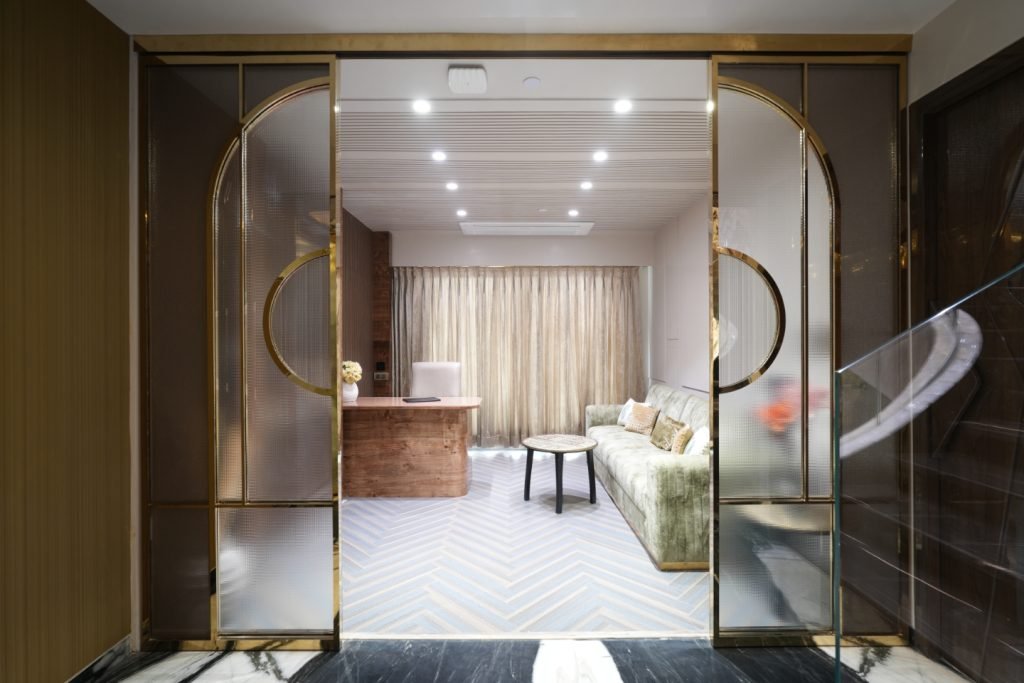
The study, seen through profile doors carrying brass arched panels with circular ring motifs on frosted glass that make the threshold feel ceremonial without heaviness, shifts immediately to a chevron-patterned light wood floor and a green velvet sofa and warm curtains and a wood desk, the room belonging clearly to someone in the way that the social spaces below, for all their material richness, deliberately do not.
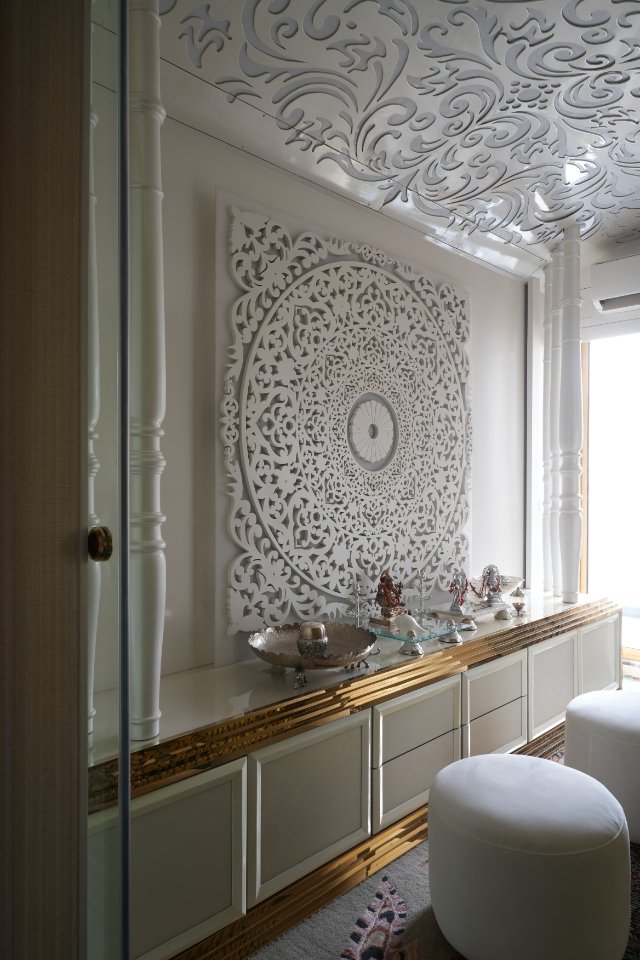
What stops you in the pooja room is the ceiling, an ornate white plasterwork surface of scrolling floral forms covering every inch overhead with the kind of unhurried precision that exists in a different relationship to time than the contemporary luxury surrounding it, and beneath it a full-scale white mandala panel of carved geometric and floral forms fills the wall above a gold-fronted cabinet holding figurines and silver vessels and offerings, the room earning its devotional character through craft rather than through separation from the rest of the house, the spiritual life of Vaikunth present throughout but concentrated here.
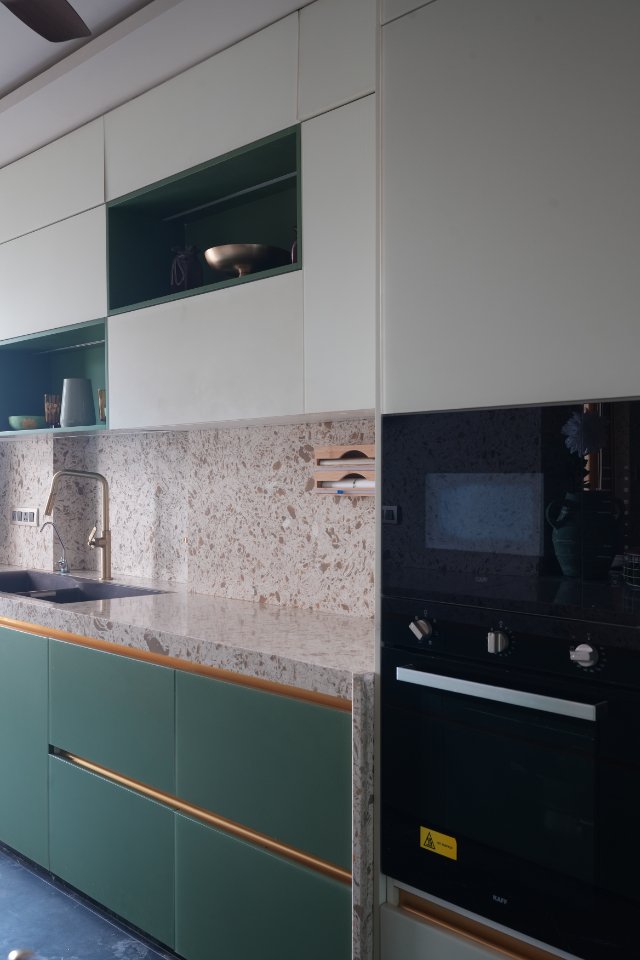
The kitchen runs forest green lower cabinetry with a brass pull rail at handle height against white uppers with a single open green-backed display shelf, the terrazzo-effect stone countertop and backsplash in warm white with brown and grey speckling sitting between the two in a combination confident enough to need no explanation, the black undermount sink, and the built-in oven handled with the same precision as everything else in a house where precision is the baseline rather than the achievement.
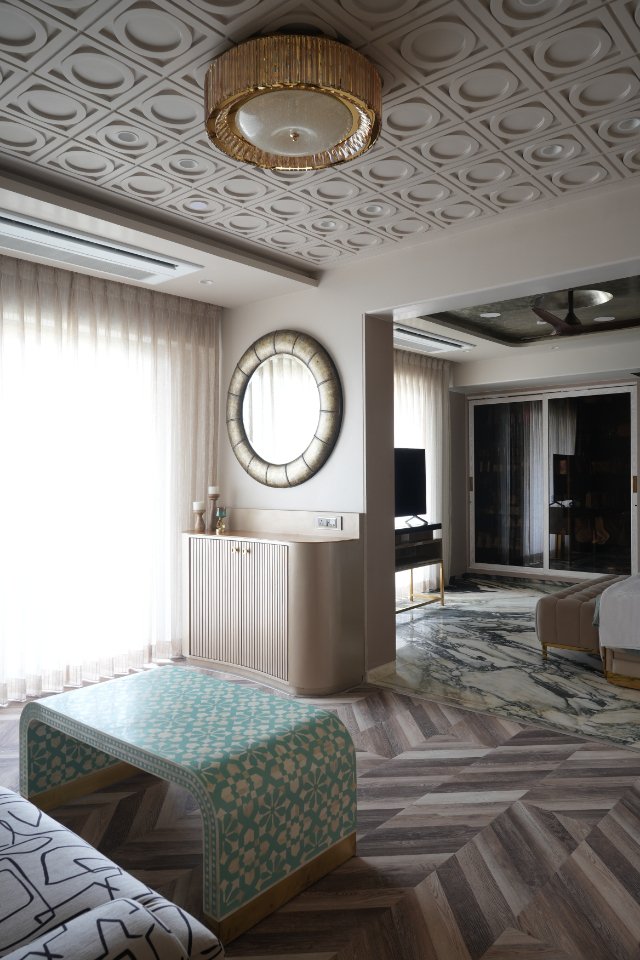
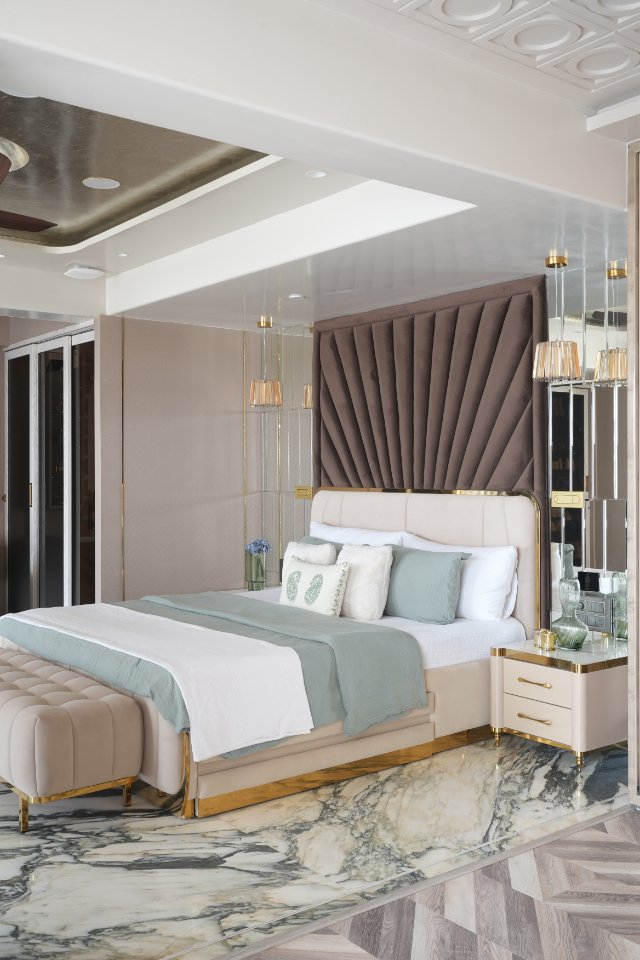
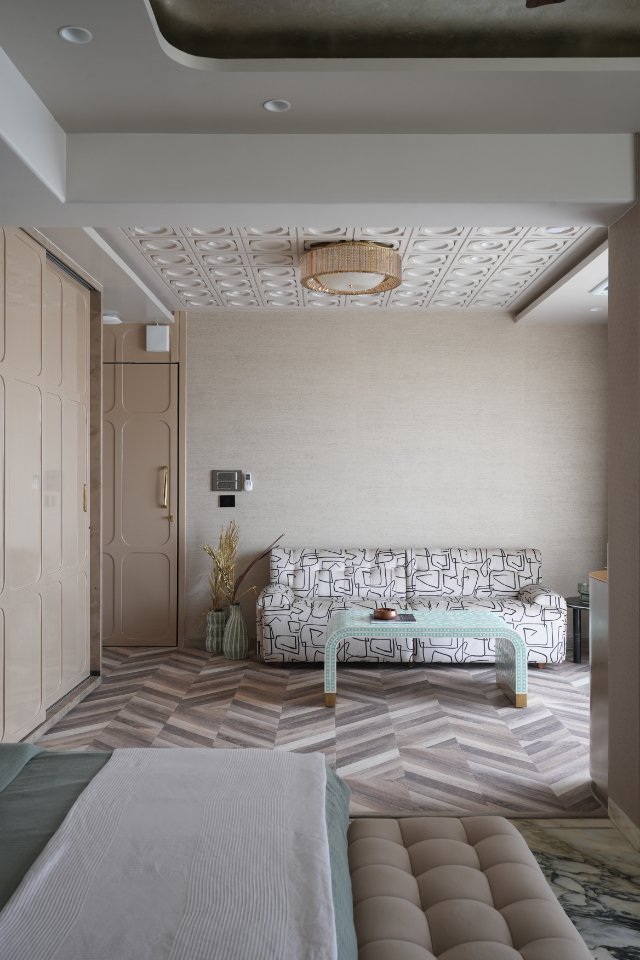
Upstairs the master bedroom gives the full wall behind the bed to a fan-pleated headboard in deep taupe velvet whose pleats radiate outward from the centre in a sunburst rising well above the bed, the velvet absorbing light rather than reflecting it so that the sculptural quality of the pleating reads entirely through texture, the blush bed frame and mint and white bedding providing the softness the wall demands, mirrored side panels with gold framing and a metallic silver ceiling above completing a room that commits to a singular idea and does not waver from it, and from this bedroom the dressing room carries a marble-topped vanity with an arched mirror circled in globe bulbs and a green velvet curved armchair pulled up to it, looking through to a walk-in wardrobe whose ceiling is covered entirely in a dense cloud of white globe lights hanging at varying heights, the teal tufted ottoman on the floor below the only furniture needed in a room that is already complete overhead, and the shower room beyond it is terracotta-red ribbed ceramic tiles on every surface floor to ceiling with brass fittings and a terrazzo floor, a decision so specific and so fully followed through that it earns the surprise it produces.
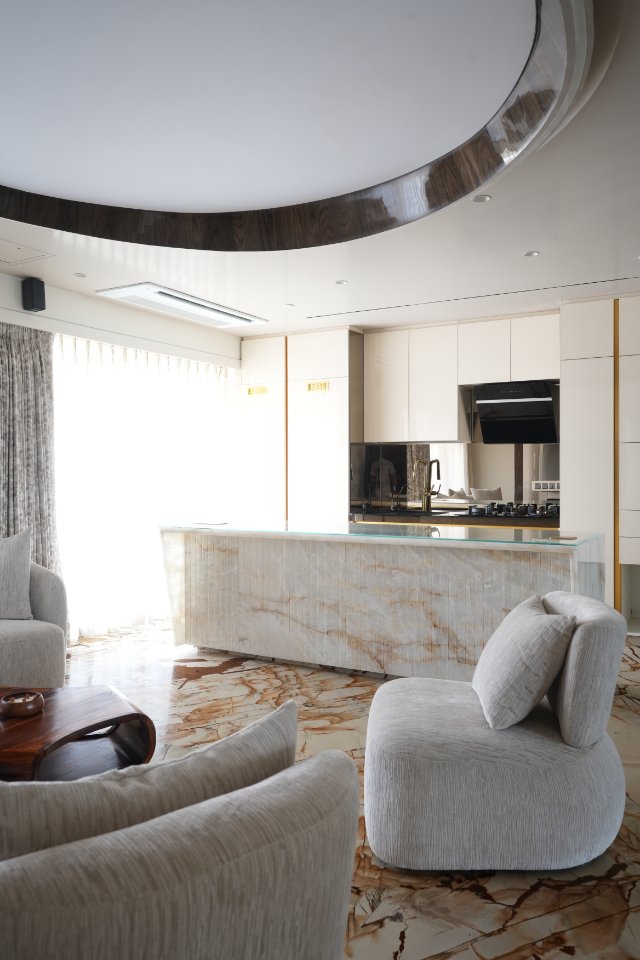
The upper family living area, its circular ceiling recess in dark veneer and polished chrome above two rounded grey bouclé armchairs on orange-veined cream marble, carries a warmth that the ground floor withholds by design, and it is in the distance between the two floors, between the drama of the black and white marble below and the quieter ease of the upper level, that Vaikunth reveals what it is actually about: a home large enough and considered enough to hold more than one version of itself at the same time.
Fact File

Designed by: Tanisha Bansal Interiors

Project Type: Residential Bungalow Design

Project Name: Vaikunt

Location: Chembur, Mumbai

Year Built: 2026

Project Size: 6,500 sq ft

Principal Designer: Tanisha Bansal

Team Design Credits: Anushka Jaisingh, Kirti Pardesi and Anjali Menezes

Photograph Courtesy: Studio Colourblind

Interior Styling: Tithi Sharma

Project Managers: Rushikesh Korade
June 1, 2026 0 comments
0 FacebookTwitterPinterestEmail
Residential

The Noir Residence: A Pune Penthouse That Speaks In Contrasts 

by DDI Edit Team June 1, 2026
written by DDI Edit Team
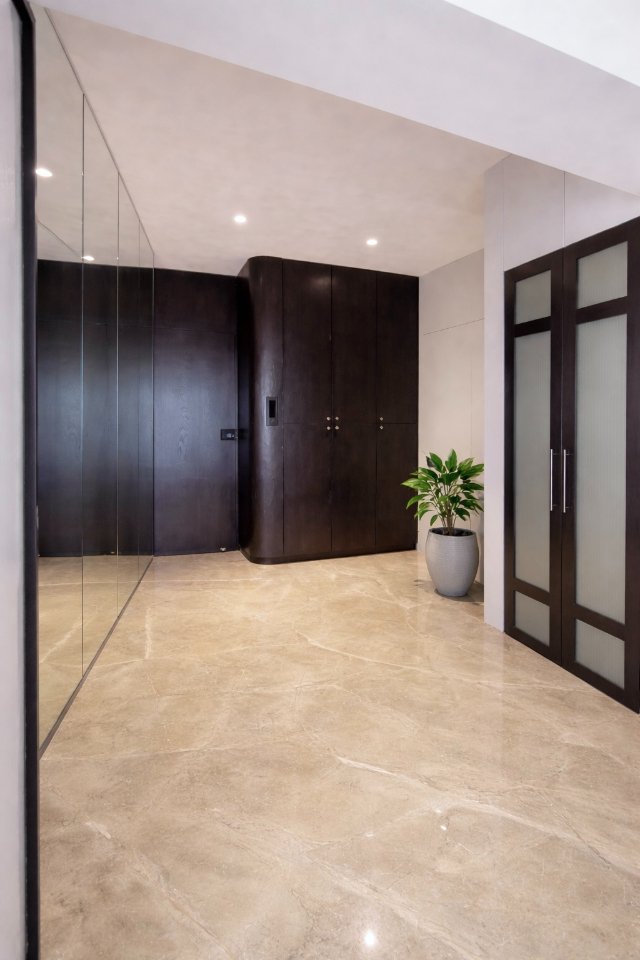
The entrance foyer of this two-level, 5,100 square foot penthouse in Koregaon Park, Pune, is where the lower floor’s intentions become clear for the first time: warm beige marble in large-format slabs underfoot; a mirror running full height along one wall; and set against it a curved column of dark espresso-toned wood that wraps the corner without a handle or a seam or any indication of what it stores, its form clean enough at the radius that it reads as a sculptural object placed in a corridor rather than as joinery; a single potted plant on the floor beside it; and a frosted glass door in a dark steel frame leading further in, the room spare and deliberate in a way that tells you the spaces beyond will hold to the same logic.

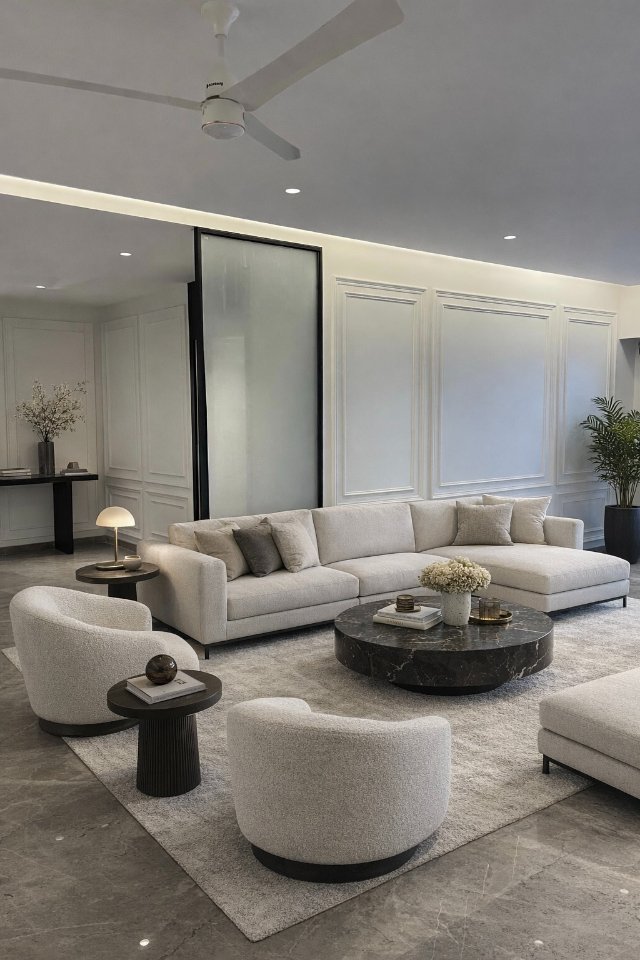
The living room confirms it. White wainscoting panels rise to the ceiling across the main walls, their classical molded grid sitting without comment next to a long off-white linen sectional with a chaise extending to one side, two round boucle swivel chairs placed in front of it, a large circular coffee table in dark marble at the center, a ribbed drum side table in dark wood carrying a small mushroom lamp, and a full-height frosted glass panel in a black steel frame standing between the seating area and the corridor behind, semi-transparent enough that the division reads as a surface rather than a wall. The Italian marble floor runs from the foyer without interruption, its polished surface picking up the warm cove light along the ceiling perimeter, a dark console table against the back wall carrying a small arrangement and a few objects, a potted palm to one side, and across the whole room the palette, cream sofa, white paneling, grey marble floor, and dark marble table, holding in a range narrow enough that the eye finds no particular place to land.

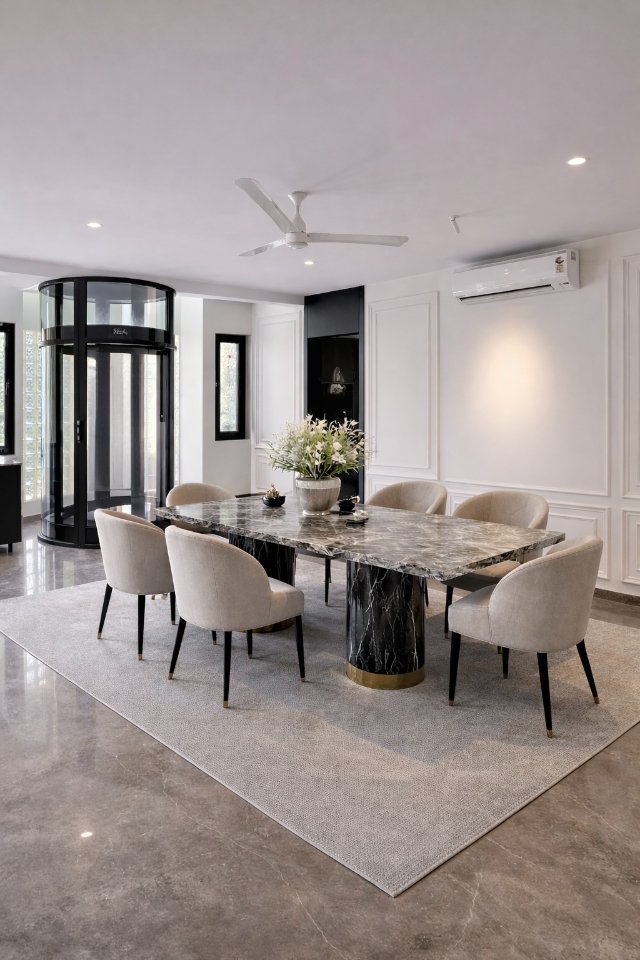
The dining room is where the lower level makes its most direct statement. A large rectangular table in black marble with bold white veining sits at the center, its base two cylindrical columns in the same stone finished at the floor with a brass ring, the top and base reading as a continuous form rather than a slab on a support. Eight barrel chairs in cream upholstery surround it, their backs curved and their black tapered legs each ending in a small brass ferrule that picks up the table’s own brass detail exactly, the same note struck across the room without ever becoming insistent. The wainscoting continues on the wall to one side, its white panels here given more room, and to the other, the cylindrical glass elevator shaft sits in the room’s periphery, its curved glass panels and dark metal frame making it as much an object in the interior as a means of moving between floors. The kitchen, staff quarters, and three bedrooms complete the lower level’s program, the entire floor unified by the Italian marble that flows from the foyer through every room, its surface reflective enough to carry natural light deep into the plan and generous enough in its scale to hold the monochromatic palette together without any single room feeling isolated from the next.

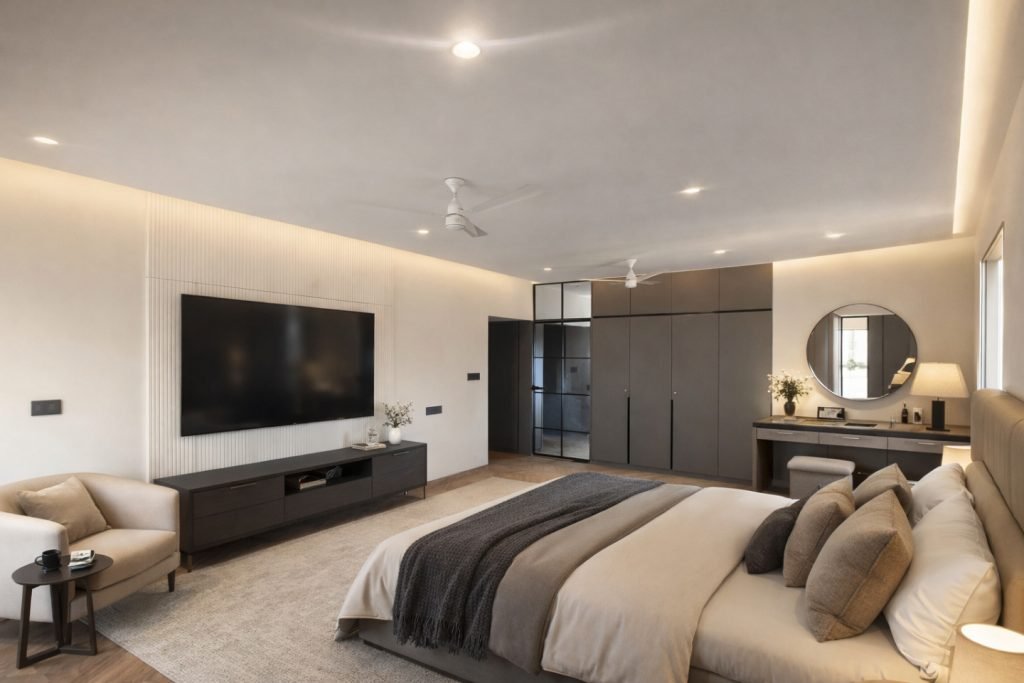
The master bedroom draws that palette to its tightest point. A wall of vertical fluted plaster sits behind the television, its narrow ridges catching the cove light at a low angle so that shadow reads as texture without the surface doing anything beyond being flat, the television centered within it on a dark low console with recessed pulls. Full-height matte dark grey-brown wardrobes with uniform flush doors cover one wall, featuring a steel-and-glass internal door to the bathroom that lets light through its glazed panels. The dressing table is a simple dark timber surface with a round mirror above it and a lamp to one side, a few objects placed on it without ceremony. The bed is upholstered in warm beige, layered with cushions in cream and grey tones and a dark charcoal throw, a cream sofa at its foot and a small round dark side table alongside, and a large area rug in warm grey-beige pulling the furniture together over the timber floor at the room’s edges; the whole room lands in a temperature rather than a color, warm enough that nothing feels clinical and restrained enough that nothing competes.

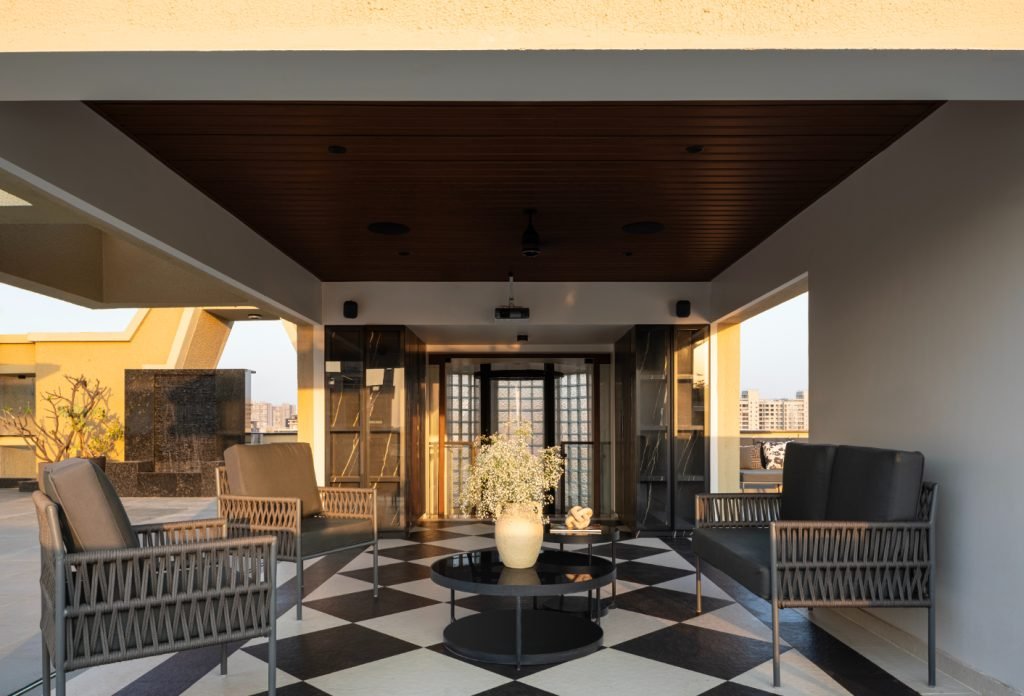
The upper terrace is a different floor in every sense, and it is here that the contrast the lower level has been quietly building toward finally opens up. The terrace contrasts the interior’s monochrome, opening to the sky and city, revealing more varied and demanding spaces. At its heart a central gazebo is anchored by a bold black and white checkerboard floor in large-format tiles, its dark timber-paneled ceiling housing a concealed pull-down screen and speakers set into the corners, woven outdoor chairs around a low round table with a large ceramic vessel of white flowers at the center, and frosted glass doors behind opening to the private lobby and elevator access, the structure sitting precisely at the boundary between inside and outside and using both conditions without committing to either. In the afternoon, the golden light falls across the checkerboard floor, the warm timber ceiling, and the woven furniture, making the gazebo feel embedded in the terrace rather than placed upon it. When the screen drops and the light fades, the same space transforms into something entirely different: an intimate entertainment enclave that the open terrace around it does not indicate.

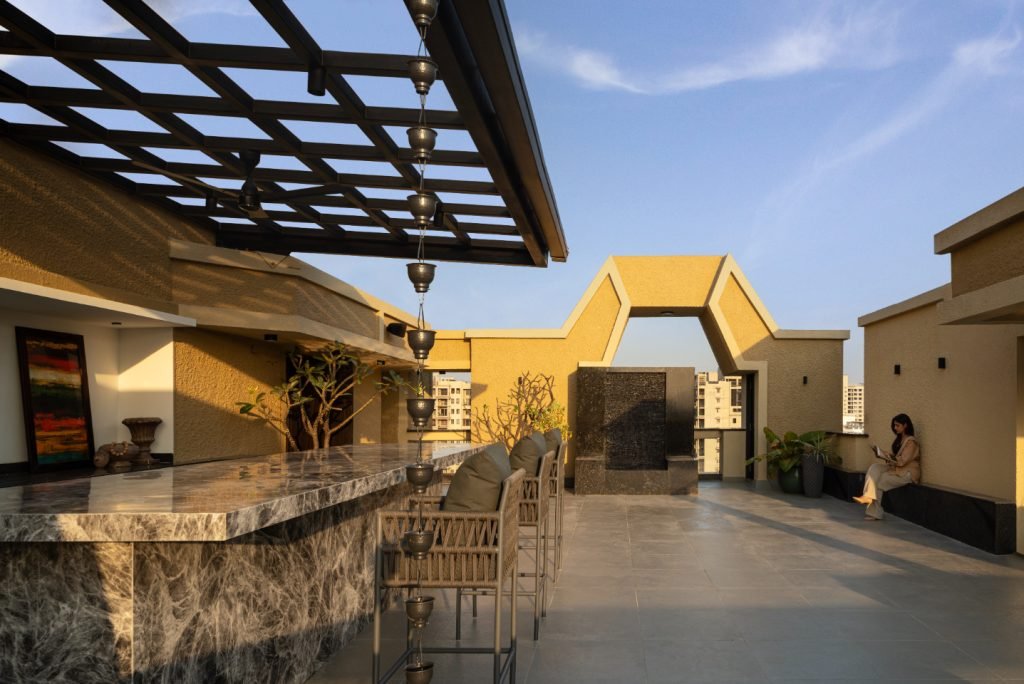
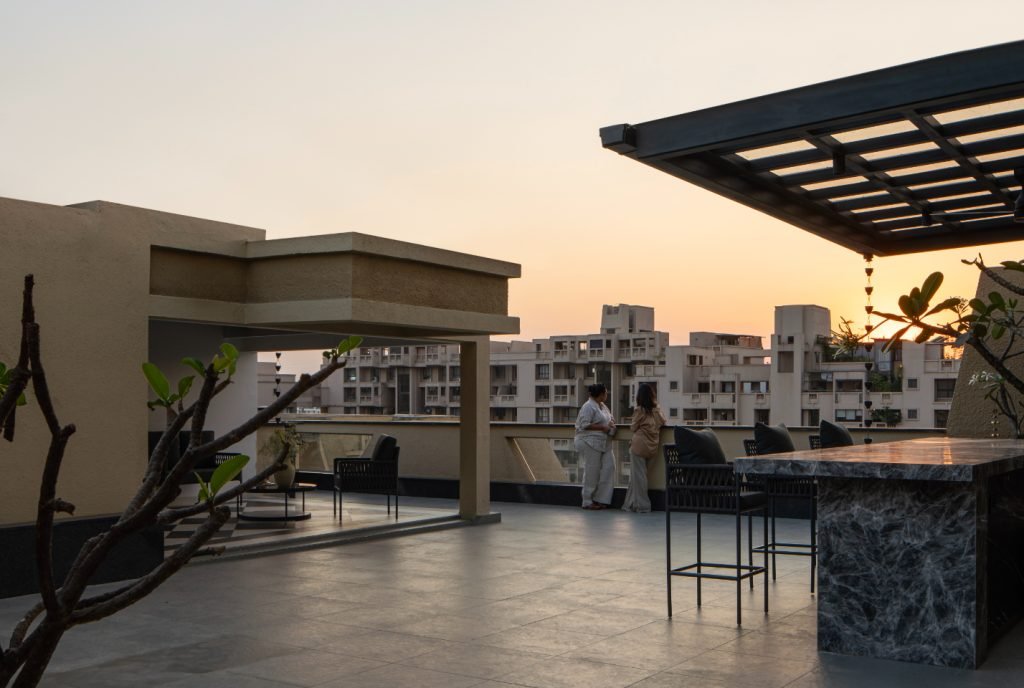
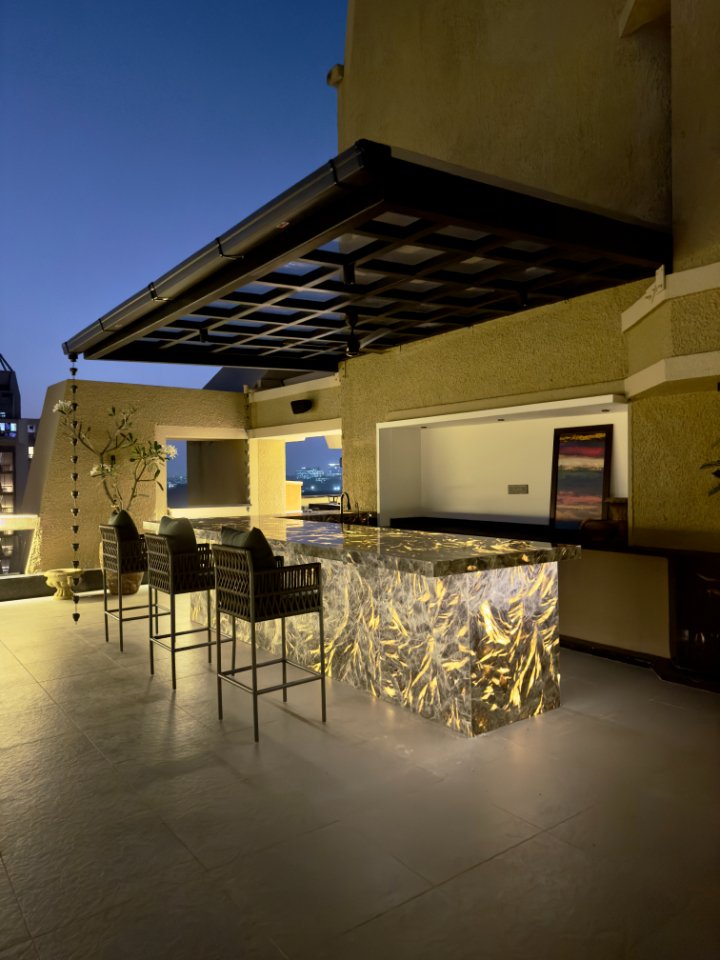
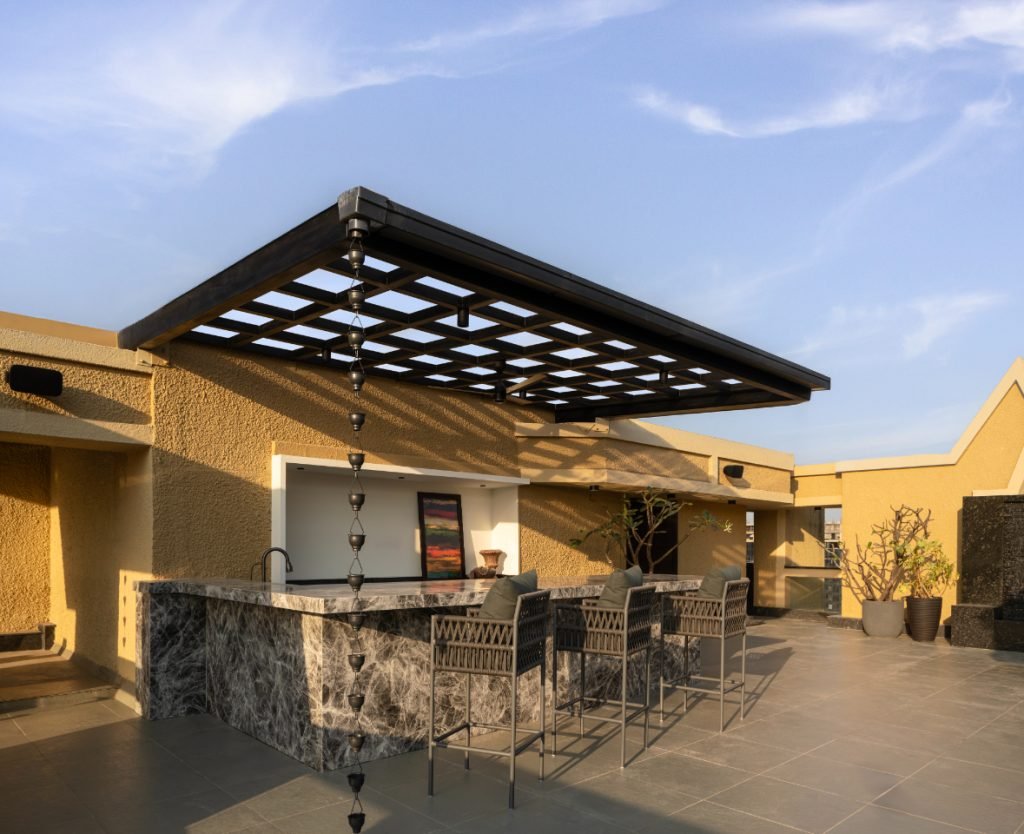
The onyx bar runs along one edge beneath a cantilevered glass canopy whose structure throws a grid of light and shadow across the counter and the woven bar stools through the day, a rain chain descending from the canopy edge in a column of small metal vessels, a plumeria tree at the perimeter, and artwork set into a recessed niche in the wall behind so that it becomes a backdrop the full length of the counter. Under the canopy the bar extends its function, the counter long enough and the overhead cover generous enough that the space transforms into an outdoor dining setting, the stone surface and the structured canopy above it giving the experience a formality that an open terrace rarely achieves. The stone in daylight reads dark grey with heavy veining, cool and horizontal; the woven stools with their rattan backs and grey cushions are pulled up alongside; the sink is set flush into the counter surface.

At night the same bar becomes the terrace’s only light source, the onyx lit from within and pushing warm amber and gold through its own translucent veining; the city is spread in the distance, and the canopy frame overhead has gone dark against it, the stone glowing in a way that has nothing to do with how marble usually behaves in a room.

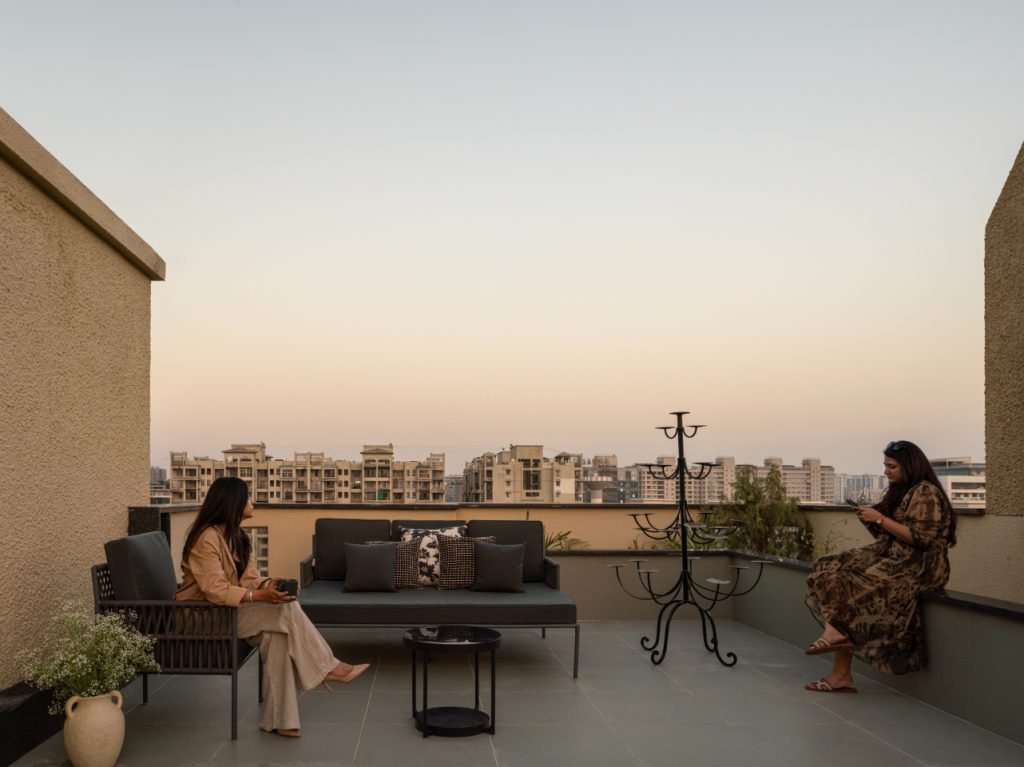
At the terrace’s far edge, away from the bar and the gazebo, the space softens into an open sit-out where a dark grey outdoor sofa with a mix of cushions faces the city beyond the parapet, a woven armchair alongside it, a wrought iron candelabra rising on a single branching stem above the seating, a small round tray table on the floor, and a clay pot of white flowers beside it, the plumeria branches crossing into the frame from the corner and the warm peach of a Pune dusk sitting behind the city’s apartment blocks without being made into a view.
This same zone features a lush planted retreat layered with greenery, a children’s play area that introduces a quieter, more domestic atmosphere against the terrace’s otherwise expansive character, and an open home office along with a discreet pantry, all completing the level. Here, the everyday and the extravagant share the same floor, each given its own place within it.

Fact File 

Project Name: The Noir Residence

Location: Koregaon Park, Pune

Project Type: Residential Interior Design

Year Built: February 2026

Built Up: 5,100 sq ft

Design Firm: Aboli Shah Atelier

Principal Architect: Aboli Shah

Design Collaboration: Shalina Barai Team

Design Credits: Vinit Barai, Sameer Sabraj, Ashfaq, Adarsh, Akhil, Ashish & Shruti Marathe

Photograph Courtesy: Manthan Yadav

Videographer Courtesy: Nayan Gayake

June 1, 2026 0 comments
0 FacebookTwitterPinterestEmail
Founders & BrandsInterviews

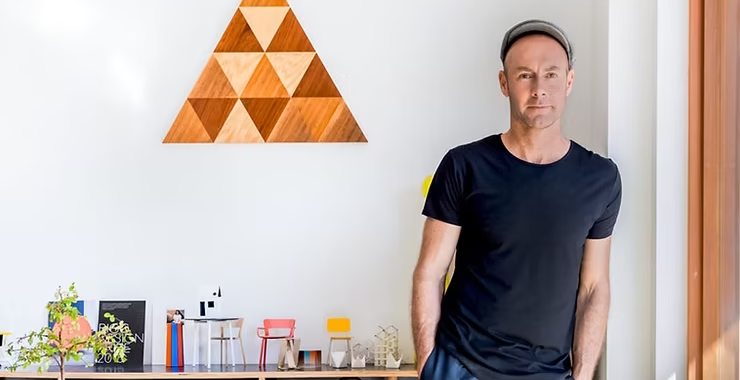
Australian Designer Adam Goodrum: The Man Who Believes Nothing Should Exist Without a Reason

by DDI Edit Team June 1, 2026
written by DDI Edit Team

In his Sydney studio, Australian designer Adam Goodrum has spent years asking a single, quietly radical question: Does this piece deserve to exist? Design Diary International’s Shweta put a series of questions to him over email, and what came back was as considered and as precisely worded as the objects themselves.

In the Sydney studio of Adam Goodrum, things get reduced. A piece begins as a concept, gets drawn, modeled, prototyped, and then cut back, over and over, until what remains is only what the object actually needs. He is interested in furniture that expresses how it is made, and that principle runs through everything the studio produces, from the Stitch Chair made by Cappellini to his work for Thonet and Artifort. Pieces that look simple until you understand them become considerably more interesting.
The relationship between structural clarity and visual softness in his work is something he has thought about deeply and describes without overcomplicating it. Structural clarity gives a piece integrity, he says. It lets you understand the object’s logic. But that logic is never meant to feel rigid or cold, because softness comes through proportion, material choice, and subtle curvature. The balance between the two is not imposed from outside but emerges through refinement, through removing what is unnecessary and adjusting what feels too heavy, through a process of reduction that continues until the piece has arrived at exactly itself. It is design as a subtractive discipline, and it is a more honest account of how enduring furniture gets made than the design industry tends to offer.

Australia has shaped his thinking in ways that are specific and worth taking seriously. Australia’s geographical distance fosters a pragmatism and resourcefulness in making, unlike the supply chains and manufacturing cultures encountered by European designers. Alongside that pragmatism sits a deep connection to landscape, light, openness, and material honesty, qualities that have shaped his preference for clarity and restraint without his ever having to consciously enforce them. Being removed from global design centers has also allowed him to develop a voice that is not overly trend-driven, and he names this directly, without false modesty, as a form of freedom. The freedom that comes from being outside the room where consensus is forming, from being able to focus on what is right rather than joining or opposing the consensus, and from simply working at a distance that makes the question of what is current feel far less pressing than the question of what is right.

“Being slightly removed from global centers has allowed me to develop a voice that isn’t overly trend-driven. There’s freedom in that distance.”

Collaboration is central to his practice in a way that is structural rather than incidental, and his account of how it actually works is more candid than the version designers usually offer in print. Rather than arriving at a manufacturer with a fixed idea, he tries first to understand what they do exceptionally well and builds from there. The best outcomes happen when there is mutual trust, when engineering and craftsmanship and design thinking push each other forward, and the final piece is better than the initial concept because it has been tested and strengthened through genuine dialogue. That last part is the important one. The willingness to let a manufacturer’s knowledge and capability improve the idea rather than treating the original concept as settled and the maker as simply the means of its execution. It is a collaborative ethic that requires a particular kind of confidence, the kind that does not need to protect the first idea from contact with reality.

The Stitch Chair, produced by Cappellini and the piece most associated with his name internationally, is where that ethic produced its most visible result. It was an exploration of making construction visible, he explains, using stitching not as decoration but as structure, reducing a chair to its essential components and expressing them honestly. It marked a moment where experimentation met commercial viability, a balance he describes as delicate and clearly meaningful. Working with Cappellini gave him direct insight into Italian design culture, an experience he speaks of with evident respect, and the longevity of the piece, its continued relevance years after it was first made, has been rewarding in the way that only work with genuine structural logic tends to be, because it does not depend on the moment it was born in to remain valid and does not need the year of its production to explain why it still exists.

“The Stitch Chair was an exploration of making construction visible, using stitching not as decoration but as structure.”

On trends, Goodrum is clear without being combative. He does not actively resist them, he says. He simply does not begin with them. The distinction matters because one is a stance and the other is just a way of working. He starts with structure, material, and purpose, and if a piece resolves well in those areas, it tends to feel grounded and lasting without longevity needing to be designed for as a separate objective. Trends, in his account of them, relate primarily to surface and styling, which is not where his interest lies. The question he returns to instead is whether something will feel relevant in ten or twenty years, a standard that most trend-driven work fails to meet.

Drawing remains fundamental to how the studio operates because it is the fastest way to test proportion and structure, and physical prototyping is equally essential in furniture specifically, where comfort and weight and tactility cannot be fully understood on screen regardless of how sophisticated the digital tools become. The studio moves between sketching, digital modeling, and physical mock-ups fluidly, each stage revealing something the others cannot, and it is a process that resists the shortcuts that digital technology makes available because Goodrum understands that shortcuts are where the errors that only become visible after installation tend to quietly hide.

Material, he is clear on this, is never applied at the end. It informs the idea from the very beginning and carries both structural and emotional qualities that shape what a piece can be before a single line has been drawn. Often a concept will emerge directly from understanding how a material behaves under tension or compression, rather than from a resolved form that is then given a material to live in. He is interested in letting materials do what they naturally want to do rather than forcing them into something artificial, and this approach is less a philosophical position than a practical one: the recognition that a material working against its own nature is a material that will eventually make that fact known, and usually at the worst possible moment.

“Material is never applied at the end. It informs the idea from the beginning.”

His understanding of design has shifted considerably since he first established his practice, and the change he identifies is temperamental rather than technical. Early on, he says, there is a desire to prove something, and over time he has grown more comfortable with restraint, more willing to let ideas develop slowly, more rigorous in what he removes. He is now more aware of longevity, both environmentally and culturally, and he applies a standard of simple justification to his own work. A piece should justify its existence. If it cannot meet that requirement, it should not be made. It is a demanding position and an unfashionable one in an industry that produces a considerable amount of furniture whose primary purpose is to be photographed, and Goodrum states it without apparent concern for how it lands.

What continues to interest him most is the intersection of utility and emotion; the challenge of creating something that performs beautifully but resonates on a quieter level as well; and the ongoing question of how construction can be simplified, how more can be achieved with fewer elements, and how the next refinement can be found in work that already appears resolved and complete. There is always another way to refine, he says, and this attitude reads less like ambition than orientation. It describes a mind that does not experience the completion of a piece as the end of a question but as the beginning of the next one—a mind permanently interested in the gap between what something is and what it could still become. This may be the most accurate description of what keeps a practice like his producing work of genuine consequence decade after decade.

Looking ahead, he is increasingly drawn to modularity and adaptability, to how furniture can evolve with people over time rather than being fixed at the moment of purchase, and to the further exploration of material innovation alongside traditional craftsmanship. These are not separate interests but versions of the same one: how an object can remain useful and meaningful not just on the day it arrives but across the years that follow, which has always been the harder and more interesting design problem. The ambition, stated plainly, is to create work that feels both contemporary and enduring, with a clarity that allows it to age well and a structure that continues to make sense long after the context it was made in has shifted and moved on. This is as precise and as honest a description of what Adam Goodrum has been doing all along as anything else in this conversation, and it reflects a kind of ambition that does not need a trend to give it direction because it already has one entirely its own.

“A piece should justify its existence.”

June 1, 2026 0 comments
1 FacebookTwitterPinterestEmail
Founders & Brands

Rajesh Bhandari of A-Class Marble, India: The Man Who Reads Stone the Way Others Read People

by DDI Edit Team June 1, 2026
written by DDI Edit Team

Five decades of sourcing the world’s finest natural stone. Quarries in Africa. Technology that thinks like a geologist. Design Diary International’s Shweta speaks with Rajesh Bhandari, Director of A-Class Marble, on what it truly takes to bring the earth’s rarest surfaces to India’s most discerning spaces.

A-Class Marble has been importing stone into India for more than fifty years, which means it has been doing this longer than most of the architects and designers who specify its material have been alive, longer than the premium residential market that now consumes it in such quantity even existed in its current form, long enough that the company’s institutional memory of the global stone trade, of which quarries produce what and under what conditions and with what consistency, is itself a kind of asset that does not appear on any balance sheet but shapes every decision the business makes. Rajesh Bhandari, its director, speaks about stone with the precision of someone who has never needed to make it sound more interesting than it is, because the material, in his telling, is already interesting enough, unpredictable enough, technically demanding enough, and beautiful enough to sustain a career of fifty years without once requiring embellishment. Design Diary International’s Shweta put a series of questions to him over email, and what came back was a conversation about process and material and the particular discipline required to operate at volume without surrendering the standards that make volume worth anything at all.

The company is based in New Delhi and today offers more than 550 varieties of marble, stone, granite, and architectural surfaces sourced from quarries and suppliers across more than forty countries, a number that places it among the most comprehensively stocked natural stone operations in the country and arguably the most significant importer of exclusive marble in India by any reasonable measure. But the scale, as Bhandari tells it, was never the objective. The early decisions that defined A-Class Marble were not decisions about how large to grow but about what kind of company to be, and they focused on building systems rather than accumulating volume, on creating clear grading protocols and disciplined sourcing and consistent processing standards and quality checks so that growth, when it came, would be supported by process rather than by intuition alone. Those choices shaped the values the company still operates by today, consistency above everything else, and a commitment to delivering stone that performs as reliably on a large hospitality project as it does in the most considered private residence.

Operating from Kishangarh, globally recognized as one of the world’s most significant marble hubs, has shaped that approach in ways worth understanding carefully. Access to material in that ecosystem is vast, Bhandari notes, but true differentiation in such an environment is earned rather than inherited, and the constant comparison and high expectations of operating at the center of a global stone conversation have pushed A-Class Marble to refine how it sources internationally, processes with precision, and inspects every slab with a rigor that the abundance of the Kishangarh market makes easy to let slip. Being surrounded by stone does not make you good at stone, and Bhandari has built a company that understands the difference between proximity to the material and genuine mastery of it.

“Growth had to be supported by process, not intuition alone.”

The most significant development in A-Class Marble’s recent history is one that shifts its identity from importer to something considerably more invested in the origin of what it sells. The company now owns and operates its own quarries in Tanzania and Zambia, a result of a long, deliberate strategy rather than mere fortune. Charting unexplored territory in Africa and finding there the raw material for three new exclusive white marble varieties that respond to evolving global design demands was an experience that combined the methodical and the genuinely unexpected in the way that the stone business, at its best, always does. Direct quarry ownership changes the nature of A-Class Marble’s relationship with its supply chain in fundamental ways, allowing the company to uphold stringent standards of ethical extraction, maintain full control over quality from the point at which the stone leaves the earth rather than the point at which it arrives in Delhi, and expand its portfolio with material that no other importer in India can offer because no other importer in India owns the ground it comes from.

That ownership also changes the nature of the company’s sustainability commitments, moving them from policy to practice in a way that Bhandari is careful to distinguish. Responsible stone processing, in practical terms, is about how decisions are made every day on the factory floor, he says, not about how they are described in a document prepared for a different audience. It involves reducing waste where possible, using energy and water more judiciously, and ensuring that each block is utilized thoughtfully rather than partially processed and abandoned. Sustainability becomes credible, in his account of it, only when it is embedded in routine operations rather than treated as a narrative sitting alongside the real business, and the standard he applies to that word is considerably more demanding than the industry average.

The technology that enables A-Class Marble to meet those standards on the processing side has changed significantly recently, and it is here that Bhandari becomes most technically specific and most clearly engaged, talking about stone cutting with the fluency of someone who has thought carefully about what precision actually costs and what it actually produces. The Innovire, a diamond-coated wire-saw machine, has significantly improved the company’s production capabilities by cutting stone with unmatched accuracy compared to conventional gangsaw systems. The machine places significantly less stress on the stone during cutting, resulting in smoother surfaces, thinner and more accurate cuts, and meaningfully reduced material loss, and its AI-enabled monitoring and data-driven cutting logic optimize each block based on the stone’s own characteristics rather than applying a standardized approach to material that is by nature anything but standardized. For a company dealing with unique premium natural stone, cutting more accurately and minimizing waste is essential, not just an operational refinement. It is a statement of values expressed through machinery.

“Sustainability becomes credible only when it is embedded in routine operations rather than treated as a separate narrative.”

Alongside the Innovire, A-Class Marble has developed StrenInn, a proprietary processing technology whose name compresses the words “strength” and “innovation” into a single term and whose purpose is to ensure that marble retains its durability, finish, and luster even after years of daily use in demanding conditions. The technology addresses directly the questions that increasingly sophisticated clients are now bringing to the material selection stage: questions about how stone will age, how it will perform under the specific pressures of Indian climates, and how it will look in ten years rather than in the first month after installation. That clients are asking these questions at all reflects a maturity in how marble is understood and specified in India today that Bhandari welcomes without reservation, because informed decisions, in his experience, lead to better outcomes for everyone involved, the client, the designer, the supplier, and the material itself.

The change in how designers engage with stone over the past decade is one he has observed closely and describes with the measured satisfaction of someone whose own position has been quietly vindicated by a broader shift in taste and intelligence. There is greater attention now to how a stone will age, how it reacts to light, and how it supports a spatial narrative rather than competes with it, and specifications have become more nuanced as a result, with designers seeking materials that integrate into architecture rather than announce themselves as its point. As luxury interiors move toward restraint, marble is finding what Bhandari calls a more architectural role, its presence increasingly subtle, contributing to atmosphere and depth rather than ornamentation, with softer finishes and calmer patterns and a quality of presence that quietly anchors a space rather than filling it with noise. This direction aligns perfectly with the material’s deepest strengths and A-Class Marble’s position in the market.

The projects the company associates itself with most closely reflect that sensibility: homes and hospitality spaces and cultural projects where material selection is driven by intent rather than excess, where longevity and spatial clarity are valued above the immediate impact of an overtly expensive surface, and where marble becomes part of the architecture rather than a layer applied to it. That preference is not merely aesthetic. It also describes the client relationship that produces the best work and most enduring associations, because the designer or developer who understands stone well enough to use it with that kind of restraint will return, bringing the next project and the one after that, and treating the supplier as a collaborator in the fullest sense rather than a vendor to be managed.

“In such contexts, marble becomes part of the architecture rather than a superficial layer.”

Looking forward, Bhandari sees the Indian luxury materials market moving toward greater discernment, a growing preference for materials that feel authentic and age with dignity, and a shift that will favor suppliers who prioritize substance and long-term value over the appeal of surfaces that look spectacular in a photograph and reveal their limitations over time. It is a forecast that positions A-Class Marble well, which may be why he delivers it without visible satisfaction, as though it is simply the direction things are moving and the company’s job is to be ready rather than to take credit for having anticipated it.

What continues to excite him personally, after everything, is the unpredictability of the material itself. The fact is that no matter how advanced the processes become and how refined the technology grows, each block of stone carries its own character and its own challenges, demands its own conversation between the cutter and the material, and resists the assumption that the previous block tells you anything definitive about the next one. “Experiencing the excitement of discovering new marble in unexplored territories of Africa fills him with genuine wonder, even after fifty years in the industry.” Which is perhaps the most instructive thing about Rajesh Bhandari and about A-Class Marble both: the discipline and the systems and the technology and the rigor are all in service of something that remains, at its core, a dialogue between control and acceptance, between what can be engineered and what must simply be encountered, between the precision of a diamond wire and the irreducible individuality of something that formed over millions of years in conditions no factory will ever replicate.

“Working with marble remains a dialogue between control and acceptance, and that balance is what keeps the industry endlessly engaging.”

June 1, 2026 0 comments
1 FacebookTwitterPinterestEmail
Founders & BrandsInterviews

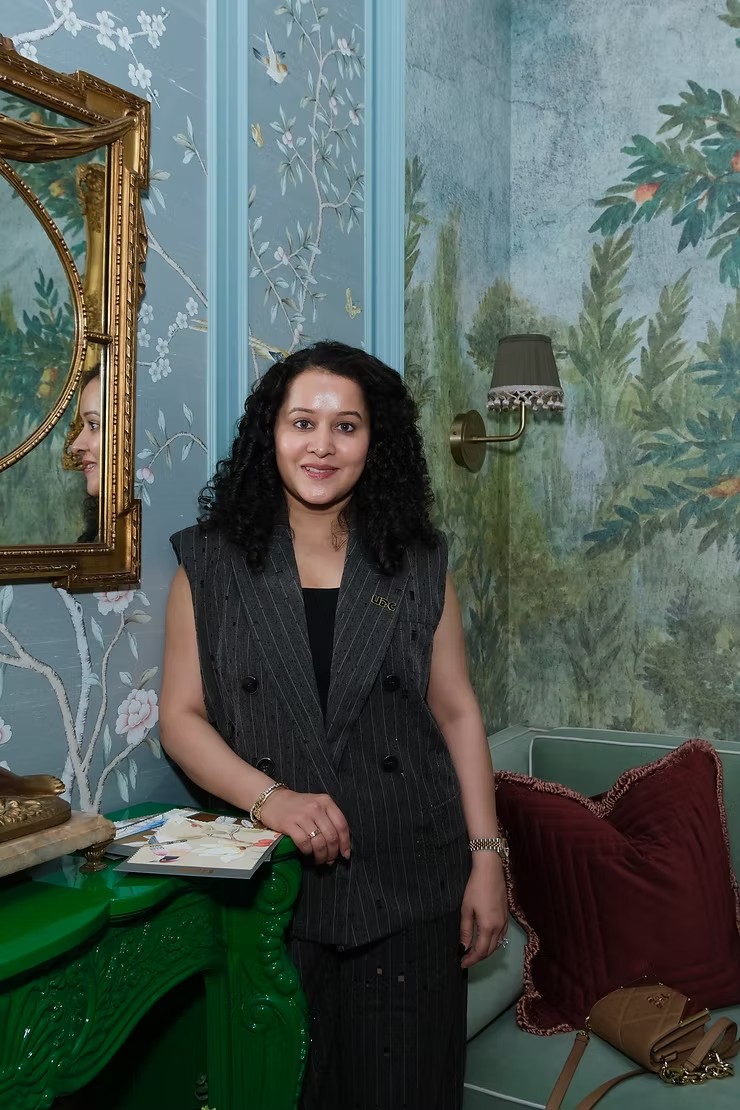
Neha Jain of UDC Homes, India: The Woman Who Turned a Paint Business Into a Wall Covering Empire

by DDI Edit Team May 31, 2026
written by DDI Edit Team

She read economics at Warwick and spent years in financial analysis before walking into the décor business and quietly rebuilding it. Neha Jain, co-founder of UDC Homes, talks to Design Diary International about turning a paint retailer into a wall covering brand and why she treats a wall the way an engineer treats a load-bearing beam.

Neha Jain did not come to design the usual way. No design school, no apprenticeship in someone else’s studio. She came from spreadsheets, with a degree in economics and finance from Warwick Business School and a habit of spotting gaps in a market before they became obvious. In 2014, she pointed that habit at her family’s paint business.

UDC Homes had been selling color to Indian homes for twenty-five years. It was one of the country’s larger paint retailers, with the kind of reputation that takes decades to build. Jain’s idea was to stop selling other people’s surfaces and start designing their own. The company moved into wall coverings.

The gap she saw was specific. “There was a clear gap in the market for customized, premium wall coverings that matched both global standards and Indian design sensibilities,” she says. India had paint. It had imported wallpaper at prices most buyers couldn’t reach. What it didn’t have was premium, made-in-India wall coverings built for Indian homes and Indian weather. Clients, she noticed, had stopped treating walls as backgrounds. They wanted them to do something.

What she describes next is the part that gives away her background. Jain talks about a wall the way a structural engineer talks about a beam, as the thing that sets the proportion and mood of a room before anything else is decided. “In many of our projects, the wall sets the tone before furniture or décor is added,” she says.

The wall comes first; everything else answers to it. In her account, wallpaper isn’t ornament. It’s architecture expressed through surface.

That belief shows up in how UDC develops a collection. A single design moves through six to eight stages before it reaches a buyer: research into trends and architecture and culture, then sketches and digital artwork, then the slow business of fixing scale, palette, and repeat, then material selection, surface testing, physical samples, prototypes, and rounds of quality checks. Only after performance testing does anything go into production. It is the testing instinct of a former analyst, transplanted into a design studio.

Performance is not a footnote for her, because in India it is a real problem. Humidity, temperature swings, the adhesion quirks of older walls, and the wear of an ordinary household—all of it gets built into material choices from the start. “Durability, texture, finish, and ease of installation are essential to luxury. They are never secondary,” she says. A wall covering that fails after three Indian summers, however good it looks in a photograph, is not a luxury product in her view.

The harder question is cultural, and it is where she is most careful. Indian motifs can be slapped onto a surface like a costume or scrubbed away entirely to chase an international blandness that belongs nowhere. Jain tries to do neither. Sometimes the reference is direct, she explains, a deliberate reworking of a heritage art form or a piece of traditional architecture. Sometimes it sits quietly in a color palette or a rhythm of pattern. “Culture does not always need to be loud to be meaningful,” she says. The aim is work that knows where it comes from without being trapped by it.

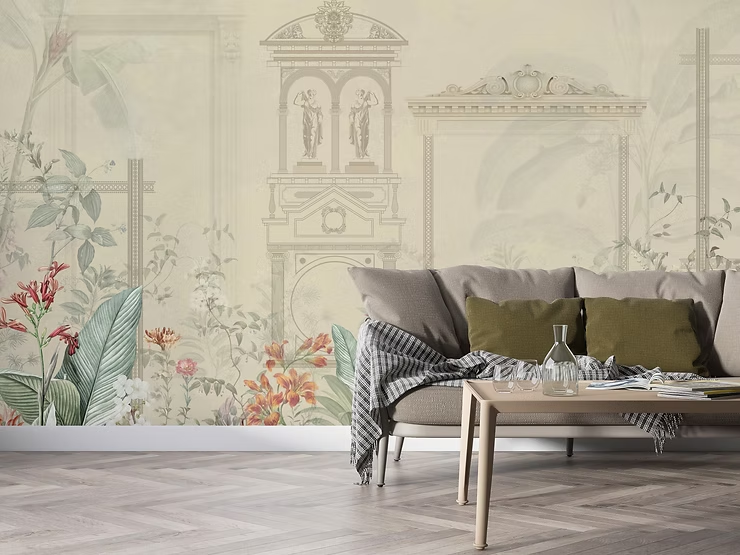
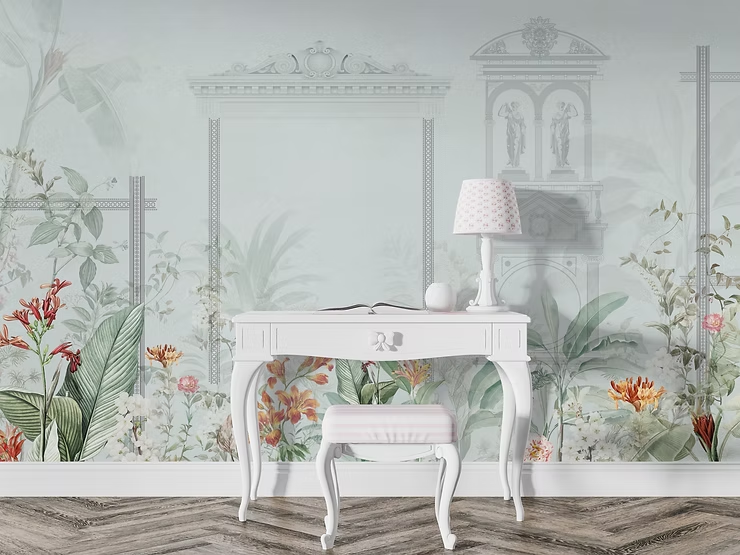
That tension sharpened in 2023, when UDC began exporting wallpaper to the United States and Dubai. Designing for several markets pulls everything toward the safely generic. Her answer has been to anchor collections in themes that travel, nature, texture, and architecture, while keeping a sensibility specific enough to be recognizably theirs. The collection she points to as the clearest expression of the brand is Roman Imperial, drawn from classical European art and structure and reworked for a contemporary room. “Instead of chasing fast trends, we aim to create designs that feel relevant for years,” she says.

There is an analyst’s logic running underneath all of it. Manufacturing limits, she has found, often produce a better design than the original unconstrained idea; a constraint in texture or scale forces a simplification the concept would never have reached on its own. So her design and production teams work as one conversation rather than two departments, makers in the room from the start, not consulted at the end when the only response left is compromise.

Ask her where the field is going, and she describes more immersion, more intelligence, more material sophistication, digital precision sitting alongside handcraft, sustainable substrates becoming standard rather than premium, and walls understood as personal expression rather than a finish picked from a sample book. Through all of it, she insists, craftsmanship stays central, the thing that keeps a surface tied to the room and the person standing in front of it.

Her advice to designers entering the field reads like a description of her own twelve years. Understand architecture before pattern. Study materials as seriously as you study design. Don’t chase trends. Build from concept and proportion. Learn from the people who make the work, because they will teach you what survives contact with reality. “Great surface design comes from observation, experimentation, and a genuine passion for detail,” she says. For someone who came here from financial markets and rebuilt a category along the way, this is less a slogan than a working method.

Interview by Design Diary International

May 31, 2026 0 comments
1 FacebookTwitterPinterestEmail
Interior Designers

Rooms That Know You: A Conversation with Lori Morris of House of LMD

by DDI Edit Team May 31, 2026
written by DDI Edit Team

While the design world spent decades apologizing for richness, Lori Morris kept building rooms that were layered, personal, and emotionally alive. Shweta of Design Diary International speaks with the founder of House of LMD about originality, obsession, and what it really means for a home to hold you.

She wrote it in an email, in response to a question about the long, minimalist years, and what was striking about it was not what she said but the temperature of it. Completely calm. No score to settle, no edge of vindication in it. Just a woman stating something so thoroughly resolved within herself that the argument had ended a long time ago and what remained was simply the work, how she has always done it, and how she will keep doing it, wherever the broader conversation decides to go next.

Lori Morris is the founder of House of LMD, a Toronto-based practice that has spent more than three decades building interiors of a particular and demanding kind. Rooms that are layered. Rooms that are specific. Rooms that are emotionally loaded in a way that makes you feel something before you have understood what you are looking at. Custom furniture designed to the exact proportion of each space. Carpets conceived for a precise atmosphere. Seating scaled to an architecture that nothing in any showroom could ever answer. When it works, and it does, you feel it the moment you cross the threshold. That is not an accident. It is the entire point.

We put a series of questions to Morris over email, and what came back was not the carefully managed language of someone protecting a brand. It was something more interesting than that. The voice of a woman who has never once looked sideways to check what the rest of the room is doing, who decided early that originality was not a strategy but a position, and who has spent every year since simply following through on that with greater confidence, greater scale, and what she describes, without any apparent vanity, as getting better with age.

Designers often face the question of whether a space should evolve or remain fixed as a moment in time; however, this question doesn’t apply to Morris’s work. Her interiors are not trying to be timeless in the neutral, inoffensive, safe-for-whoever-comes-next way that word usually implies. They are trying to be specific. This person. This life. This particular way of moving through a home. And specificity, by its nature, does not date the way fashionable things date. It simply becomes more itself over time, more settled, more exactly what it always was.

She is direct about this when the subject comes up. A room should carry a story that you feel the moment you step inside, and she uses the word “story” not in the vague, mood-board sense it has been worn down to mean in recent years but in the precise sense of a narrative with a logic and an emotional destination. Something that begins with a client and their personality and their daily life and their private dream of how a home might make them feel and ends with a room that could not belong to anyone else. So particular, so complete in its expression of one life, that placing anyone else inside it would feel like a category error.

Every design should carry surprise and personality, she writes. When you walk into a room, you should feel something. The space should say something to you, because if it does not, you simply walk right past it. The way she phrases that, the walking right past it, suggests a failure so total that it renders everything else about the room beside the point. Materials, scale, craftsmanship—all of it is meaningless if the emotional charge is absent. Which tells you something important about how Morris understands her own work. Not as decoration applied to a surface that was already resolved, but as the creation of an atmosphere that is itself the architecture. The feeling and the space are inseparable from each other, built together from the start.

A well-designed space, she adds, feels seamless and cohesive to the eye. When everything works in harmony, the beauty lands before the brain has had time to process the individual parts. That instinctive recognition is for her the signal that the design has done what it was supposed to do. Not admiration exactly, but something more immediate than that, something closer to the feeling of being held by a space that was built entirely around you.

“When you walk into a room, you should feel something. The space should say something to you, because if it does not, you simply walk right past it.”

When the conversation turns to process, to where a project actually begins, what comes back sounds less like a design methodology and more like a form of inner sight. The finished room arrives in her mind whole and complete before a sketch has been made, before a material has been chosen, before a single conversation with a contractor has taken place. She is matter of fact about this in a way that makes it sound entirely ordinary, which perhaps for her it is. If you are building a house from scratch, she explains, the process begins with the architecture. But the concept is always client-driven. She needs to understand what style they love, what they want the home to feel like, and how they live day to day, because gathering all of that is the foundation of the story she is going to tell through the design. Once that foundation is laid, the project begins with a sketch of what she already sees in her head. She usually envisions the finished room before it has even started, and everything that follows is a matter of working back from that vision. Her team builds out the full design package from a concept that already exists, complete somewhere ahead of them.

It is worth sitting with that image for a moment. A designer working backwards from a finished interior that exists first only in the mind. It goes a long way toward explaining why her spaces feel the way they do. Resolved. Inevitable. Specific in a way that has nothing to do with trends and everything to do with a singular point of view held consistently over a very long time, a point of view that never needed the external world to confirm it before it felt justified in proceeding.

“I usually see the finished product before it has even started. That vision becomes the starting point. Then our team works back from there.”

She talks about furniture the way an architect talks about load-bearing structure. Not as objects placed within a space to make it feel inhabited, but as extensions of the architecture itself. Pieces that could not exist anywhere else because they were conceived for this room and this room only. It was scaled to its exact proportion, weighted to its exact atmosphere, colored, and textured to complete a vision that was already whole before the first measurement was taken. In many of the homes we design, she writes, the rooms are quite significant in size, and you simply cannot walk into a store and find a piece of furniture that fits the scale or proportion or feeling we are trying to achieve. And so they design the pieces themselves. Seating areas, coffee tables, carpets, and a great many other elements, all custom-made and all resolved down to the last detail. This is not a luxury in the sense of an added extra. It is a necessity because the final vision exists first in her head, and that vision is not something you can buy off a showroom floor. It has to be brought into existence so that it fits seamlessly into the architecture and the atmosphere of the home, so that it could not be anywhere else and nothing else could be there instead.

There is something almost obsessive in this level of specificity, and Morris does not shy away from it. The obsession is the work. The refusal to approximate is the philosophy. A room in which even one element has been settled for rather than conceived is a room in which the vision has been compromised, and compromising the vision is not something she appears to have any particular talent for.

Luxury is a word the design world has been renegotiating for years, pulling it away from excess and toward discretion, away from ornamentation and toward material purity. Morris listens to none of it, not because she is unaware of the conversation but because she has her own definition and it is more useful than the one currently in circulation. Luxury in design can mean different things to different people, she writes. Some define it by size and scale, by square footage or intricate detail or expensive materials. But for her, luxury is really about a feeling. A home that hugs you and wraps around you, creating the sense that you are in a space that is opulent and beautiful and completely yours. And she is equally clear that none of this requires formality or stiffness, because true luxury does not have to be formal or overly fancy; that is often a misconception. It can be organic and natural, calm and Zen-like, or light and monochromatic, or it can be an explosion of magical LMD color. What matters in every case is the atmosphere, the enchantment, the refinement, the comfort, and the serenity a space creates when everything has finally come together exactly as it should.

“Luxury is the feeling of enchantment, refinement, comfort, and serenity that a space creates when everything comes together perfectly.”

She wants clients to be overwhelmed when they walk through the door of a finished home for the first time, overwhelmed in the best sense, that particular and unrepeatable sensation of a dream being returned to you more complete than you had imagined it. After all the time and energy and investment they have put in, she writes, the goal is for them to feel it was all worth it, that the result is even better than they imagined. The emotional connection that it produces is what makes her happiest. Because the feeling a room gives you is ultimately what the space expresses through its design, and that feeling was the point before any material was chosen or any furniture was designed. It was always the point. It is the only point that matters when the work is finally standing in front of you asking to be felt.

She wants the rooms to hug you forever, she writes at one point. Not just to impress on first encounter but to keep working on you, to welcome you back every time you come through the door. It is perhaps the most honest and most demanding definition of what a home should do that you will find anywhere in contemporary design culture, and it makes most of what passes for luxury residential design look like it has been aiming at the wrong target entirely.

The conversation around maximalism has been loud in recent years, the design press welcoming it back with considerable enthusiasm, treating its return as a cultural moment worth marking. Morris receives all of this with the equanimity of someone watching a party form around a place she has been standing quietly for thirty years. Because she never left. This has always been the style. And the broader culture catching up to it does not change anything about how she works. No, it does not feel different, she writes, because we never left that approach. This has always been our design style. Rather than following trends, we create our own and have always stayed true to that direction. There is something almost clarifying about the plainness of that statement. The refusal to perform excitement about a vindication she never needed. For Morris, validation was irrelevant, and its absence was not a problem. She was going to make these rooms regardless.

“Rather than following trends, we create our own, and we have always stayed true to that direction.”

She is frank about the fact that clients today are more engaged with their homes than they have ever been. More specific about how they want to live, less concerned with whether a room follows traditional rules and more focused on whether the space will actually support them and their family in the way they need. She brings to that conversation a confidence she describes as something she carries into the room, a confidence that gives clients confidence, that creates the conditions in which genuine creativity becomes possible because the fear of getting it wrong has been quietly removed before anyone has sat down. When a client comes to the House of LMD, she writes, they are usually ready for something original and open to creativity and individuality, and her role is to guide them through that process and help bring their vision to life in a way that feels authentic and truly personal. Which sounds simple until you consider what it actually requires: the ability to hear what a person wants their life to feel like and then build the physical environment that produces exactly that feeling, custom and complete and entirely specific to them, down to the last piece of furniture and the last square yard of carpet.

There is a version of a long career in which early instincts calcify into habit, the vision narrows, and the work becomes more refined but also smaller. Morris describes something that sounds like the precise opposite. A career in which the confidence to execute has been catching up steadily to the scale of what she could already see, closing the gap between the finished room in her head and the finished room in the world so that the work now is bolder and more complete than it has ever been, not because the vision has changed but because the ability to deliver on it has grown deeper and surer. My style has evolved in the sense that I have simply become better with age, she writes. The originality and creativity have always been there, the artistic approach, the no-rules attitude, and the rebellious sense of luxury; all of that has always been part of the work. What has really changed is the level of confidence in what I can achieve. Earlier in her career she could see the vision clearly but was sometimes still working out exactly how to bring it together. Today that confidence is much stronger. The ideas are more expressive, the execution more complete, and the homes larger and more ambitious.

She is better, she says, and she says it the way someone reports an observation rather than makes a claim. The way a person states something they have simply noticed to be true after a long time of paying close attention. It lands not as arrogance but as something more interesting than that. Evidence of a career that has rewarded consistency not with comfort but with greater capacity, greater range, and greater ability to deliver on a vision that was always this large and always this certain of its direction.

“The work has become bolder, more adventurous, and more refined over time. Everyone wants to see what we can create, and we are here to deliver.”

When the conversation turns to legacy, Morris returns as she does throughout this exchange to the idea of intention. The full artistry of every element brought together like pieces of a puzzle, each one placed with care and deliberateness toward the completion of a whole that is more than the sum of its decisions. She is clear that even though the work may appear very complex, it is all very intentional. Nothing arbitrary. Nothing decorative in the shallow sense. Everything was aimed at something specific, and everything arrived there. She wants to be remembered as an innovative and creative and artistic designer who set her own trends and created a distinct point of view that was always true to herself, who built a style so recognizable that you can identify it immediately, walk into a room, and know without being told whose work you are standing inside.

Given what the past three decades have actually produced, that is not an ambition. It is already a fact.

The style is something very original, she writes, something that had not been seen before, and I would like to be remembered as an original innovator in design because that is truly what I have always set out to do. Reading it back, you realize the text is not a statement about the future at all. It is a description of what has already happened, of a career built entirely on that premise and delivered on entirely. The only question that remains is what comes next, which, knowing Morris, is probably already finished and complete somewhere in her head, fully formed, waiting patiently for the rest of the world to catch up.

May 31, 2026 0 comments
1 FacebookTwitterPinterestEmail
Interior Designers

Celia Sawyer: The Woman Who Makes the Sky Feel Like Home

by DDI Edit Team May 31, 2026
written by DDI Edit Team

Celia Sawyer has designed palaces that fly and salons that sail. In a rare conversation with Shweta for Design Diary International, Britain’s most quietly formidable interior designer talks about the discipline behind the drama and what luxury really means when everything else falls away.

She was fifteen when she walked out of school in Bournemouth with almost nothing on paper and a quiet, unshakeable conviction that she would find her own way. What followed was not a straight line. There was a stint as a dental nurse. A brief, self-described unsuccessful brush with modeling. Then she took on a role that placed photographers’ talent with some of London’s most competitive advertising agencies, including Saatchi and Saatchi, because beautiful things had always pulled at her, and she had always known how to make them matter to other people. The pivot into design came the way the best things often do, sideways and without warning. She bought a London property, transformed it entirely, added a floor, and the people who came to see it left wanting her to do the same for them.

That was the beginning. What came after is a career that follows no template, because none existed.

Today, her Mayfair studio is counted among the most coveted luxury design practices anywhere in the world. Royalty from Saudi Arabia. Global celebrities. Sporting icons. Entrepreneurs whose projects span continents and whose names will never appear in any press release she issues, because discretion is as much a part of what she delivers as the design itself. In 2017, she designed the warrant officer’s mess aboard HMS Queen Elizabeth for the Royal Navy, demonstrating the same seriousness she applies to all her projects, regardless of location. She has been ranked among the top ten interior designers in the world, recognised in the Top 100 Most Influential British Entrepreneurs, listed among the Top 250 Most Powerful Women Leaders, and given the Inspiration Award for Women in 2013. She serves as ambassador for the British Heart Foundation and the Prince’s Trust, patron for Women’s Refuge, and mentor for the British Library.

Television came looking for her too. Channel 4 cast her as one of four dealers on Four Rooms, a role she kept across five series while the show won a Royal Television Society Award in 2014. The BBC followed with her own prime-time series, Your Home in Their Hands, which opened in 2014 to more than three million viewers weekly. All of this happening in parallel with a design practice that was, at that very same moment, operating at the highest levels of the global luxury market.

Her portfolio reads like a wish list. Residences in London, Barbados, Hollywood, New York, and the Emirates. Private superyachts. Helicopter interiors. And aircraft, extraordinary, one-of-a-kind privately owned aircraft, are perhaps where her work reaches its most singular expression. She built it all herself from nothing, and that fact is central to how she works and what she believes.

The world Sawyer operates in requires something beyond taste. It requires a deep, almost intuitive understanding of people who can have anything and have long since stopped being impressed by the expensive. Designing for air and sea, she says, demands a completely different intelligence than designing a home on land. Engineering, physics, and weight distribution all have to live inside the same decisions as emotion and atmosphere. The goal, always, is a space that feels utterly still even when it is moving at six hundred miles an hour.

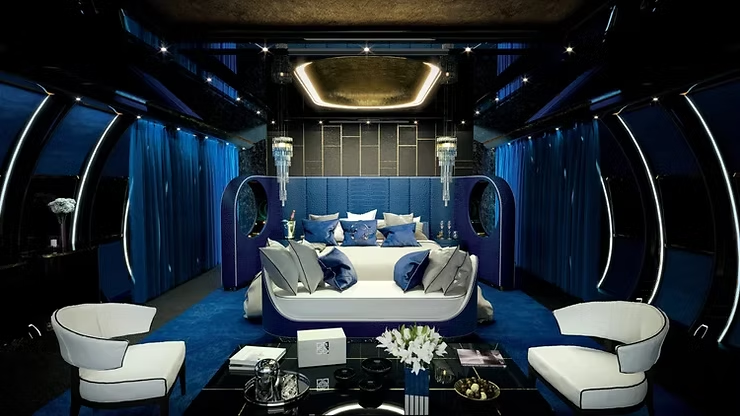
A commission from a Middle Eastern royal illustrates the scale at which she works. He asked her to transform a privately owned Airbus A340 into what he himself called a residence in the sky. The master suite was layered in deep blue, anchored by a king-sized bed with a hand-stitched crocodile leather headboard, flanked by bespoke crystal fixtures that were individually engineered to remain perfectly stable in flight. Gold and crystal moved through the whole interior like a continuous thread. The main bathroom housed a Swarovski crystal and glass washbasin. The bath beside it was carved from midnight-blue marble and fitted with a mirror-faced integrated television. In the salon and lounge, she followed the aircraft’s own curves with gold-plated ceiling sections that opened the space visually, setting them against linear seating in hand-stitched Tuscan leather, silk, and velvet arranged in the majlis tradition, warmth held inside grandeur. Two crystal chandeliers with gold accents hung above a bar that glowed from within. A palace, moving through the sky.

Designing a jet or a yacht, she says, is like writing music inside a set of rules. Excess is not available as a tool. Every curve, every material, every line has to justify being there. When it works, it looks effortless. On water the same principles shift with the medium. Her yacht interiors breathe with the rhythm of the sea, curved cabinetry echoing the horizon, champagne tones spreading across silk and polished wood, and light moving as the water moves beneath the hull. “You design not only for how something looks,” she says, “but for how it moves.”

Her starting point, on any project, whether it flies or sails or stays on solid ground, is never visual. She walks into a space thinking about how it should make someone feel. That feeling becomes the foundation for every decision that follows. Her interiors are cinematic without being theatrical, spaces where light, texture, and reflection have been arranged to produce a specific emotional experience rather than a specific visual impression. Even in the most constrained and technically regulated environments, the intention is to move the person inside them.

Every aircraft and marine commission requires close collaboration with engineers and technical specialists to meet safety and performance standards throughout. She speaks about working within the laws of nature not as a restriction but as the point where the work becomes genuinely interesting. The discipline that physics and regulation impose forces a quality of decision-making that, when it is handled well, produces results that feel inevitable.

Her clients know almost nothing about each other, and she intends to keep it that way. Royalty, global leaders, creative figures, sporting personalities, and entrepreneurs are involved in projects on every continent. She names none of them. Privacy is not a policy for her; it is a principle. Success does not need an audience, she says. It can live quietly inside the confidence of the work itself.

That quietness has come to define her understanding of luxury too, which has moved a long distance from the industry’s old obsession with rarity and price. True luxury, as she lives and practices it now, is calm. It is comfort and silence and beauty that does not announce itself. Technology tucked beneath texture. Light that feels like it arrived naturally. Materials that breathe rather than perform. One beautiful focal point, she says, lets a space breathe. Too many statement pieces just compete with each other. Luxury is no longer about rarity. It is about emotional resonance. It is about how a space understands you.

The commission that changed everything came early, a private jet that reframed the whole practice. That was when she understood she was not designing spaces. She was designing experiences, and beneath that, she was designing emotion. It is a distinction she has never let go of, and it is why her work reads as unmistakably hers across environments as different as a superyacht salon and a London townhouse. She always starts with intimacy, regardless of the scale. How will someone sit here? Where will the light fall? How will they feel? Design, she says simply, must always begin with the human being inside it.

Her sense of beauty has shifted alongside everything else. It used to be about perfection. Now it is about harmony, authenticity, and balance. Nature, she says, always shows you how. Whoever decided you cannot pair green and blue has never watched the sky meet the trees. Her clients, wherever in the world they come from, share one quality she recognizes the moment she meets them. People of real taste know authenticity the instant they encounter it. They want things made with intention and things that carry meaning. And the intention behind every commission she takes is the same one it has always been. She wants the work to last, not only in the physical sense but also in the emotional one. Luxury, she says, should endure. It should never simply fade.

Continue Reading
May 31, 2026 0 comments
1 FacebookTwitterPinterestEmail
Founders & Brands

Nanotechnology in Interior Design: The Future of Surface Protection Explained

by DDI Edit Team May 31, 2026
written by DDI Edit Team

In the finest spaces, what separates a room that truly endures from one that simply ages is often something you cannot see, cannot touch, and will almost certainly never think about. Varun Mukhi, the founder of Vetro Power, an Indian nanotechnology company, has built his entire practice around exactly that invisible idea.

Ask anyone who works seriously in luxury interiors what the most overlooked element of a premium space is, and the conversation will drift toward materials, craftsmanship, light, and proportion. The most important decision in any space is often made long after the designer has left and the photos have been taken.

Mukhi grew up in a family connected to both the textile and chemical industries, and that gave him an early, particular curiosity about how materials behave over time. Not how they look when they are new, but what happens to them as the years quietly accumulate. When he began working closely on interiors and hospitality projects, he kept running into the same frustration. The design would be considered and precise. The materials were chosen with genuine intelligence. And then, as he puts it plainly, daily life would take over. Premium projects across Mumbai and Delhi would begin showing their age within months of completion. High footfall, humidity, food spills, and harsh cleaning chemicals steadily damage floors, despite careful specification, unless protection is considered at the right moment, which is rare.

The gap between aesthetic intent and long-term performance is precisely where his work lives. Through Vetro Power’s Nano-Tech Services division, he applies nanotechnology-based protection systems to some of the most demanding surfaces in the country, from the upholstered suites of five-star hospitality groups to the fabric wall panels of cultural institutions to the stone and silk and hand-knotted carpets of private residences where the investment in material is significant and the tolerance for wear is essentially zero. The argument he makes, quietly and without drama, is that protection is not an add-on. It is part of the space’s life cycle. If you care about design, you have to care about durability. Reactive care, he says, is always more expensive and more painful than protection that was planned from the very beginning.

Before Mukhi recommends any treatment for any surface, he proceeds by understanding the material science first. How porous is the surface? How does it react to moisture? What cleaning procedures are being followed? Then he studies usage patterns closely. Is it a hotel lobby sofa used by hundreds of guests daily or a private home with light and careful use? He also reviews existing maintenance habits, because aggressive cleaning often causes more damage than the spills it was meant to address. Only after evaluating all of these factors does he recommend a system. It must work in real life, he says, not just in theory. This diagnostic rigor is what separates a genuinely useful protective treatment from the kind of product that performs beautifully in a laboratory and fails quietly in an actual room.

The technology itself operates at a level invisible to any unaided eye. Rather than forming a film on the surface of a material, which is how older protective coatings worked and why they were rightly distrusted by anyone who cared about how fabric actually feels, the treatment bonds at the nanoscale and alters the relationship between the surface and whatever comes into contact with it. In the case of fabric, nothing changes in any perceptible sense. Linen still breathes. Wool remains soft. Leather ages as it should. Silk retains its particular quality of light and drape. There is no change in texture, color, or odor. What changes is performance. Liquids form higher wetting angles and bead away rather than penetrate. Thicker substances that would otherwise stain permanently can often be lifted with neutral cleaners when the surface is properly protected. Mukhi calls it invisible performance enhancement, and there is no more precise way to put it.

The misconceptions that surround this category of work are worth addressing directly, because they have for years prevented the conversation from happening at the right stage of any project. Many people assume that coatings will make fabrics stiff, glossy, or synthetic in feel. That was true of older technologies. Modern nanotechnology systems are designed to remain entirely invisible. Another misconception, perhaps the more consequential one, is that protection eliminates the need for cleaning. It does not. This approach makes cleaning less aggressive and more efficient, which is an important consideration for the long-term care of fine interiors. The industry is also largely unregulated, meaning anyone can make bold claims about being nano or non-toxic. Clients need to look for credibility, ask for real test results, global certifications, and a genuine track record.

Natural materials occupy a special place in this conversation because they are both the most prized surfaces in any luxury context and the most vulnerable ones. Natural materials require respect, as Mukhi frames it. The treatment must not block breathability or alter texture. Linen should still breathe, wool should remain soft, and leather should age naturally and beautifully. Some materials respond extremely well and show strong repellency, while others behave with more complexity. Deep knowledge of materials and years of experience across premium surfaces build the trust that underpins his practice.

Mukhi understands the distinction between hospitality and private residential work intimately, having operated in both fields for years. Hospitality functions at scale and under constant pressure. Spaces are in use every single day, and brand perception depends entirely on consistency. There is very little margin for visible wear. In busy settings, even small improvements in surface resistance can greatly extend the lifecycle of interiors, reducing replacement frequency, operational downtime, and long-term maintenance expenses. Protection systems reduce the absorption of spills and contaminants, which allows housekeeping teams to clean surfaces more gently and efficiently, reducing fiber stress and surface wear over time. In private homes, usage is lighter, but expectations are deeply personal. The investment is often more significant, and the attachment to the original condition of the space runs far deeper. Budget sensitivity is real in hospitality because protection is invisible and its value is realized over time rather than immediately, and that trust, Mukhi says, has been built purely through performance.

The broader conversation around protective chemistry has grown considerably more sophisticated recently, partly because clients have grown more sophisticated alongside it. After the pandemic, clients started asking detailed questions about toxicity, fumes, indoor air quality, and long-term exposure—previously unusual concerns—while today, safety and compliance are of equal importance. Today, safety and compliance carry equal weight. Greater access to information has made stakeholders more aware and more demanding, and this shift is a positive development.

What most people miss when they think about surface protection is that stain resistance is the most visible benefit but far from the most significant one across a space’s longer life. Protection also helps preserve color consistency, slows fiber degradation, offers some UV resistance in certain applications, and reduces the need for harsh cleaning chemicals. Over time, that translates into less material damage, lower maintenance intensity, and better overall surface aging. A space designed to remain beautiful a decade later requires this mindset, but most are built differently, leading to unexpected aging.

Mukhi believes that architects and designers can do their jobs better by treating protection as part of the material strategy instead of adding it as a separate chemical layer at the end. During design discussions, consider how the material will actually perform over five to ten years. When protection is integrated early, it supports the design quietly without ever interfering with aesthetics. Ideally it enters the conversation at the specification stage, included in the bill of quantities like any other technical element. When protection is built in during material selection, it remains effortless and invisible. When added later, it becomes reactive and harder to integrate well. Early planning ensures the design intent is preserved without compromise.

The future he describes is one where this kind of thinking becomes standard rather than exceptional. Brands have already begun launching pre-treated fabrics and tiles with built-in performance features. As sustainability and longevity become more central to how the design world measures its own success, extending the life of materials will matter far more than the frequency of their replacement. Functional performance will increasingly become a genuine selling point within design itself. Pollution, humidity, and heavy use all affect surfaces in India in ways that designers from other climates and traditions do not always fully account for. Architects and designers create spaces people connect with emotionally. In this context, the role of material science is to create conditions that allow this connection to endure quietly and without announcement, remaining invisible for the years that follow the opening.

The room that holds its character across a decade, that looks in its fifth year the way it looked in its first, that maintains the emotional connection it was designed to create long after the people who specified it have moved on to other projects, is the room that understood these principles. Not the expense of the materials. Not the reputation of the designer. But the quality of the decision to build something lasting and the intelligence to protect it once made.

May 31, 2026 0 comments
1 FacebookTwitterPinterestEmail
Founders & Brands

Elena Salmistraro, Milan: The Italian Designer Who Puts Feeling Into Every Object She Makes

by DDI Edit Team May 31, 2026
written by DDI Edit Team

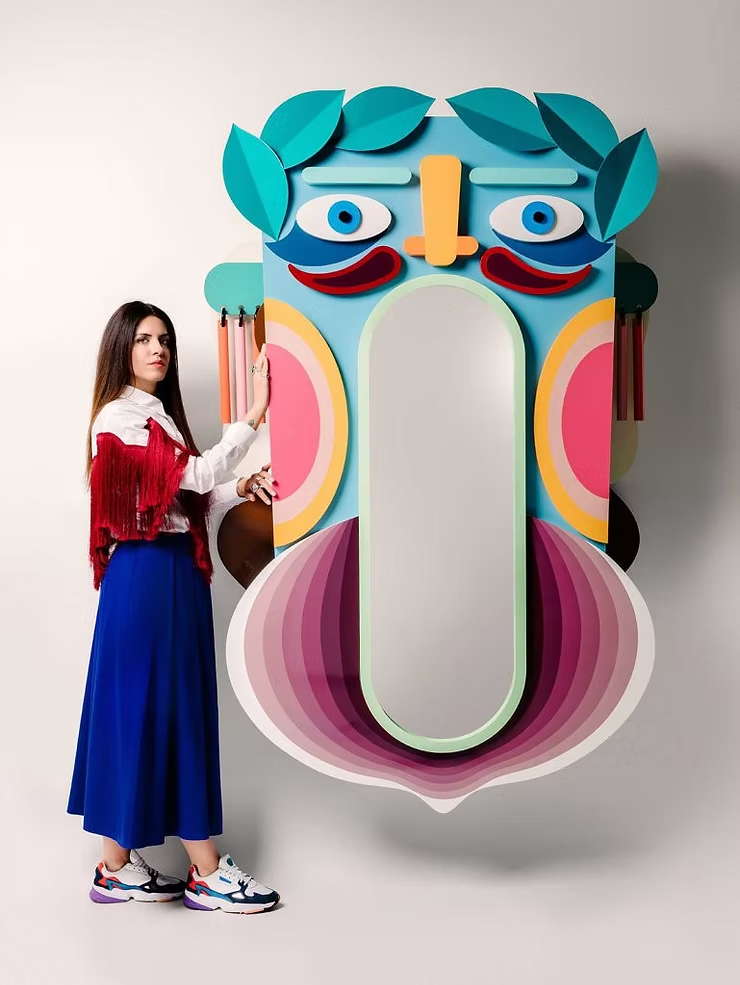
Her studio in Milan moves between product design, art, fashion, and illustration without apology. Her objects feel alive, sometimes mythological, always unmistakably hers. Alisha M. of Design Diary International speaks with Elena Salmistraro about growing up with beauty all around her, why emotion is not the opposite of rigor, and what it means to give imagination a physical form.

Her first memory of an object that moved her was Aldo Rossi’s La Cupola for Alessi. She was a child, watching it sit in the kitchen, and what she felt was not admiration for a well-made thing but something closer to wonder. It looked like a tiny castle, she says, a miniature building with a life of its own, something you could look at for a long time and keep finding. She lacked the language to describe what design was or why this object felt different, but she understood viscerally that it went beyond its function, that it was architecture, play, and sculpture, and that the maker had considered more than just how to boil water. That early recognition, present and fully felt before it could be articulated or explained, shaped everything that came after.

Ceramics arrived next, and with it something even more significant than a new material to work with. Through ceramics, she discovered that she could build worlds herself, that the ideas living only in her imagination could be given weight, surface, and tangible form, and that matter could become the home of thought. It was, as she describes it, the moment she understood that imagination could live inside things, that the gap between what she pictured and what could physically exist in a room was not a fixed distance but something she had the capacity to close.

Growing up in Italy means absorbing a visual education that is never quite formal and never quite finished. It arrives without announcement, accumulating in the light falling across a piazza at a particular hour, in the exact proportions of a doorway, and in the way a centuries-old building holds its corner with a confidence that reads as effortless and required generations of accumulated knowledge to achieve. Salmistraro absorbed all of it without realizing she was being taught, the way children absorb language before they understand grammar, and what it gave her was not simply an eye for beauty but a physical instinct for proportion, a bodily sense of when something is right and when something has gone even slightly wrong. Proportion is not only aesthetic for her, she says; it is emotional. When something is well proportioned, you feel it settle. It gives you a quality of peace that is difficult to explain but immediately recognizable, the way a melody played perfectly in tune gives you something that goes beyond the notes themselves, and when something is off the discomfort arrives just as quickly and just as physically before the mind has had time to diagnose the problem.

When she arrived at Politecnico di Milano, after years at an art institute where expressive freedom was the only rule anyone took seriously, the encounter with structure came as a genuine shock. She had come from a world of color and drawing and pure creative impulse, where the question of whether something was technically correct was always secondary to whether it was felt, and suddenly there were systems and logic and engineering requirements demanding to be met before any of the interesting questions could even be asked. It felt like a cage, she says, and that is not a softened or retrospectively affectionate description. It genuinely felt like one for a while. Through sustained engagement with the discipline rather than resistance, she slowly discovered that it revealed itself as something else entirely. Once she understood the rules properly, she could make real choices about them, could decide with genuine knowledge when to follow them and when and how to depart from them, and that informed choice turned out to be a far deeper and more useful form of freedom than the unconstrained kind she had started with. Knowing what you are doing when you break a rule is completely different from simply not knowing the rule existed.

The question of when she first understood that emotion could live inside an object takes her straight back to that kitchen and that coffee maker. What she felt when she looked at it as a child had nothing to do with its function; it was all about something the object was doing beyond its function. It made her dream. Years later, as she worked through her studies and then through the accumulated experience of real practice, she came to understand that capacity as design’s most essential power and its most demanding responsibility: the ability to make someone feel something, to make them smile, to surface a memory they had not thought about in years, or to experience a sudden and unexpected sense of connection to something larger than the object in front of them. When a piece can do that, she says, it has gone beyond its narrowest purpose. It has become something alive in a way that purely functional objects, however beautifully resolved, lack. That aliveness is what she has aimed for in everything the studio makes, across every material, scale, and kind of commission, from the very beginning.

Every project reflects her unique perspective, her passions, and her vulnerabilities. She has never subscribed to the notion of a designer who hides behind their work in the name of neutrality or professional restraint. Every mark, every choice, every decision about color or surface or proportion carries a trace of the person who made it, and for Salmistraro, drawing and color have always been first and foremost ways of communicating feeling rather than simply constructing form. That is where the empathy in her work comes from, she says, from sincerity rather than strategy, from the genuine exposure of a personal perspective rather than the careful calibration of an audience-tested aesthetic. Empathy arrives at the moment when someone looking at what you have made recognizes a part of themselves in it, and that recognition is not accidental or lucky. It is what the work has been aiming for since the very first sketch.

The characters that populate her objects, figures that feel animated and mythological and occasionally unsettling in ways that are more interesting than comfortable, arrive through two routes, and Salmistraro is equally committed to both. Some figures emerge almost on their own while she draws, taking shape before she has fully decided what they are. They seem to arrive from somewhere ahead of the conscious design process and insist on being included. Others come directly from her sustained and serious engagement with mythology, which she considers one of the most powerful and underused creative sources available to contemporary designers. She views it as an ancient language that remains completely alive, dense with symbols that speak about the human condition in all its complexity, contradiction, and shade. For her, mythology is a living conversation about human identity, fears, and desires, with her characters embodying these complexities without needing to declare them. They are not illustrations of mythological figures. They are something stranger and more personal than that, shaped by the stories but not confined to them, recognizable as ancient and simultaneously entirely of her own making.

She continually explores ceramics, metal, and glass, thoughtfully considering how discovery persists in materials she has engaged with for decades. Every material has a voice, she says, and knowing a material more deeply does not silence that voice. It teaches you to hear it with greater precision and greater nuance, to understand what it is actually telling you rather than what you have already decided it means. Ceramics in particular are living materials, ones that deform and react and change in the kiln and that resist and yield in ways that are never entirely predictable regardless of how much experience you bring to the process. It insists on a genuine dialogue rather than simply accepting the instructions it is given, and that insistence, which once felt like a frustration, has come over time to feel like the most interesting thing about working with it. Over years of practice she has come to understand that deep familiarity with a material does not exhaust its possibilities but opens them. Once you fully understand what a material can do, you begin to wonder what it has never done and how far you can push it in that direction without distorting its essential nature or asking it to be something other than what it fundamentally is.

Her collaborations with Alessi, Moooi, Bosa, and other global brands have not softened or diluted her signature, and the reason is a principle she applies to every single one of them without exception. She does not work for a company but with one, and the distinction matters at every practical level as much as it does as a statement of professional philosophy. Every brand she has worked with brings its own history and accumulated identity and specific meaning in the world, and her task when she enters that context is to bring her own vision into genuine dialogue with all of that, not to impose it wholesale but not to subordinate it either, to let the two meet and respond and push against each other until something emerges that neither side could have arrived at working alone. When the dialogue is truly sincere, the result carries both voices clearly and distinctly. The company becomes the context, and her authorship remains fully visible within it, and that, she says, is when the work becomes genuinely worth making, when it does something that could not exist without both sides of the conversation being equally present and equally committed.

Holding on to the emotional and spiritual dimension of design against the pressure of commercial constraints and the relentless reality of tight timelines is one of the biggest ongoing challenges of her practice, and she speaks about it with the honesty of someone who has not found a complete solution but has developed a workable relationship with the difficulty. The design industry runs on schedules and budgets and deliverables and the accumulated pressure of clients and production windows and launch dates, and genuine creativity needs a quality of space and silence that those conditions do not naturally generate or protect. What she has learned over years of working within those realities is to keep the emotional thread alive despite the noise, to return at each stage of a project to the essential question of why this particular piece matters and what it is actually trying to say and who it is meant to move and how. When that thread holds, even an object produced entirely within commercial constraints and to a fixed deadline and a fixed budget can carry a soul, can do what she needs it to do, and can reach the person who encounters it. The limits, she says, are not the enemy of the poetic. Sometimes they are precisely where the most poetic solutions are found, because they force a precision of response and a quality of necessity that unconstrained freedom, for all its apparent advantages, very rarely demands of itself.

Her studio’s work across brands and galleries and disciplines and scales reflects a philosophy that has remained fundamentally consistent even as the ambition and the reach of the practice have grown considerably over the years. Design and art and craft are not separate territories requiring separate entry points or separate justifications for her. They are parts of the same ongoing conversation, different ways of approaching the same essential questions about what an object can mean and what it can make a person feel and what it can do to a room and to the life that moves through that room every day. The answer she keeps arriving at, in ceramics and in metal and in glass and in illustration and in everything else the studio makes, is that the feeling was always the point, the structural starting place and the final measure of success both. Rigour and technical knowledge and material intelligence are the means by which that feeling becomes possible. They are not the destination. The destination is the moment when someone picks up something she has made or stands in front of it or simply shares a room with it and feels, without quite being able to say why, that the world has become briefly more alive and more interesting and more worth paying attention to.

That is what Aldo Rossi’s coffee maker did for a child standing in an Italian kitchen a long time ago, looking at something that looked back. It is what Elena Salmistraro has spent her entire career learning, with increasing precision and increasing confidence, to give back.

May 31, 2026 0 comments
1 FacebookTwitterPinterestEmail
Architects

Ar. Abhinav Goel of RMJM Milano, Italy: The Architect Who Learned to Listen Before He Drew a Single Line

by DDI Edit Team May 31, 2026
written by DDI Edit Team

He has designed in Turkey, worked through the realities of Ethiopia, and is currently building what will be the tallest skyscraper in Central Asia. Yet ask Ar. Abhinav Goel, Principal at RMJM’s Milano and Mantova studios, what architecture is really about, and he will tell you, without hesitation, that it is about belonging. Alisha of Design Diary International speaks with him about patience, place, and the long, slow work of building something that lasts.

He remembers the fairy chimneys of Cappadocia not as a postcard image but as a spatial idea waiting to be translated. When his studio began working on the Sanko Headquarters in Turkey, that memory became the building’s central logic, a full-height internal atrium carved into the heart of the structure, bringing light and air and a quality of geological depth into a contemporary office building sitting in a business district full of glass. The exterior is clad entirely in stone, quiet and unhurried against the reflective surfaces surrounding it, rooted in the material culture of the region in a way that its neighbors simply are not. The building could not be lifted and placed elsewhere without losing the thing that makes it worth looking at. That, for Goel, is the only measure that matters. Not the rendering, not the award submission, not the press coverage, but whether a building belongs so completely to its place that separation from it would leave both the building and the place diminished.

This is what more than a decade of working across Europe, the Middle East, and Asia has distilled in him: not a formal language or a recognizable signature but a discipline of attention—attention to what a place carries in its memory and how people actually occupy it and what the climate and the cultural context demand of a building before the architect has offered anything at all. Generic architecture, he says, is what happens when that attention slips, when the tools become the ideas and the image begins to substitute for the thinking behind it. The current moment makes this particular failure unusually easy to fall into, and he has thought carefully about how not to.

His path into architecture was not defined by a grand ambition toward authorship. What drew him was quieter than that, an instinct toward service, toward the possibility that design could improve the texture of everyday life in ways that went largely unnoticed by the people it was serving. Architecture revealed itself over time as the medium through which that instinct could take physical form. But the understanding of the profession he carried in the beginning, in which the architect resolved a brief into a building and the building was essentially a finished object with a clear identity, did not survive sustained contact with how practice actually works. Working across different cultures and geographies and scales, he came gradually to understand that a building is not an object in the way he had initially imagined it. It is a framework for relationships between people and place and climate and time, a thing that accommodates life rather than controlling it, that listens before it speaks, that earns its place in a city or a landscape rather than simply occupying it.

Patience arrived not as a conscious choice but as a direct consequence of working in a profession that slows you down whether you intend it or not. Projects run over years and sometimes over decades, shaped by collaboration and constraint and the shifting priorities of clients and planning authorities and economic cycles that have no interest in aligning themselves with anyone’s individual sense of urgency. But Goel is careful to keep patience separate from passivity, because the commercial realities of practice are equally real and carry equal weight in any honest account of how architecture gets made. Time costs money, and clients understand this even when architects occasionally forget it, and the genuine challenge is developing the judgement to know which decisions need sitting with and which demand momentum, a kind of professional intelligence that only becomes reliable within a relationship of genuine trust between architect and client, where both sides are moving together rather than pulling in different directions.

He has learned this the hard way more than once. In his experience, stalled projects, shifting briefs, and unclear client visions are common, not exceptions. They are simply part of it, as ordinary and as recurring as any other condition of the work. What they have taught him is that the architect’s role in those moments extends well beyond the design act itself, that architects often become educators in the most practical sense, holding the clarity of a project steady while the client’s understanding of it is still finding its footing, explaining consequence and process and long-term impact with enough patience and conviction to keep the conversation moving forward productively. A stalled or challenged project approached with this understanding is not a failure but a correction, the kind of pressure that forces a reckoning with what actually matters and produces outcomes more grounded and more honest than an uninterrupted process would have reached.

The trip to Ethiopia for an international competition is the example he returns to when the subject of unlearning comes up, because it was the experience that most directly dismantled a confidence he had not realized he was carrying. He arrived with a design approach and an architectural language he believed in, and both were challenged almost immediately by the reality on the ground. Financial feasibility shaped nearly every decision in that context, and no amount of design conviction could change what cost and availability and construction logistics made possible. Being physically present revealed priorities and constraints and cultural realities that no amount of remote research could have communicated in the same way, and the experience taught him something he has carried ever since, that presence forces architecture to move from confidence to clarity, that unlearning is not a loss of knowledge but a refinement of it, that the building that responds honestly to lived conditions is always more responsible and more meaningful than the one that insists on its ideal version of itself.

His position as Principal within RMJM’s Milano studio places him inside a practice that carries both a strong global legacy and a specific institutional philosophy, and the way he navigates that combination tells you something important about how he understands his own authorship. Legacy, for Goel, offers direction rather than constraint. RMJM’s global outlook and its accumulated technical depth across cultures and scales give individual projects access to a collective intelligence that a smaller practice simply cannot offer in the same way, and the studio’s core conviction that thinking globally and designing locally are not competing positions but the same act performed at different registers aligns closely with how he understands his own practice. His voice within that framework develops through approach rather than through formal signature, through how he reads a place and engages with a team and holds decisions accountable from first concept through to final execution, and individuality sustained through consistency of judgment over time turns out to be more durable than individuality asserted through style.

Within that collaborative structure, leadership operates at a level that is often invisible in exactly the ways that design authorship is visible, and he believes this is correct. Architecture is a collective act, and every project results from many people’s contributions, which usually go uncredited in published works; acknowledging this is accuracy, not modesty. His own role begins with shaping the core concept and continues through the long process of refinement and exchange with engineers and consultants and clients, knowing when to push an idea forward and when to stand back and let it develop through someone else’s intelligence, a form of authorship that is less about controlling outcomes than about maintaining clarity of intent while giving the work room to become more than any single person could have made it.

Some ideas within that process need protecting because they form the structural logic of the project, the spatial and narrative decisions rooted in place without which the building loses its coherence and its reason for being. Others are meant to evolve, and the selection of the collaborators through whom that evolution happens is itself a design decision as consequential as any material or spatial choice. When collaboration is genuinely intentional and built on a shared understanding of what the project is trying to achieve, ideas are strengthened rather than diluted, and the building that results is better than any one person’s initial concept could have produced independently.

Technology sits within this same frame of means and ends. He uses digital tools without reservation and has thought carefully about what they can and cannot do. They manage complexity, speed, and visualization with a power that no previous generation of architects had access to, and that is genuinely useful. The danger arrives when the tools begin to lead rather than assist, when visually compelling renders begin to substitute for actual thinking about how a building will feel to the person standing inside it, when what something looks like in a digital image begins to matter more than what it will be made of and how it will meet the climate and the ground. Architecture ultimately exists beyond the screen, and every digital decision must eventually translate into light and material and human experience, and when technology is treated as a means rather than as an authority, it allows precision and efficiency to coexist with intuition and craft in ways that strengthen the work. When it is treated as anything else, the work begins to drift toward surfaces that look impressive and mean very little.

Sustainability, in his understanding of it, occupies the same territory between the measurable and the felt. While he takes certifications and standards seriously, a building deemed sustainable solely for meeting a checklist overlooks its fundamental purpose. What he is reaching toward is a quality he describes as emotional sustainability, the kind that arrives not in technical audits but in how a building actually feels to inhabit over years and decades, in the comfort that comes from shade available when the day is hot and air moving naturally through a room and a garden integrated into a daily routine and a plaza that draws people together without being engineered to do so. These are forms of sustainability experienced rather than measured, and they are what allow architecture to persist in the memory of the people who use it, which is ultimately the only kind of persistence worth designing for. Alongside these lived qualities, the structural principles remain non-negotiable: orientation, passive comfort, material longevity, and integration with the landscape—decisions he does not compromise on because they are inseparable from the emotional ones. Many vernacular traditions carried this wisdom long before it was formalized as a professional category, and the task today is to bring it into the present without losing either its technical rigor or its deeper human logic.

His Indian background and his European practice have given him a particular kind of double vision that he has come to understand less as a tension to be managed than as a resource to be used. Coming from an Indian context makes him more attuned to density and informality and the layered use of space, to how public and private lives overlap in ways that European spatial traditions tend to keep separate, to how architecture can accommodate the full messiness of life rather than imposing a tidied version of it from above. Working within a European studio has reinforced clarity and structural precision and the discipline of process and rigour. These two perspectives have not cancelled each other out but sharpened each other, producing an awareness of how differently the same space reads depending on who is standing in it and what their life has taught them to expect from the world around them. Within a team this awareness becomes practically useful, because assumptions that feel entirely self-evident in one cultural context can carry completely different meanings in another, and part of his role is to bring those differences into the design conversation early, before they become problems, rather than treating them as complications to be resolved after the important decisions have already been made.

Walking matters to him in the way it matters to people who use it as a form of thinking rather than simply a form of movement, because it reveals at the most immediate human scale how differently cities have been designed for the body and for the life that moves through it every day. European cities that allow walking as a natural and pleasurable part of daily life, with streets scaled and connected and safe enough to be experienced slowly and without anxiety, tell a very different story about civic priorities than the large parts of Asian cities where continuous walking infrastructure still does not exist and pedestrian movement is fragmented and often actively hostile, where the city has been designed for the car and the pedestrian is an afterthought. This contrast, encountered repeatedly across the geographies he has worked in, has deepened his sense of how profoundly the design of the public realm shapes behaviour and dignity, and it feeds into how he thinks about every project at every scale, from a building’s relationship to the street it sits on to the broader question of what the city owes the people moving through it.

The work that draws him most now is defined not by typology or geography or scale but by a quality of intent, and the typologies that compel him most directly are the ones that engage with human experience at its most unguarded and most vulnerable. Education matters to him in particular because a school is an extension of parental care, and the way a child feels stepping into it on the first morning of term carries a significance that goes well beyond any spatial brief or any technical performance metric. Healthcare matters for similar reasons, because the people moving through those buildings are often in the hardest and most frightening moments of their lives, and what architecture can offer them in those moments is not spectacle but dignity and calm and a quality of reassurance that must be designed for rather than left to chance. And the same intelligence that produces that kind of architecture, he insists, can and should be brought to work at any scale and any typology. Stadium projects currently in development for an undisclosed client are being conceived not as single-use venues that sit empty for most of the year but as urban generators, with markets and health facilities and other everyday programmes woven in so that the buildings remain genuinely active and useful to the surrounding city well beyond the handful of days each month when a game is being played. Architecture understood not as an object of power but as a framework for care and continuity and shared civic life, which is the understanding he keeps returning to regardless of the scale or ambition of the project in front of him.

The skyscraper in Dushanbe, which is intended to become the tallest building in Central Asia, is the project that most clearly illustrates what he means when he talks about patience as a condition rather than a virtue. The ambition is significant and the timeline is correspondingly long and demanding, and he has made his peace with this completely, not reluctantly but with a genuine understanding that the length of the journey is not separable from the quality of what is being built at the end of it. Progress inside a project of this scale feels incremental from day to day, but it accumulates over time, and the moment when an idea that has been held and refined and tested across years finally translates into a space that people actually inhabit is the kind of reward that only the sustained commitment produces. Architecture rewards the committed, he says, and he means it not as a motivational sentiment but as a straightforward description of how the work operates.

To young architects looking at international practice from the outside and imagining something defined by speed and glamour and decisive authority, he offers a correction rooted in direct and sometimes difficult experience. International practice is built on patience and on a willingness to carry responsibility in contexts far removed from one’s own, where every decision carries cultural and social consequences that cannot be fully anticipated in advance and must be navigated with humility and care. Greater reach brings greater expectation and the work demands a restraint and a consistency and an acceptance that progress is rarely linear and recognition is rarely prompt. Much of the effort remains invisible, and it is precisely that invisible labour, the sustained discipline and quiet consistency and commitment to getting something right even when no audience is present to notice, that gives architecture its credibility over time and its capacity to endure. The practitioners who last in this profession, he says, are not driven by the desire to be seen. They are driven by the work itself and by a patient engagement with what a building can do for the people who will spend their lives inside it, and by an understanding that architecture which truly matters is not the kind that announces itself. It is built carefully and sustained quietly and understood slowly, over the years that follow its completion, by the people it was always for.

May 31, 2026 0 comments
1 FacebookTwitterPinterestEmail
Newer Posts
Older Posts

Recent Posts

  • Florim Introduces SensiVenezia, a Porcelain Stoneware Collection Inspired by Venetian Terrazzo
  • LEGO Botanical Wave Transforms TANK Shanghai with 380,000 Brick-Built Flowers
  • The Great Eastern Home Introduces Its Latest Collection of Italian Vintage Mirrors
  • Smart Homes Are Changing Architecture: What Happens When Technology Becomes Part of the Building?
  • AARQE9’s Nikhaar Dhawan & Bahaar Dhawan Rohatgi Unveil the Sculptural Lunar Drip Table

Recent Comments

  1. Smart Home Architecture: How Technology Is Changing Design on Aqara Smart Lock U500: Three Versions for Gates, Glass Doors and Standard Entrances

Newsletter

  • Home
  • About Us
  • Contact Us
  • Editorial Policy
  • Privacy Policy

© 2026 Design Diary International. All Rights Reserved.

Design Diary International
  • Home
  • Project
    • Residential
    • Hospitality
    • Commercial
    • Public & Cultural
  • Interview
    • Architect
    • Interior Designer
    • Founders & Brand
    • Artist
  • Material
  • Product
  • Feature
  • DDI Finds
    • Emerging Studio
    • Rising Designers
    • New Practices
  • About
  • Magazine
  • Contact Us