
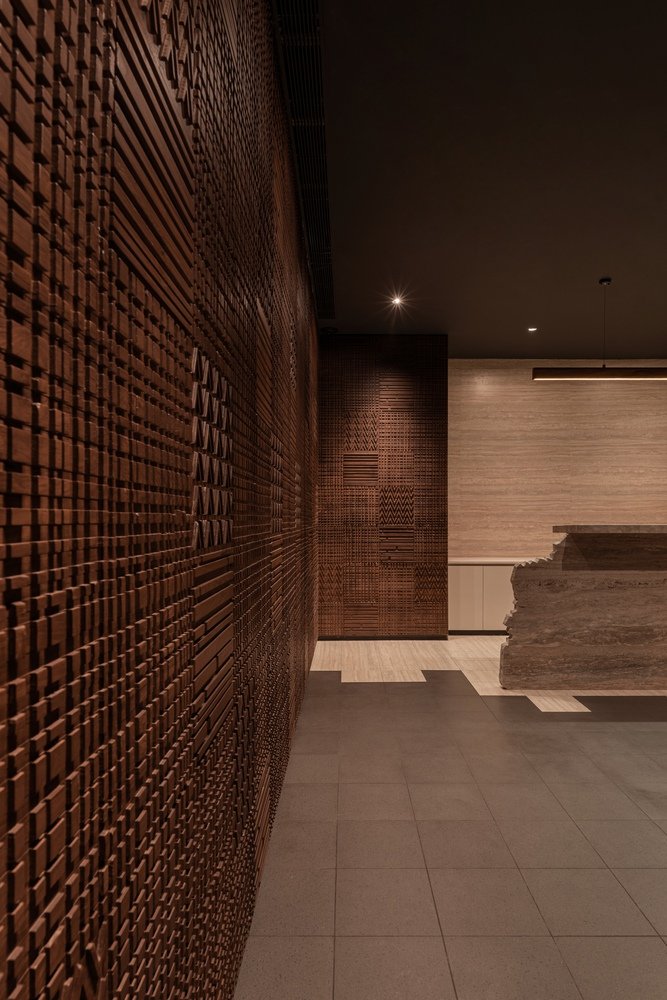
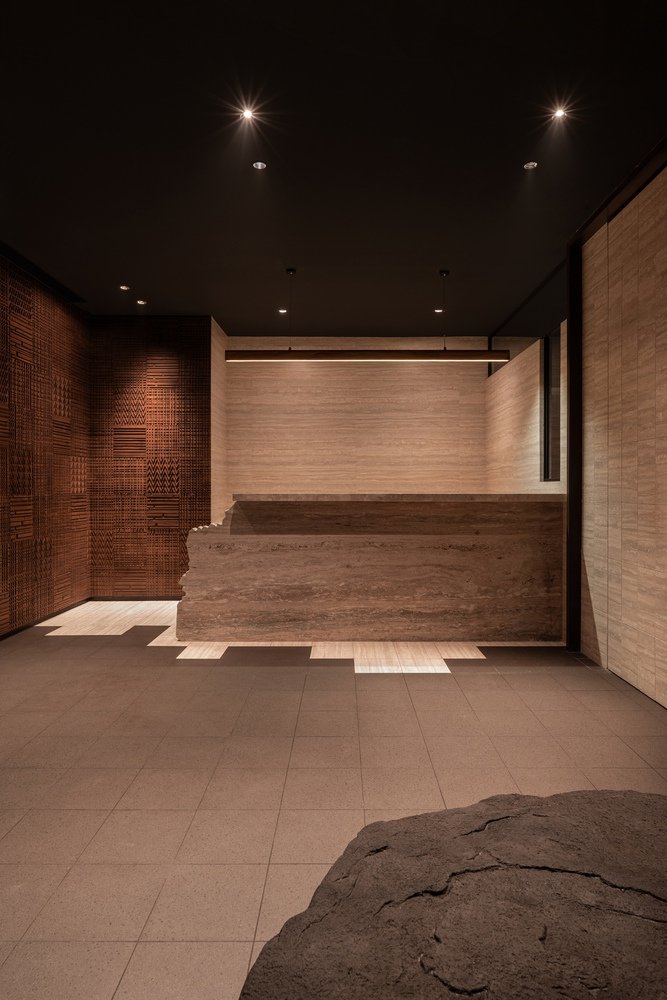
The wall to the left of the reception desk in this 6,512-square-foot office interior for a developer company in Kolkata is the one that takes the longest to read: floor-to-ceiling blocks of warm brown wood stacked and interlocked in varying orientations, their arrangement forming a shifting field of geometric patterns across the full surface, horizontal rows giving way to chevrons, chevrons to diagonal grids, diagonal grids back to horizontal, the whole thing reading as part wall, part textile, part something for which there is not an immediate category, and it is this surface more than any other that tells you what Abin Chaudhuri was working through when he designed The Spatial Continuum, which is that restraint and craft are not opposites, that a minimal interior can carry something handmade and intricate without the two things cancelling each other out.
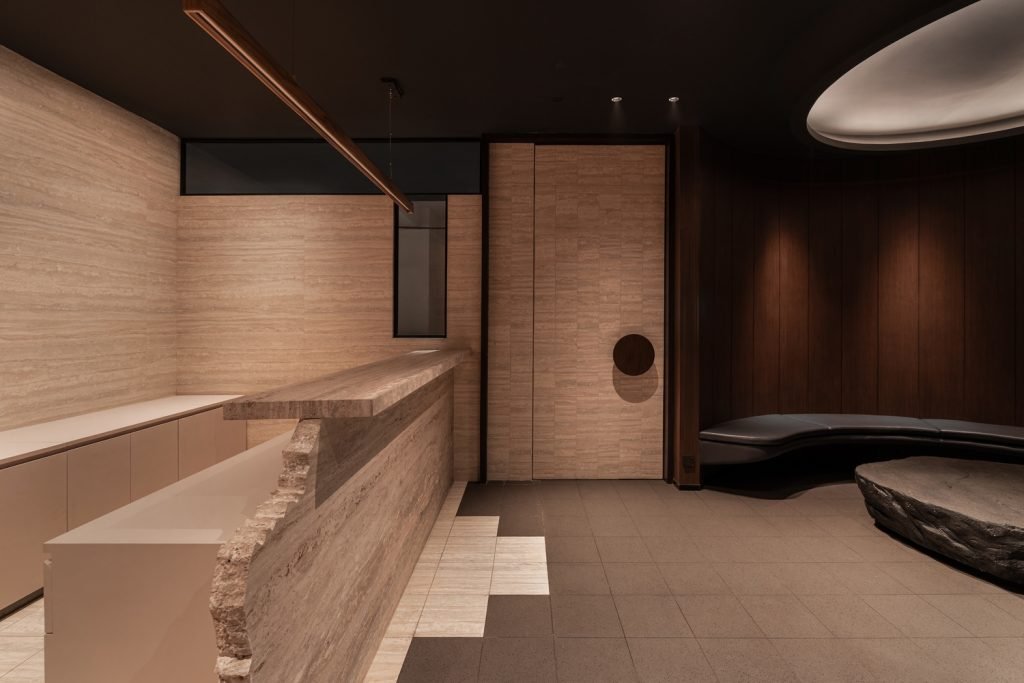
The reception counter directly across from it makes the same point in a different material. The travertine has a smooth, polished top surface that is horizontal like a desk surface, while the face on the visitor’s side is left deliberately rough, preserving and exposing the stone’s natural fractured edge. This way, the same block of material appears both finished and unfinished at the same time, with the quarried origin of the stone fully visible on the most front-facing surface of the office.
A linear pendant in warm bronze hangs above it, a travertine-clad door stands behind it with a single circular dark disc as its only hardware, and at the base of the desk the floor transitions from the dark grey tile of the main lobby into an inlaid travertine geometric pattern that marks the desk’s footprint on the floor. A large raw basalt boulder sits directly on the lobby floor to one side, its irregular dark form sitting in the reception as though it arrived before the architecture did.
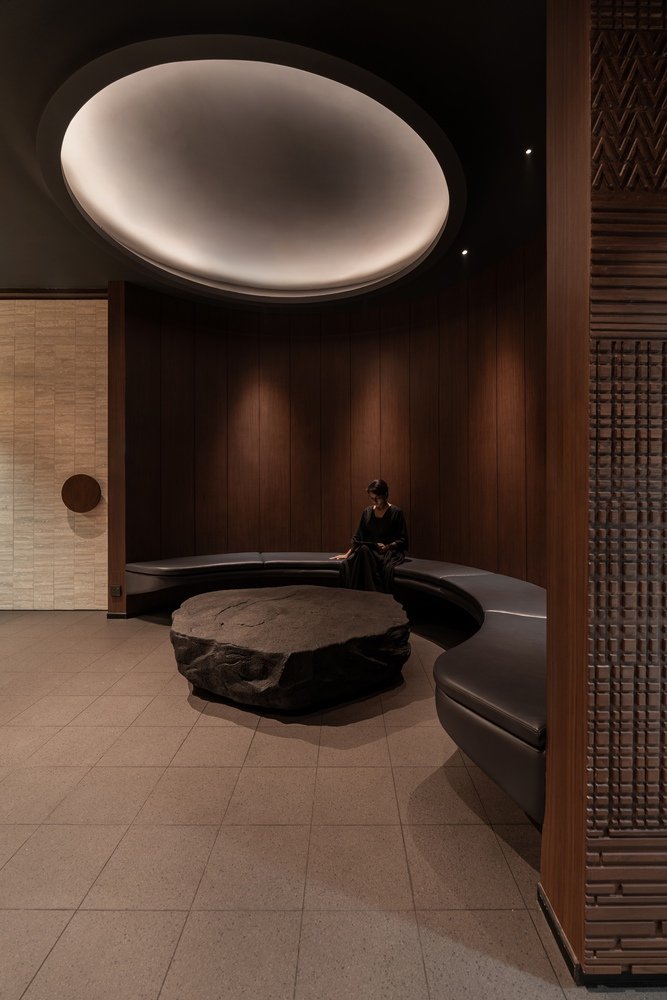
The seating alcove within the reception moves into a darker and more enclosed register. Dark timber wall paneling in vertical planks curves around a continuous black leather banquette, the bend of the bench following the bend of the wall, and at the center of this arc the same rough basalt stone appears again, this time as a low table, its flat top and natural broken perimeter making it the room’s least processed surface and, for that reason, the most arresting. Above it, a large elliptical recessed ceiling light glows in warm white against the dark ceiling, its oval form hovering over the seating with the quality of a moon rather than a fitting, the only source of light in a space that is otherwise entirely in shadow.
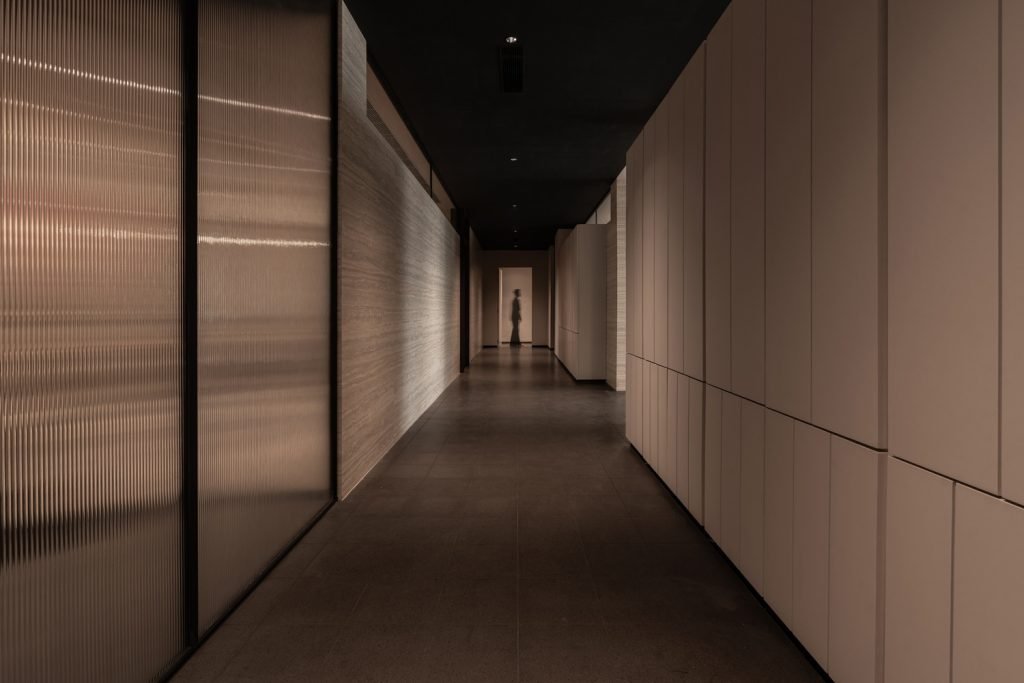
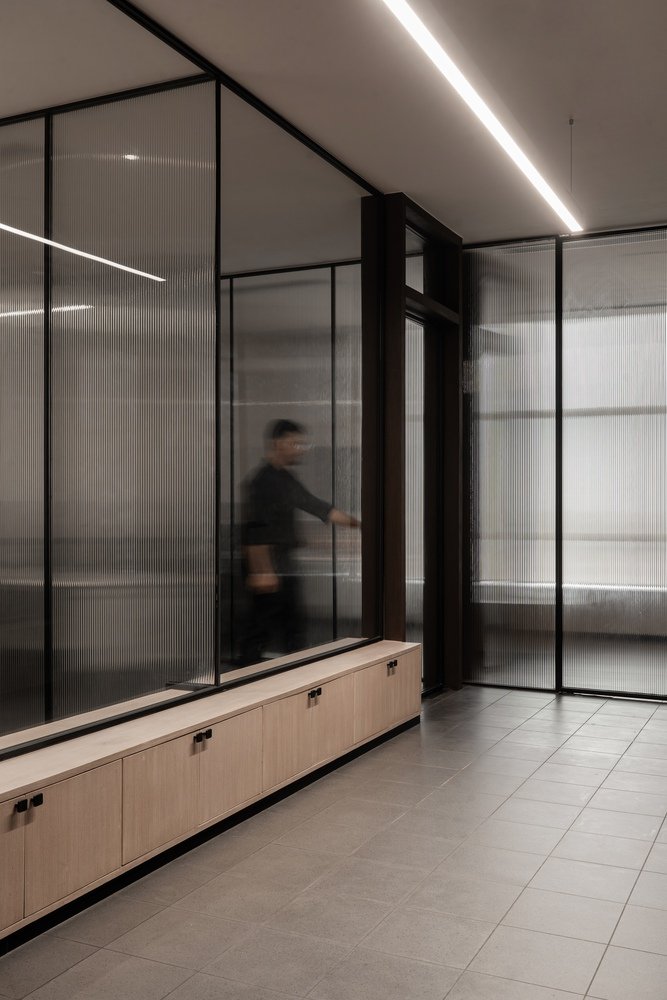
The corridor running the length of the office is where the project’s spatial logic becomes visible. One side carries the private zone: ribbed, fluted glass partitions in dark steel frames reveal stone-clad interiors behind them, the glass diffusing the light from within so that the offices read as warm amber volumes through the corridor rather than as transparent rooms, and alongside the glass, a low credenza in light oak sits at the base. The other side is flush panel walls in warm, sand-toned joinery running without interruption, their surfaces divided only by hairline shadow gaps, everything behind them invisible.
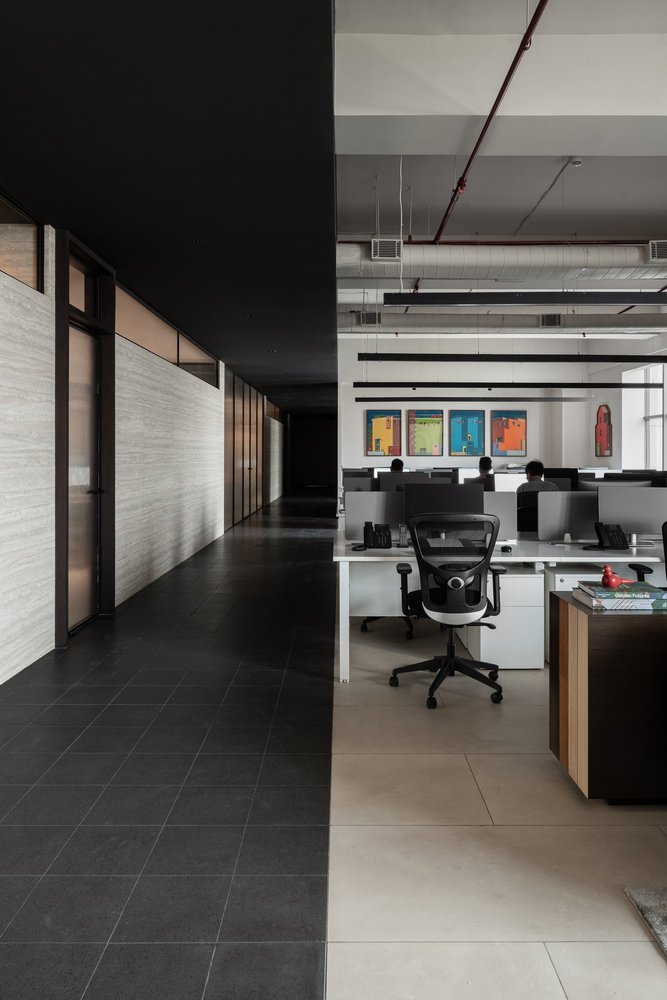
The ceiling throughout is black, the floor is in dark grey tile, and moving through this corridor, with warm glowing glass to one side and quiet flat panels to the other, is an experience that has been designed rather than left over.
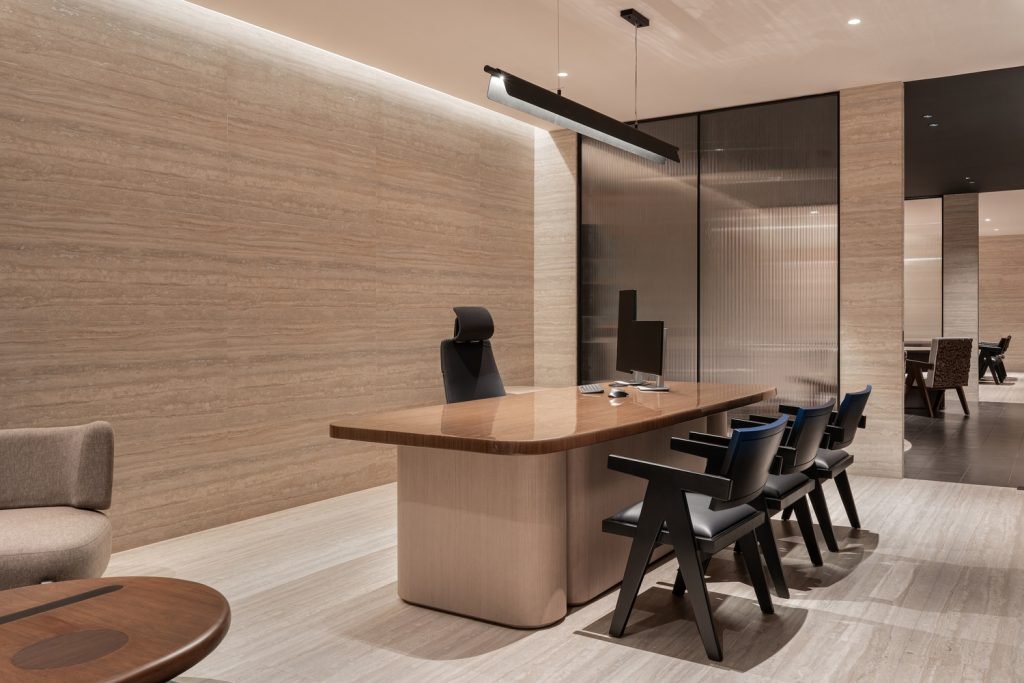
The private offices feature travertine wall cladding from the reception, glowing warmly with linear veining and backlighting at the cornice. In the principal cabin, the desk is in warm timber with softly rounded corners and a solid curved pedestal base, its form organic enough that it reads as furniture rather than office equipment, three chairs in black with Pierre Jeanneret-derived X-frame legs placed across from it, and a linear pendant above.
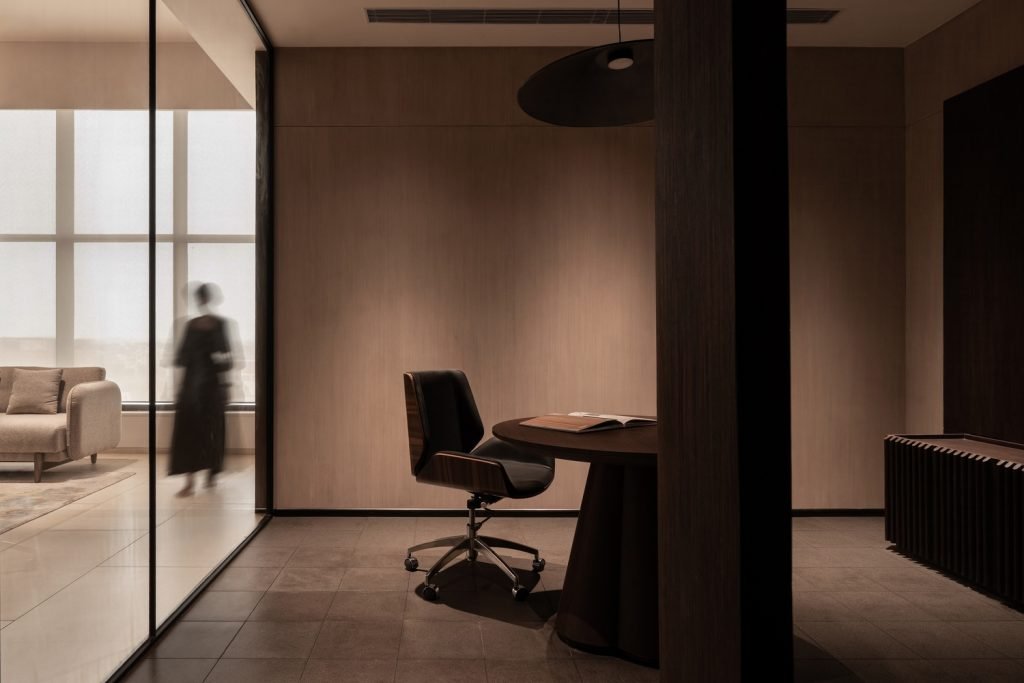
Through the fluted glass partition beyond, another room is visible, its forms softened and blurred by the ribbed glass, the layers of transparency and material multiplying across the depth of the plan. Elsewhere in the private zone, a smaller cabin carries a round dark timber table on a pedestal base and a single leather office chair, a large disc-shaped dark pendant above, the room quiet and focused, and through its glass wall the lounge beyond is visible with a blurred figure moving through it.
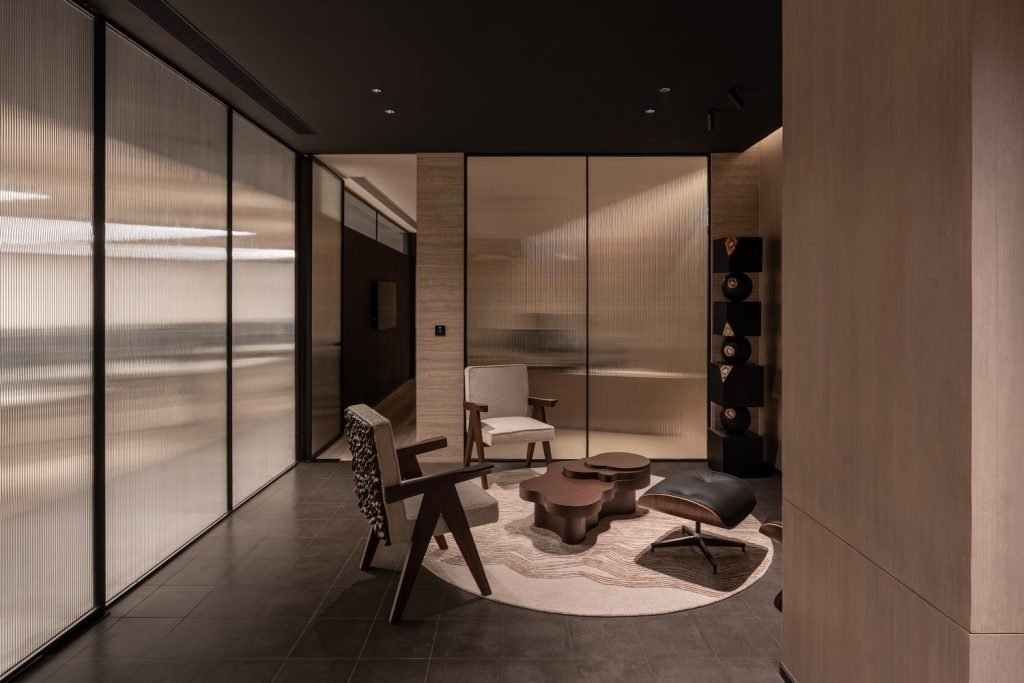
The breakout lounge sits at the junction of the private and open zones, with a round off-white rug with an organic topographic pattern on the dark floor, a set of clover-shaped low tables in dark timber clustered at the center, a classic Eames lounge chair in black leather with its ottoman, a dark timber sculptural chair alongside, and against the wall a tall stack of dark ceramic vessel forms each diminishing in scale toward the top, reading as sculpture rather than as shelving. Through the fluted glass partitions enclosing this pocket, the stone-clad office behind glows warm, and the whole corner operates as the kind of cocooned pause the open floor cannot offer.
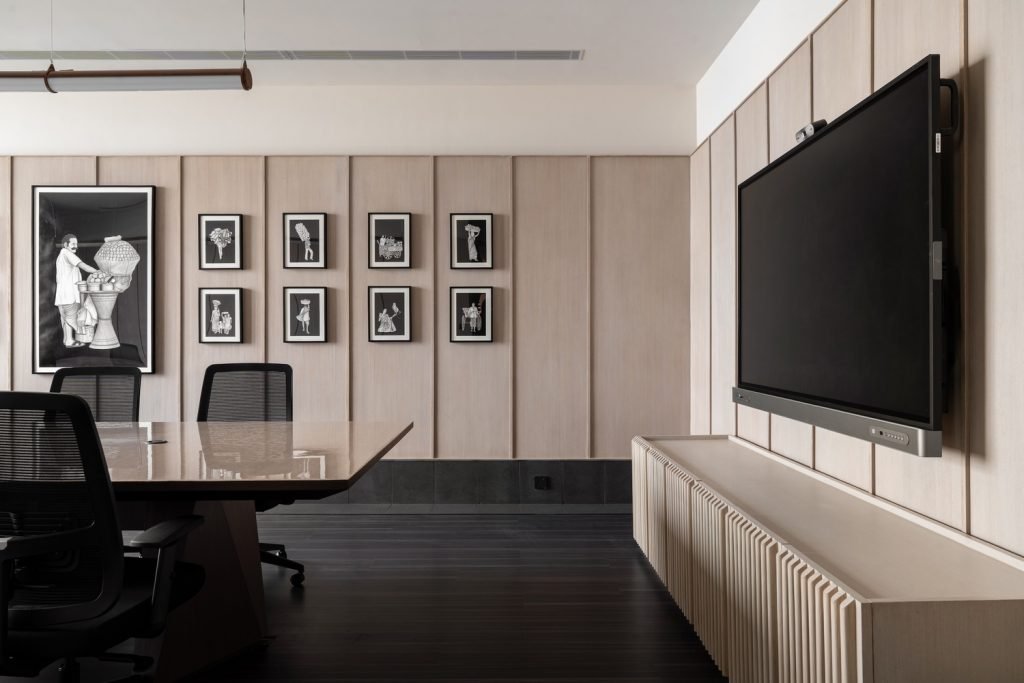
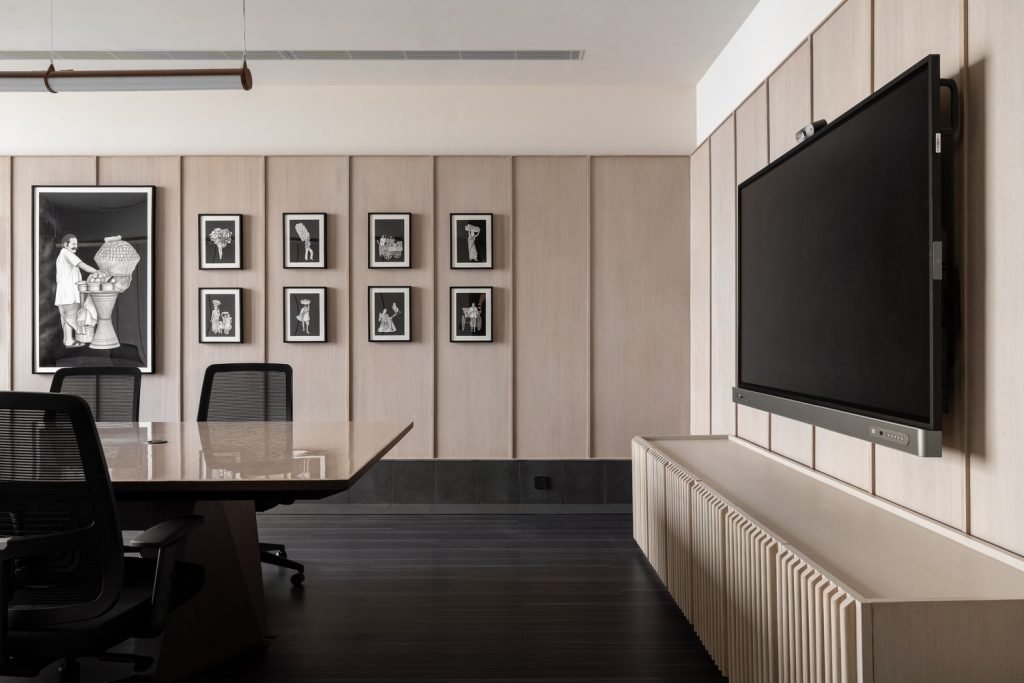
The conference room sits behind the workstation floor and works in a different palette: light oak paneling in tall vertical planks, a high-gloss dark timber conference table, black mesh ergonomic chairs, and on the long wall a collection of black and white photographs in varied frame sizes, a large portrait of a man beside a ceramic vessel anchoring the arrangement, the rest of the grid smaller and more intimate, the art giving the room a character that the rest of the office earns through material and craft.
A ribbed light timber unit below the mounted screen extends the pale wood tone to the presentation wall, creating a noticeably warmer and more domestic atmosphere than the corridor.
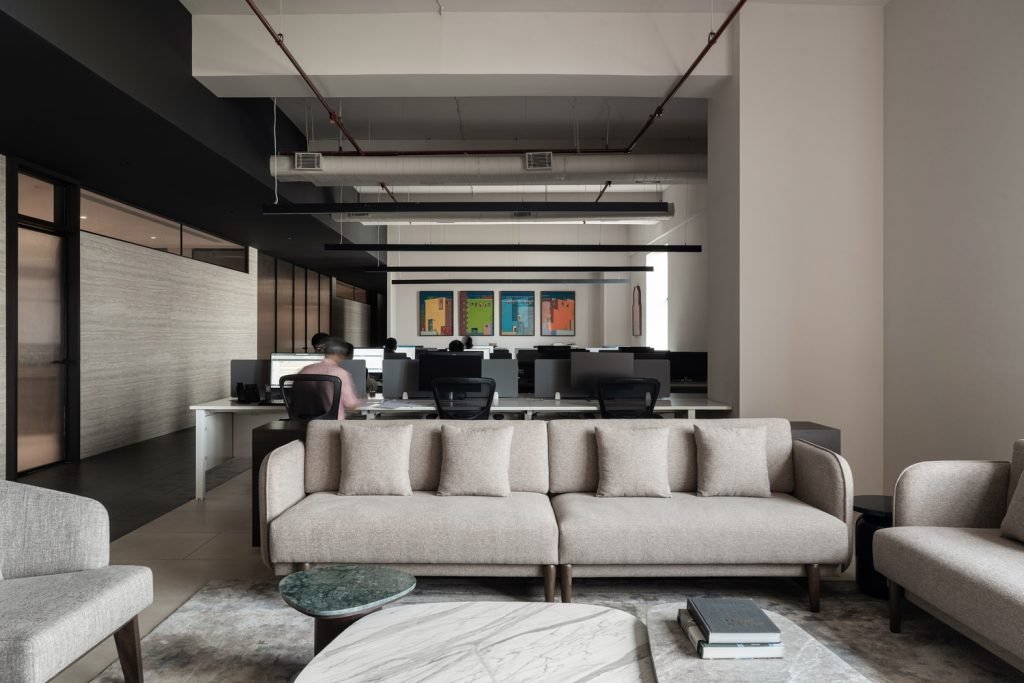
The open workstation floor occupies the brightest and most expansive part of the plan, its ceiling exposed and painted black with services and linear pendant lighting running in parallel rows, white workstations in clean rows below, and the floor open and legible from the lounge that marks its edge. Three large canvases in vivid orange, green, and blue with architectural motifs hang on the back wall, their color the sharpest contrast in the project to the warm neutrals of the private zones, a beige linen sofa, a green marble side table, and a white stone coffee table sitting at the threshold between the two worlds, the open floor behind and the enclosed spine ahead.
Fact File
Project Name: The Spatial Continuum
Location: Kolkata
Project Type: Office Interior Design
Year Built: 2025
Built-up Area: 6,512.17 sq ft
Design Firm: Abin Design Studio
Principal Architect: Abin Chaudhuri
Team Design Credits: Abin Chaudhuri, Pratishi Parekh, Priyanjana Das, Somendra Muhale, Jibendra Basak, Partha Ghoshal, Amit Kumar Sonar
Photograph Courtesy: Manan Surti Photography
Website: abindesignstudio.com
Instagram: @abindesign_studio
