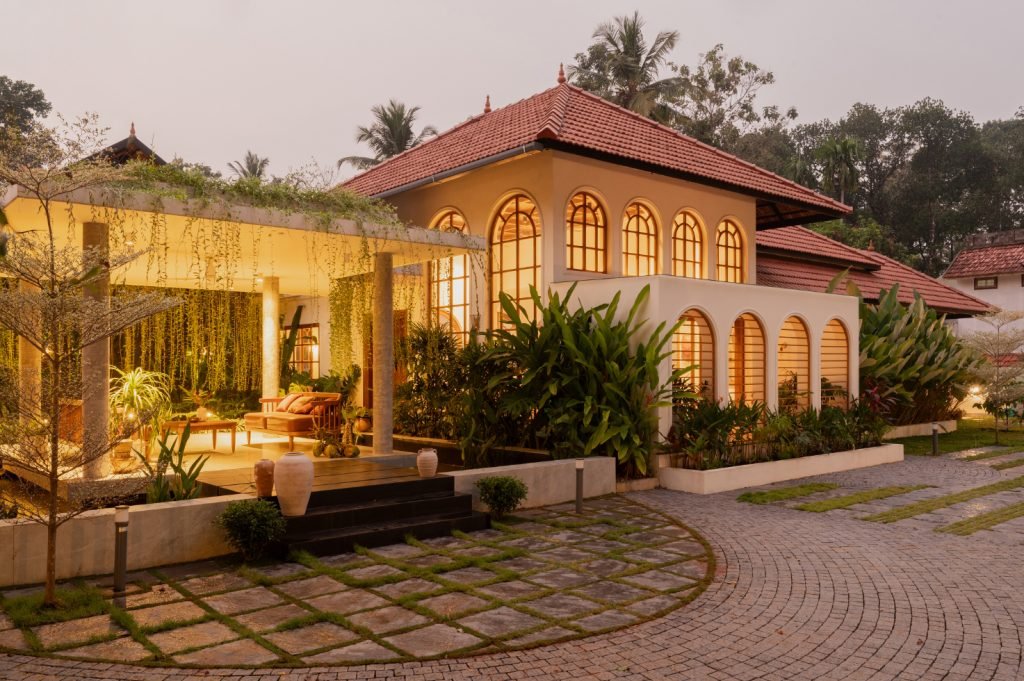
Bharanikavu sits in Kollam district in southern Kerala, where the landscape stays dense and green through most of the year and the light at dusk turns everything amber before it goes. It is in this setting that De.Solve Studio, led by Ar. Arjun V A, Ar. Anoop P Nair, and Ar. Ananthan S, completed Arcade in 2025, a 4,488 square foot single storey residence for a businessman, his wife who teaches, and their two daughters.
The family came to the project with a clear and deeply held set of references: the grandeur of single-storey colonial palaces and the spatial sensibility of traditional Kerala architecture. What they wanted was not a reproduction of either but a house that carried the spirit of both into contemporary life. Arcade is the architects’ answer to that ask, and it holds together as completely as any house of recent years in Kerala.
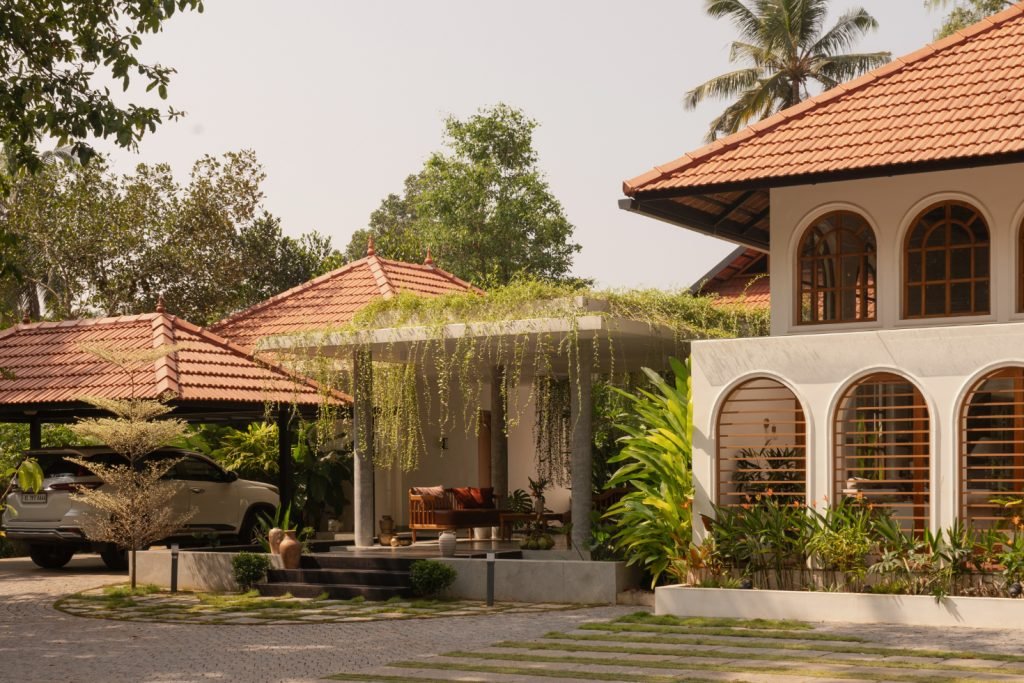
The approach tells you what the house is about before you reach the door. The driveway is laid in a circular cobblestone pattern with grass growing in the joints between the stones; the geometry draws the eye toward the building as the coconut palms and tropical planting of the site frame it from either side. The facade that comes into view is a layered composition that takes time to fully read. At plinth level, a row of arched openings with horizontal timber louvers runs along the base of the main block, with dense plantings of heliconia, cordyline, and tropical species rising in raised planters in front of them. Above the plinth, a row of tall pointed arched windows with warm timber frames sits within cream-rendered walls under a clay tile hip roof, its ridge finished with a decorative finial at the peak.
To one side, the entrance pavilion extends as a separate structure with cylindrical concrete columns supporting a flat slab roof that has been entirely colonized by trailing vines, long green curtains of them cascading toward the ground in a way that makes the boundary between the built and the grown genuinely unclear. The architects describe the interplay of arches and layered roofscapes as the most striking architectural feature of the house, and standing in front of it at dusk when the arched windows are lit amber from within and the vines are in dark silhouette against the fading sky, that description is not overstated.
The entrance lobby is one of the most carefully realized spaces in the project. The entrance lobby blurs the boundary between exterior and interior, opening on all four sides to lush greenery and trailing vines that create a green canopy overhead. A carved timber main door of considerable scale and presence anchors the back wall, its surface detailed in a grid of raised panels that catches the light differently through the day. Cylindrical concrete columns support the flat roof above. To one side a wooden daybed with rust cushions sits facing the greenery, the space functioning as an outdoor living room before the house proper begins. A waterbody at the entry adds a sensory dimension to the arrival sequence, the sound of water present before the door is reached. The morning light filtering through the vines and the plantings moves across the polished concrete floor in patterns that shift through the day, and it is in this space that the project’s aspiration for quiet luxury grounded in simplicity is most plainly legible.
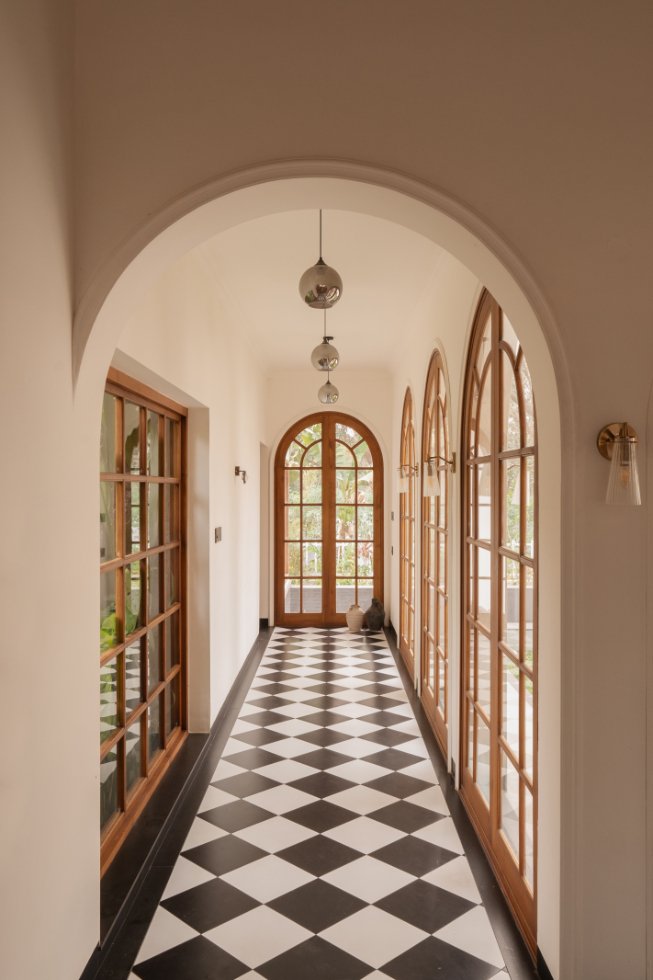
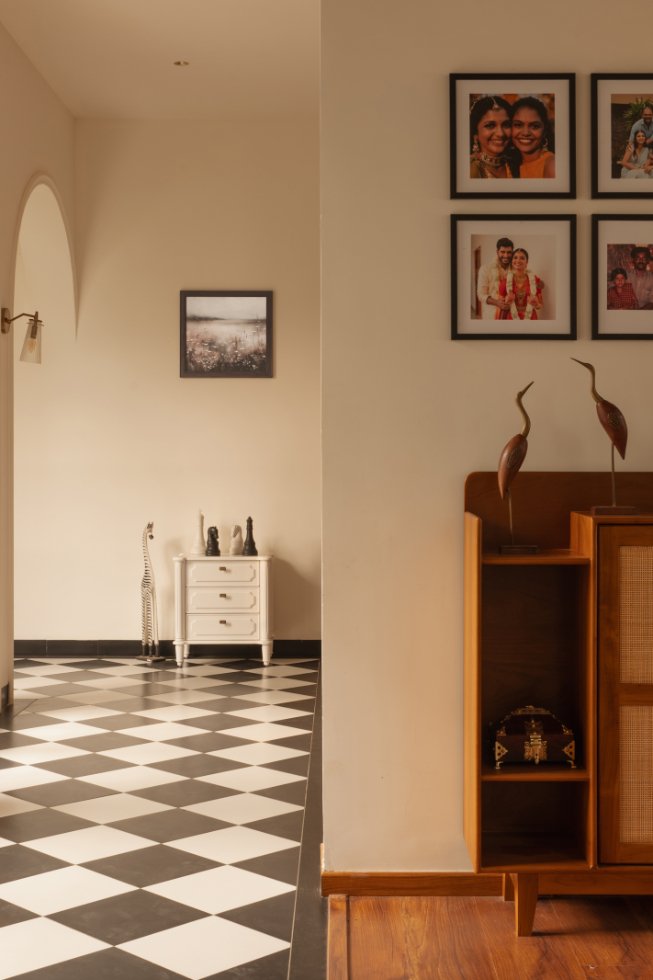
From the green foyer, an internal corridor divides the house into its two principal zones, and this corridor deserves to be discussed at length because it is one of the finest interior passages in recent Kerala residential architecture. The floor is laid in large-format black and white diamond checkerboard tiles, the pattern giving the space a confident rhythm that carries all the way to its end. On one side, a procession of plaster arches frames timber-framed windows that look out to the courtyard and garden beyond, each bay containing a brass wall sconce at the same height, the repetition building into a spatial sequence that feels genuinely processional.
Silver triple-globe pendants hang at intervals along the length of the corridor from the ceiling above. The whole passage terminates in an arched timber door with a terracotta pot set beside it and the garden visible through the glazing beyond, framing the view as carefully as any designed prospect in the project. Walking this corridor from one end to the other is not a neutral act of circulation. It is a spatial experience that sets the tone for every room it connects.
To one side of this axis lies the semi-public wing, accommodating a convertible space that can function as either a guest bedroom or an office depending on what the household requires. To the other lies the private zone, where the family living room, dining area, kitchen, and three bedrooms unfold around the corridor and around a private courtyard that forms what the architects describe as the climactic and emotional heart of the house. This courtyard draws natural light and ventilation through the plan while visually connecting the family spaces that face it. Extending from the most private corner of the plot, a swimming pool is positioned to maximize seclusion while also cooling the breeze that passes through it before flowing into the courtyard and the adjacent living areas.
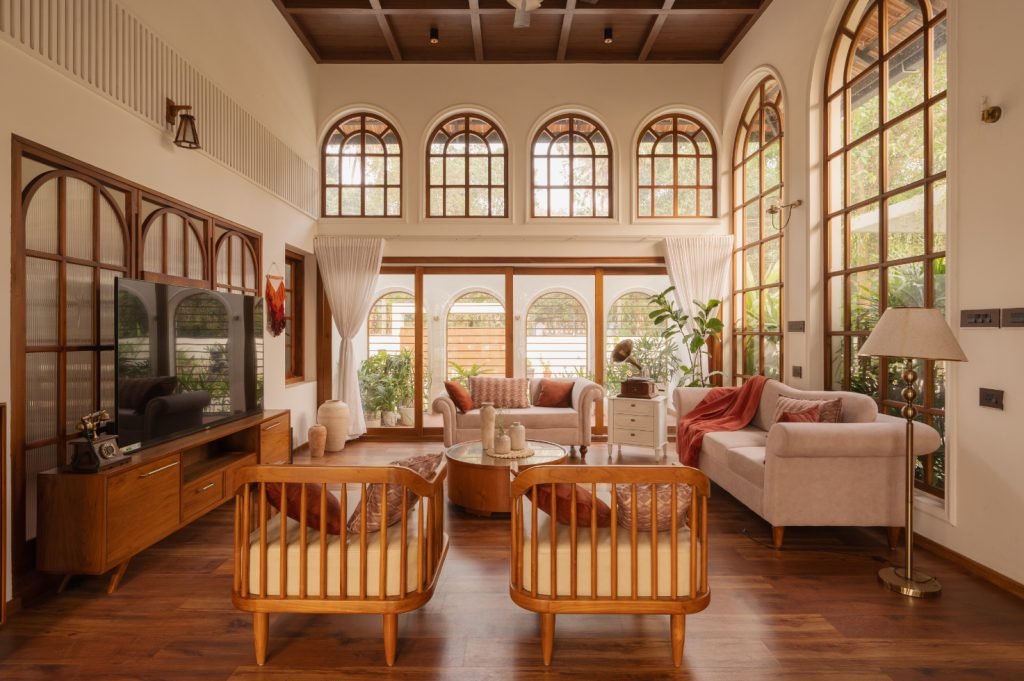
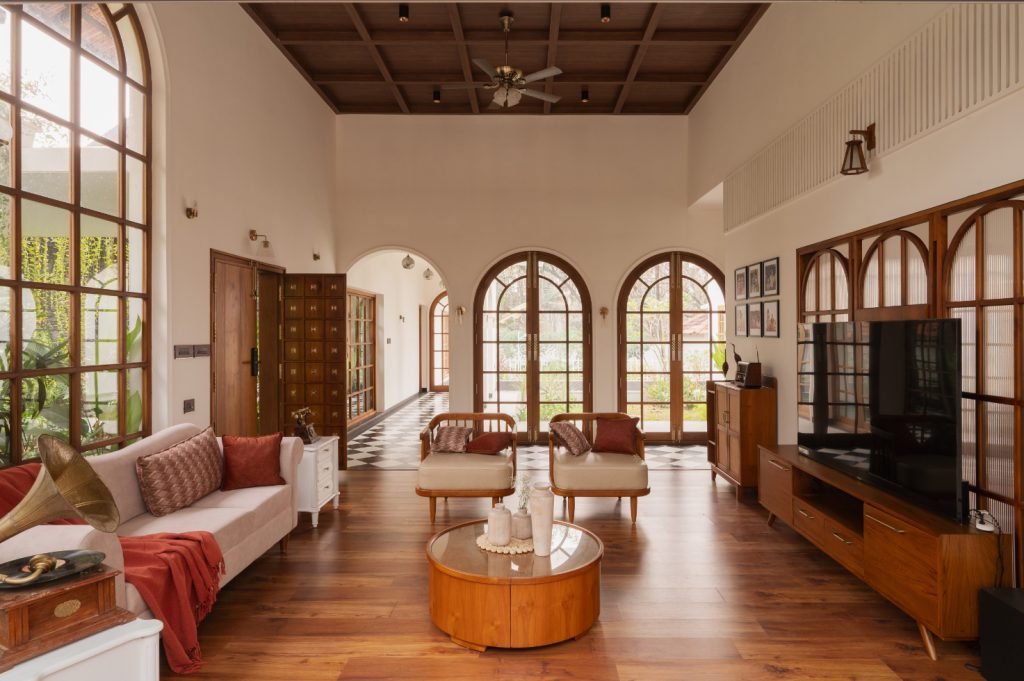
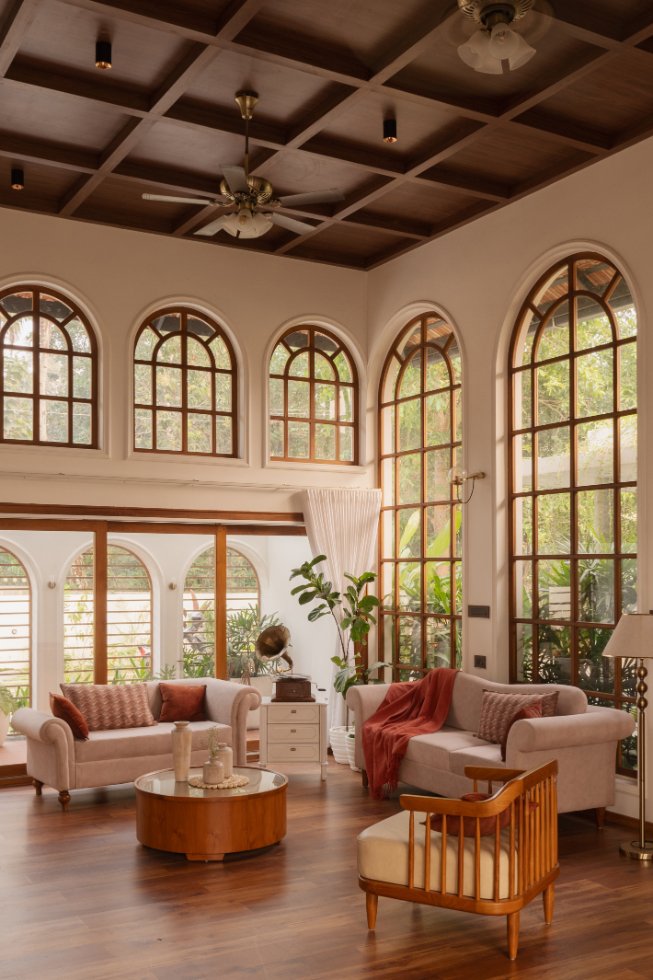
The living room is where the architectural language established on the facade is most fully delivered inside. The room has a tall ceiling with a dark coffered timber grid overhead, the squares of the coffering deep enough to cast their own shadows and give the ceiling genuine visual weight. The exterior wall is entirely given over to arched windows in two registers, full-height arched French doors at the lower level, and a row of tall pointed arched clerestory windows above, all in warm timber frames with the garden pressing close on the other side. In the photographs, the combination of the dark coffered ceiling, the cream walls, the double register of arched glazing, and the warm walnut floor produces a room of genuine richness, one that holds the colonial reference the clients described without feeling historical or frozen in time. Light pink upholstered sofas with rust accent cushions sit around a round wooden coffee table with a glass top, two wooden spindle-backed chairs are positioned at the front of the seating arrangement, a vintage-style floor lamp stands to one side, and an indoor ficus is in the corner.
A TV unit with arched panel detailing sits against the opposite wall, the arched motif carried even into the joinery so that the architectural language of the building is present at every scale. Morning light from the east and the softer evening glow from the west wash the room in natural golden tones through the day, the quality and direction of the light shifting as the sun moves across the site.
The dining room is glimpsed most dramatically from the corridor through an arched doorway that frames it before you enter. Three tall arched French windows in warm timber occupy the far wall, the garden visible beyond them, and the room sits on a raised timber-floored platform that lifts it slightly above the checkerboard corridor level, the transition between the two floor surfaces marking the move from circulation to gathering. The dining table and chairs are in light timber; globe pendant lights are clustered above a ceiling fan; a monstera plant is in one corner; and a white-painted sideboard is in another.
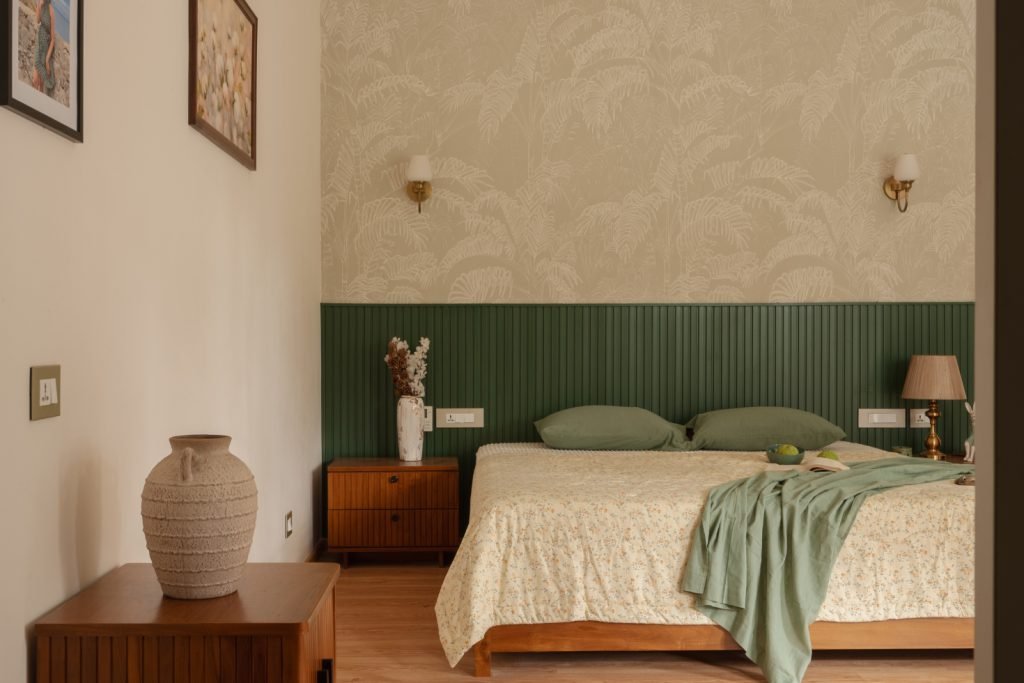
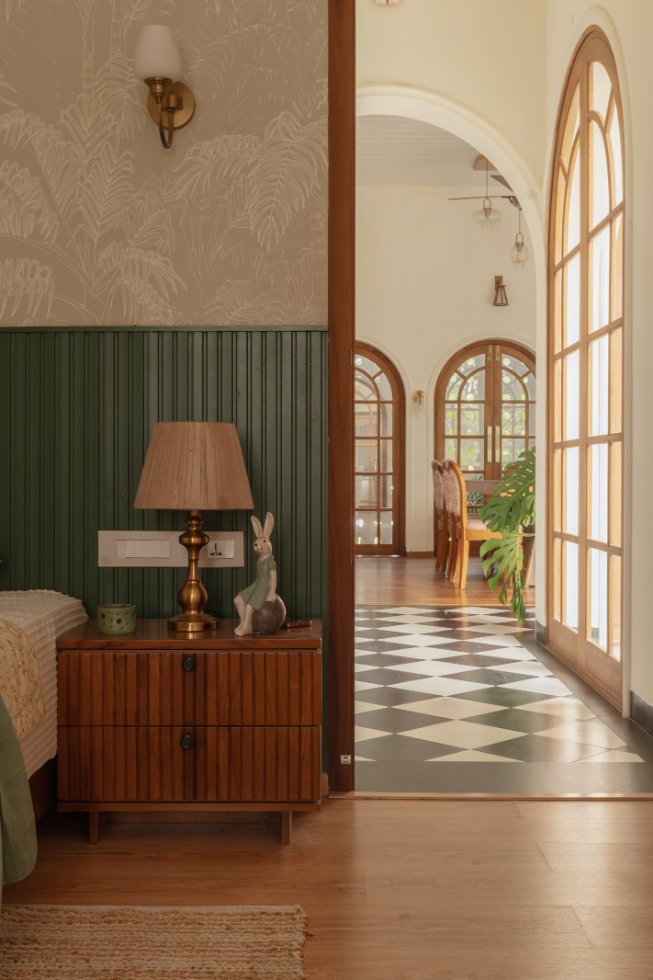
Looking through one of the bedroom doorways into the corridor beyond is its own small visual pleasure. In the foreground, a bedside table carries a brass lamp with a pleated shade, a small rabbit figurine, and a brass power socket against a wall of deep green vertical panel wainscoting below botanical wallpaper printed with palm and leaf forms in soft sage tones. A brass wall sconce sits above. Through the arched doorway behind, the checkerboard floor of the corridor extends away, arched windows visible at the end, the depth of the frame giving the shot three distinct spatial layers. It is a detail that rewards the kind of looking that good interiors invite.
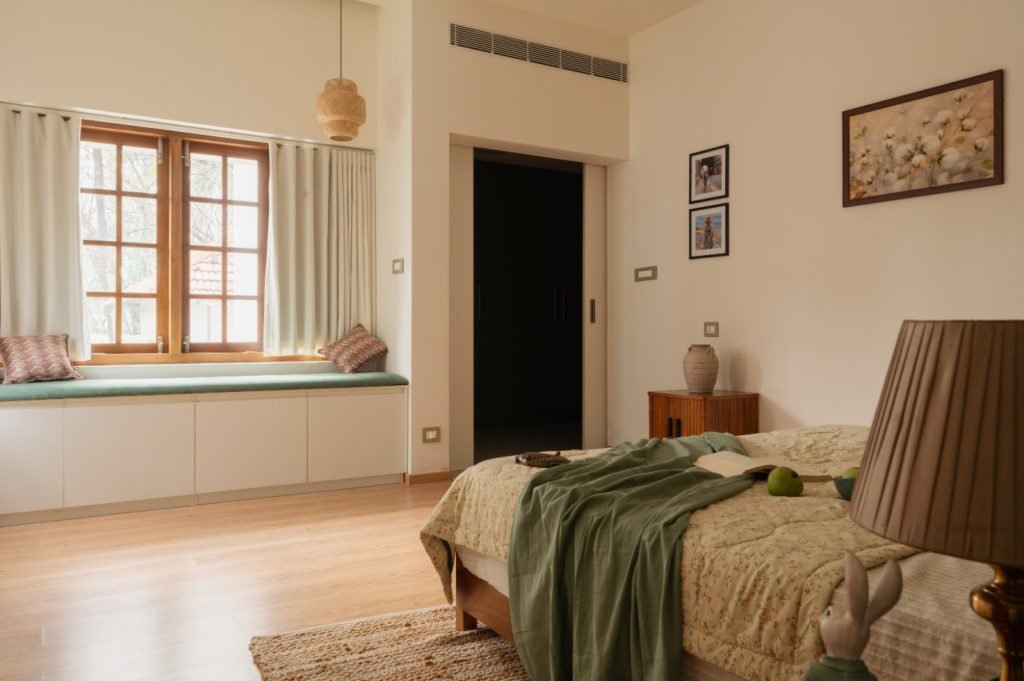
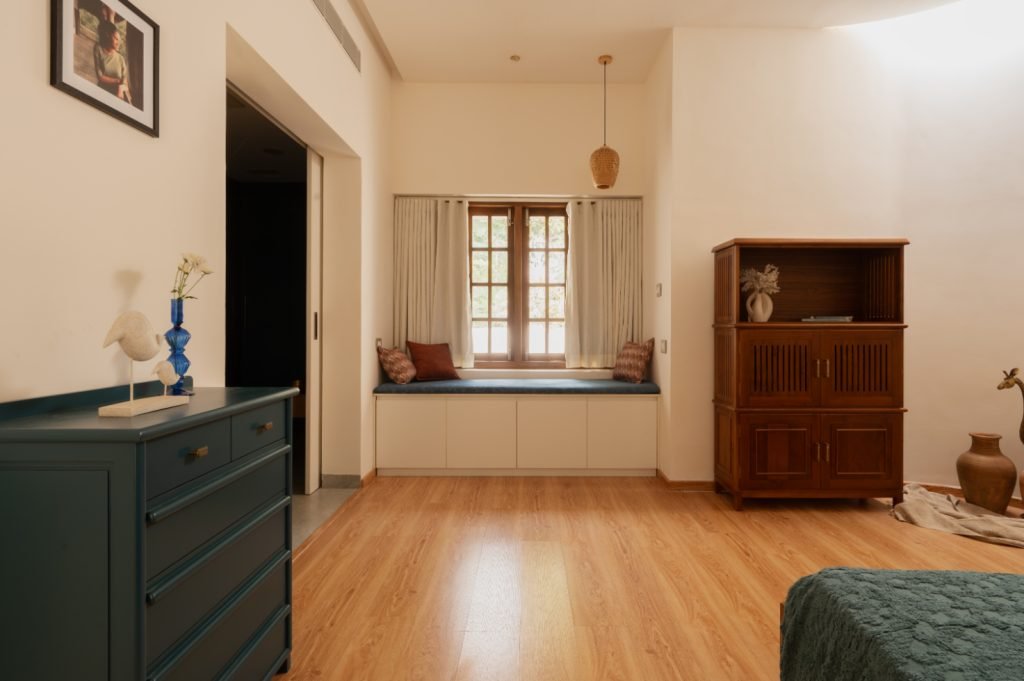
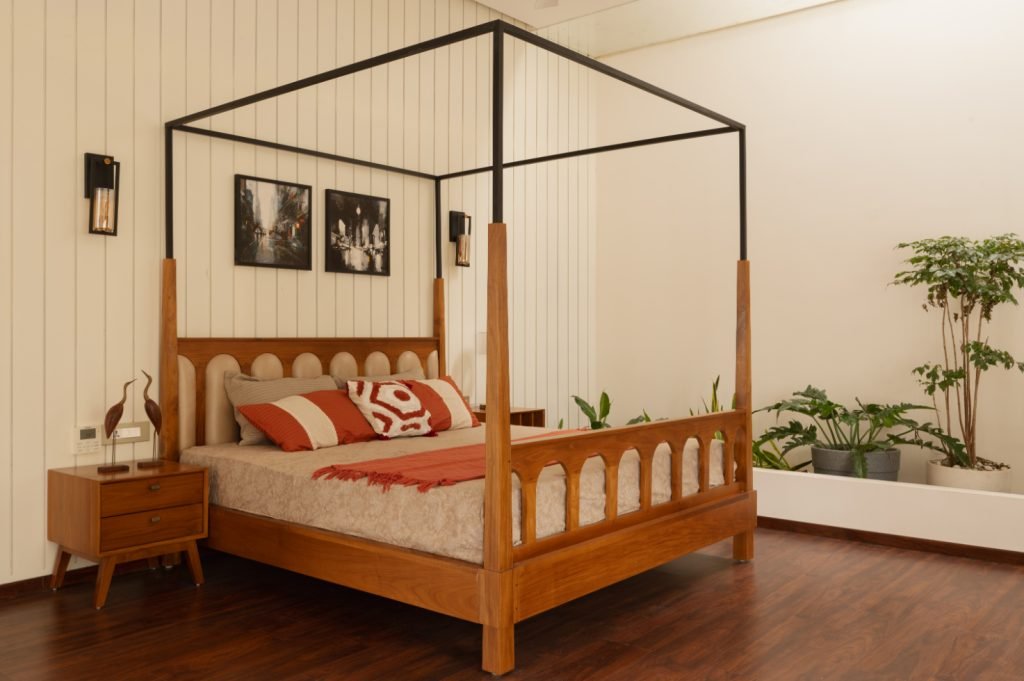
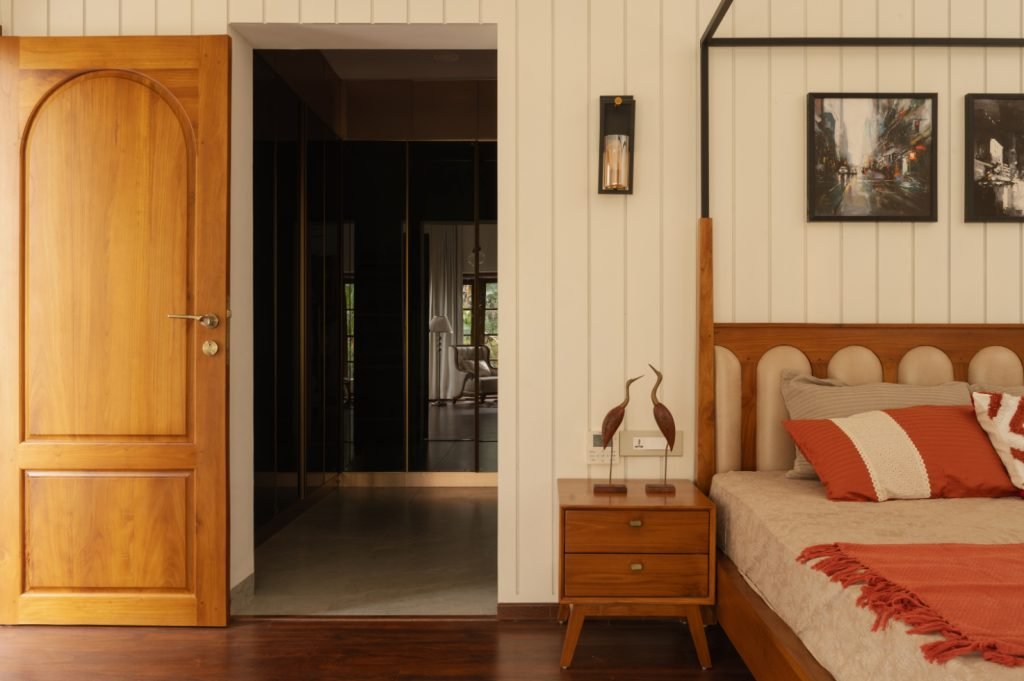
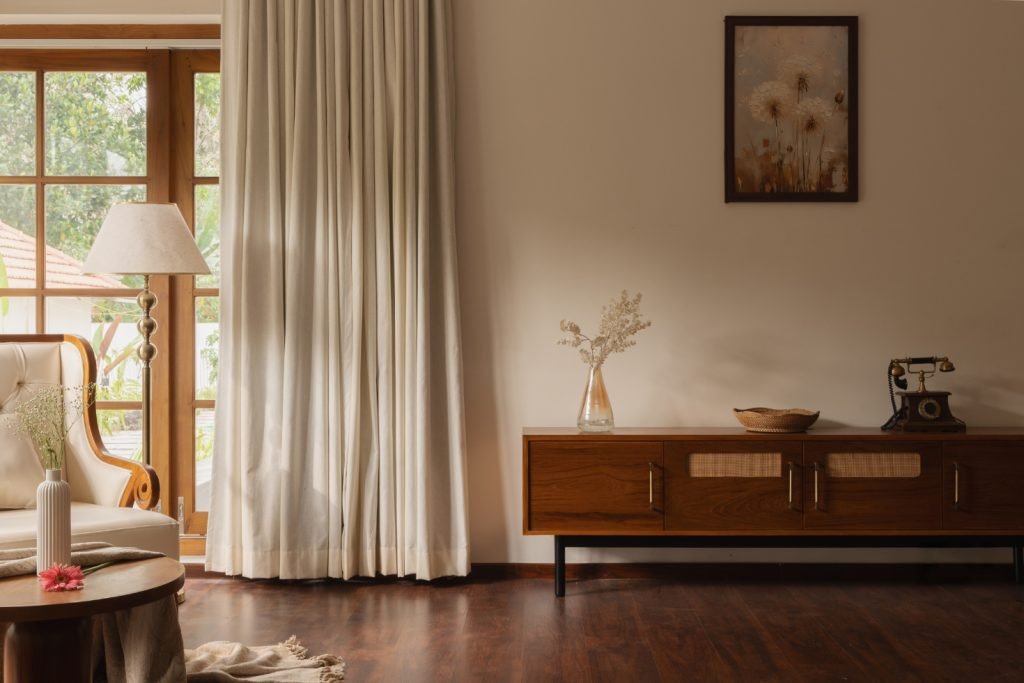
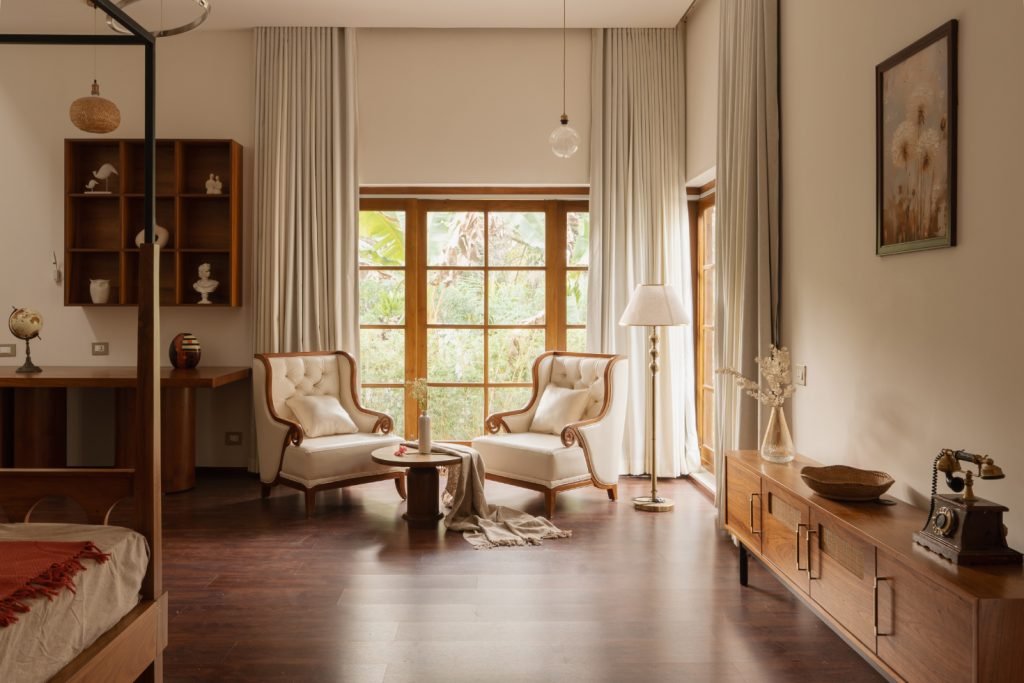
The bedrooms themselves are each resolved within the same vocabulary while having distinct characters. One is anchored by a four-poster bed with a black metal canopy frame and a carved wooden headboard carrying arched cutout detailing that echoes the architectural arches throughout the house, terracotta and rust bedding, cream vertical shiplap-style walls, and wall sconces on either side. A small planted corner with an indoor tree sits in the angle of the room, the planting bringing the green of the entrance lobby inside. Another bedroom has a window seat built into a timber-framed bay window looking out to the garden, a teal-painted chest of drawers with brass handles to one side, a wooden slatted cabinet opposite, and a rattan pendant overhead. A sitting area within what appears to be the master suite has two tufted carved wooden armchairs in cream upholstery positioned before a large timber-framed French window that looks directly into banana palms and tropical planting, the garden framed as deliberately as any artwork. A rattan-fronted sideboard carries a vintage black telephone, a glass vase of dried flowers, and a woven bowl; the room is composed with the ease of a space whose occupants know precisely what they want to live among.
The palette throughout, soft whites and warm wood in every room, holds the house together while allowing each space its own temperature and mood. The arched windows and timber frames that define the exterior reappear at every interior threshold and within the joinery details, creating the continuity between outside and inside that the brief asked for and that the photographs confirm at every scale. Arcade is a 4,488-square-foot house in Bharanikavu that revitalizes a family’s deep admiration for colonial grandeur and Kerala spatial tradition without diminishing their significance.