
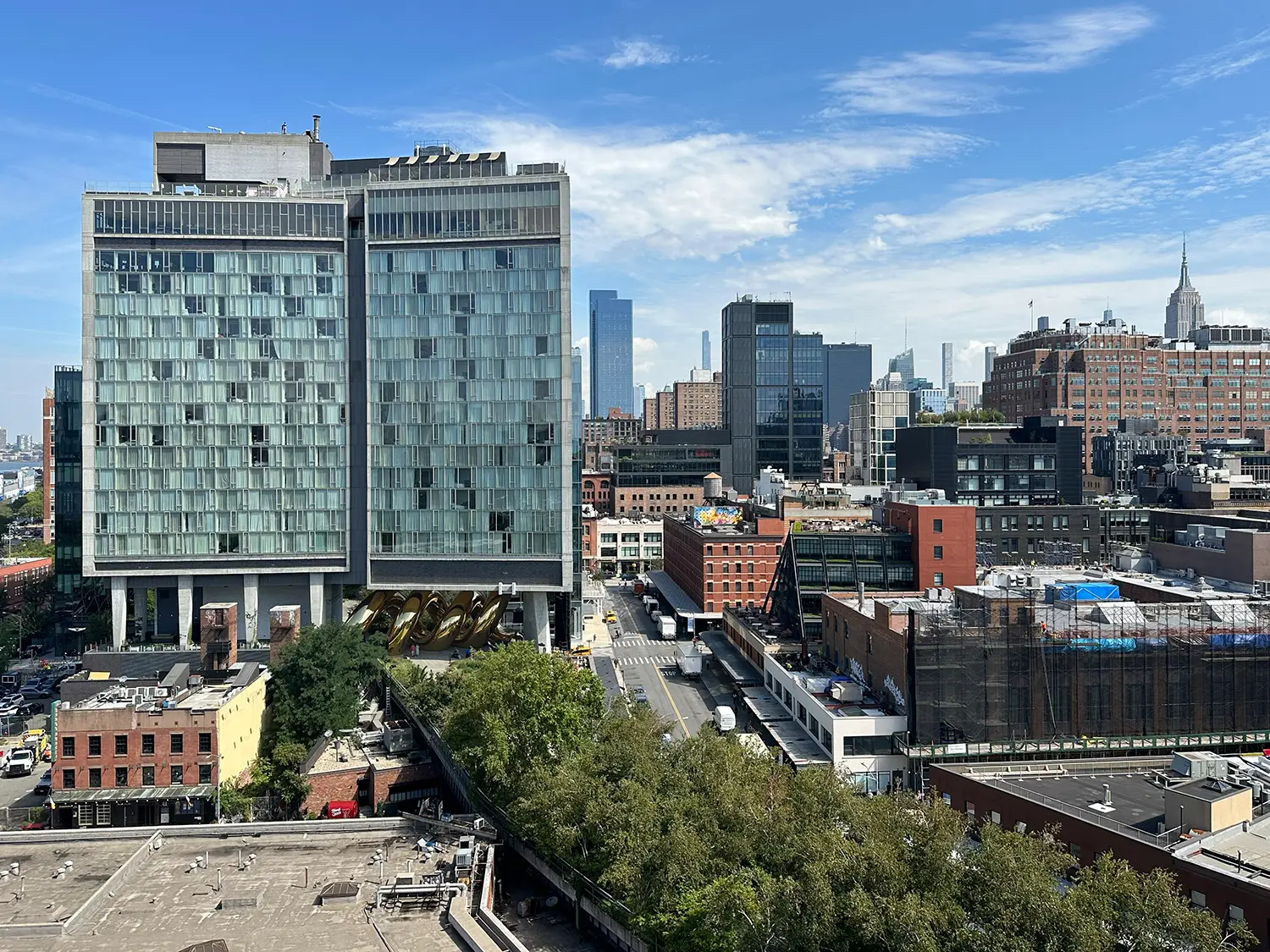
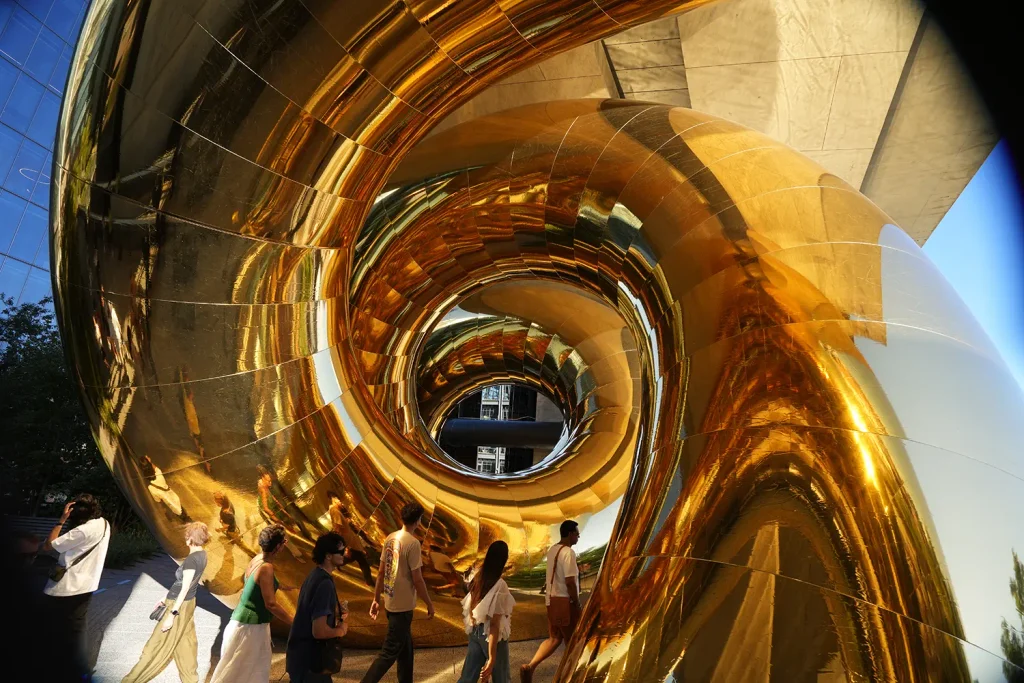
A golden serpent now moves through one of New York’s most recognizable public spaces, but there is considerably less substance to it than its appearance suggests. Rising from beneath The Standard and extending through the High Line at Little West 12th Street, auruBOROS: Urban Memory and Collective Dream is a 30-meter inflatable installation by Plastique Fantastique. Its mirrored golden skin suggests polished metal, while its actual structure depends on air and a network of ventilators.
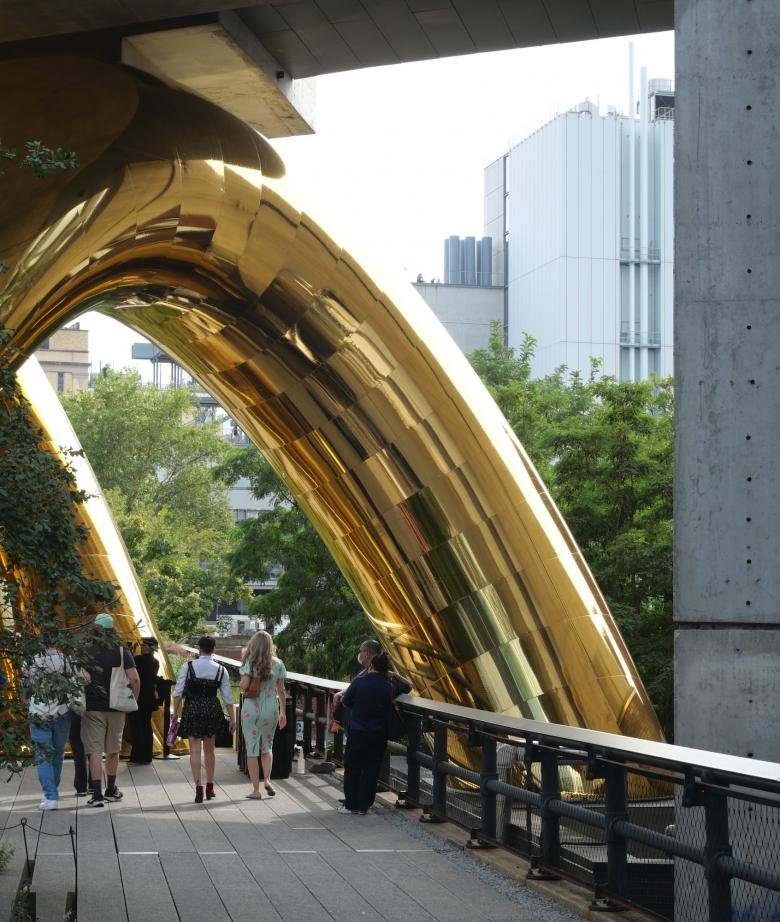
Commissioned by Bvlgari for the New York chapter of its Serpenti Infinito series, the installation marks the Italian jewelry house’s first public art commission in the United States. Rather than reproducing the Serpenti motif as an enlarged piece of jewelry, the project places the serpent within the architecture and circulation of the city, allowing it to occupy the High Line as a temporary structure rather than a permanent monument.
Plastique Fantastique, the Berlin-based art and architecture duo founded by Marco Canevacci and Yena Young in 1999, has built its practice around temporary spaces and pneumatic structures. Both artists trained as architects. Rome-born Canevacci studied at TU Berlin, while Seoul-born Young studied at Yonsei University and Aalto University. Their work has repeatedly explored what happens when air, rather than conventional building materials, becomes the primary means of creating volume and space.
For auruBOROS, that approach is applied to one of the oldest symbols associated with Bvlgari. The title combines aurum, Latin for gold, with ouroboros, the ancient image of a serpent consuming its own tail. The artists retained the symbolic reference but abandoned its traditional circular form. Instead of closing in on itself, the serpent opens out and enters the city.
The result is a form that moves across several layers of the site. It rises from the street beneath the High Line, passes through the space beneath The Standard, and continues along the elevated park. Visitors encounter it from different levels and perspectives, sometimes walking alongside the inflated body and at other points passing beneath it.
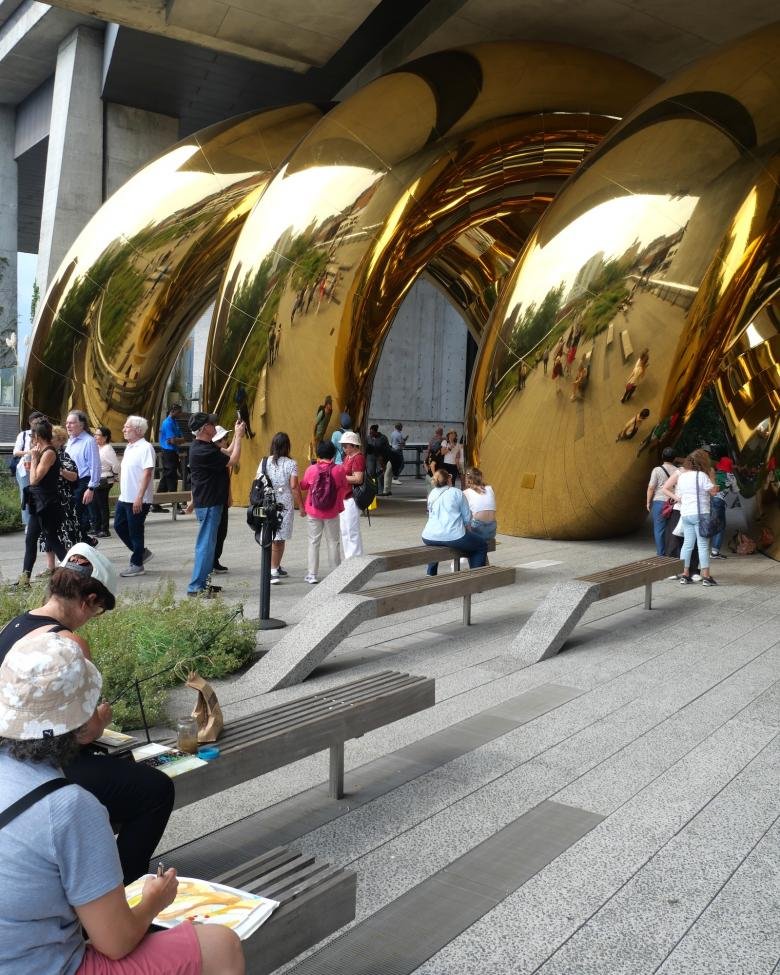
This relationship with the existing architecture is central to the installation. The serpent has not simply been placed on the High Line as an isolated sculpture. Its shape responds to the narrow elevated walkway, the hotel structure, the street below and the movement of pedestrians through the site. Its scale is substantial, but its pneumatic construction allows it to occupy that space without the structural mass normally associated with a work of comparable size.
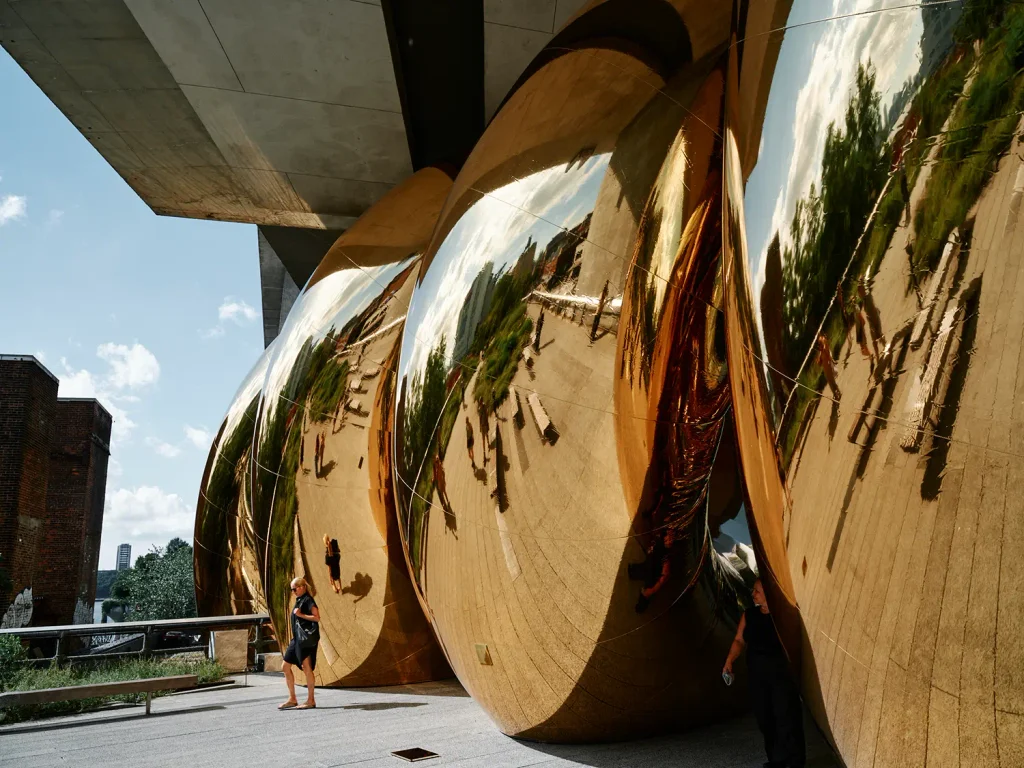
The sculpture is made from golden mirrored TPU, a material that gives the inflated tubes their metallic appearance. From a distance, the skin can suggest polished gold or another solid reflective material. Up close, the construction reveals its lightness. The apparent weight of the serpent is an optical effect created by its colour, finish and scale.
That contrast is fundamental to the work. Gold carries associations of permanence, wealth and material value, while air is invisible and transient. The sculpture depends on the latter to maintain the appearance of the former.
The artists have described this tension as an important part of the project. Although auruBOROS appears monumental, it remains light, fragile and temporary. Its existence is conditional on the continuous operation of the equipment that keeps the structure inflated.
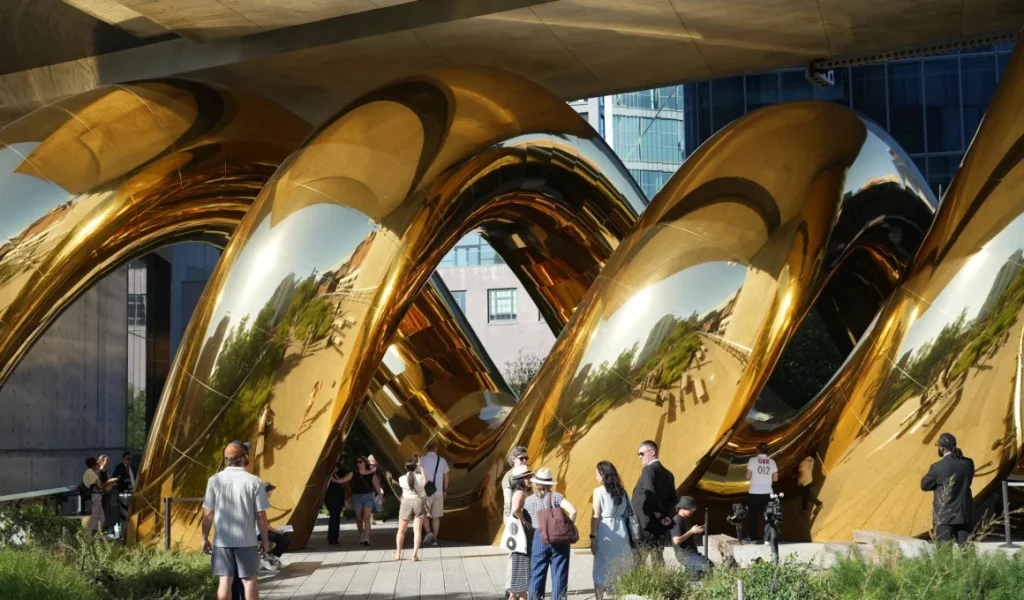
The mirrored surface introduces another layer of change. Instead of presenting one fixed image, the sculpture constantly absorbs fragments of its surroundings. Buildings, vegetation, sky, pedestrians and passing light are reflected across the curved skin. The High Line therefore becomes part of the artwork’s appearance, with the reflected environment changing according to the time of day and weather.
A person standing beside the serpent may appear alongside a fragment of brick façade. A section of sky can occupy one curve while the planting of the High Line appears across another. The sculpture does not offer a single complete view of itself because its surface is continually broken up by the environment around it.
This makes the installation particularly suited to the High Line, a public space already defined by transformation. The elevated park occupies the former West Side Line of the New York Central Railroad, where an infrastructure built for freight movement was given a new civic purpose. Its industrial structure remains visible beneath a landscape of planting, pathways and public art.
The project also continues Plastique Fantastique’s interest in inflatable structures as a form of public architecture. The duo’s earlier projects include a large inflatable ring installed across a Paris footbridge during Nuit Blanche in 2023 and an installation at the Venice Pavilion during the 58th Venice Biennale in 2019. Across their work, the use of air allows conventional architectural ideas of permanence, weight and enclosure to be questioned.
For auruBOROS, the artists connect air to the Greek concept of pneuma, a word associated with breath, air and spirit. The reference gives the material a conceptual role, but the physical reality remains straightforward: air is what allows the structure to achieve its enormous scale while remaining remarkably light.
Bvlgari’s Serpenti has been part of the house’s visual language since the mid-20th century. The motif became particularly associated with watches and jewelry, where the snake’s coiling form could be translated into flexible structures that wrapped around the wrist. Serpenti Infinito extends that established identity into artistic and spatial projects.
Previous editions of the series have appeared in Shanghai, Seoul and Mumbai. Each location has provided a different setting for the serpent, allowing the symbol to be interpreted through local environments and artistic practices. In New York, Plastique Fantastique’s inflatable construction introduces a deliberately temporary quality to an emblem traditionally associated with precious materials.
The distinction is important. The installation does not attempt to imitate the physical properties of jewellery. Instead, it uses the visual language of preciousness while making the underlying structure almost weightless.
The work was fabricated in Lübeck, Germany, before being installed in New York. Measuring approximately 30 by 10 by 10 metres, it occupies a considerable volume while remaining dependent on pneumatic pressure rather than a conventional structural frame.
Its temporary nature also changes the way it is experienced. Unlike a permanent public monument, auruBOROS has a defined lifespan. It appears on the High Line for eleven days, from September 10 to September 20, 2026, before being dismantled.
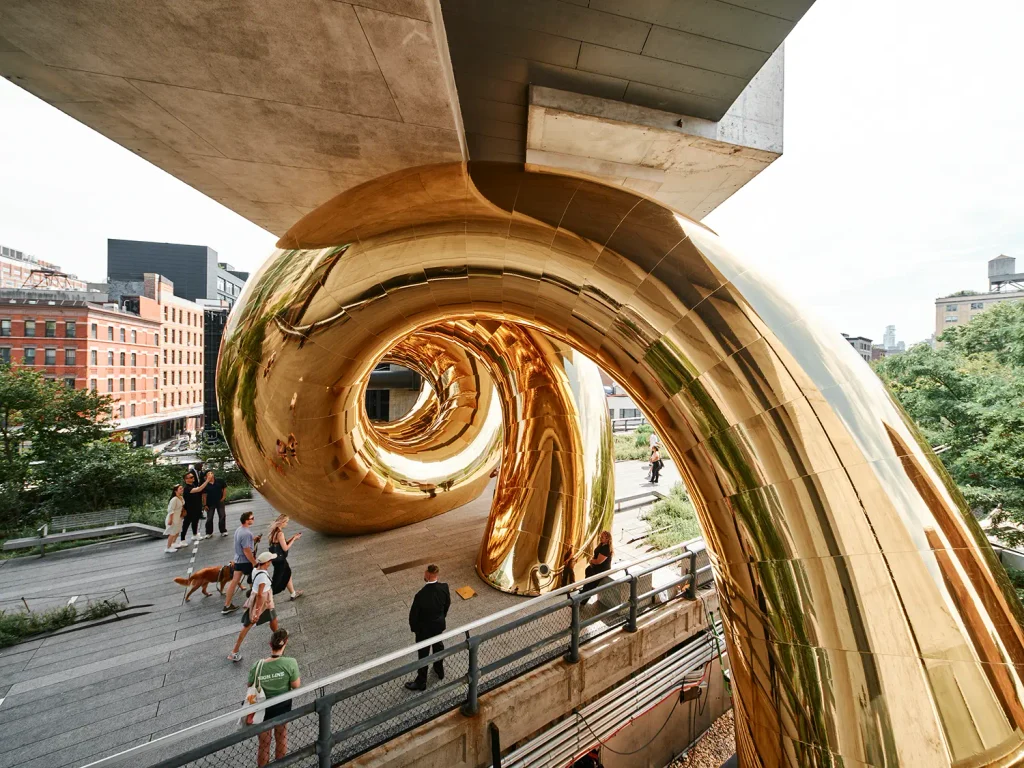
During that brief period, the sculpture becomes part of the daily movement of the park. Visitors do not need to enter an exhibition or buy a ticket to encounter it. It occupies the same path as commuters, tourists, residents and people simply passing through the High Line.
That accessibility is particularly relevant to the project’s public-art status. The serpent is not presented as an object separated from everyday urban life. It shares the space with it.
The reflective surface reinforces that interaction. People become part of the image simply by standing near the work, while the architecture and landscape around them are incorporated into the same field of reflection. In this sense, the sculpture records its surroundings without using a conventional image-making process.
The idea of collective memory in the title therefore extends beyond the serpent itself. The work exists through the accumulation of encounters, reflections and changing conditions during the short period in which it occupies the High Line. What one visitor sees at midday will not be identical to what another sees later in the evening.
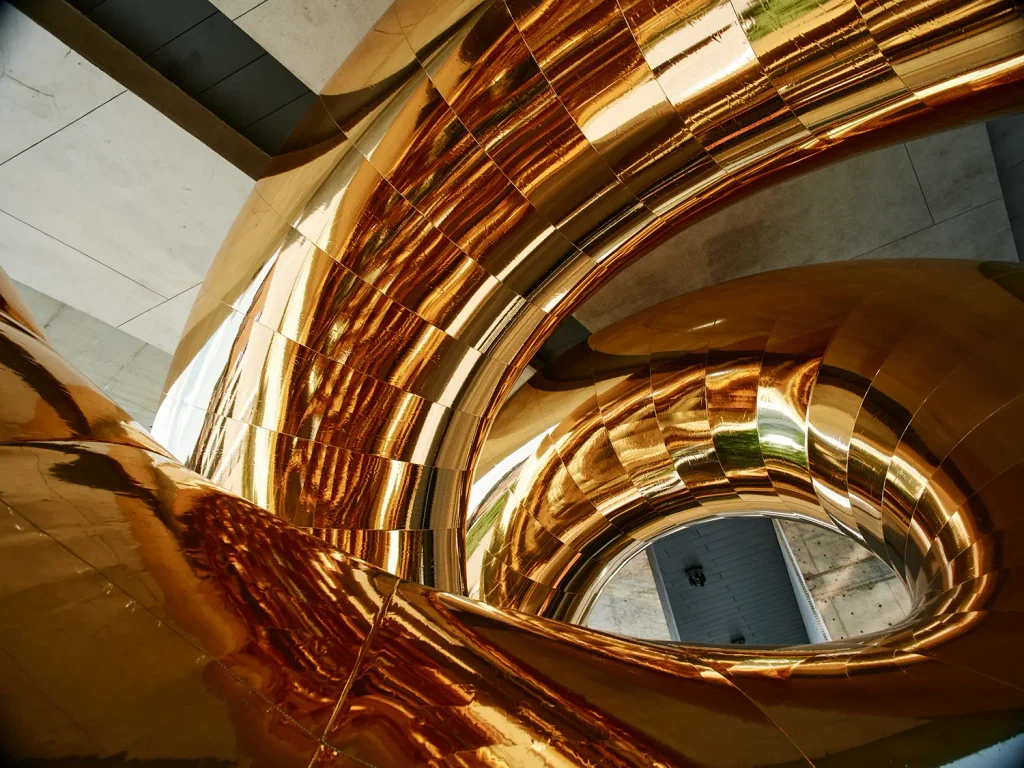
The work’s apparent permanence is consequently an illusion. The golden surface remains visually consistent, but everything around it changes. Light shifts, people move, weather alters the reflections, and the city continues its normal activity.
Eventually, the air will be switched off and the serpent will disappear. What remains is the experience of a structure that briefly altered the scale and character of the High Line without becoming a permanent part of it. For Bvlgari, auruBOROS extends the Serpenti motif into public space. For Plastique Fantastique, it continues a long investigation into air, temporary architecture and the relationship between constructed forms and their surroundings.
For New York, it is another temporary intervention in a public landscape built from the idea of transformation.
Fact File
Year: 2026
Typology: Public Art, Temporary Installation
Artist / Practice: Plastique Fantastique
Artists: Marco Canevacci, Yena Young
Commission: Bvlgari, Serpenti Infinito
Location: The High Line, Little West 12th Street, New York City, USA
Material: Golden mirrored TPU, pneumatic air system
Dimensions: 30 × 10 × 10 m
Fabrication: Lübeck, Germany
Status: Temporary installation
On view: September 10–20, 2026
