
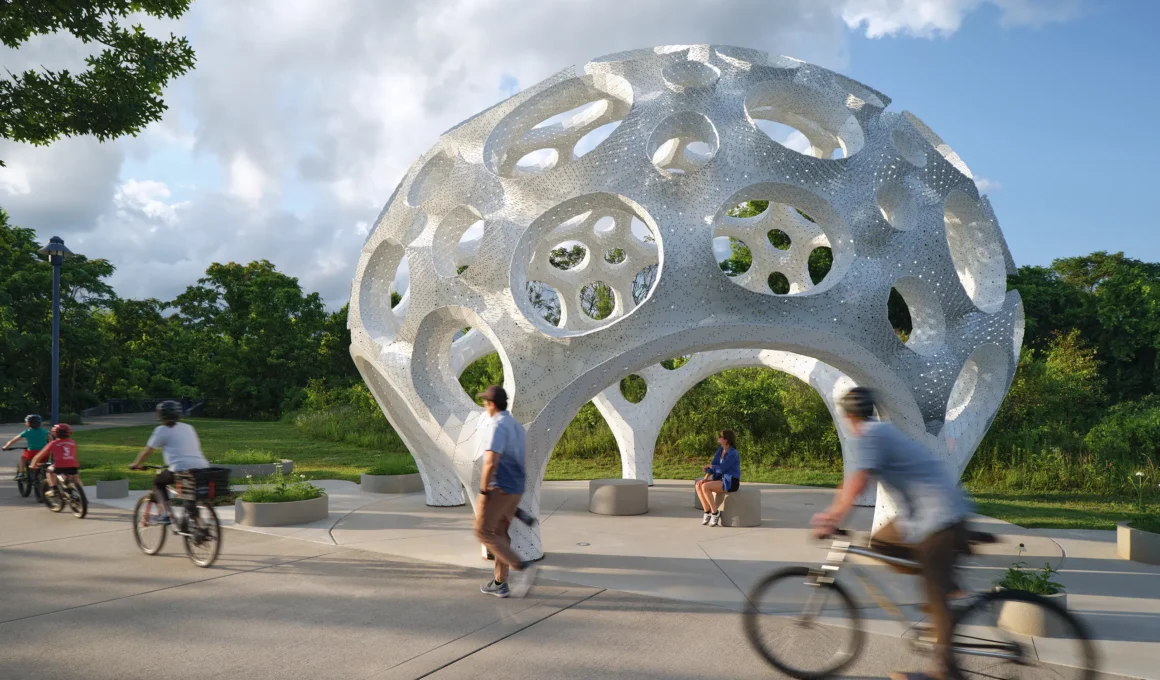
Marc Fornes / THEVERYMANY has installed Moonrise, a permanent public structure at Wheland Foundry Trailhead in Chattanooga, commissioned by Public Art Chattanooga, and the studio is insistent on one point above all: that it should be read as a civic space rather than a sculpture. The name refers to the moment the moon clears the horizon and a familiar landscape briefly turns into something else, which the studio offers as a metaphor for a project it positions on the threshold between art and architecture. From a distance, in the photographs, the dome reads as a fragment of lunar surface, and only up close does it resolve into a system of interlocking aluminum strips, each said to be three millimeters thin, riveted by hand into a self-supporting double-layer shell.
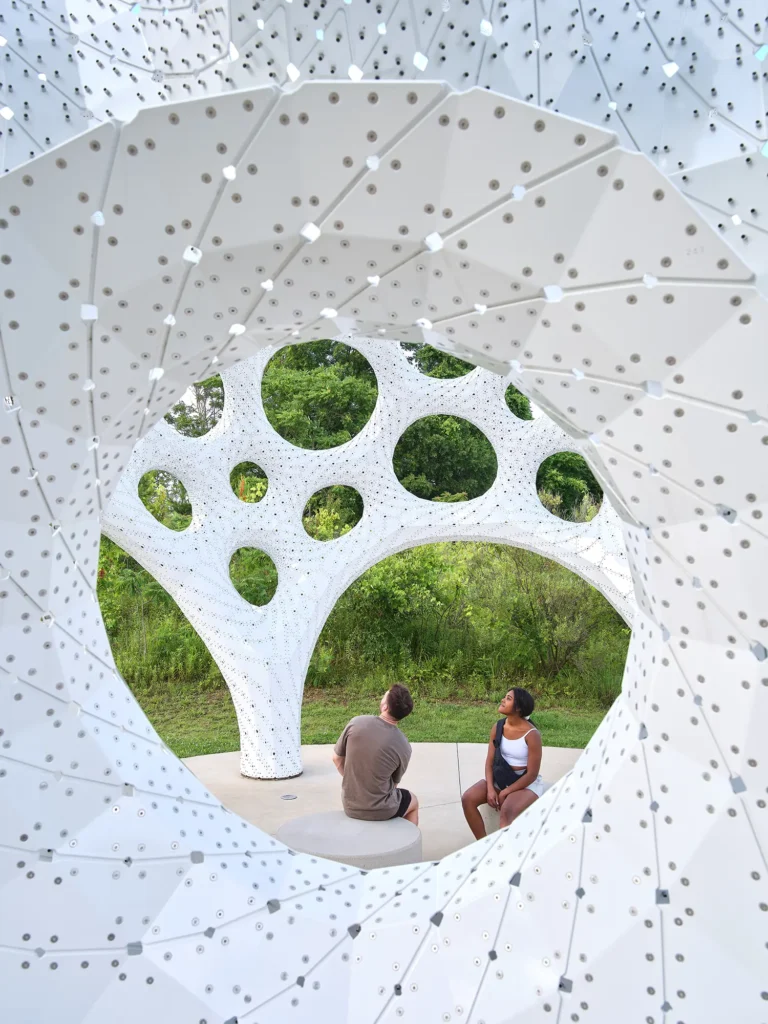
The studio’s central argument is that the structure and the aesthetic are the same thing. THEVERYMANY has spent more than a decade working between computational design and physical fabrication, and it presents Moonrise as a continuation of that line, citing Buckminster Fuller’s principle of doing more with less and reworking geodesic logic through algorithmic form-finding. By the studio’s account, the geometry is generated rather than drawn, with each component shaped by code, cut by machine, then carried to the site and assembled like an oversized three-dimensional puzzle so that rigidity and span come from the interlocking precision of the parts rather than from mass. It is a coherent description of the method, though it is also the studio’s own framing of its work, and a visitor has no way to read the algorithm off the finished surface.
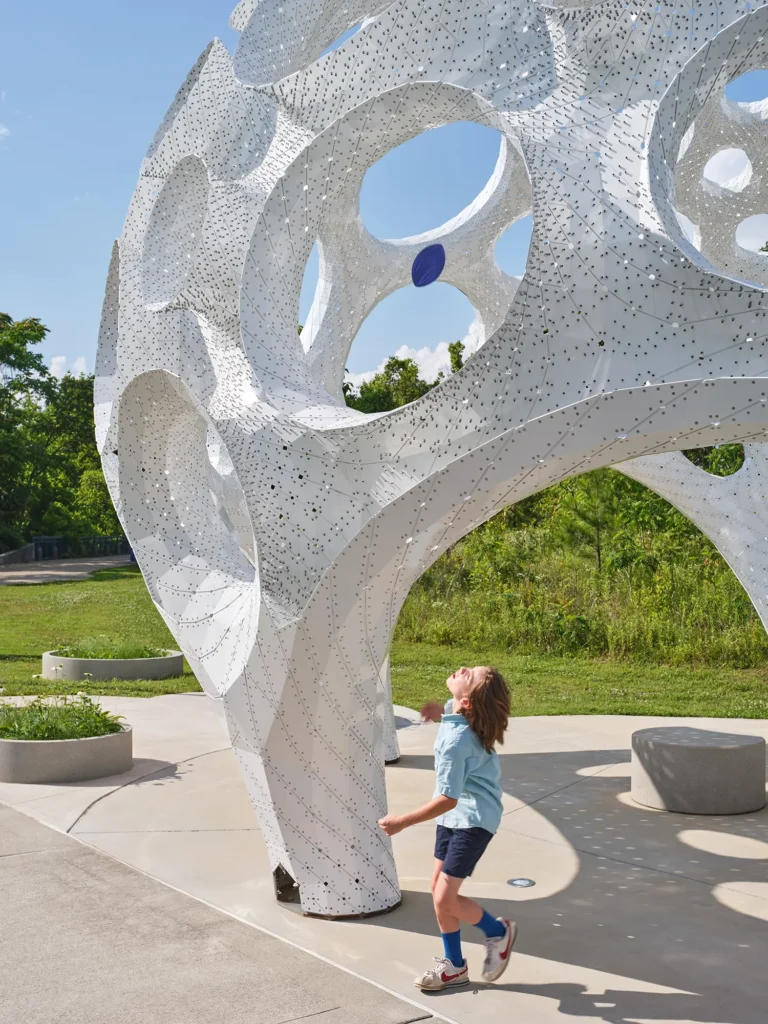
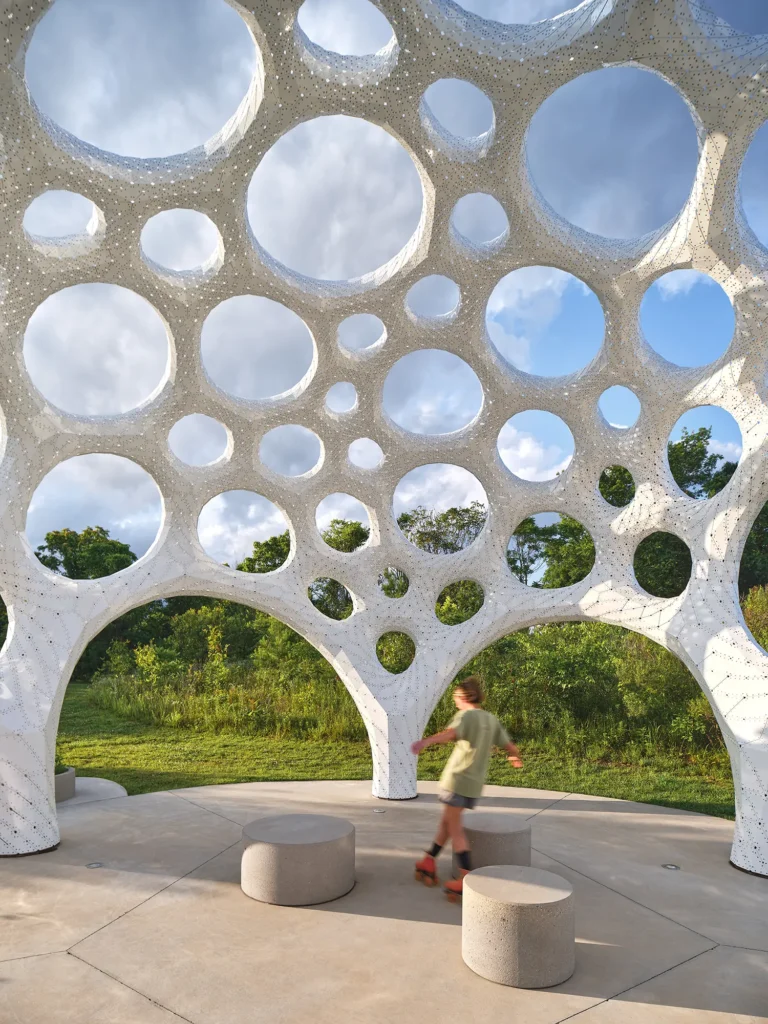
The fabrication logic, as explained by the studio, is what does the structural work. The double-layer shell is said to spread loads across the whole surface so that no single strip carries much stress alone, with the riveted connections between the two skins providing the depth that thinness cannot. What looks like one continuous surface is described as two skins acting together, and the many circular openings punched through the shell are presented not as decoration but as a way of removing material while keeping structural continuity, each aperture supposedly calibrated to the load paths around it. The photographs make the two-layer depth visible at the cut edges of the openings, which supports the account, even if the precise structural behaviour is something only the engineering can verify rather than the eye.
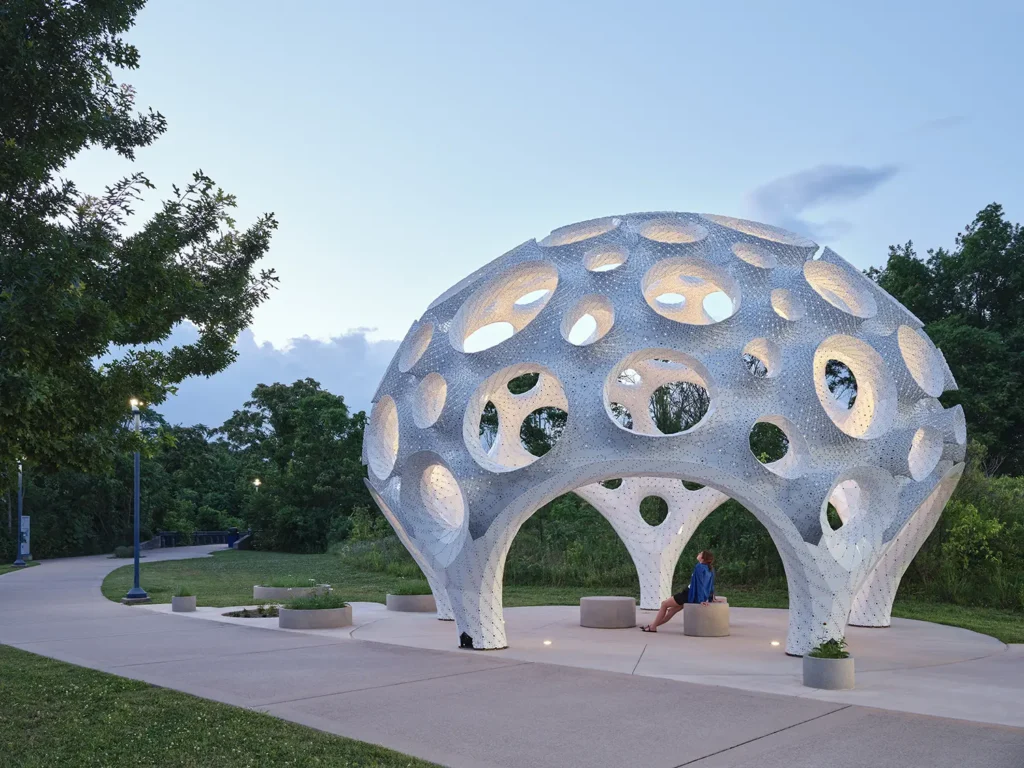
The experience the project trades on is one that changes with distance, and here the images and the claim line up reasonably well. From across the park the dome reads as a single white object dense with texture, its shadow patterning the plaza. At middle distance the apertures open it up and it turns permeable, letting light and sky through, and the wide shots of cyclists passing show that shift clearly. Inside, the openings frame fragments of sky, cloud, and tree, and the riveted surface overhead becomes a field of fine detail. The source material claims the structure produces a genuine slowing-down in the people who pass through it, and while the photographs do show visitors seated and looking up, whether that deceleration is real or simply a well-staged photo set is exactly the sort of claim a press image cannot settle.
The relationship to the site is one of the more persuasive threads, partly because the studio underplays it. Wheland Foundry Trailhead is named for a former metal foundry, a place where metal was once cast and assembled, and installing a rivet-assembled metal structure there sets up a quiet rhyme between the site’s industrial past and the project’s method. Fornes does not, by the account given, make the reference explicit, which is to the project’s credit, since the resonance reads as contextual rather than literal. It is the kind of connection that works precisely because it is not spelled out.
The civic claim is the one worth pressing on, because it is the project’s own headline. Fornes states that Moonrise is designed for gathering, rest, and reflection, with circular concrete seats orienting people toward the dome to support this purpose. The structure is permeable enough to enter, large enough to shelter a group, and open enough to keep a connection to the park. Whether it actually performs as everyday civic infrastructure, somewhere residents return to across seasons, is something only time and use will show, and the freshly completed, sun-populated-to-lightly-populated photographs cannot stand in for that record.
It is also worth noting what the framing leaves out. There is no public figure here for cost, fabrication time, or how the thin aluminum and its many riveted joints are expected to weather Tennessee’s seasons over years of outdoor exposure and public handling, all of which matter for a structure that stakes its case on permanence and minimal material. The studio’s roster of commissioners, from luxury brands to a place in the Centre Pompidou collection, is offered as evidence of seriousness, but it is reputation rather than performance data, and a civic structure ultimately has to answer to maintenance budgets and weather as much as to design pedigree.
What is not in dispute is that Moonrise is an accomplished piece of computational fabrication, and the photographs make a strong case for its sensory pull. The open question is the one the project sets for itself by refusing the word sculpture. A dome this thin, this intricate, and this dependent on being experienced from within asks to be judged as civic space rather than as spectacle, and that is a higher and slower bar than a striking silhouette. Whether Chattanooga returns to it once the novelty fades, and whether it holds up to the wear that genuine public use brings, is what will decide if the claim was earned or merely well made.
Fact File
Project name: Moonrise
Studio: Marc Fornes / THEVERYMANY
Typology: Public art, permanent pavilion / civic installation
Location: Wheland Foundry Trailhead, Chattanooga, Tennessee, United States
Commissioned by: Public Art Chattanooga
Structure: self-supporting double-layer aluminium shell
Material: 3mm aluminium strips, hand-riveted
Method: computational form-finding, machine-cut components, hand assembly
Photography: Keith Isaacs
