
Dika Architectural Design Center has completed the Fuzhou ESUO Future Kindergarten at No. 12 Shangxiadian Road, Jianxin Town, Cangshan District, Fuzhou, for client Fujian Shenghe Education Management Group, covering a land area of 4,408 square meters and a total construction area of 9,613 square meters, and the building that has come out of that brief is unlike anything else currently standing in the city’s educational landscape.
From the basketball court that faces the main facade, the building reads immediately as a departure from every convention that typically governs kindergarten architecture in China. The structure is entirely white, its surface punctuated by circular porthole windows of varying sizes, irregular openings, and a geometry that refuses to resolve into a recognizable orthogonal form, sitting instead somewhere between a vessel, a lunar base, and a purpose-built world that belongs entirely to the children inside it. To the right of the main block, a freestanding sculptural white volume rises in an organic, almost biomorphic mass, its curved surfaces and tubular connectors reinforcing the interstellar narrative from the outside in a way that no signage or cartoon imagery could. The ground plane in front of the building is surfaced in a deep red rubber running track with white markings and blue paving and basketball courts, with color used as a spatial signal rather than decoration, making the campus readable and navigable to a child without a single word of instruction.
Architecture as the Third Teacher
The design team’s core position, which governs every decision made across the project from the roof down to the door handles, is that a kindergarten’s architecture should function as what Dika calls the third teacher, not a container for education but an active participant in it. This meant rejecting the conventional design logic that places the building as background and furniture or toys as the primary experience and instead embedding the theme of exploring the universe into both the building’s forms and its spatial functions from the very first line drawn in the design process. The team deliberately abandoned the concrete cartoon symbols that appear in most traditional kindergartens, choosing instead to work entirely through abstract architectural forms, fluid spatial logic, and the construction of layered scenes that allow the interstellar narrative to build gradually as a child moves through the campus, without ever resorting to illustration or literal representation.
Genuine child-friendliness, as Dika defines it, operates on three principles: respecting children’s natural curiosity without indulgence, encouraging imagination without flamboyance, and ensuring safety without restriction. These three ideas are not in conflict here but are expressed simultaneously, which is architecturally the harder thing to achieve and the more convincing thing to look at. Circulation routes, flexible spaces, and the integration of classrooms with activity zones are all arranged so that children move intuitively and self-direct their exploration rather than being guided through a predetermined sequence of single-purpose rooms, and the result is a building where spatial exploration itself becomes a growth game that requires no adult to initiate.
The Exterior and the Outdoor Interstellar Base
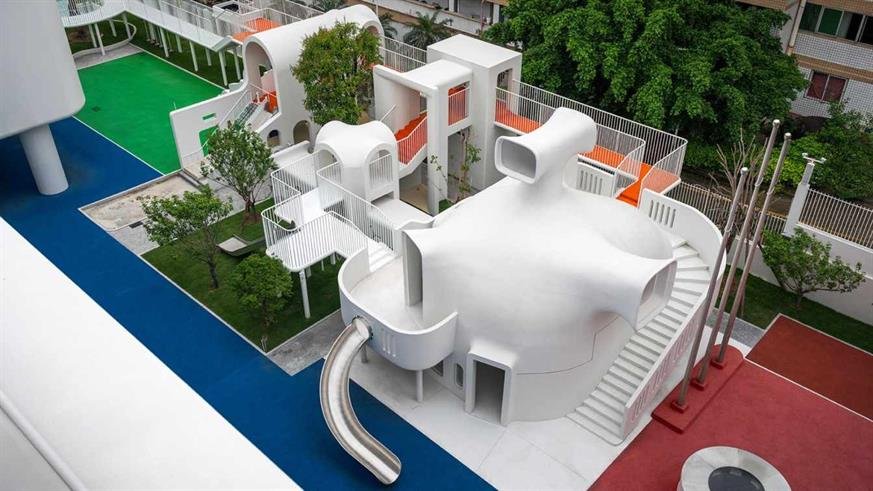
Viewed from above, the campus reveals the full ambition of the three-dimensional activity system that Dika has constructed across the site. The outdoor core zone takes a cluster of cosmic settlement pods as its design prototype, with staggered curved white volumes, interconnected three-dimensional circulation routes, a central domed structure that functions as the outdoor adventure complex’s focal point, its surface smooth and unbroken except for small porthole openings at the base, a curved stainless steel slide that sweeps from its upper level to the ground, and a staircase that climbs to its roof terrace. This structure sits within a landscape of blue, red, and green ground surfaces, connected by raised walkways and overlooked by orange-accented arched structures that frame views across the campus and provide shaded, semi-enclosed spaces for smaller-group activity between the main outdoor zones.
The blue staircase that rises from the outdoor ground plane is one of the campus’s most direct spatial gestures, a single bold element in cobalt blue that cuts across the predominantly white and red palette of the exterior and gives the outdoor circulation a landmark that children can orient themselves around from anywhere on the site. Tube slides run from the upper levels of the play structures to the ground, and the entire system of ramps, stairs, elevated walkways, and slides means that movement between different levels of the campus is never purely functional but always part of the adventure sequence the design has constructed.
The Corridors as Interstellar Plank Roads
The corridors that connect the building’s internal spaces and wrap around its outdoor edges are one of the most distinctive spatial decisions in the project. Dika has designed them not as passage nodes but as what the team calls “interstellar plank roads,” a narrative thread that connects the exploration routes across the entire campus and gives children a reason to slow down, look around, and engage with the space rather than simply move through it. The yellow-orange corridor visible along the building’s perimeter is the clearest expression of this: a sequence of arched openings in deep amber yellow, each one framing a different view of the campus beyond, with orange rubber flooring underfoot and blue rubber visible through the arches at a lower level, the colors shifting as a child moves through and creating a sensory sequence that changes with every step. Light falls through the arches in long diagonal stripes across the floor, and the curved surfaces on either side of each opening soften what would otherwise be a hard transition between inside and outside.
These corridors are designed as all-weather adventure paths shielded from wind and rain, which makes them usable throughout Fuzhou’s rainy season and ensures that the outdoor exploration experience is not interrupted by weather in the way that a conventional kindergarten’s play areas would be. As children move through them, they can pause at the arched openings, chase light and shadow, or engage with the small interactive moments built into the corners and recesses beneath the arches so that the passage itself becomes part of the daily exploration rather than time spent waiting to arrive somewhere else.
The Planet Room and the Astronaut Installations
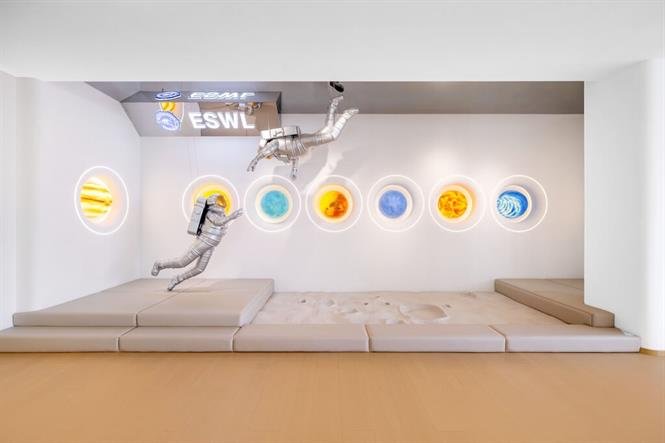
Inside the building, the interstellar theme finds its most direct spatial expression in the room designed around floating astronaut sculptures and illuminated planet installations. Two life-sized silver astronaut figures are suspended in the space, one reaching toward the wall and one tumbling in mid-air above a cushioned platform, and behind them a row of circular wall-mounted displays shows the planets of the solar system in illuminated color, each one glowing with its own color and texture against the white wall. The platform below is covered in soft grey cushioning with a small sculptural surface texture, and the overall effect of the room is that of a pressurized cabin interior, quiet and contained, with the cosmos visible through its circular windows. This is the room where the building’s conceptual anchor is most visible: the idea that a child who spends time in a space like this is not being told about space but is being placed inside it and that the learning that follows is spatial and physical before it is verbal or instructional.
The Activity Room with Climbing Wall
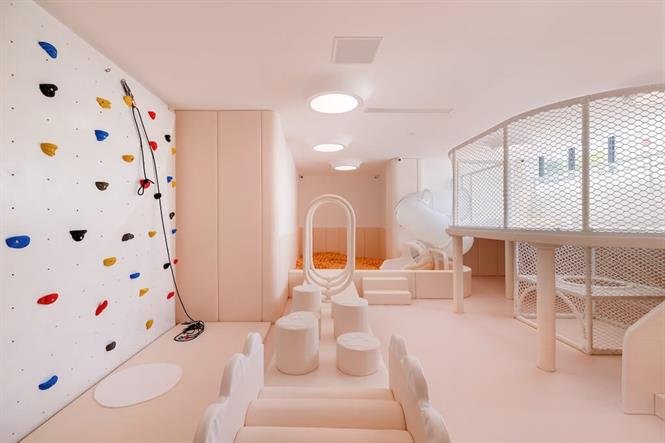
One of the building’s fully equipped indoor activity rooms combines a climbing wall, a ball pit, a tube slide, and a mesh-enclosed elevated play platform within a single continuous space finished in a warm blush pink that runs across floor, walls, and ceiling without interruption. The climbing wall occupies the full height of the left wall and is fitted with colored holds in red, blue, and yellow against a white surface, providing a range of grip sizes and positions that accommodate children at different stages of physical development. The ball pit sits beyond it, filled with orange balls and accessed via a low arch opening, with a tube slide dropping into it from the level above. The mesh-enclosed platform on the right side of the room sits at an elevated level connected to the slide and to the main floor below, and the circular ceiling lights are recessed into the pink surface so that the room reads as a single enveloping spatial experience rather than a white box with equipment added to it. Every surface that a child might come into contact with is rounded, padded, or smoothed, and the color palette of the room keeps the energy high without introducing the visual noise that primary-colored equipment in a white institutional space typically produces.
The Classroom with Arched Shelving
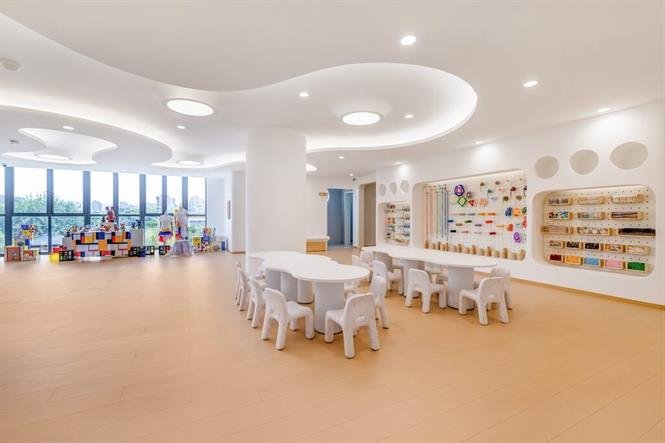
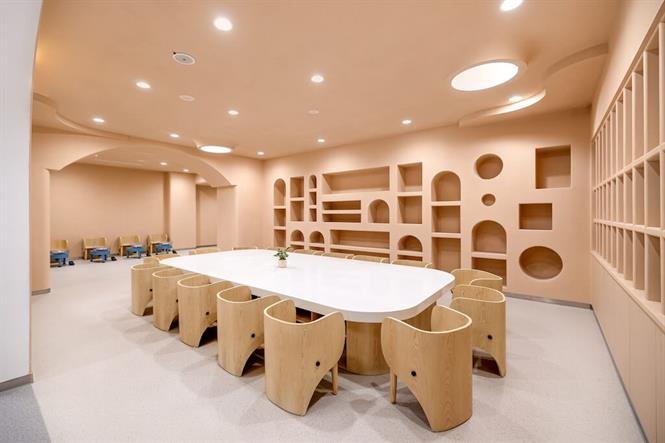
The dining and gathering classroom shows a different register of the same design intelligence, with warm peach walls, a terrazzo floor, and a wall-mounted shelving system of considerable spatial ambition: arched niches, circular openings, and rectangular recesses of varying sizes are arranged across the full width of the wall in a composition that reads as an architectural elevation rather than a storage solution, each opening a different size and shape, and each one contributing to a surface that gives the room depth and character without requiring anything to be placed in it. Curved wooden chairs scaled to children sit around a single large white table with rounded corners, and the ceiling carries circular recessed lights that echo the circular motifs in the shelving wall. The adjacent smaller classroom visible through an archway continues the peach palette with smaller-scaled seating, and the transition between the two spaces is handled through the same arched threshold language that runs throughout the building.
The Restroom
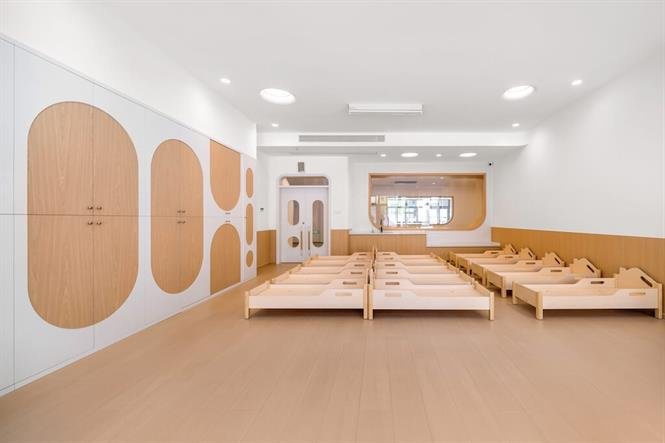
The nap room takes a quieter approach to the same material palette, with white walls and warm wooden flooring providing a calmer, lower-stimulation environment appropriate to the room’s function. A full-height storage wall in white with large oval timber inserts serves as the room’s defining feature, the warm wood tones introducing softness and natural material quality into what is otherwise a light, restrained space. Small wooden cots are arranged in rows across the floor, and the circular ceiling lights and arched door openings maintain the building’s geometric language without imposing it in a way that would compete with the room’s need for quietness. The windows in the nap room carry the same rounded timber framing as the storage wall, and a low viewing window set into the wall allows supervision without the full visual exposure of a glass door.
The B&B Italia UP Series
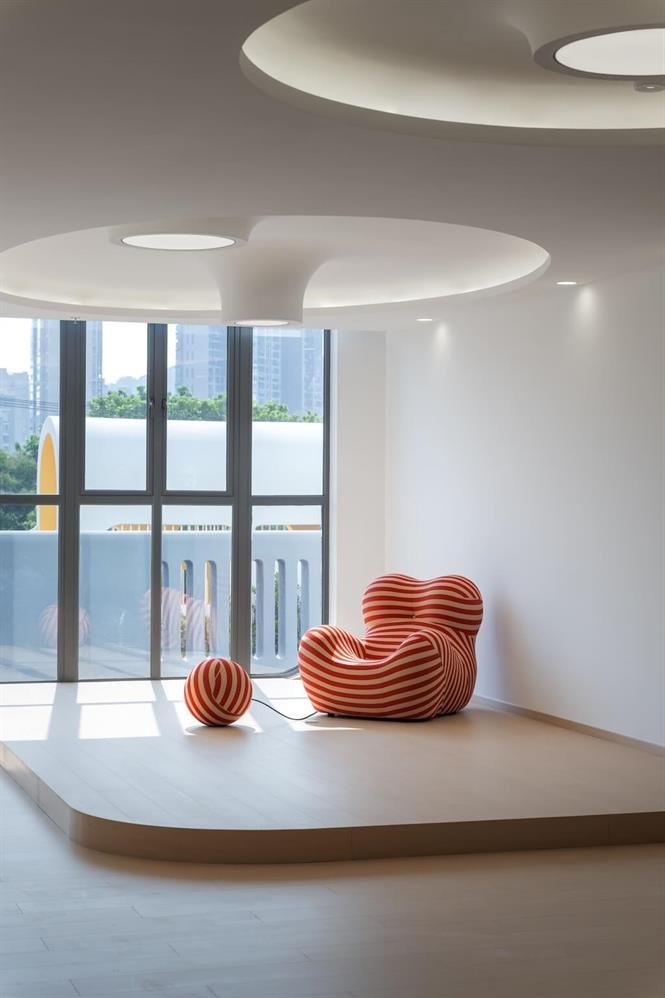
The furniture selection includes the UP Series by B&B Italia, the frameless, fully enveloping chair and ottoman first presented by designer Gaetano Pesce at the Milan Furniture Fair in 1969, specified here in a bold red and white stripe that makes each piece immediately identifiable as an object of visual and tactile interest in a space that is already rich with both. The chairs appear in the building’s more open, contemplative spaces, placed on raised timber platforms or near large windows where a child can sit and look out across the yellow corridors and the campus beyond, and the contrast between the chair’s exuberant graphic quality and the white calm of the rooms it occupies is precisely calibrated. The choice of this specific piece, with its long design history and its quality of unconditional physical enclosure, communicates something about the emotional register the project is aiming for: a space that holds children rather than only activating them.
Construction Challenges
The irregular geometry of the building presented significant technical challenges throughout construction that were resolved through close collaboration between the design and construction teams at every stage of the build. The arched outdoor spaces feature an asymmetric arch and curved ramp design that place extremely high demands on on-site casting techniques, requiring precise execution, careful surface polishing, and continuous coordination between disciplines that in a more conventional project would work more independently. Fuzhou’s rainy climate added further complexity to a process that required dry working conditions, increasing time pressure across the entire construction program. Every arch edge required rounding, and every concrete base layer had to be polished to form smooth arcs before any finish was applied, ensuring that the safety standards mandatory for a kindergarten were met without reducing the visual integrity of forms that depend on their smoothness and continuity to read correctly. The gap between the building as drawn and the building as constructed is, by any measure, small, which is a more significant achievement in a project of this geometric complexity than it would first appear.
Project Overview
Fuzhou ESUO Future Kindergarten is located at No. 12 Shangxiadian Road, Jianxin Town, Cangshan District, Fuzhou, China. Land area: 4,408 square meters. Construction area: 9,646 square meters. Client: Fujian Shenghe Education Management Group Co., Ltd. Design: Dika Architectural Design Center.
For more information visit www.dika001.com
