
When Prague-based RDTH architekti, led by principal architects René Dlesk and Tamara Kolaříková with design team members Kristián Vnučko and Kristýna Kopecká, took on the reconstruction of this 101 square meter apartment with an 8 square meter loggia, the starting point was a question that most apartment renovations never ask: what if nearly every wall came out?
The answer, completed in 2026 from a 2022 design, is a 96 square meter usable floor plan that does not divide itself into rooms in any conventional sense and that holds within its continuous space the functions of what might otherwise be a four-bedroom apartment, a sleeping area, two kitchen configurations, a bathroom, a toilet, a home office, and a dining zone, all of it organized not by partition walls or doors but by a single compact furniture block placed and slightly rotated at the center of the layout so that each functional zone falls naturally into place around it. The apartment, photographed by Filip Beránek, balances the logic of a studio with the spatial hierarchy of a multi-room flat, and the photographs make clear that this balance is not theoretical but genuinely lived.
The Case for Removing the Walls
The starting observation behind the No-Wall Apartment is a specific and defensible one: apartments organized around a central corridor, with individual rooms connecting to it like grapes on a stem, impose fixed boundaries on light, ventilation, movement, and use that do not suit every resident and do not adapt to changing needs over time. The enclosed room, however well proportioned, has a clearly defined beginning and end, and that clarity can feel liberating or limiting depending entirely on who is living in it and what they need from the space on a given day.
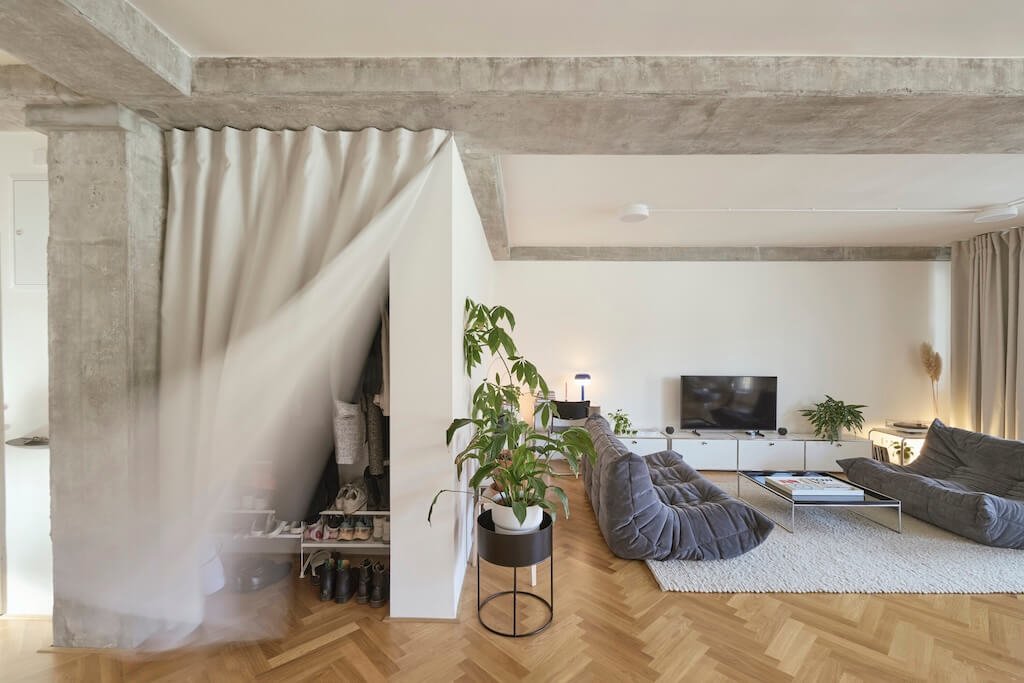
With the exception of the installation shaft and the skylight, RDTH Architekti removed all fixed partitions from the interior and then restructured what remained using three primary building elements: built-in furniture, glass concrete blocks, and curtains. Everything beyond these three elements, the freestanding furniture, the plants, and the personal items and accessories, is insertable and removable, meaning the apartment retains the ability to change as its residents’ lives change, without structural intervention. The toilet is the only space in the apartment with a conventional door. Every other transition between zones is handled by the central furniture block, by the glass block walls of the sanitary areas, or by full-length curtains that can be drawn or opened in an instant.
The Central Furniture Block
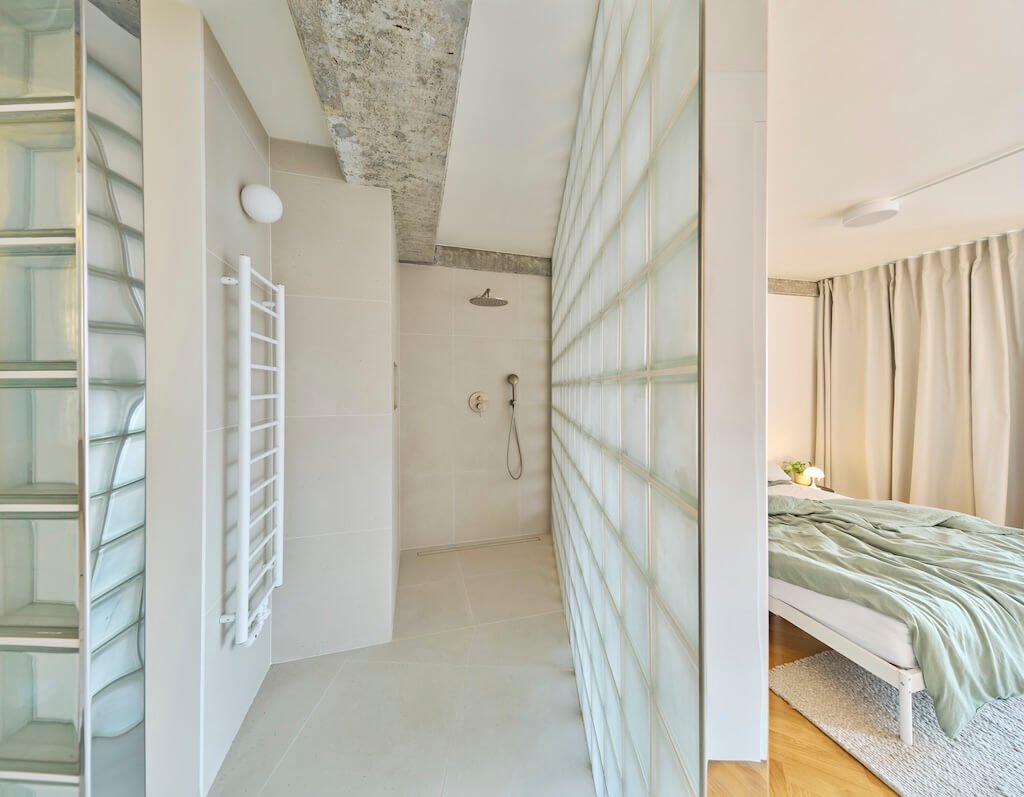
The furniture block that sits at the heart of the layout is the project’s most considered spatial decision, and in the photographs it reads as exactly what it is: a compact white volume slightly rotated off the apartment’s primary axis so that its faces create four distinct zones without any of them being enclosed. On one side the bedroom opens toward it, with a white bed frame and sage green linen sitting against the large glass concrete block wall that separates the sleeping area from the bathroom beyond it. On the other side, the living area unfolds, with the herringbone oak parquet running continuously across the full floor and the exposed concrete columns and beams of the building’s skeleton rising at intervals through the space. The block itself contains storage and service functions, and because it does not touch the ceiling, the space reads as a single room no matter which part of it you are standing in.
Two Kitchens
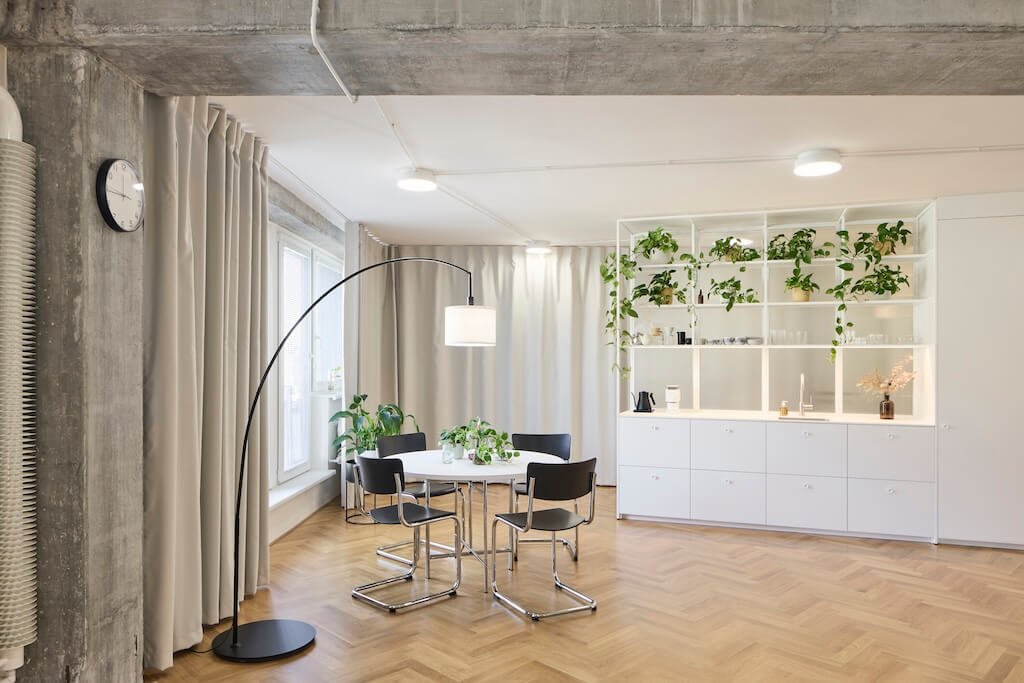
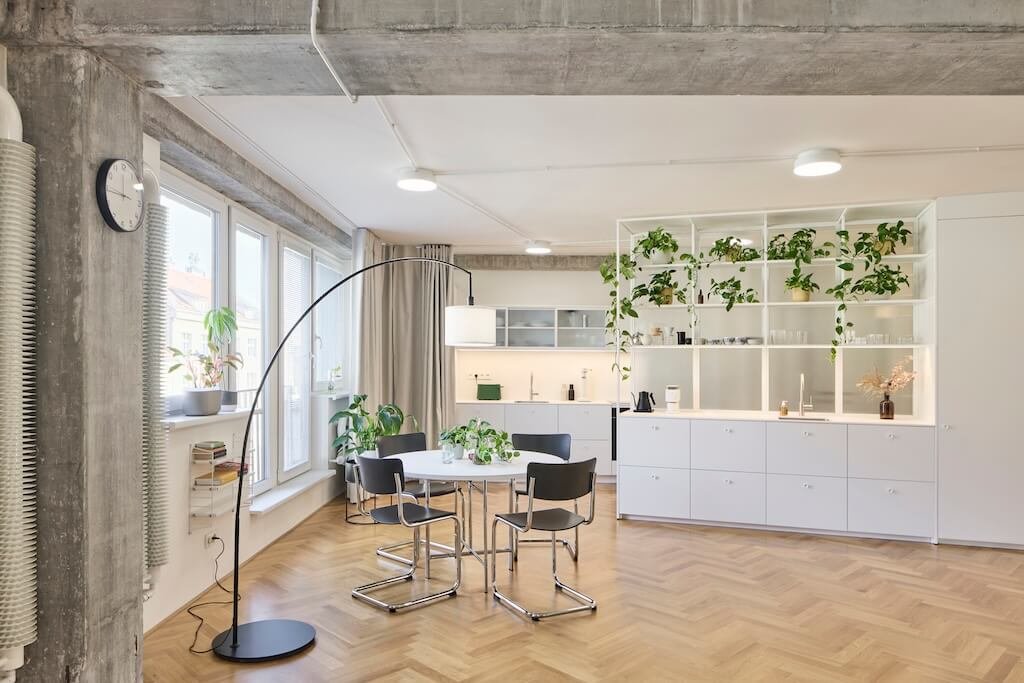
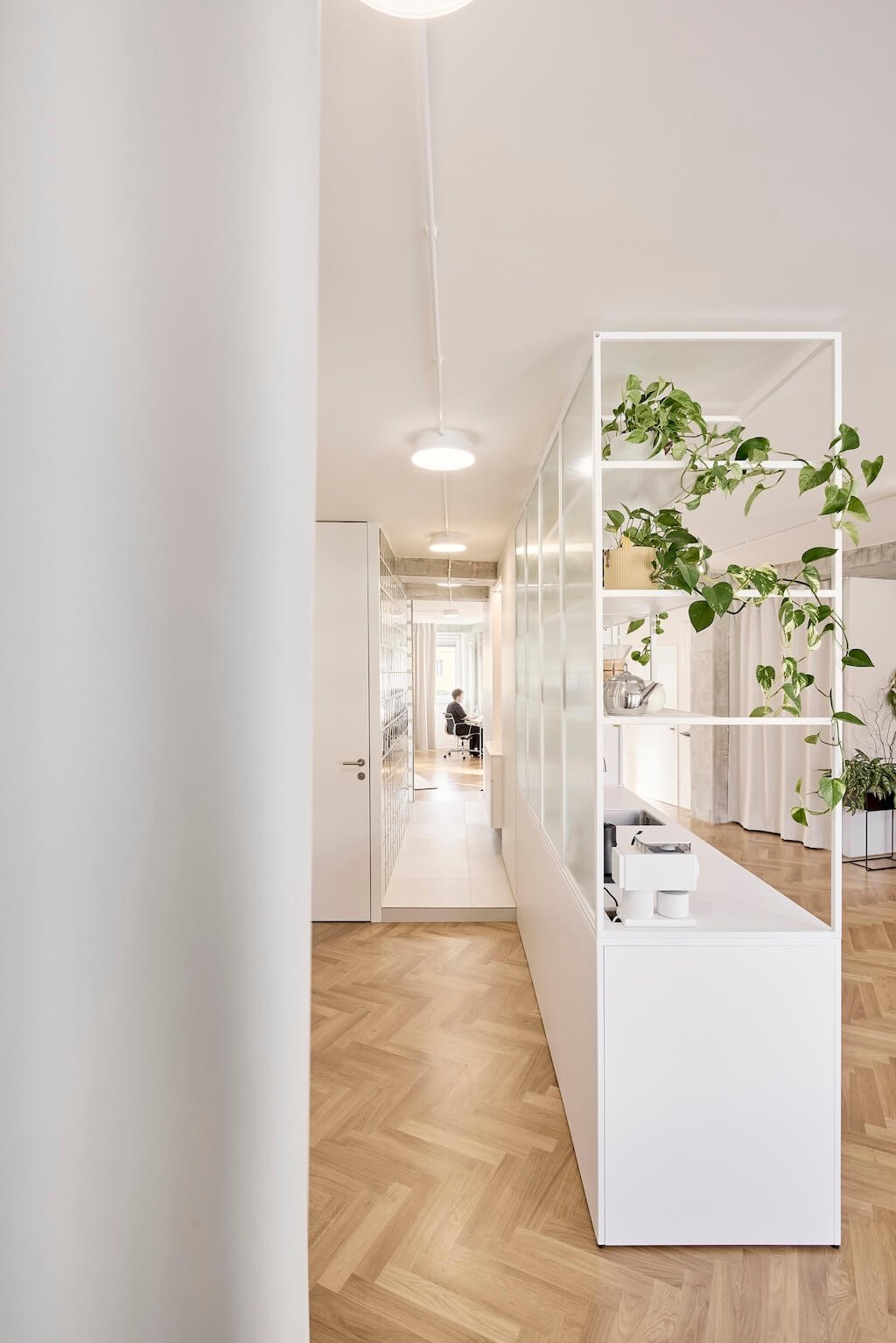
The apartment contains two distinct kitchen configurations, a decision that reflects both a practical reality and an honest acknowledgment of how urban domestic life in a well-served city actually works. The first kitchen sits directly in the living area and functions as what the architects describe as a home café: it is not intended for cooking and takes the form of an open shelving unit with ribbed glass panel doors, white cabinetry below, and a worktop surface, the kind of setup suited to coffee, breakfast, and the casual use that bookends a day spent largely outside the apartment. This unit, visible from the dining table where a round white table sits with cantilever chrome chairs beneath an arc floor lamp, works as both a display surface and a spatial divider between the dining zone and the living area beyond.
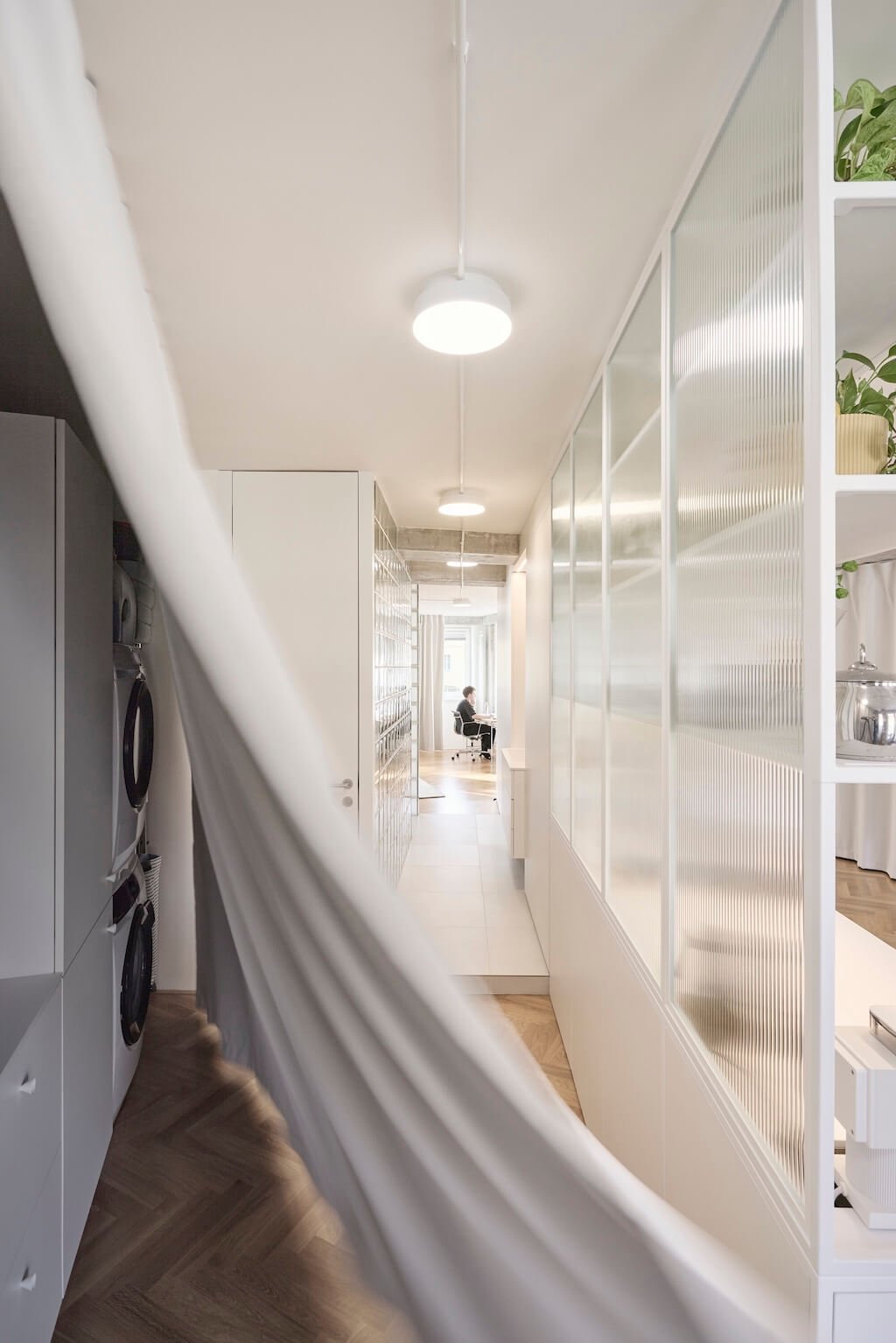
The second kitchen, fully equipped with all appliances and connected to a freestanding stacked washer and dryer, occupies the rear of the layout and is separated from the rest of the apartment by a full-length curtain that runs on a ceiling track and can be opened or closed entirely within a few seconds, as the image of a figure pulling the curtain apart to reveal the white kitchen behind makes physically clear. When the curtain is closed, this half of the apartment disappears. When it is open, the kitchen, the laundry, the open shelving stacked with plants and kitchen equipment, and the corridor leading to the home office at the far end of the plan are all visible in a single diagonal view that shows the full depth of the floor plate.
The Sanitary Block and the Washbasin Decision
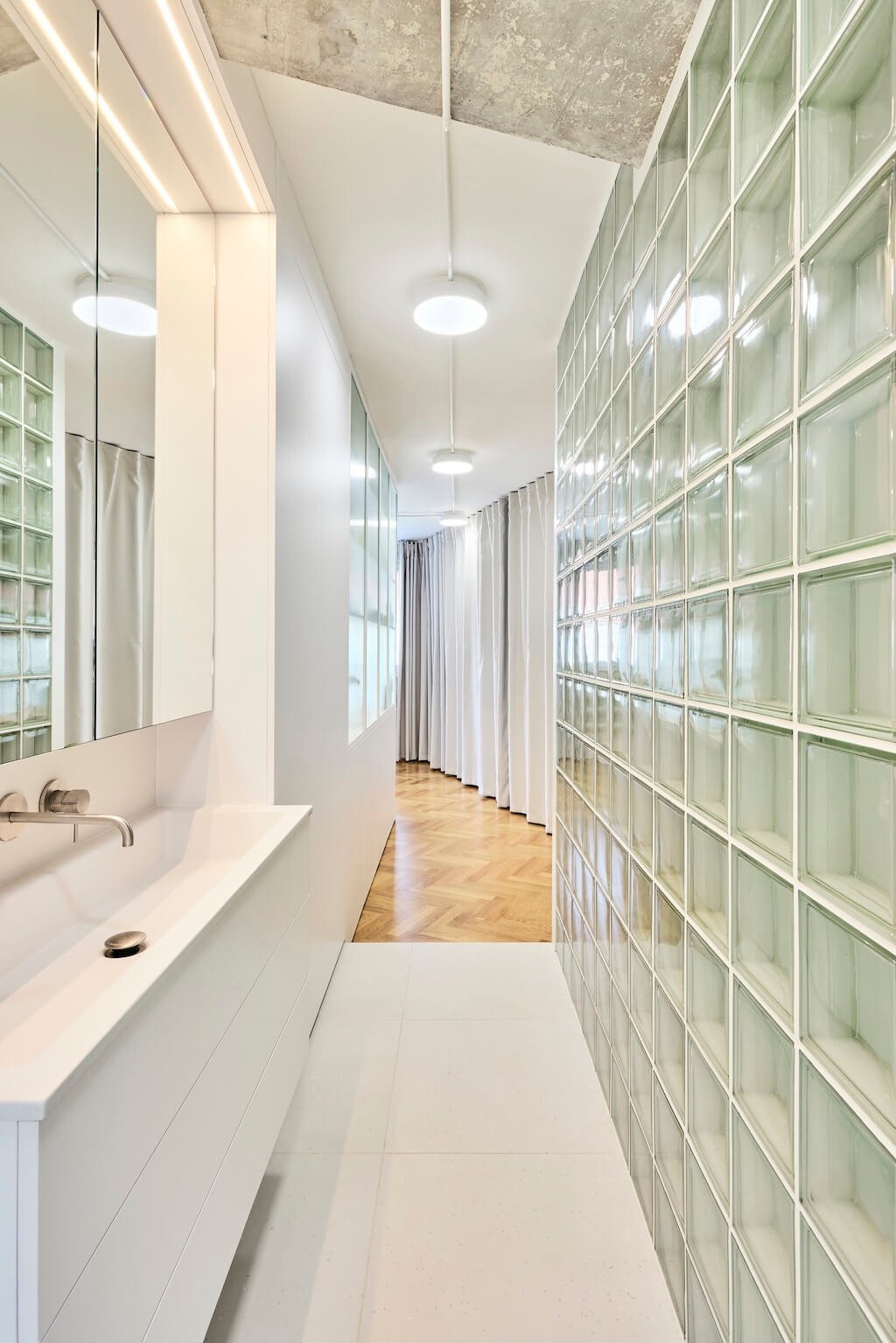
The sanitary facilities are organized behind the central furniture block, separated from the living and sleeping areas by walls built from glass concrete blocks, a material that transmits light while remaining opaque to vision, so that the bathroom and shower area contribute to the general luminosity of the apartment without sacrificing privacy. The glass block wall runs the full height of the partition and is wide enough to form the visual backdrop to the sleeping area on one side, its grid of pale green-tinted glass blocks reflecting light across the sage green bedding and the white floor of the shower zone on the other.
One of the more specific spatial decisions in the sanitary block is the deliberate placement of the washbasin outside the enclosed shower area, on a raised section of floor that contains the water and sewage distribution for both the basin and the sink, which runs along the length of one wall with a wall-mounted brushed steel tap and a linear LED-lit mirror above. By moving the washbasin outside the wet zone, the architects have given it a function that extends beyond hygiene: it becomes accessible from the corridor, from the bedroom, and from the wider living space, which in practice means it works as a utility surface as much as a bathroom fitting and does not require anyone to enter the shower room to use it. The toilet occupies its own smaller enclosed volume adjacent to the sanitary block, separated by an opaque but light-transmitting glass concrete wall and fitted with the apartment’s only conventional door.
Materials and Atmosphere
The exposed concrete skeleton of the building is the apartment’s primary material statement, and RDTH Architekti have returned it to its natural finish of raw concrete after what was presumably a previous renovation that had concealed or painted over it. The columns appear at regular intervals across the open plan, their texture and color sitting in deliberate contrast to the white plaster of the internal walls and the white built-in furniture throughout, and the concrete beams that run between them at ceiling height give the space a structural legibility that makes its openness feel earned rather than arbitrary. A clock sits directly on one of the concrete columns in the dining area, and the contrast between that domestic gesture and the industrial quality of the material it is fixed to is characteristic of the whole project’s relationship between the raw and the inhabitable.
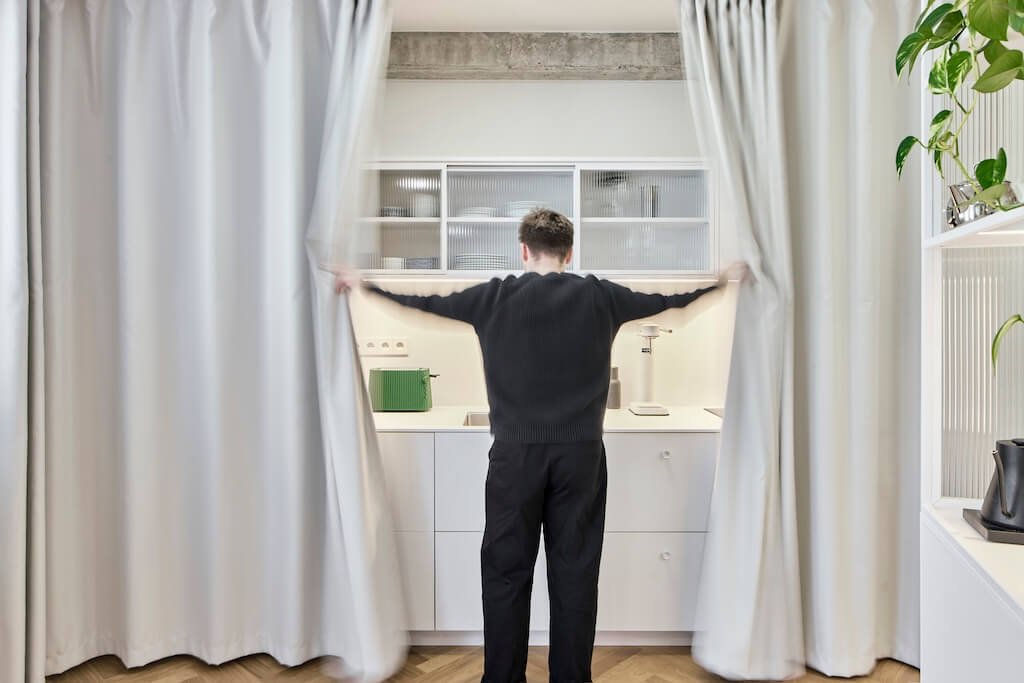
The floor throughout the apartment is solid oak-wood parquet in a herringbone pattern, warm and consistent across every zone, with the transition to ceramic tiles marking the raised threshold of the bathroom and shower areas. The curtains, in a neutral linen-adjacent tone, appear at the windows and as spatial dividers, and in both roles they serve the same two functions the architects assign to them: instant light regulation and improvement of acoustic comfort. The open shelving units in white steel carry trailing pothos and other indoor plants across multiple rooms, introducing a consistent green note that runs through the apartment from the dining area through to the corridor and the kitchen.
Lighting
The lighting system across the entire apartment runs on a single circuit, with individual fittings controlled digitally either from the residents’ mobile phones or from a home tablet, and with digital rocker switches placed in the positions where conventional switches would normally be found. The fittings themselves are simple, predominantly circular flush-mounted ceiling lights in white, with the linear LED strip above the bathroom mirror as the only directional exception. The decision to run everything on one circuit with digital control rather than separating the apartment into lighting zones by room is consistent with the overall logic of the project: the apartment does not have rooms in the conventional sense, so it does not need room-by-room lighting zones.
The City as an Extension of the Home
One of the design decisions that shapes the apartment’s storage and program is explicitly tied to its urban location. Within a ten-minute walk there are grocery stores, restaurants, cafes, sports facilities, parks, cultural institutions, a large library, and a metro station with a direct connection to the international airport, and RDTH Architekti have treated this proximity as a reason to keep the apartment’s storage capacity for groceries minimal and its floor plan correspondingly open. An apartment that can rely on the city for most of what a conventionally equipped flat would need to provide internally can afford to use that freed-up area differently, and the No-Wall Apartment does exactly that, keeping the square meterage it has gained by removing both walls and storage requirements in open, uninterrupted floor space.
Openness as a Long-Term Decision
The architects are direct about the fact that the degree of openness in this apartment is a conscious and informed decision rather than a universal proposition and that future residents or future needs might require a different configuration. The layout is designed to accommodate those changes without structural work: elements of the built-in furniture can be replaced, additional dividing elements can be introduced, and the curtains, glass blocks, and central furniture block that currently define the spatial hierarchy can be supplemented or reconfigured as priorities shift. The apartment in its current form is a response to a specific client’s specific moment, and the honesty of that framing is part of what makes the project worth studying.
Project Details
Project name: No-Wall Apartment. Architecture firm: RDTH architekti. Location: Prague, Czech Republic. Photography: Filip Beránek. Principal architects: René Dlesk, Tamara Kolaříková. Design team: Kristián Vnučko, Kristýna Kopecká. Construction: David Koubek. Gross floor area: 101 m². Usable floor area: 96 m² apartment, 8 m² loggia. Design year: 2022. Completion year: 2026. Materials: Solid oak-wood parquet, ceramic tiles, glass concrete blocks. Client: Private.
