
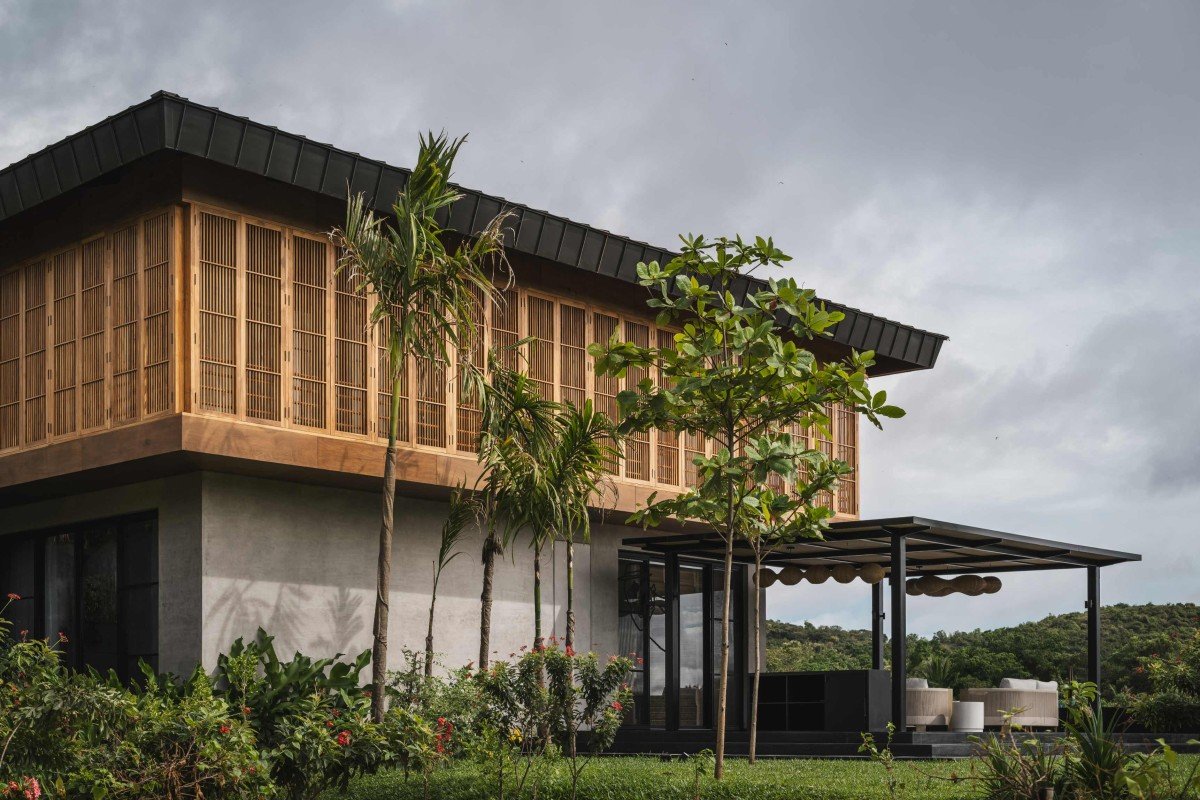
The ten-acre property in the village of Agarvado took a decade to acquire. Nestled between the Chapora River and a dense mangrove belt, the ten-acre property features three man-made salt pans that predate any architect’s arrival, making it a site that requires patience. When Saahil Parikh and Nupur Shah of We Design Studio first visited, it was monsoon season. The terrain was so waterlogged they could barely cross it, with mud climbing to their ankles before they had covered much ground. They came back anyway and kept coming back until what finally emerged from that marshy, specific, quietly extraordinary landscape was a house that looks as though it was always going to be exactly here.
Coastal regulations in Goa limit how much you can build and where, which meant that 6,000 square feet had to carry five bedrooms, six bathrooms, a full program of living and dining and kitchen and bar, and a spa below the pool deck, without the excess that a less considered brief might have allowed. Parikh and Shah responded by placing the house at the southern edge of the largest salt pan so that the reflective body of water sits in constant, shifting view and by letting the logic of the site and the demands of the tropical climate set the terms for everything else. The result is a house of three distinct layers that reads from the outside, particularly from across the pool where the infinity edge dissolves into the saline water and the mangroves stretch beyond it, as a single unhurried object held carefully against the Goan sky.
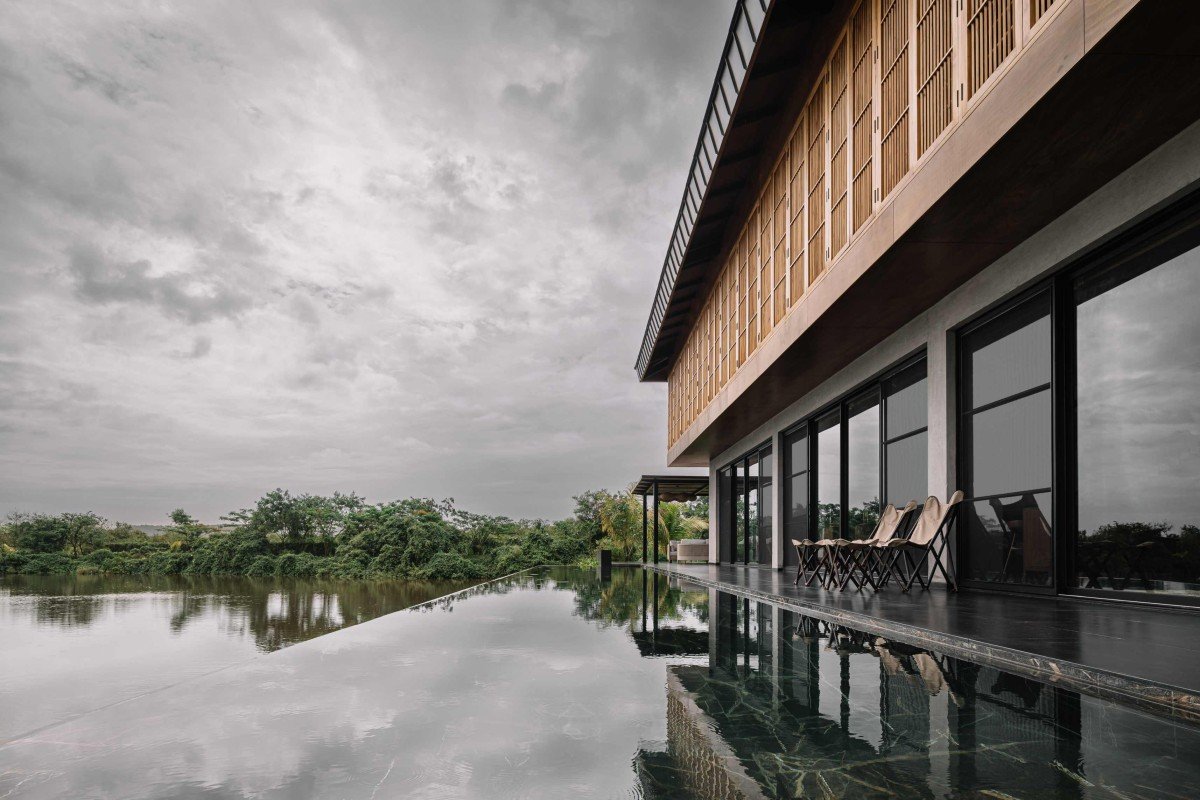
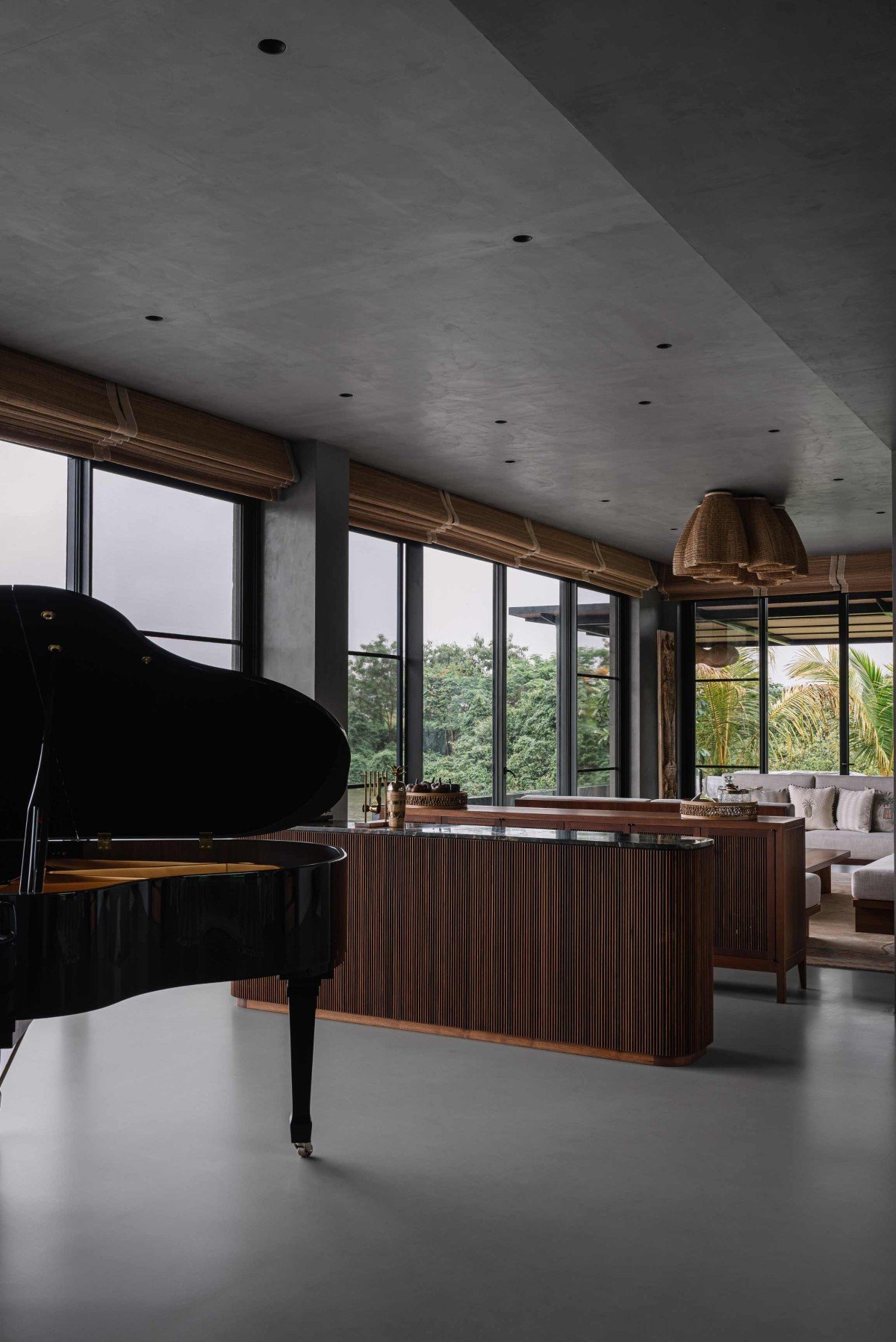
The ground floor is raw concrete, low and heavy, anchored to the earth. The living and dining rooms, the kitchen, a bar, and a guest bedroom that faces south toward a belt of dense foliage all occupy this level, opening through full-height glazing to the pool deck and the salt pan beyond. Above it, a cantilevered volume entirely wrapped in openable teak louvered screens holds four bedrooms and a family lounge, the warm grain of the teak sitting against the grey of the concrete below with the ease of materials that belong in the same landscape. A titanium-zinc alloy roof, dark and precisely pitched, sits over everything, its clean edge cutting against the grey monsoon sky in photographs that make the building look as though it has always been part of the horizon it interrupts. At night, the light filtering outward through the teak screens gives the upper floor a lantern quality, visible from across the water.
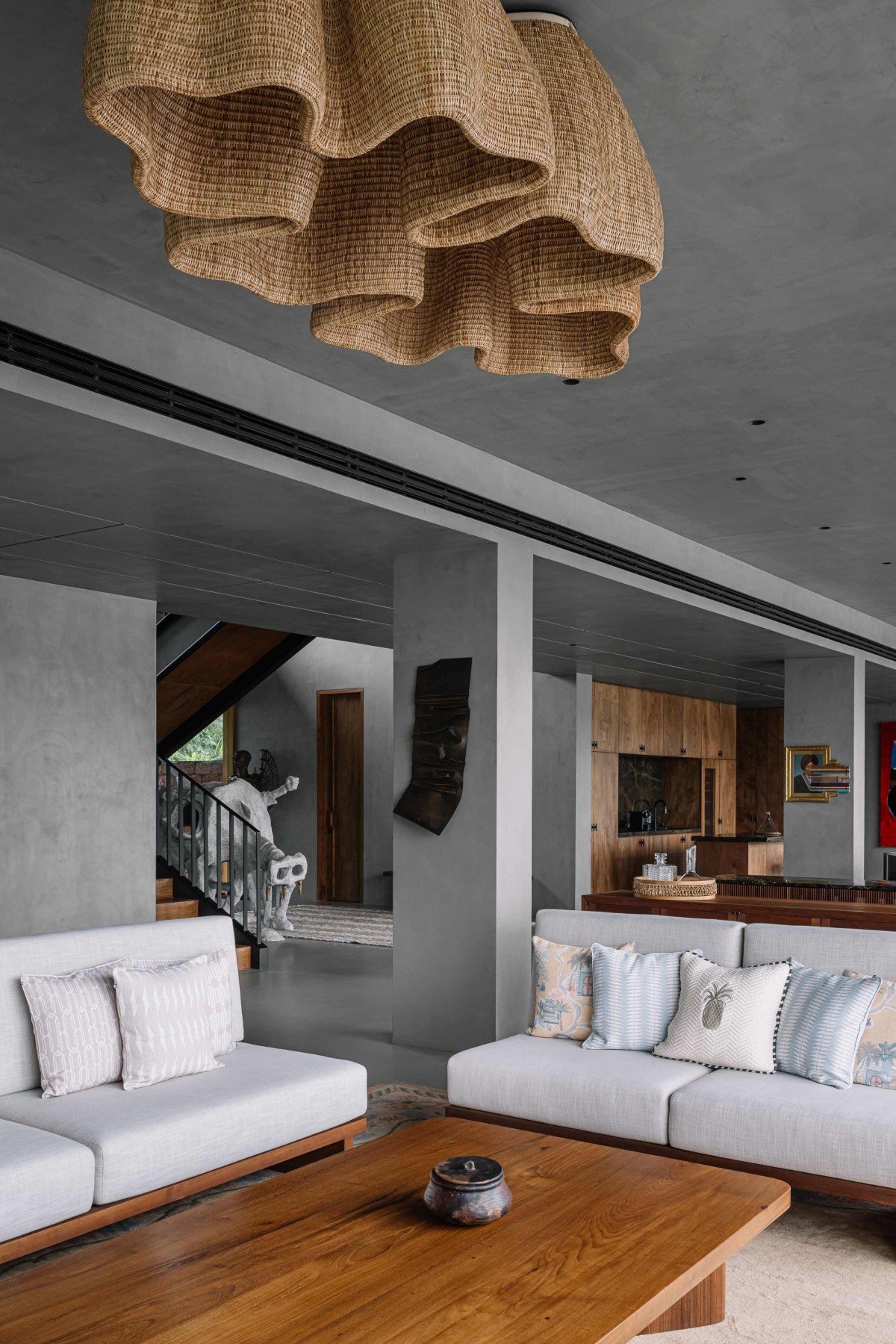
Arrival is from the land side, up black stone steps beneath a steel-framed entrance canopy flanked by laterite brick walls, the red of the laterite warm against the grey of the concrete and the dark of the steel. The entrance frames a view straight through the double-height interior to the salt pan on the other side so that the landscape the house sits within is present from the very first moment of entry. Inside, the ceiling rises to follow the pitch of the roof, with grey cement plaster walls running uninterrupted from the floor to the exposed timber beam. Two low grey linen sofas sit around a long solid wood coffee table on the polished concrete floor, a large woven rattan pendant overhead, its form organic and voluminous, more closely related to something found on a shoreline than to anything manufactured. Bamboo roller blinds on one side, the full width of the salt pan through the glazing on the other. On days when the light is flat and the water is still, the pool and the pan beyond read as a single continuous surface, the boundary between the built and the natural genuinely indistinct.
An ancient carved wooden panel leans against a column near the staircase. The art in this house is not decorative in any conventional sense. It accumulates through the rooms the way a personal collection does over decades, which is to say without a single governing logic, each piece present on its own terms. A dark abstract work is mounted on the wall of the living room. A circular painting anchors the dining area. Framed works in various registers punctuate the grey plaster at intervals across the ground floor. At the base of the black steel staircase, a large, imposing pale grey sculptural form takes up the floor with authority, dramatically altering the character of the space around it. It sits beneath the staircase the way a significant work always sits: as though the room was arranged around it rather than the other way.
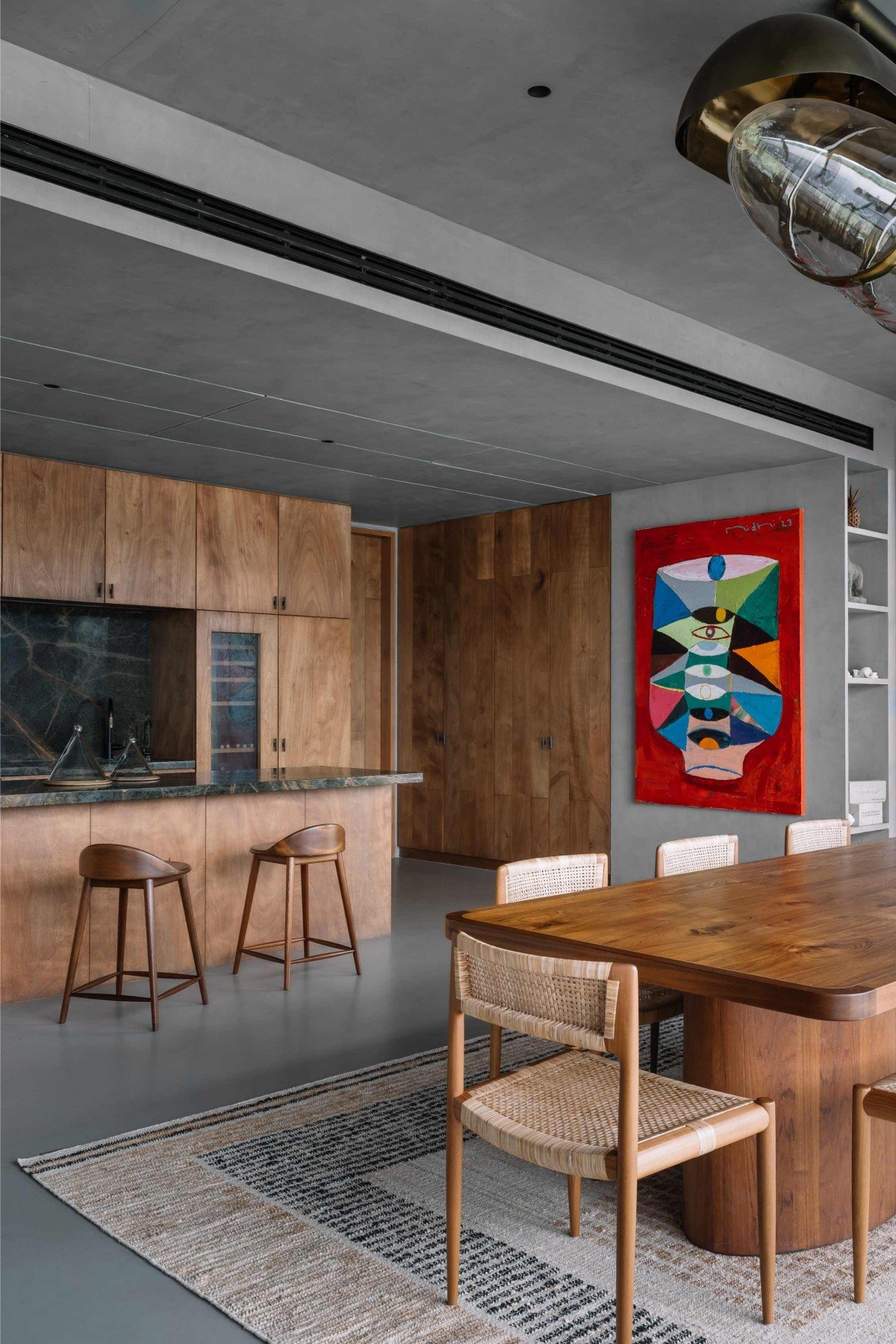
The dining table is solid teak, long and rounded at both ends, surrounded by cane-back chairs. A brass and glass industrial pendant hangs above it. The bar and kitchen cabinetry behind is warm oak, floor to ceiling, set against countertops and a backsplash in richly veined dark green granite, the stone so particular in its patterning that it reads almost as a geological specimen. An aged brass pendant hangs over the island. The concrete floor continues through. It is a kitchen that is completely resolved without drawing attention to itself, which in a house so full of things demanding attention is its own kind of achievement.
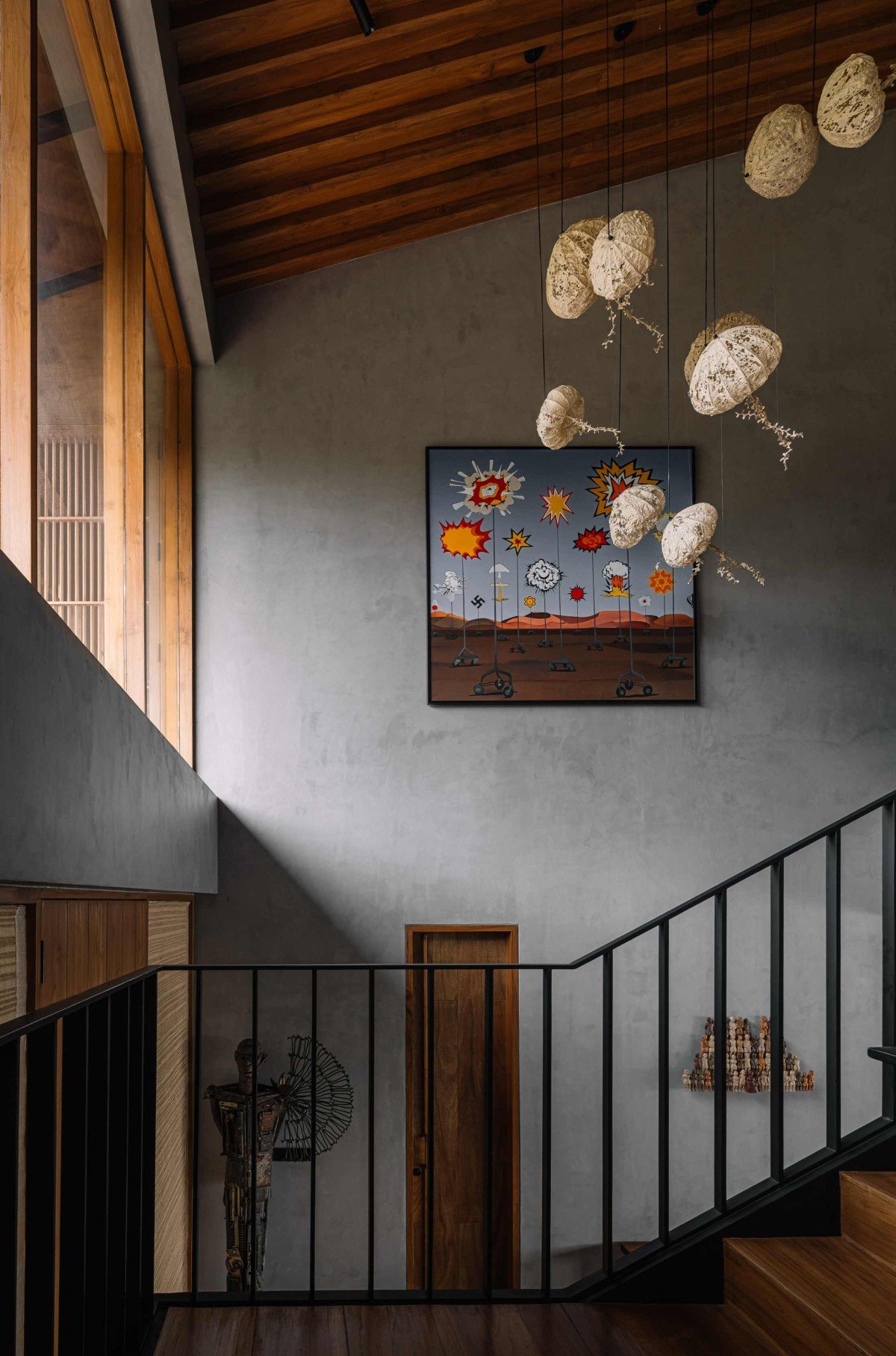
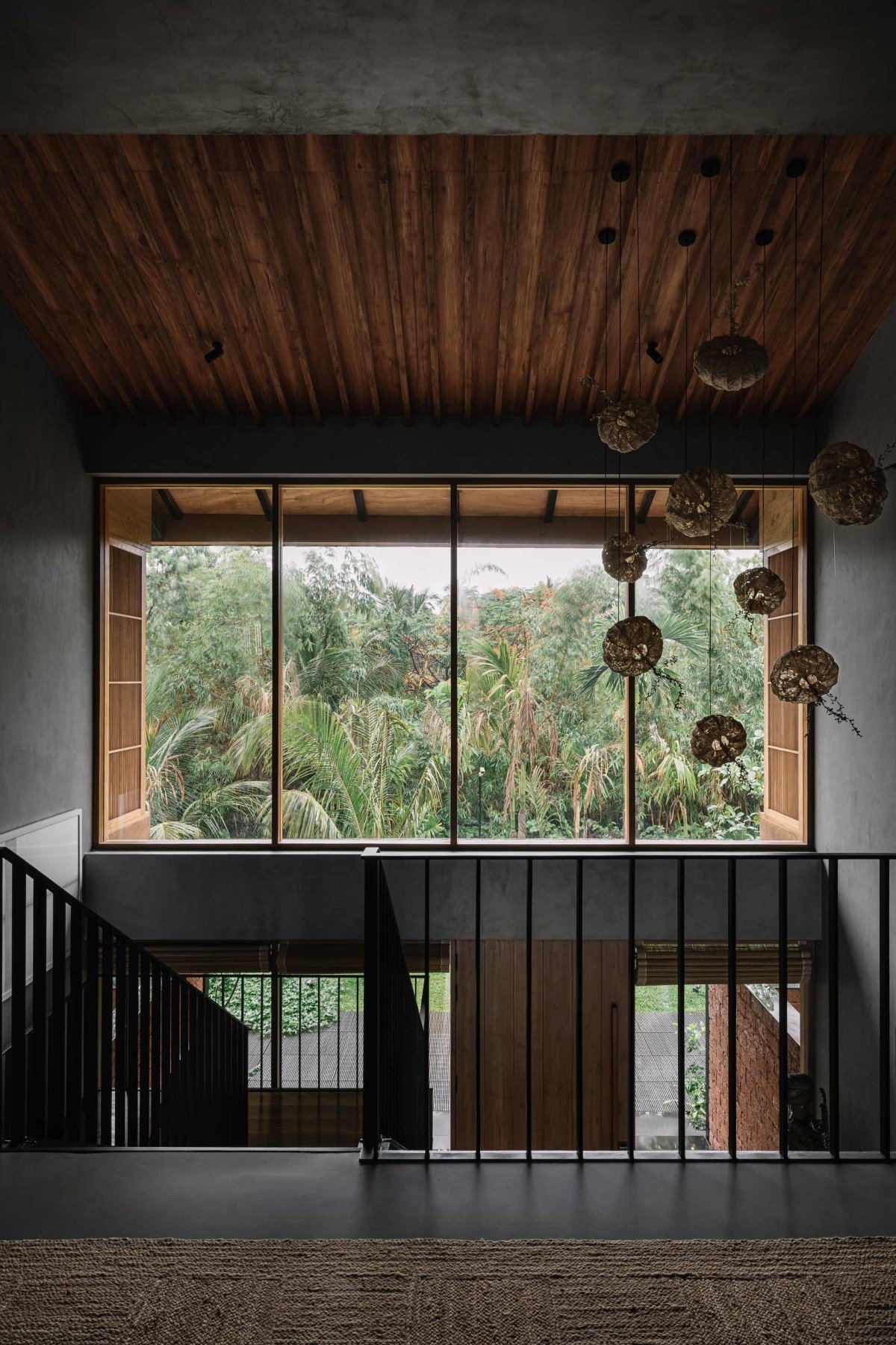
The black steel staircase climbs through the double-height void beside a large, bold painting in vibrant yellows, reds, and oranges, the only vivid element in an otherwise muted house. At the upper landing, looking across the black railing, a full-width picture window frames an unbroken wall of tropical green, the mangrove canopy so close it reads almost as a painted surface. Organic nest-like pendant lights cluster from the timber ceiling of this landing, echoing the nearby vegetation and blurring the boundary between the manmade and the natural.
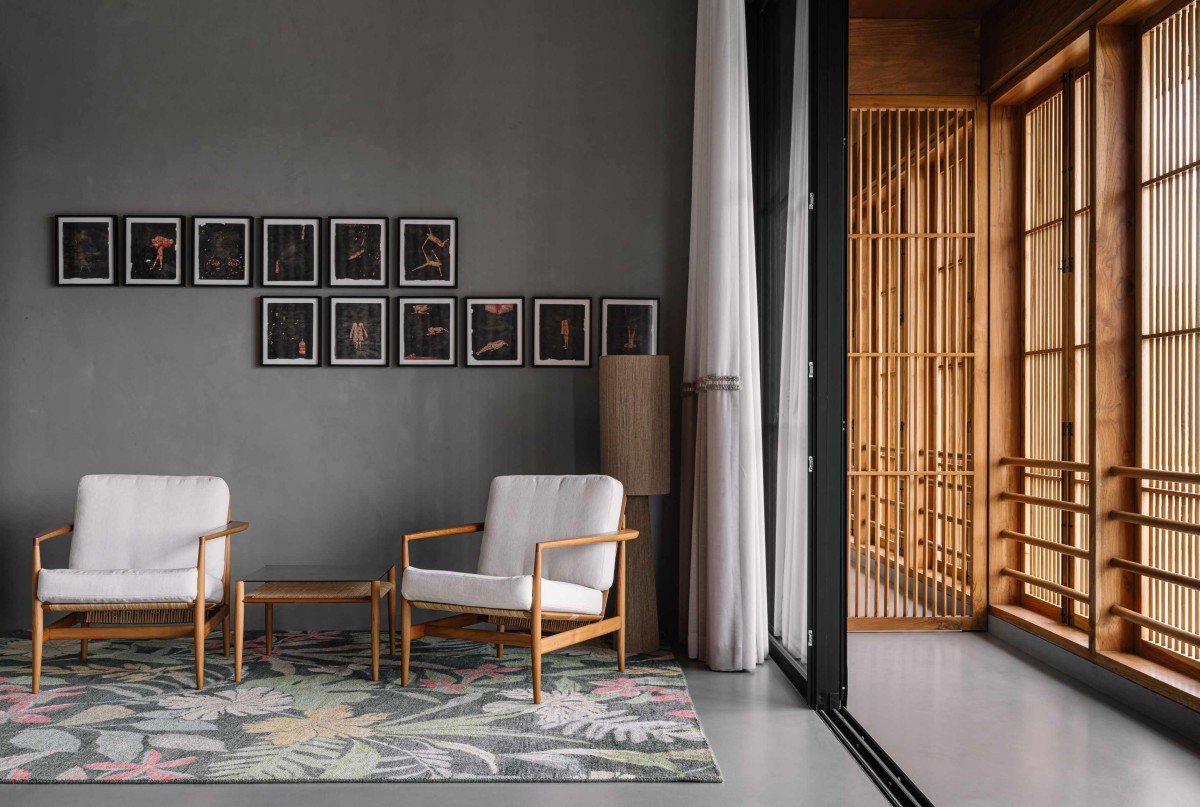
The first-floor corridor runs between the bedroom doors on one side and the teak louvered screens on the other, and on a sunny day the slats cast long parallel lines across the grey cement floor that shift and narrow as the hours pass. It is the kind of incidental architectural experience that photographs well but feels better in person, the quality of light so particular to this building and this landscape that it could not have been produced by any other combination of materials and orientation. The family lounge at the end of this corridor is the warmest room in the house: a large curved pleated sofa in pale grey, round armchairs, a circular jute rug, a dark wood coffee table, and a bronze pendant light shaped like a cluster of tropical leaves hanging from the timber ceiling, the teak screens filling the full wall behind the furniture, the landscape beyond them present in fragments.
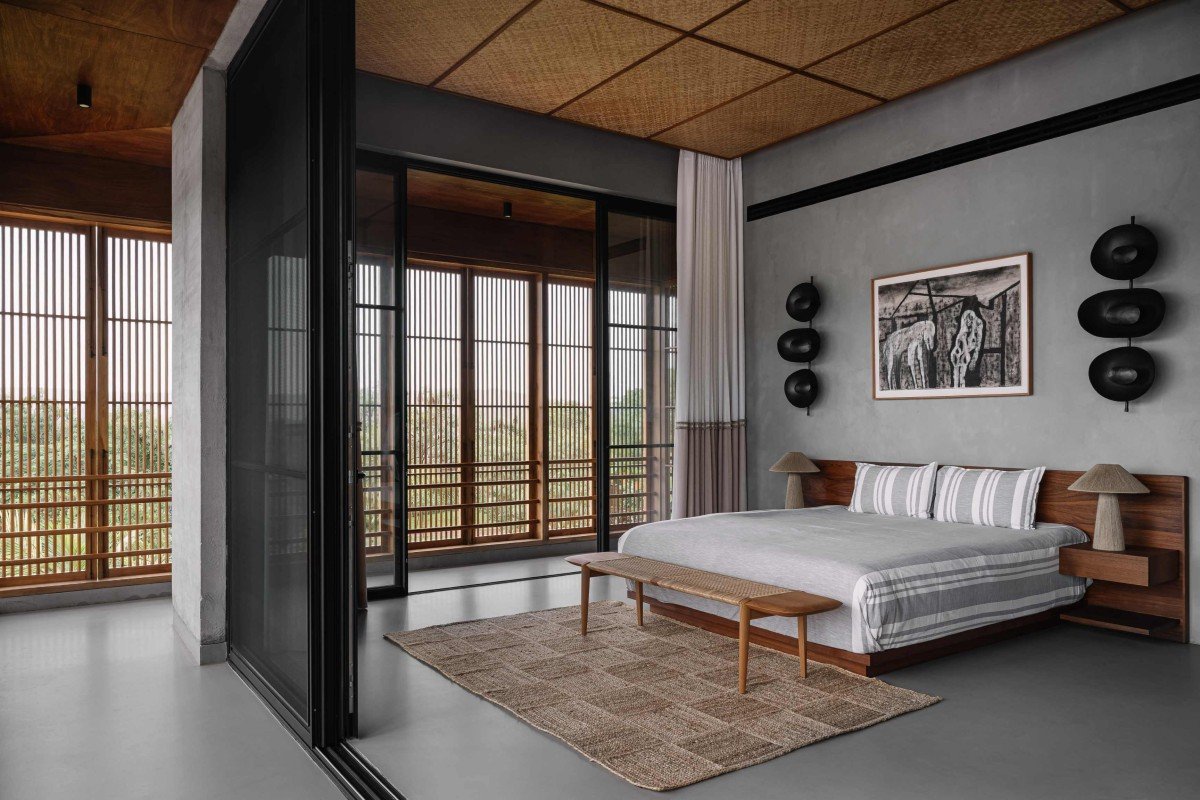
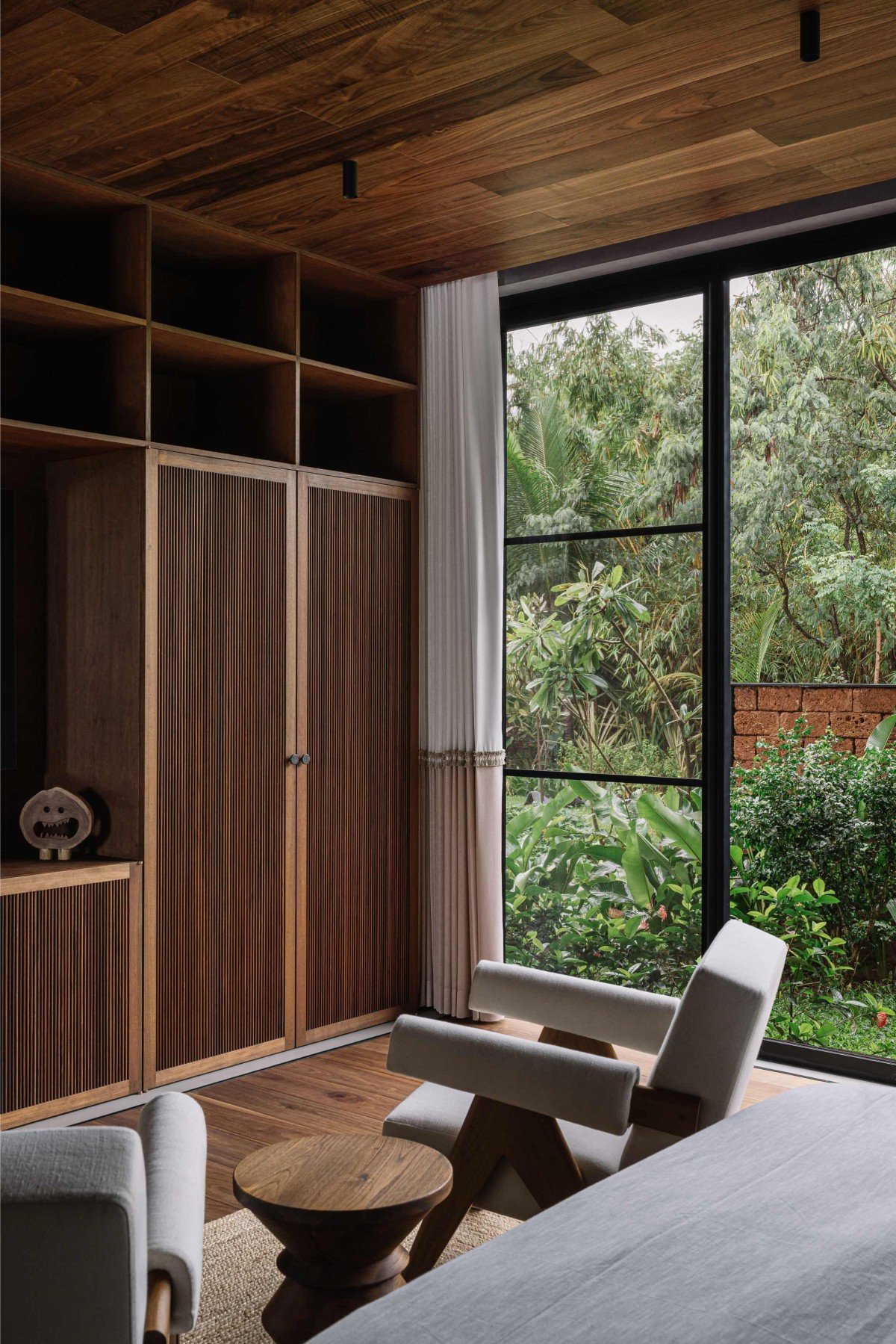
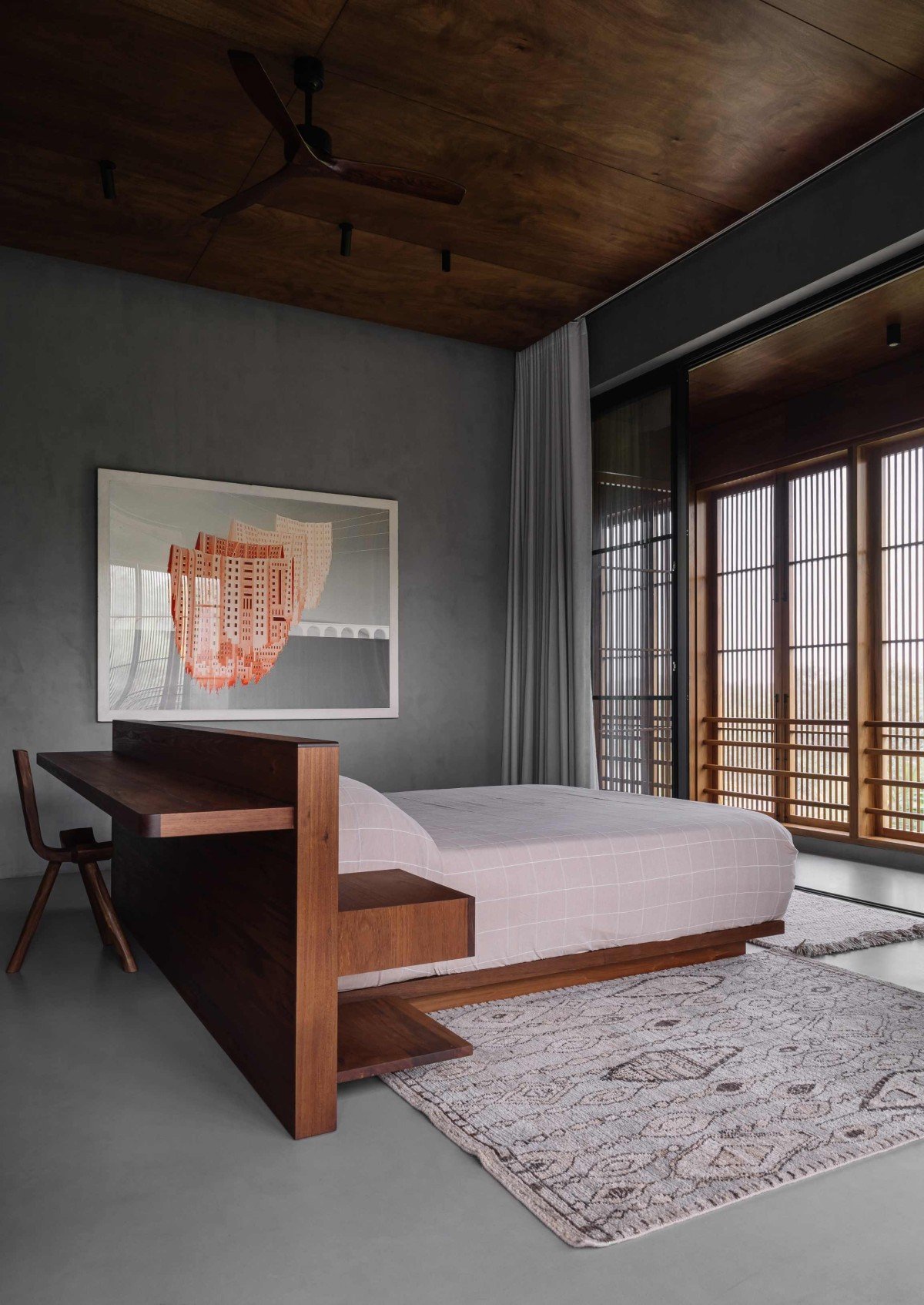
The bedrooms share the same material ground throughout: grey cement plaster, dark timber ceilings, ceiling fans, teak screens, and full-height glass opening to the continuous balcony that wraps the entire first floor. Within that shared register, each room has its own character. One has a platform bed with a solid wood desk integrated behind the headboard, a framed artwork in deep red and grey above it, a patterned rug, and through the glazed wall, nothing but a tropical canopy. Another has a walnut bed with paired side tables and lamps, a cane bench at its foot, black sculptural wall sconces flanking a framed figurative work, and the salt pan landscape reading through the louvered screens in long horizontal lines of water and sky. A third room features floor-to-ceiling glass opening to a private garden, warm timber flooring, and upholstered armchairs facing the lush Goan green, blurring the boundary between the room and garden.
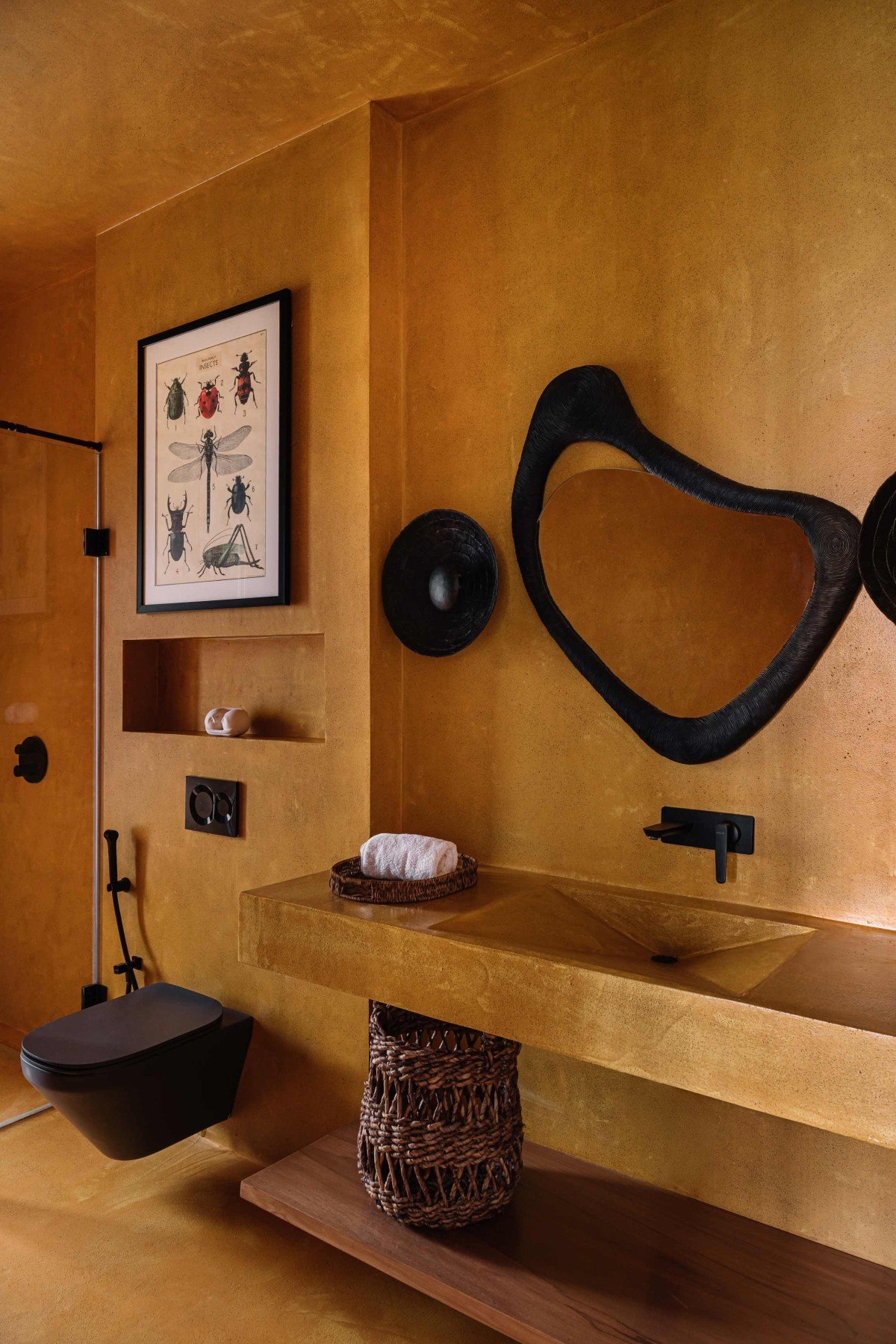
The bathrooms are where the house allows itself the most freedom. One bathroom features black textured stone, an organically shaped mirror in a rope-wrapped surround above a black undermount sink, and sculptural black sconces with globe bulbs. It is so monochromatic and so still that it reads more like a room designed for thought than for grooming. The other goes somewhere entirely different: dark green-veined marble covering every wall and surface, the stone’s white veining catching the light in ways that change depending on where you are standing, a ceiling installation of glass and ceramic beads in green and white forming botanical and tropical leaf shapes overhead, a white ceramic vessel sink on a timber vanity, and brass fittings throughout. In two rooms of the same house, there are two completely different understandings of what material intensity can achieve when it is given enough confidence to follow through.
Below the pool deck, reached by a separate stair, a spa with a steam room, sauna, and changing rooms occupies a subterranean level that completes the program without altering the building’s profile from the outside. The ten acres beyond the house hold a pickleball court, an all-weather gym fitted with equipment made from recycled timber, a yoga pavilion, a greenhouse growing produce for the household, and a private jetty that reaches toward the river. Each element is thoughtfully integrated, harmonizing with the house and the surrounding landscape.
Building within a coastal regulatory zone in Goa brought specific technical demands. A coffer dam was required for the pool. An open municipal drain had to be integrated into the site planning. Each problem was resolved within the design rather than around it, making the house more thoughtfully designed as a result.
What Parikh and Shah have built on this salt pan in Agarvado is a house that is deeply specific to where it stands, to the quality of light that moves across that water, to the weight of the monsoon sky, and to the way the mangroves hold the horizon at a particular height. The materials are local, the logic is climatic, and the art that fills the rooms is personal in the way that only a collection gathered over decades can be. It is 6,000 square feet on ten acres, and the proportion feels exactly right.
Fact File
Project: Salt Pan House
Location: Agarvado, Goa, India
Area: 6,000 sq ft
Year of Completion: 2025
Design Firm: We Design Studio
Lead Architects: Ar. Nupur Shah and Ar. Saahil Parikh
Photography: Ishita Sitwala / The Fishy Project
Instagram: @wedesignstudio_mumbai
