
Sumedang sits in the highlands of West Java, a town set among hills that turn a deep green in the wet season and haze blue at the horizon on clear days. It is not a city that gets much attention from the architectural press, which makes what Suatudio has built here quietly significant. Rumah Tahu, a residential project completed in 2025, houses a single family in two generations. The architect and his wife are the residents of the South Dwelling, while his parents occupy the North Dwelling. The practice designed Rumah Tahu as a single architectural entity comprising two interconnected dwellings, prioritizing family relationships over programmatic convenience.
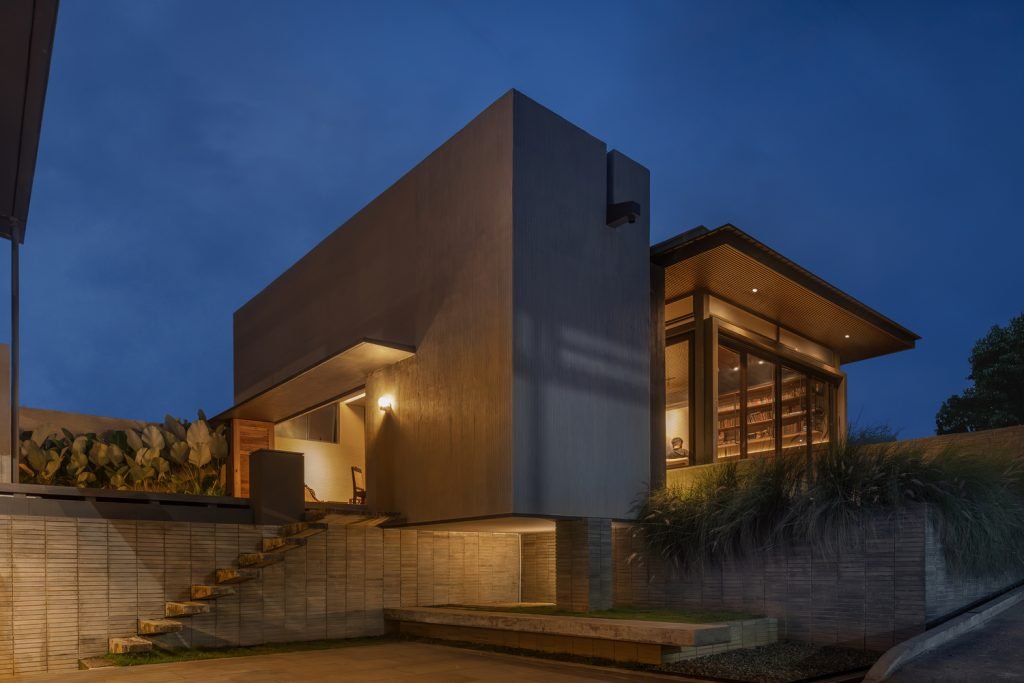
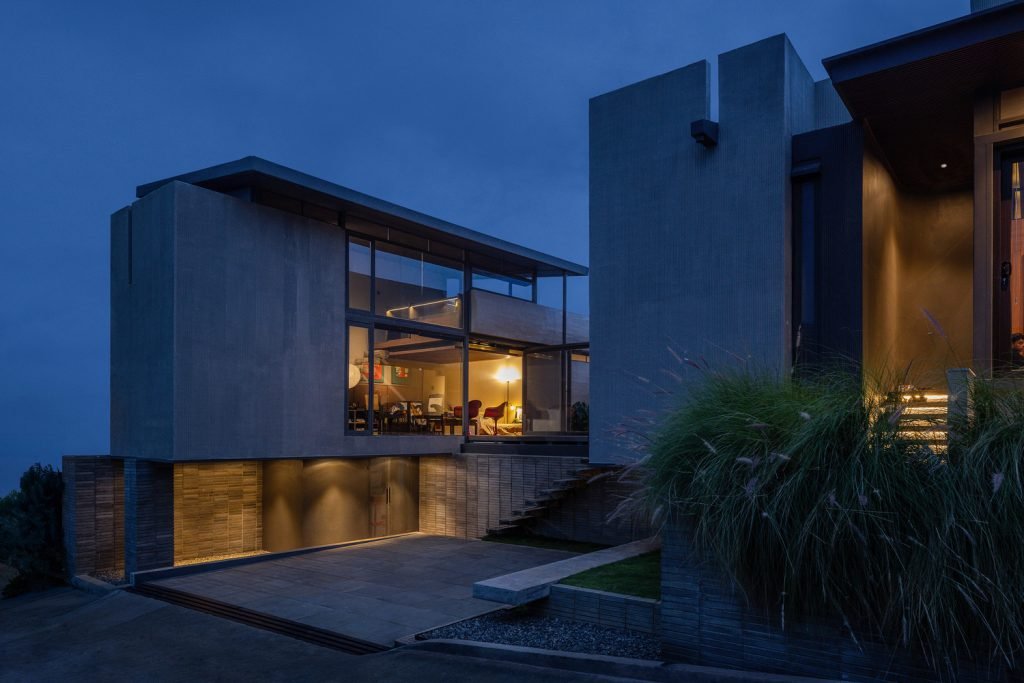
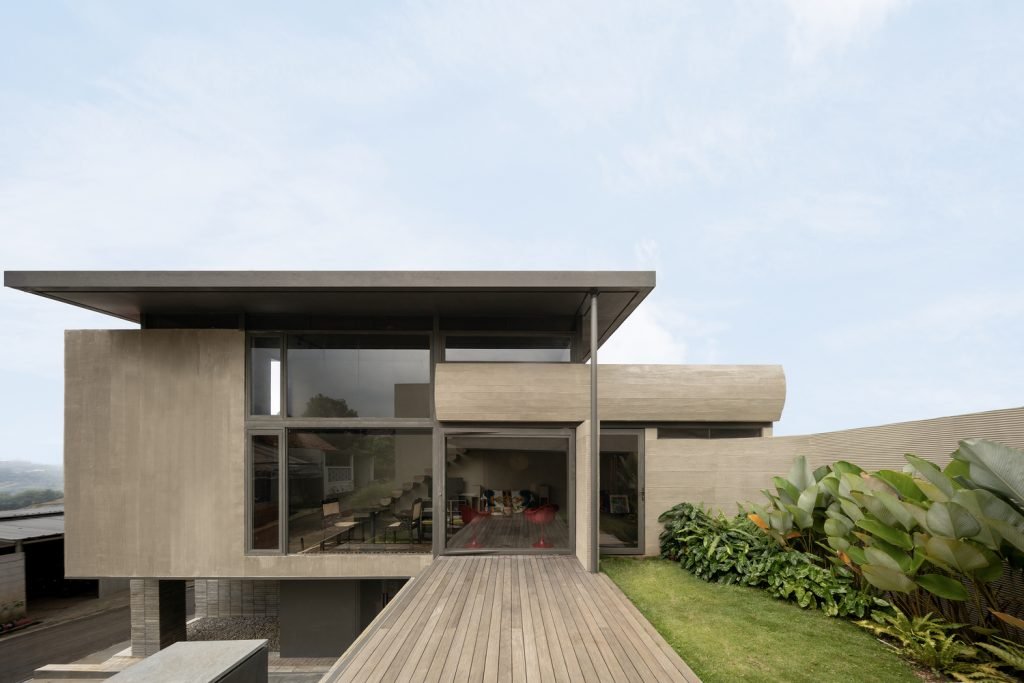
From the street, the two buildings read as a pair of board-formed concrete volumes sitting on a sloped site, connected by wide stone and concrete steps that climb the ground between them. The concrete is not the smooth, poured grey of institutional modernism but something more considered, a fine ribbed texture running consistently across every surface, almost like corduroy, shifting in tone between warm sand and cool grey depending on the light and the time of day. Below each volume, slim horizontal courses of dark charcoal brick form the plinths where the buildings meet the sloping terrain, a different texture and a different scale from the concrete above, grounding the structures without making them feel heavy. Wide cantilevered roof overhangs on dark steel frames extend over the glazed facades, cutting the tropical sun and giving both buildings a horizontal emphasis that keeps them from feeling monolithic despite the solidity of the concrete walls. Dense sweeping clumps of ornamental fountain grass are planted around the base of the North Dwelling in particular; their movement in the wind softens what would otherwise be a very hard edge between building and ground.
At night the project reveals a different character entirely. The concrete recedes into the darkness, the ribbed surface catching only the ambient light from the street, and what you see instead are the interiors glowing through the full-height glazing. The South Dwelling dining room and living space are warm with table lamps and the soft burn of timber joinery. The North Dwelling shows a large paper globe pendant hanging low over a round dining table, a Noguchi-scale presence that gives the room its identity from thirty meters away. The two buildings on the hillside at dusk, their interiors lit and the mountains of West Java visible as dark shapes behind them, look like exactly what they are—two households that have chosen to remain close to each other.
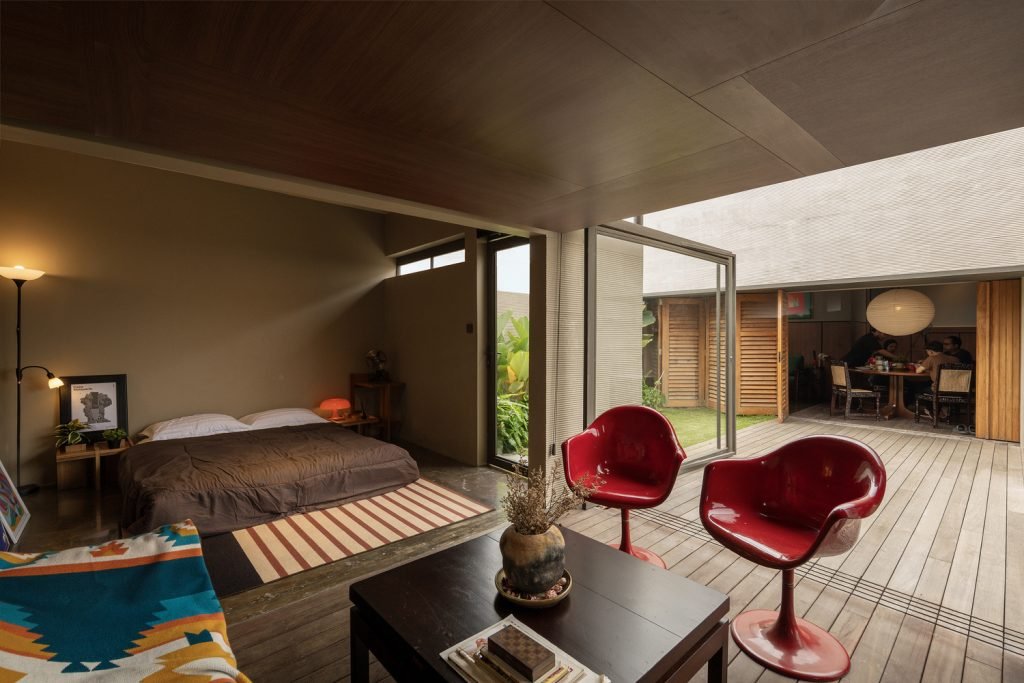
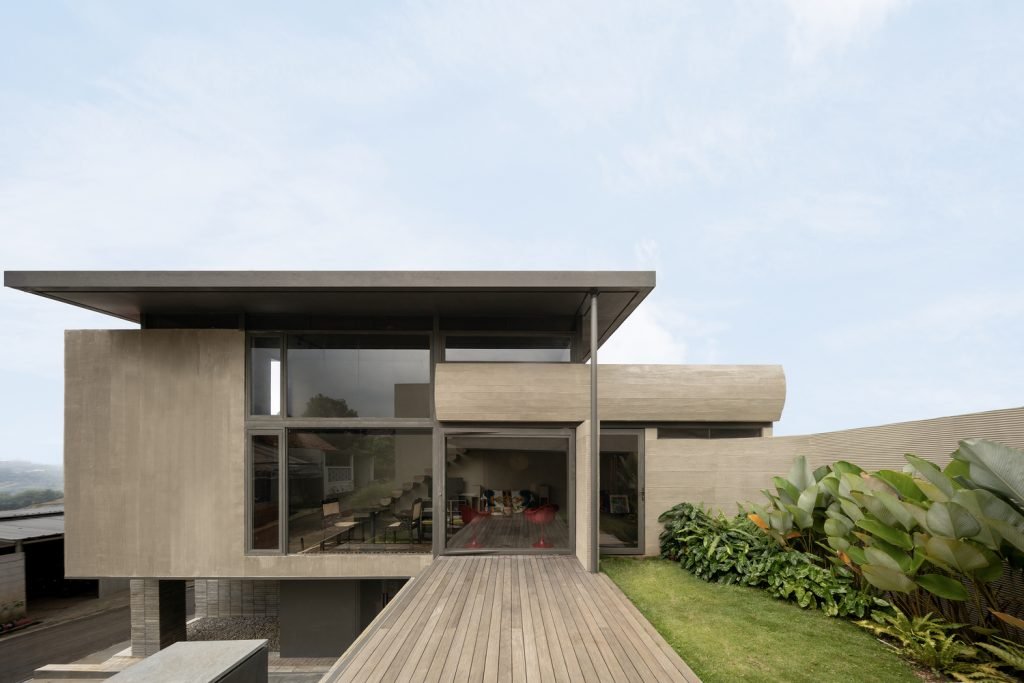
The project takes the standard Indonesian type-36 housing plot of 72 square meters as its starting point and refutes the assumption that limited floor area must produce limited spatial quality. Suatudio retained half of each 72 square meter plot as open space, a decision that immediately changes what the house feels like to be inside. The garden is placed not at the front of the building, as the typology conventionally dictates, but along its side, creating a long continuous outdoor room that runs the full length of the dwelling and connects directly to the interior through large panels that open completely. The ulin wood deck, made from Bornean ironwood, one of the hardest and most durable timbers in the region, spans between the two dwellings and between the interiors and the garden. It is wide enough to be furniture, to hold chairs and a table and a conversation, and warm enough in tone against the grey concrete to pull the eye toward it from every angle. When the glazed panels of both dwellings are opened simultaneously toward the deck and garden, the interiors, deck, and garden merge into a single continuous space, and the distinction between inside and outside becomes a matter of where you choose to sit rather than where the architecture says you should be.
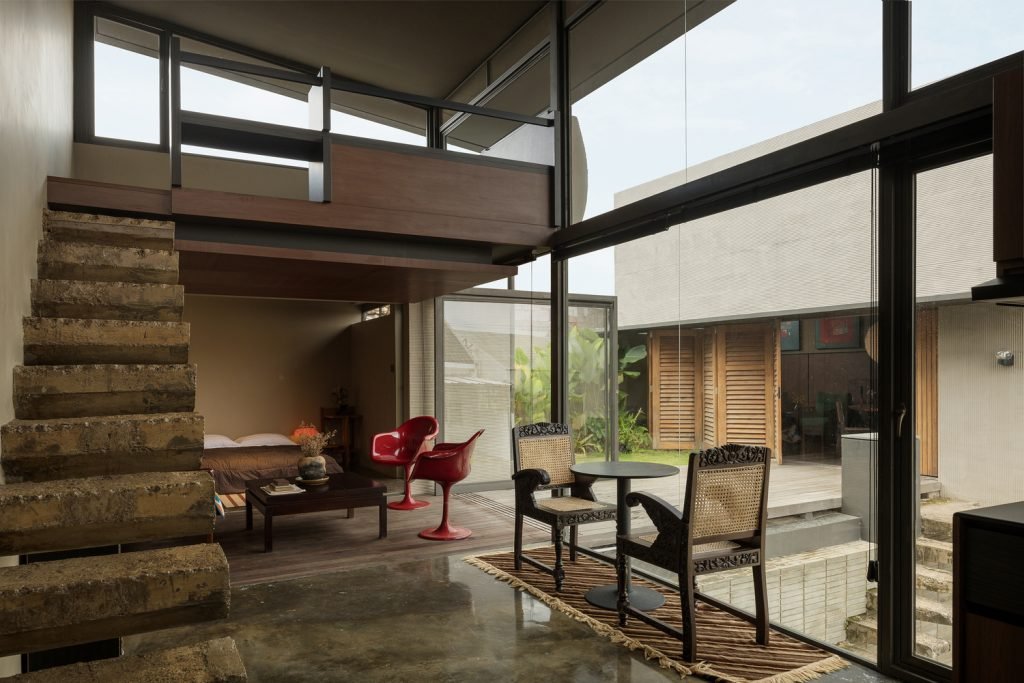
The South Dwelling is organized around spatial openness and cross-ventilation. Permanent partitions are kept to a minimum in the central area, which stays fluid and flexible for daily use. The bathroom is positioned at the eastern end of the plan, where it acts as a thermal buffer against the morning heat from that direction. The bedroom sits at the western end for greater privacy. The double-height living space is the most dramatic room in the house, and it earns that description through volume and character rather than size. A staircase built from rough-cut stone climbs one wall to a mezzanine level above, the texture of the stone deliberate against the smooth concrete and dark timber of everything around it. Below, the living room holds an eclectic mix of furniture that speaks clearly to the architect who lives here—vintage carved Indonesian chairs with rattan backs sit alongside red tulip-style seats from a different era entirely, a dark timber coffee table, a striped rug, books, and objects arranged with the casual confidence of someone who knows exactly what they like. The full-height glazed wall opens entirely onto the ulin deck and through it to the garden, the bedroom visible through a sliding glass partition to one side with its own direct connection to the outdoor space, red chairs positioned at the threshold as if the deck were simply another room.
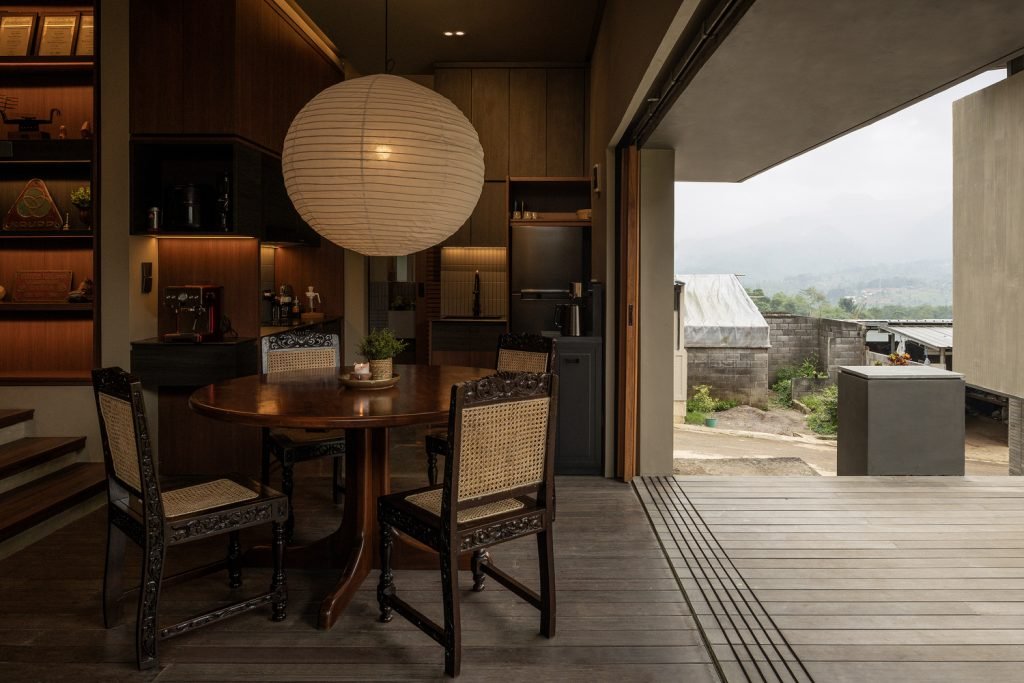
The North Dwelling, more enclosed and suited to an older generation, maintains a clear connection to the shared garden and South Dwelling via the deck. The studio organized it into two zones. The semi-private zone brings together the dining area, kitchen, sitting room, and bathroom in a continuous space that can be opened fully toward the side garden through large folding timber and glass panels. The dining room is anchored by the large paper globe pendant that reads so clearly from the outside at night, hanging low over a round solid timber table surrounded by carved wooden chairs with rattan seats—furniture that belongs to a household with a long history and a considered relationship with Indonesian craft. Behind the dining table, dark timber joinery lines the kitchen wall, shelved and organized and lit from within, a coffee machine given its own dedicated counter space in a detail that says something particular about the priorities of whoever lives here.
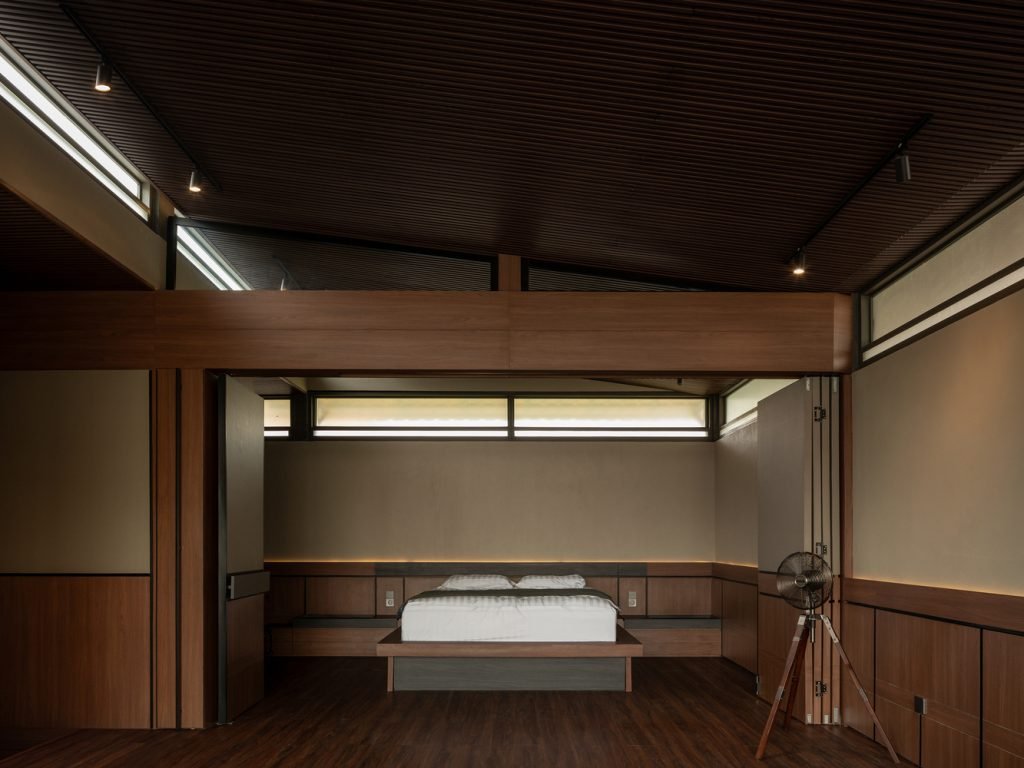
The sitting room in the North Dwelling is the room that stays with you longest. A wall of steel bracket shelving runs floor to ceiling, carrying what appears to be several hundred books in the full range of conditions that a well-used library acquires over decades—some upright, some stacked, some leaning, all read. Low seating is arranged in front of it, cushioned and without armrests, positioned for a long afternoon rather than a brief visit. A slatted timber ceiling runs overhead; clerestory windows set high in the wall bring in a band of diffuse light that travels across the room through the day without ever becoming harsh. The private zone of the North Dwelling contains the main bedroom and a living room connected by a sliding wall that can be opened to form a single larger space when the family gathers across both dwellings. The bedroom itself is almost entirely dark timber, paneled walls, a slatted ceiling, and a platform bed sitting low to the floor, with clerestory strip windows running along the junction of wall and ceiling so that the room has light and air without any sense of exposure.
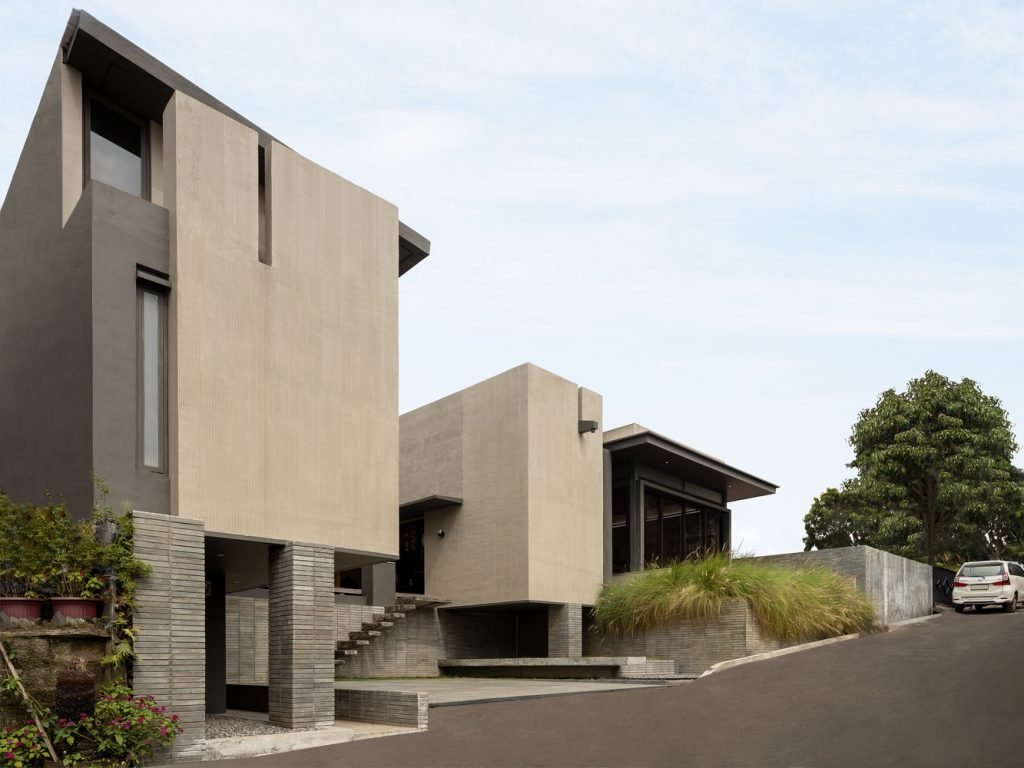
The material consistency across the two buildings holds everything together without making the project feel repetitive. Board-formed ribbed concrete, dark charcoal brick, warm ulin timber decking, dark steel framing, and timber joinery inside each material appear in both dwellings, and each carries through from exterior to interior in a way that makes the project read as a single piece of architecture regardless of which household you are in. The tropical planting, with banana plants with their broad leaves catching the light in the courtyard between the buildings and the ornamental grasses moving in the wind at the perimeter, keeps the project rooted in its West Java hillside setting.
Rumah Tahu covers a combined area of just over 1,400 square feet across both dwellings. It is a project that takes the most ordinary housing constraint in Indonesia and uses it to ask a more interesting question than the constraint usually produces: not how do you fit a family into 72 square meters, but how do you design a home around the specific shape of a family relationship?
Fact File
Project Name: Rumah Tahu
Location: Sumedang, Jawa Barat, Indonesia
Architect: Suatudio
Principal Architects: Gagas Firas Silmi, Arif Rachman Hidayat, Adhietya Orlandho Putra Sunarmo
Lead: Gagas Firas Silmi Design
Team: Rahsya Afwan
Structural Engineering: Alite
Project Type: Private Residential
Project Size: 1,410 sq ft
Year of Completion: 2025
Photography: Tristan Salim
Website: suatudio.com
Instagram: @suatudio
