
Chiang Saen sits at Thailand’s northern tip, where the Mekong forms the border with Laos and the mountains of Myanmar pile up on the opposite bank. It was once a significant city of the Lanna Kingdom, and that history has not gone anywhere—temple ruins push through the soil, old city walls still stand in sections, and the vernacular architecture of the region carries centuries of accumulated knowledge about how to build in this climate, on this terrain, for this particular way of life. When BodinChapa Architects, led by Phitchapa Lothong and Bodin Mueanglue, were commissioned to design a private residence here, the site came with all of that weight attached.
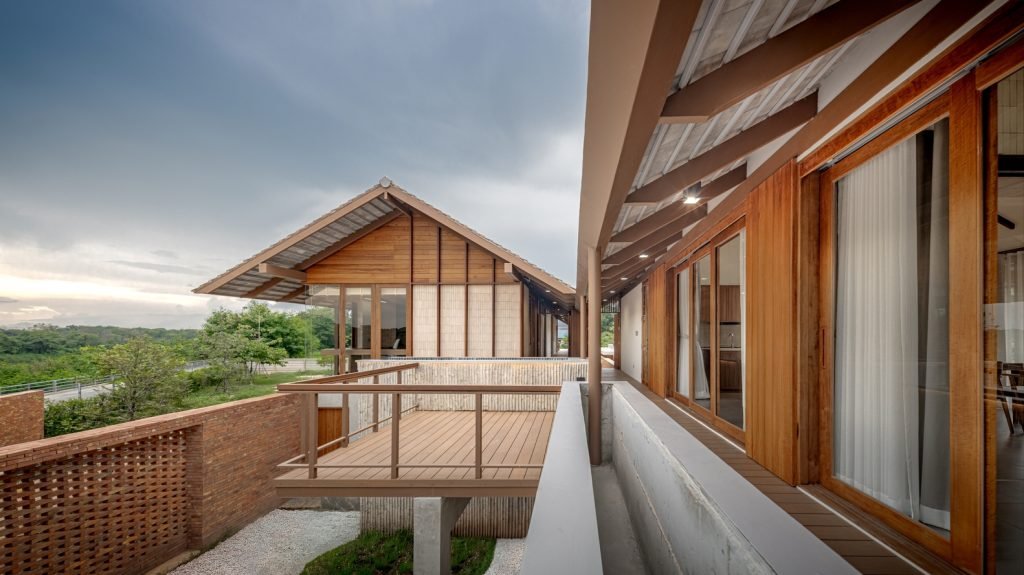
Their response was to take it seriously. The architects first studied Lanna vernacular housing, particularly the Ka Lae house, known for its steep gabled roof and efficient management of heat, rain, and social rhythms over centuries. The point of that research was not to find forms worth reproducing but to understand the reasoning behind them, reasoning that turns out to hold up well against contemporary ways of living. The Ka Lae house was built with its gable end facing south, orienting the long axis of the building across the sun path to manage solar gain and capture the prevailing breeze. Baan SudSaenSuk does the same, and the south-facing gable end here frames a view of the Mekong River and the mountains beyond that makes the climatic logic feel like an act of generosity toward whoever lives inside.
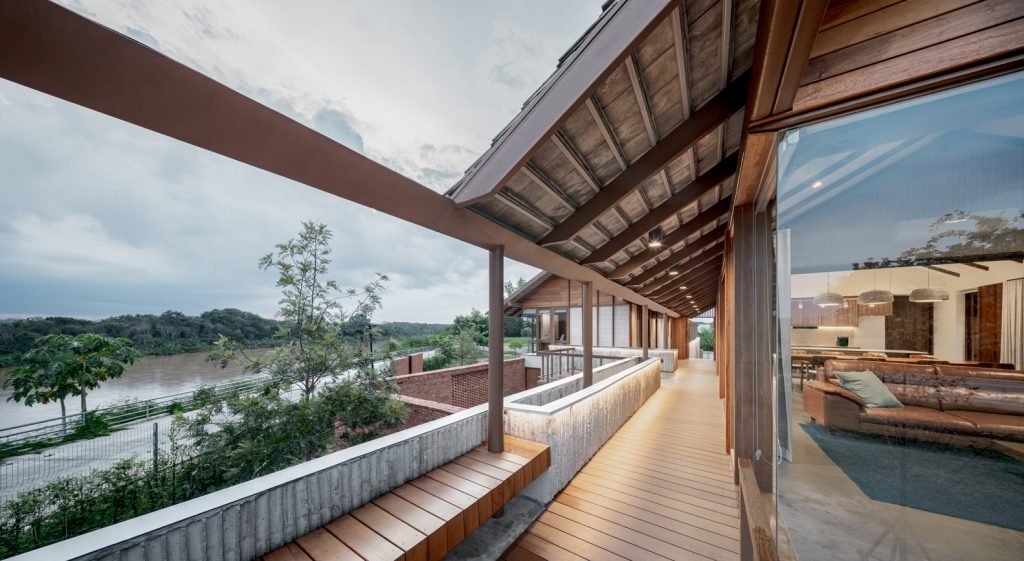
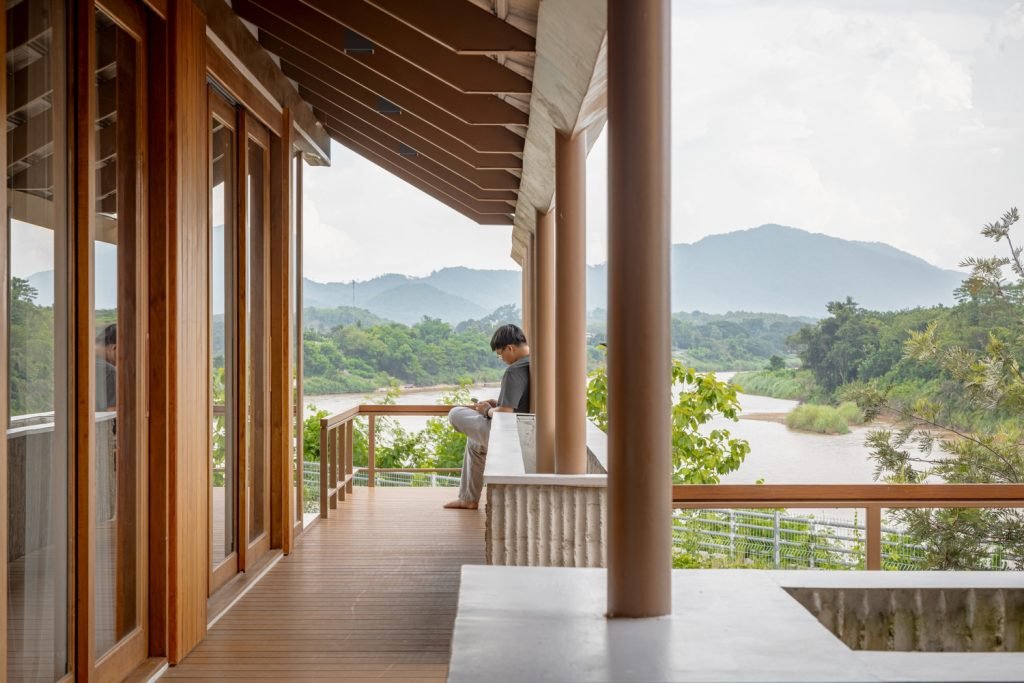
The site sits close to the river, separated from the bank only by a public village walkway, which created the central design problem of how to open the house toward that landscape without exposing it to everyone passing by. The architects rotated the building axis 45 degrees from the site boundary so the long elevation never runs parallel to the walkway, creating a spatial buffer wide enough for planting and earthen mounds to filter views from the path. The house is elevated on a cast concrete base, referencing traditional Lanna architecture, which enhances air circulation, improves views of the river, and provides useful storage below. From the south-facing terrace, the Mekong bends through the frame of the roof overhang, mountains layered behind it in blues and greens that change through the day.
The plan follows the traditional Lanna twin-house concept, separating the sleeping quarters into one gabled volume and the kitchen and service areas into a second, keeping private life clearly distinct from the activity of cooking and gathering. The two volumes are connected by the Chan and the Tern, transitional spaces native to northern Thai domestic architecture with no clean Western equivalent. The Chan extends as open timber terraces to the north, south, and central areas of the house, while the Tern functions as a semi-open connective zone at the heart of the plan, neither room nor corridor, linking the two volumes while drawing air through the building and reducing heat in the interior rooms. Connecting the twin gables above is a continuous rainwater gutter that channels collected rainfall into brick water reservoirs positioned to the north and south of the house, where it is stored and reused for garden irrigation. It is a passive system that works precisely because the building’s section and its environmental strategy were developed together from the start.
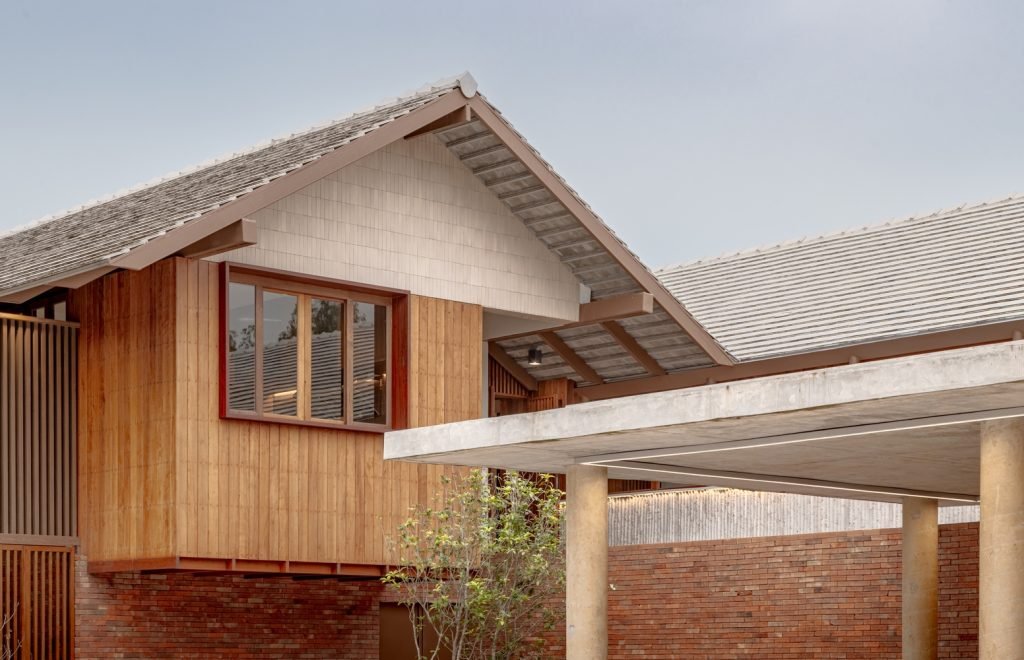
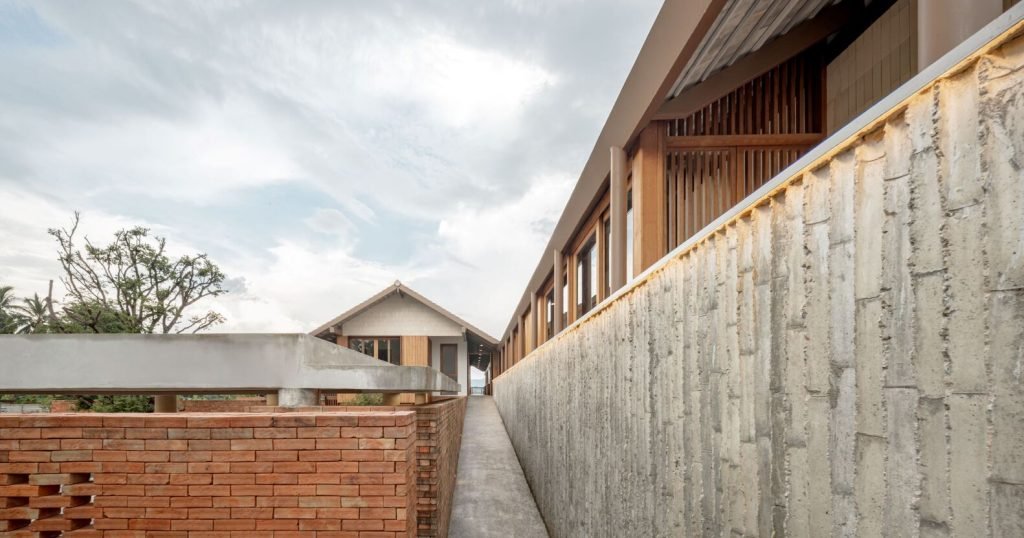
Along the perimeter the architects reinterpreted the fa lai, the traditional sliding wooden panels of Lanna architecture, as contemporary facade elements in the form of timber screens and louvred panels that provide visual filtering and an additional layer of privacy. They give the elevations a rhythm and depth that shifts through the day as the light angle changes, the house reading differently at dawn than it does at dusk. The architectural lines of the building are articulated through brick and cast-in-place concrete walls, the concrete cast using bamboo as formwork to leave a striated vertical texture across the surface. Brick wall planes and earthen mounds form another defining characteristic of the house, drawing the surrounding greenery physically closer to the living spaces while visually anchoring the building to the earth beneath it. These same elements mediate the perceived height of the elevated structure, establish the boundaries of an internal courtyard, and organize the landscape around the house into a coherent whole. Together with the bamboo-textured concrete walls, they unify the architectural components without any single element dominating the others.
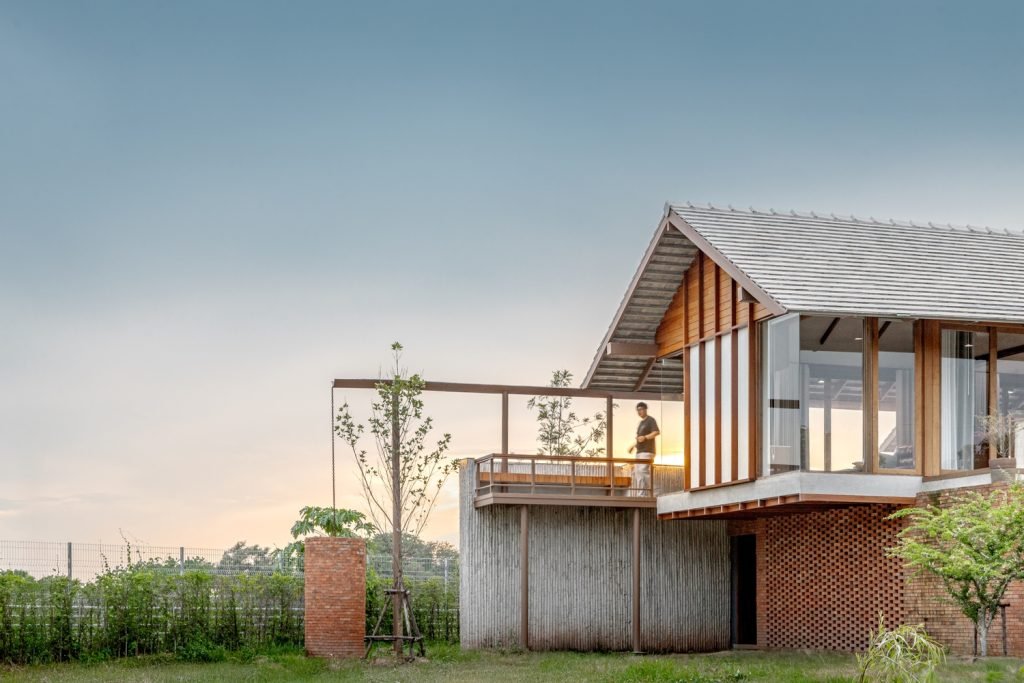
Inside, the pitched ceilings follow the roofline through each room, the master bedroom sitting under exposed timber beams with pale ceramic tile walls, hardwood floors, and a full-height glazed opening to the south that pulls in garden light and a view of the trees. The study is positioned with a direct sightline to the Mekong, floor-to-ceiling timber-framed glazing holding the river and the mountain range in frame across the desk in a view that changes with the season and the water level. The living spaces open onto the river-facing terrace through sliding glazed panels, and it is on that terrace, under the generous overhang of the roof with the Mekong below and the mountains of Myanmar across the water, that the accumulated intelligence of every decision made in this project becomes most apparent.
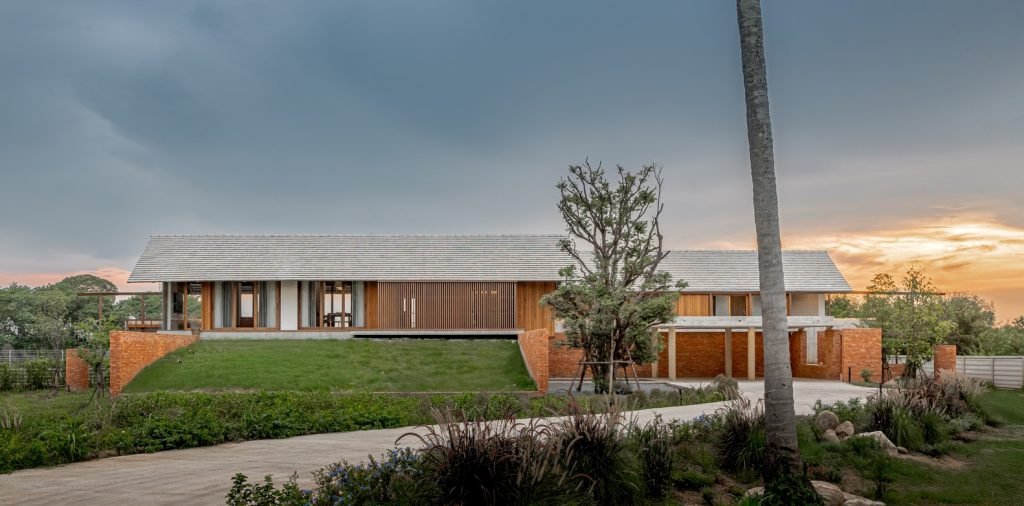
Completed in 2025 across a built-up area of just under 7,000 square feet, Baan SudSaenSuk is architecture that grows from where it stands, shaped by a river, a kingdom, and a way of building that understood this landscape long before contemporary practice arrived to interpret it.
Fact File
Project Name: Baan SudSaenSuk
Location: Chiang Saen District, Chiang Rai Province, Thailand
Architect: BodinChapa Architects
Principal Architects: Phitchapa Lothong, Bodin Mueanglue
Project Type: Private Residence
Built-up Area: 6,996 sq ft
Year of Completion: 2025
General Contractor: Blackboard Construction
Manufacturers: L-Thai, Watsadu Niyom
Photography: Witsawarut Kekina
Firm Website: bodinchapa.com
Firm Instagram: @bodinchapa_architects
