
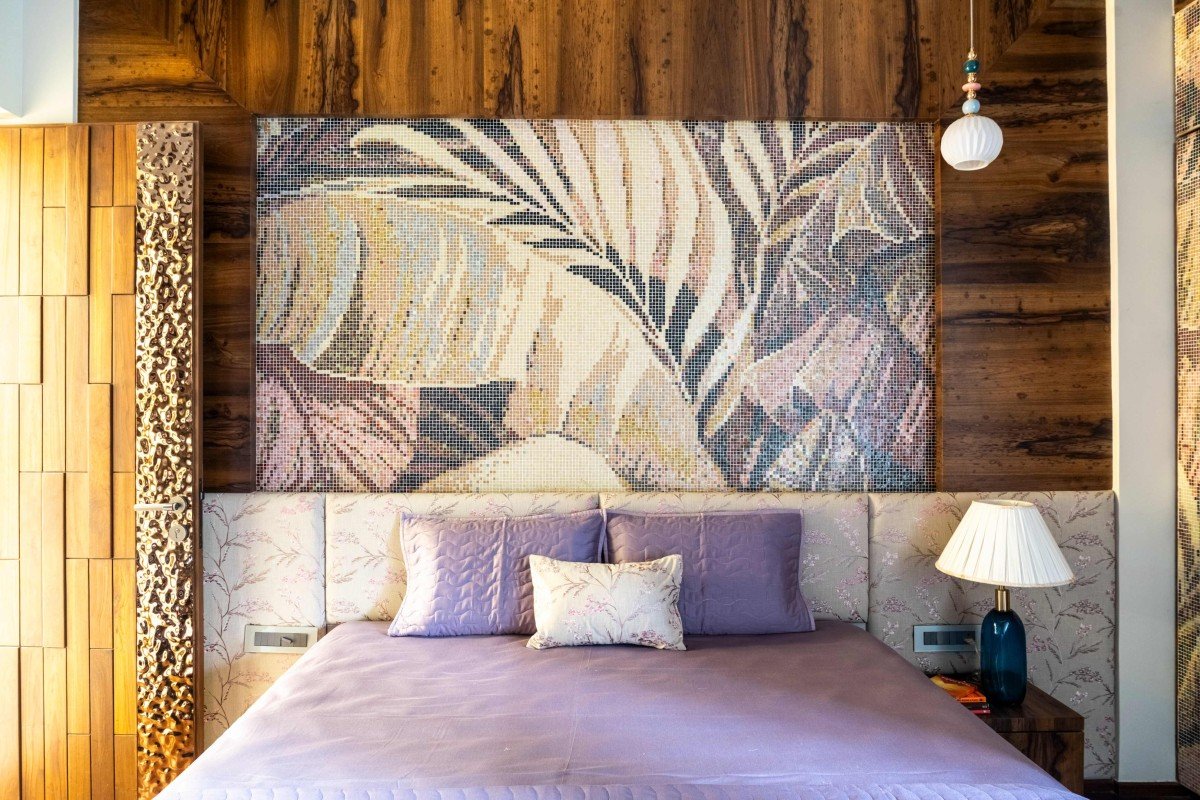
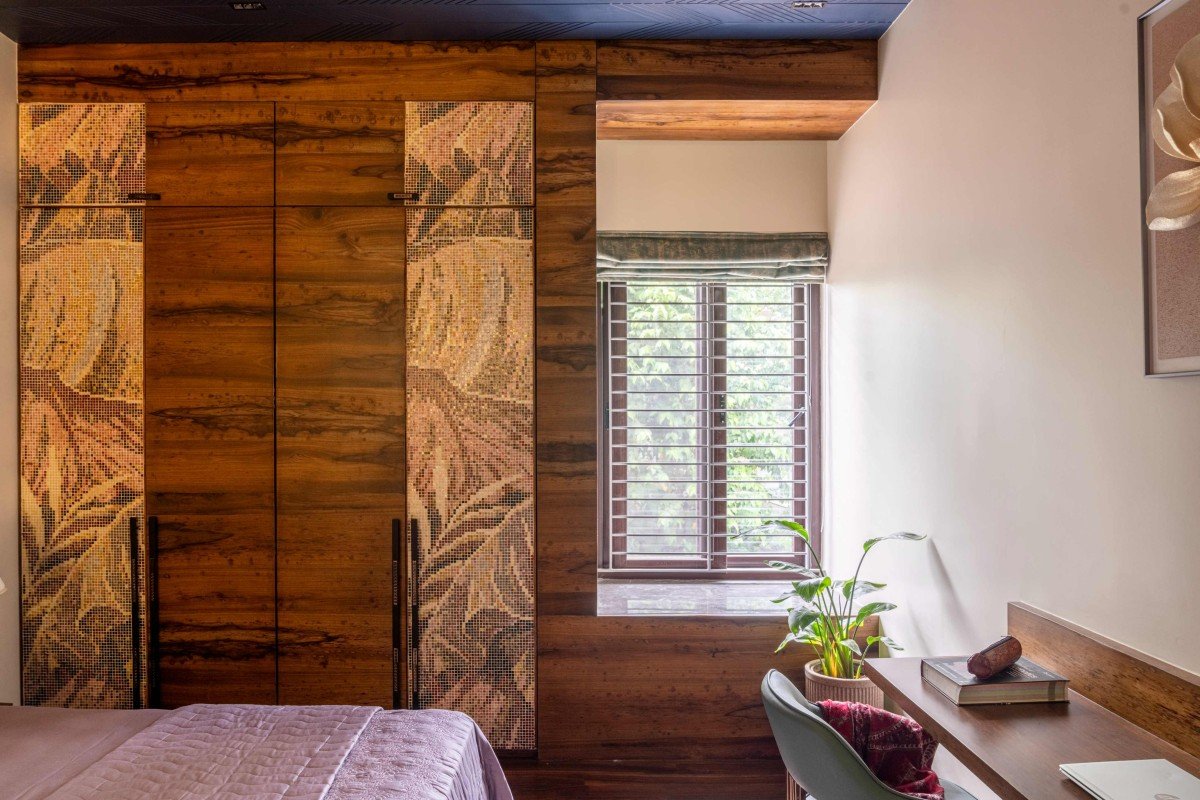
The wardrobe in one of the bedrooms of this 5,500 square foot house in Hubballi is surfaced not in veneer or lacquer but in a mosaic of small tiles arranged into a composition of tropical leaves, the monstera and palm forms rendered in gold, amber, orange, and cream across the full height and width of the doors, and the same composition continues across the room to a large mosaic panel set into the dark walnut wall above the headboard, the leaves here in softer tones of pink, lavender, and cream, the two surfaces holding a conversation across the width of the space, and it is in this room that you understand the botanical preoccupation running through the entire house, from the CNC-cut leaf-and-vine panel on the facade to the figured screen door in the master bedroom, the same organic vocabulary returning in material after material, which tells you what Ar. Vishwas Jeevannavar of VJ Architects was thinking about when he designed House by the Tree, a residence on a site in Hubballi whose defining natural feature is the mature tree at its edge.
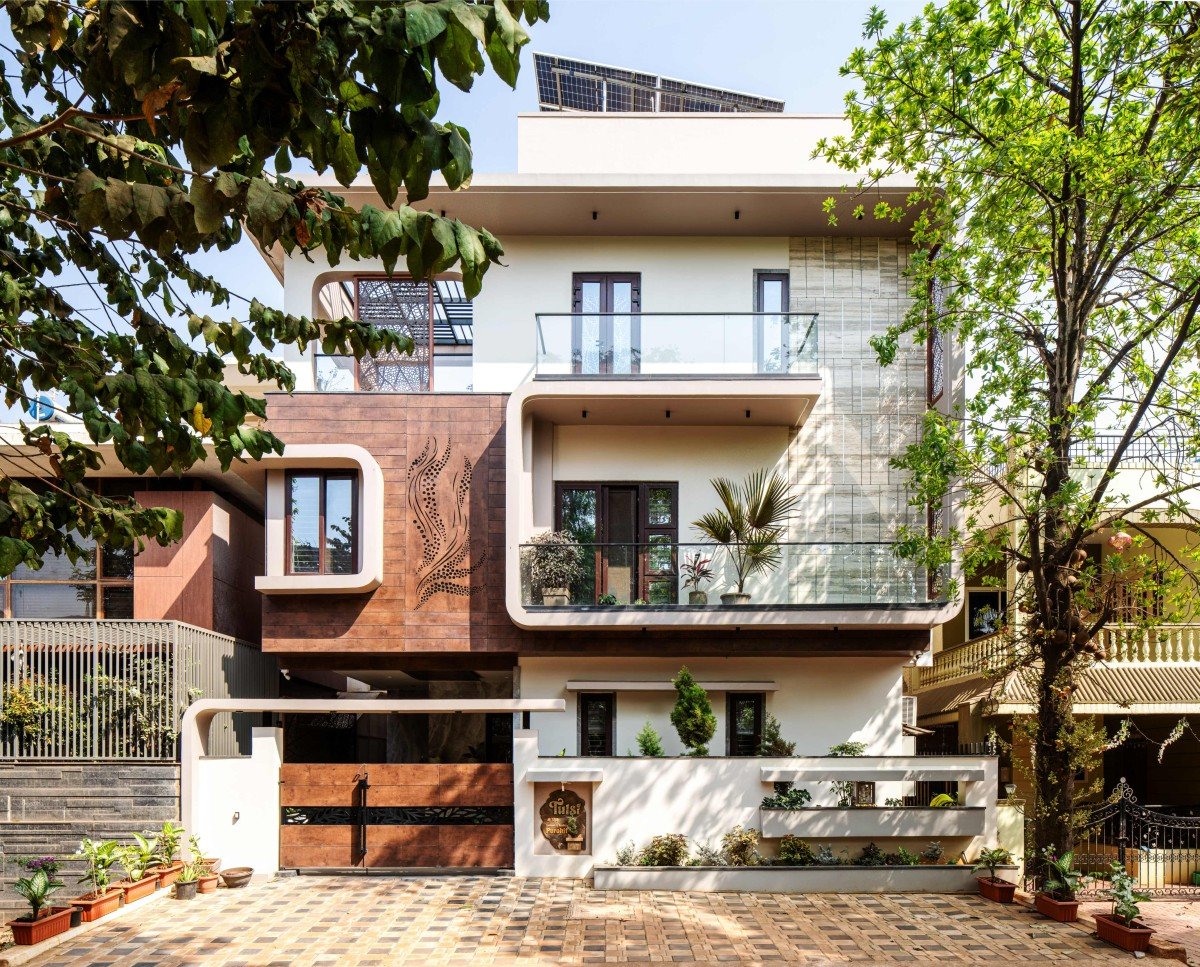
 From the street, the facade makes its first statement: a dark brown volume on the first floor with the botanical CNC panel cut into its surface, leaves and stems pressed out of the solid cladding so that light passes through and the panel reads as both wall and screen, set against white rendered sections on the ground floor and warm beige stone tiles on the right flank with linear LED strips running between them so that at dusk the elevation glows in a combination of warm amber and cool geometry; the cantilevered second-floor balcony with its glass railing and planted pots extending toward the tree canopy; solar panels on the roof; a small niche at the gate carrying a deity figure; and the brick-paved forecourt below.
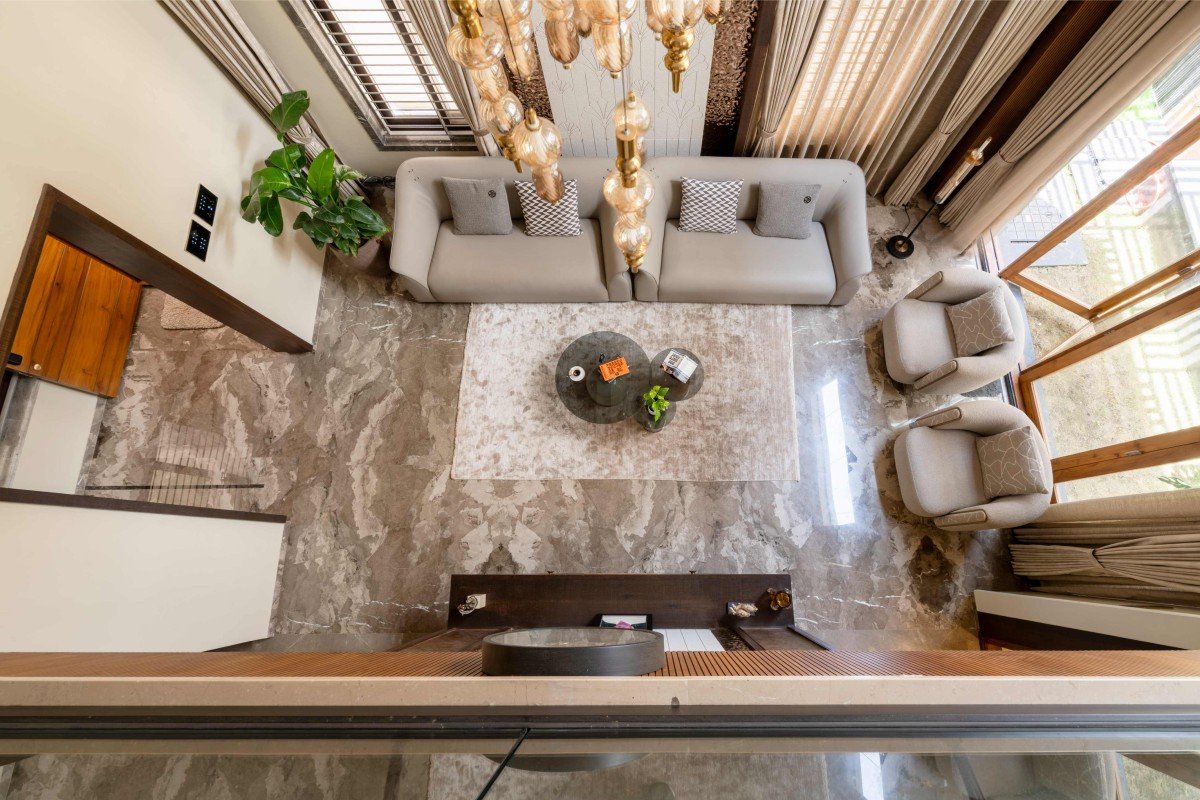
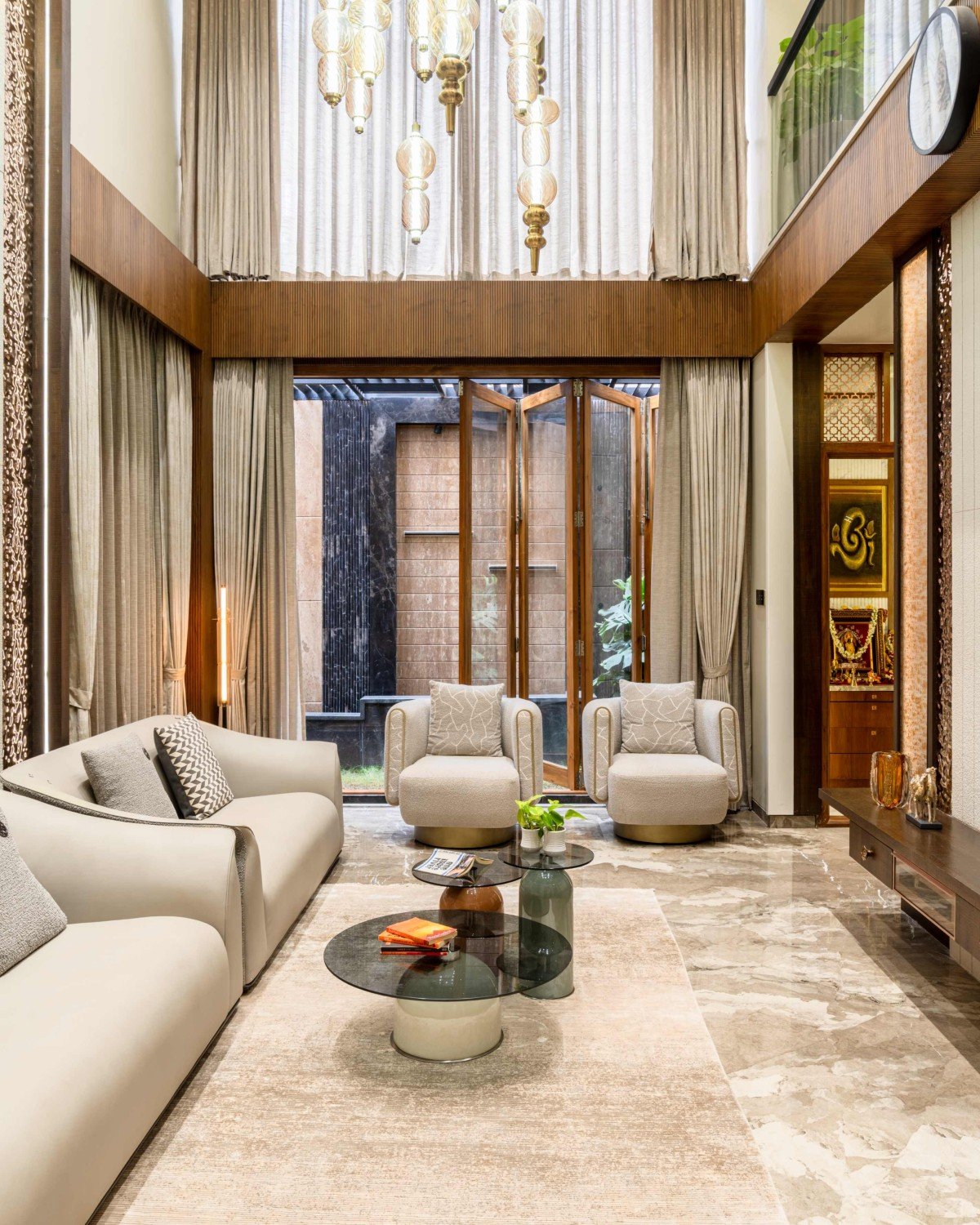
Inside, the double-height living room opens the house at its largest scale: bifold timber-framed doors fold entirely away to a courtyard where a water feature in dark stone sits against a planted wall, and descending through the full height of the volume is a chandelier of multiple amber teardrop glass pendants on brass stems at different lengths, the cluster reading as a three-dimensional form rather than a light fitting, warm against the cream curtains that flank the doors. A cream sofa and two barrel armchairs sit around two circular glass-top coffee tables of different sizes, and on the wall to one side, the puja room is visible through its opening, the gold Om symbol on its marble wall catching the living room light from across the room.
The puja room door is carved dark wood, the frame dense with floral and arabesque carving, a transom of lattice jali above, and the carved surround occupying the full height of the opening. Inside, there are white marble walls with grey veining, a large three-dimensional gold Om symbol on a dark wooden backing panel, a marble altar shelf arranged with deity figurines, framed photographs, flowers, diyas, and offerings, and a crystal pendant above.
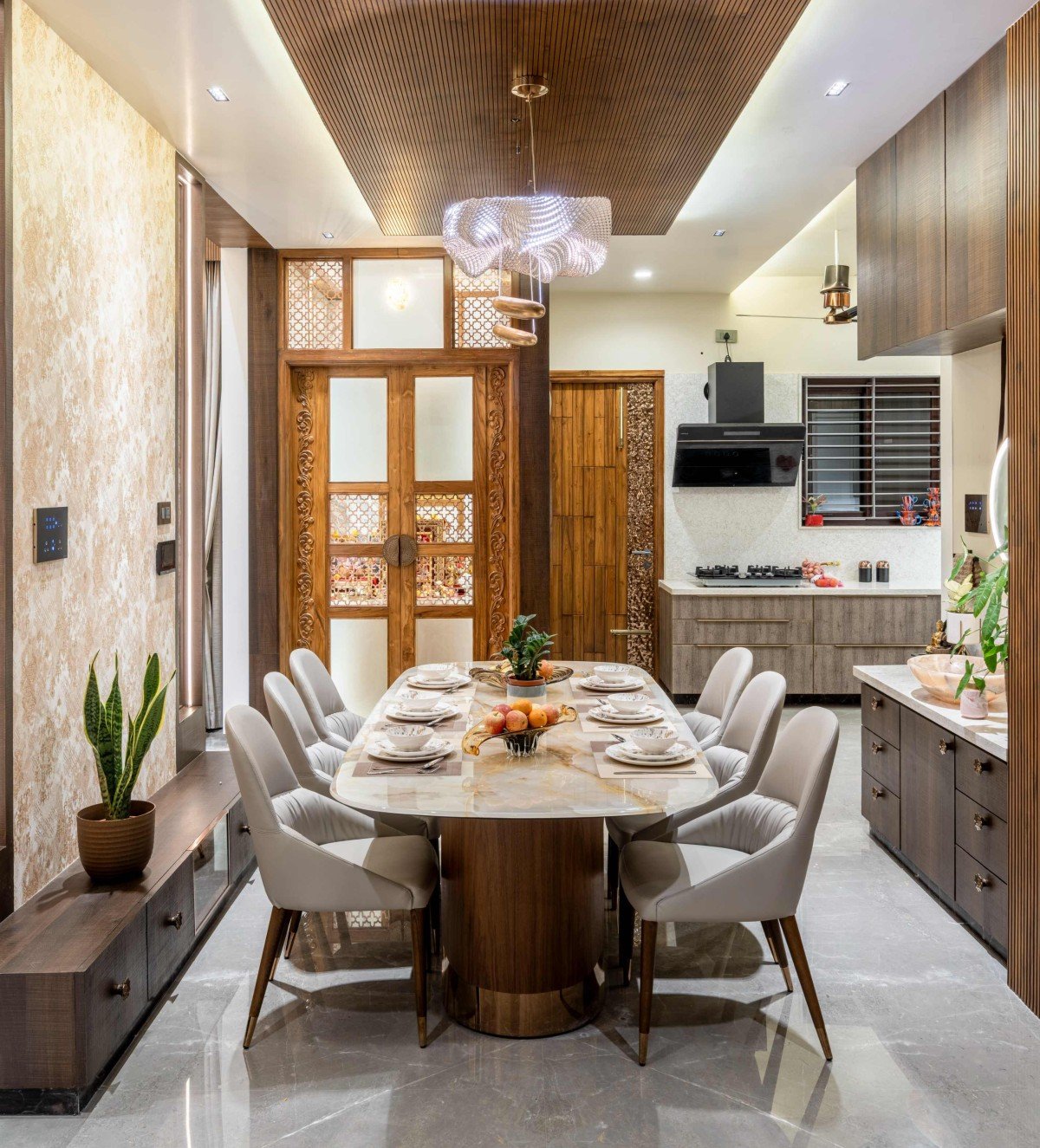
The dining room holds the house’s most theatrical single object: an onyx table, its surface warm honey-gold with orange and amber veining, set on a single dark walnut cylinder; eight cream high-backed chairs around it; and above it a chandelier that is a sculptural form first and a light fitting second, an undulating surface in crystal that waves across the ceiling plane with multiple copper pendant drops descending from it at varying lengths, the piece shifting in quality depending on where you stand beneath it. Dark walnut ribbed panels line the ceiling around the white central section, the kitchen opens into the zone on one side, and the puja room door with its carved surround faces the table from the other so that the room is framed on one side by the most contemporary object in the house and on the other by its most traditional one.
The staircase landing between the floors carries a three-dimensional painted relief of Radha and Krishna on a swing set into a recessed wall niche, the figures modeled in depth, the colors vivid against the cream wall, a small wooden bajot with an open book below it, and a tall potted plant alongside.
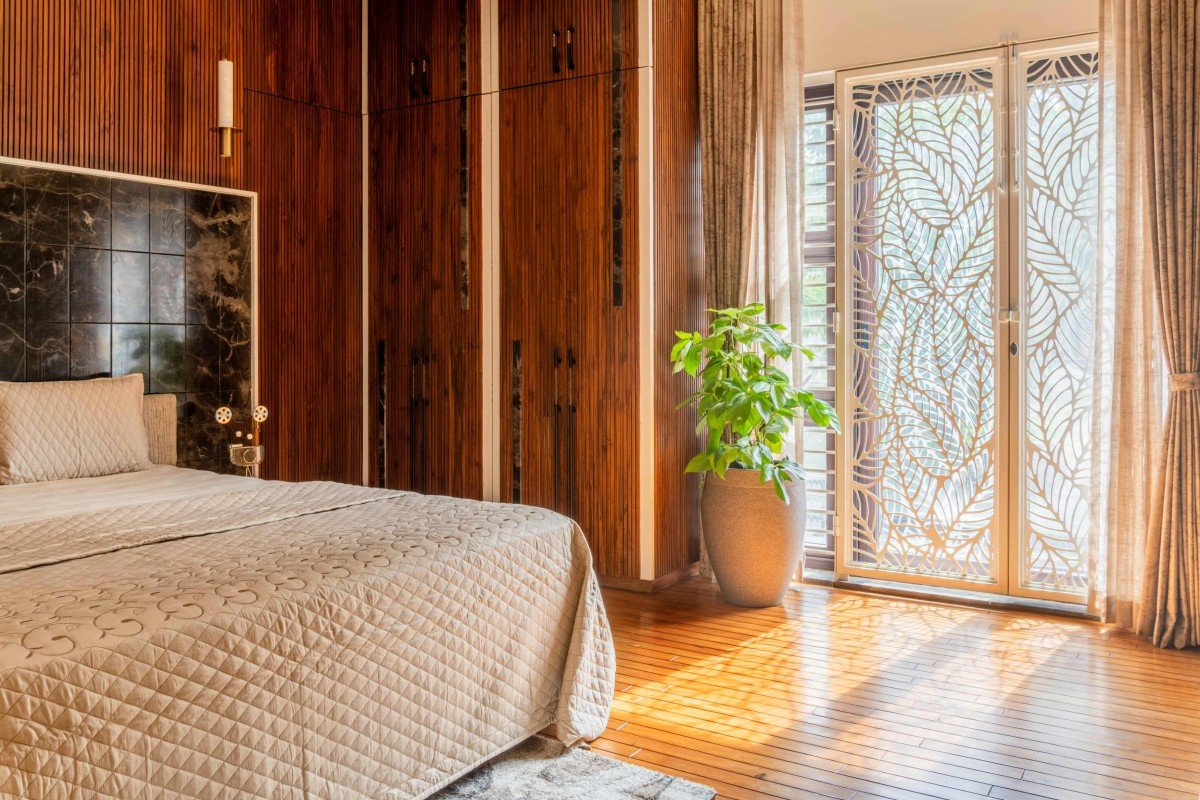
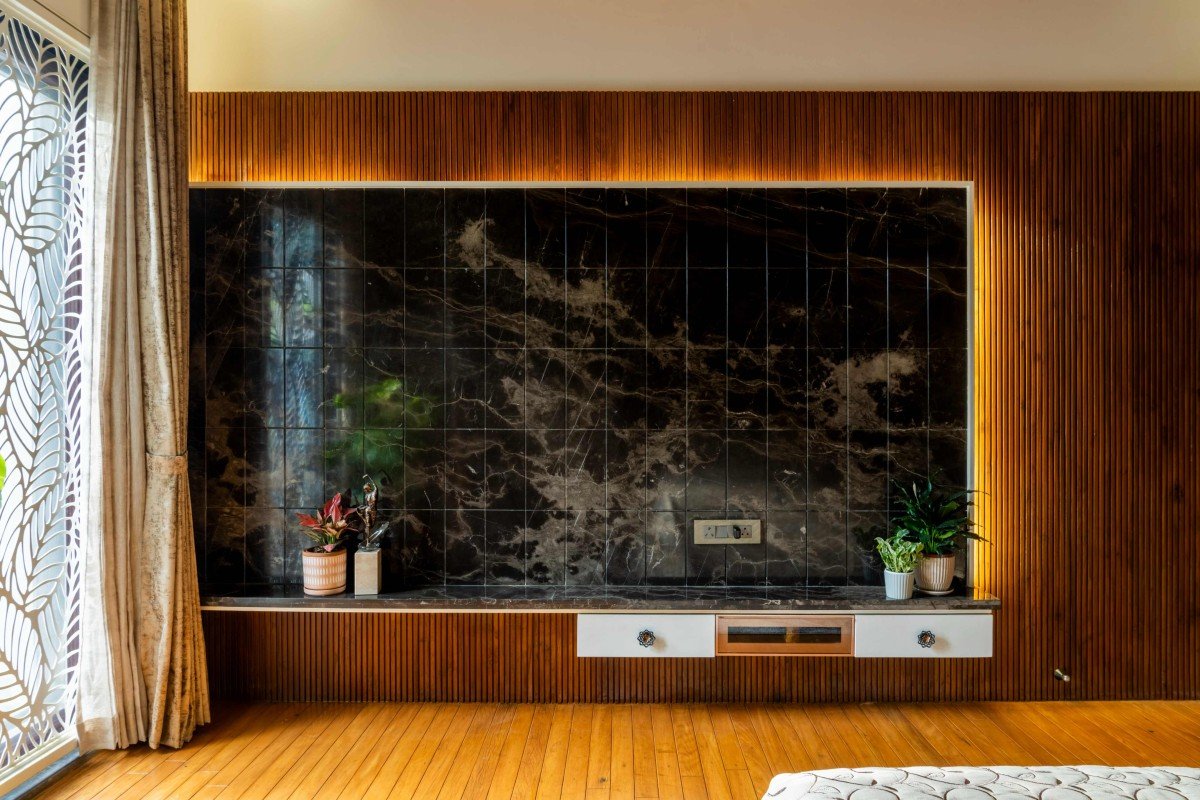
The bedrooms each carry their own complete material identity. The master bedroom has dark walnut ribbed panels on the headboard wall and around it and set into them a panel of black marble with white and silver veining, the margin around the marble backlit in warm amber so that the stone glows within its frame, and a floating shelf below with white drawer units and small plants on the warm timber floor. The screen door on the room’s opposite wall features a leaf-and-vine cutout pattern in cream that filters afternoon light, creating shifting botanical shadows across the floor, while the motif of the facade is brought indoors in a different material.
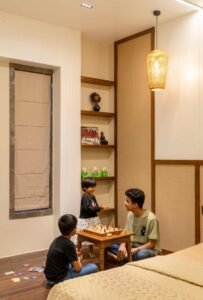
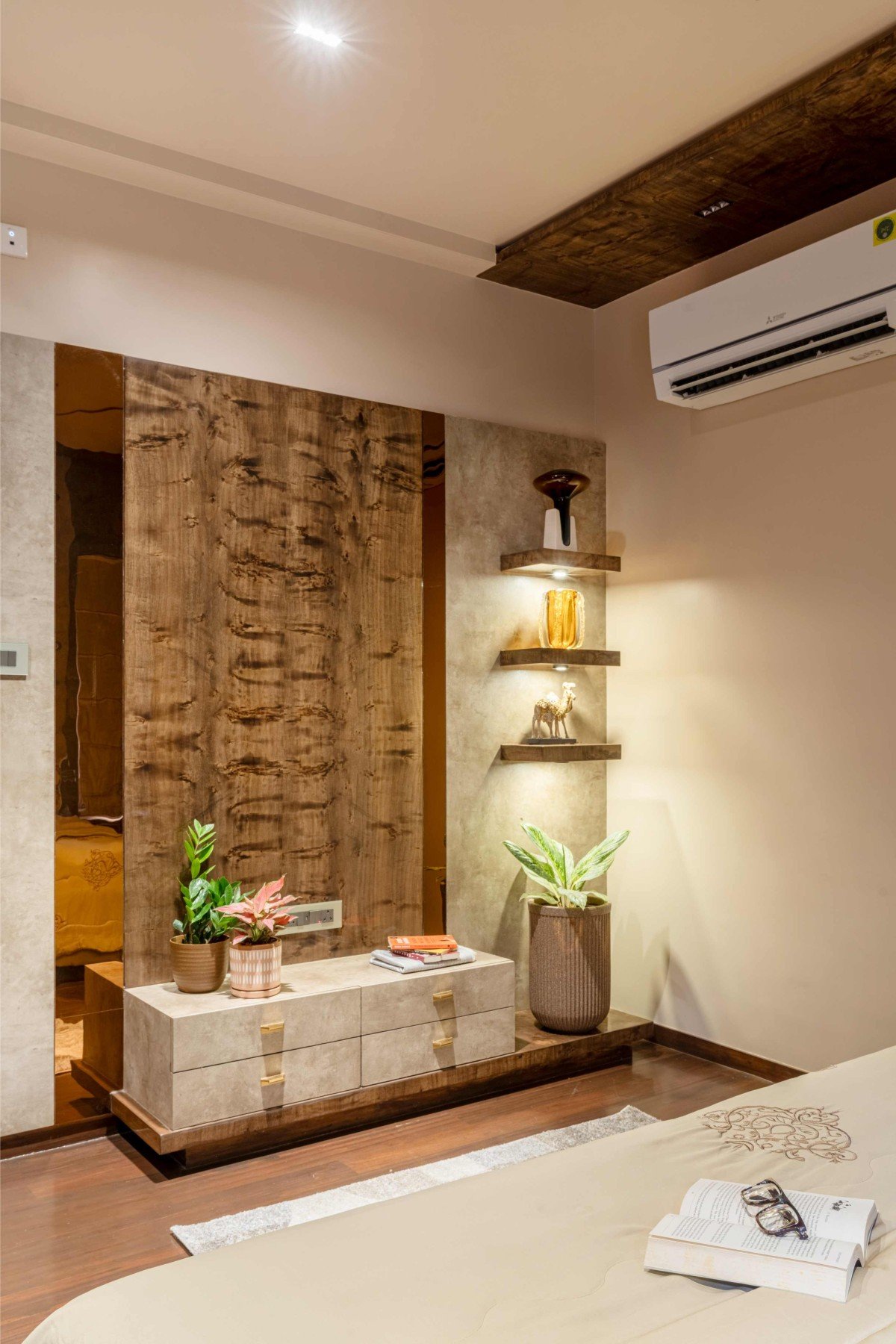
The figured burl wood bedroom wraps the same dramatically grained veneer across the wardrobe doors and the walls to either side and into the ceiling trim, the swirling figuring so intense that the room reads as a single continuous surface broken only by a small louvered window and a brass sconce, with warm gold embroidered linen on the bed. A third bedroom carries a cream-and-grey two-tone wardrobe with a dark wood paneled feature wall holding a painted golden tree-of-life artwork and a crystal wall sconce alongside it. The children’s bedroom is quieter in its arrangement, a built-in wooden shelf niche with fabric-backed panels holding small figurines and a painted canvas, the dark hardwood floor in use rather than on display, and three children playing chess on the floor in the afternoon light.
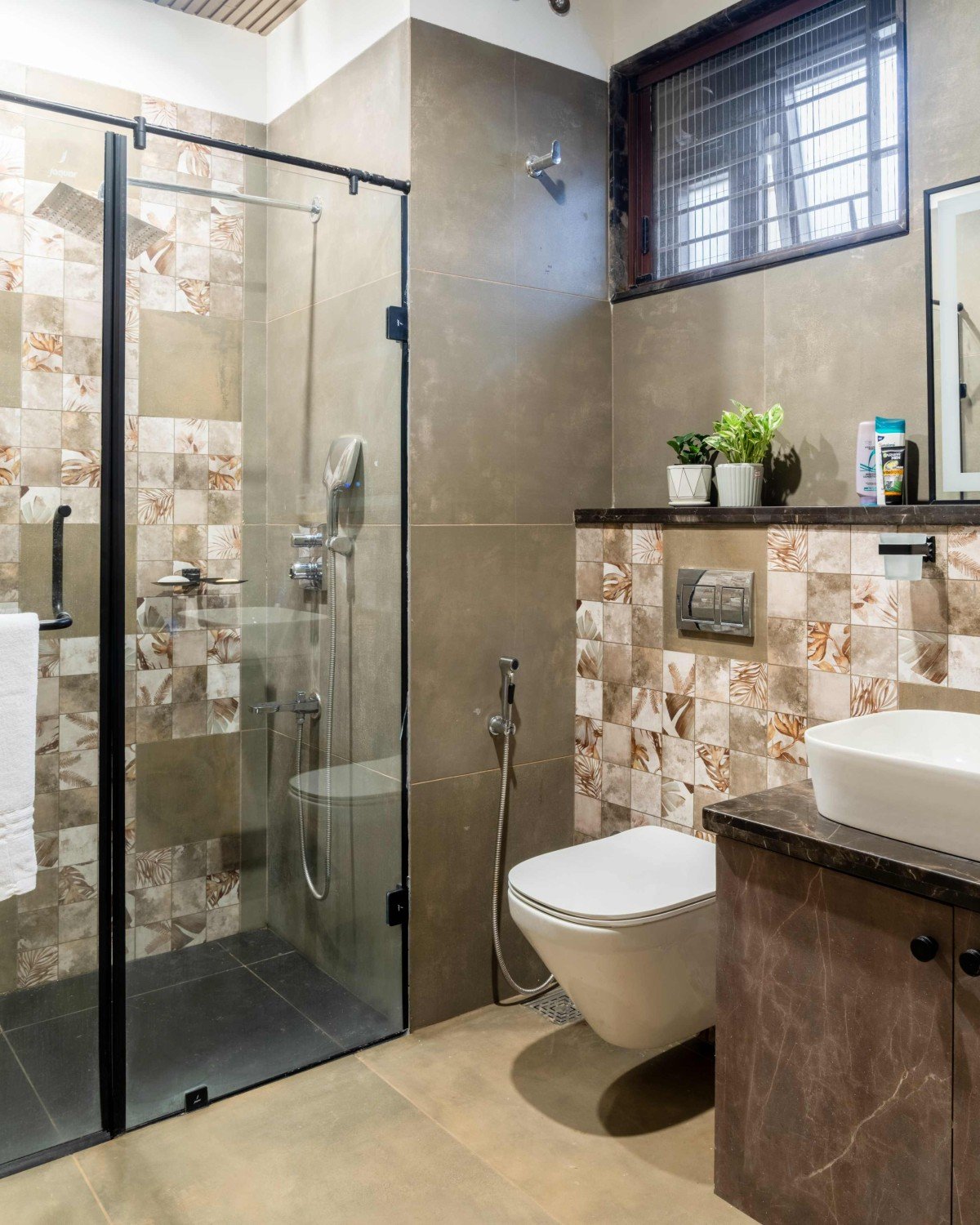
The bathroom carries botanical-print tiles in warm brown and cream alternating with plain grey large-format tiles in the glass-enclosed shower and a dark marble vanity top with a white vessel sink.
The botanical panel on the facade, the screen door in the master bedroom, the mosaic on the wardrobe doors, the mosaic above the headboard, and the tree outside with its canopy extending over the driveway all share the same motif, which runs from the street to the innermost room of the house.
Fact File
Project Name: House by the Tree
Location: Hubballi, Karnataka, India
Architect: VJ Architects ,
Lead Architect Designer: Ar. Vishwas Jeevannavar
Area: 5,500 sq ft
Year of Completion: 2025
Instagram: @vjarchitects
