
In Malappuram, where the monsoon arrives heavy and the land stays green through most of the year, Yuuga Design Collective has built a house for a family of three that draws its spatial logic from the Kaavu, the sacred grove of Kerala tradition, where humans, nature, and other living beings share the same ground without any one of them claiming authority over the rest.
EMA, completed in 2025, is 1,700 square feet of lime plaster, reclaimed timber, salvaged stone, and Mangalore tile, designed for a husband, wife, and their son Siva, and conceived from the start as an environment to be inhabited rather than an object to be seen.
This is EMA, a 1,700-square-foot residence in Malappuram, Kerala, completed in 2025 by Yuuga Design Collective, led by Mithun Balan and Arun. It was built for a family of three, a husband, a wife, and their son Siva, with an intentionally spare brief: two bedrooms, a shared living, dining, and kitchen space, an attic for work and fitness, and a seasonal summer bedroom designed to function without air conditioning. The aspiration was for a house that feels inward-looking and tactile rather than outwardly expressive, privileging sensory comfort over visual display. Yuuga Design Collective conceived EMA through the philosophy of the Kaavu, the sacred grove of Kerala tradition, where humans, nature, and other living beings coexist without hierarchy. Within this worldview, architecture is not an act of dominance over land but a quiet participation in an existing ecosystem, and every decision in the project, spatial, material, ecological, and philosophical, flows from that position.
The design process followed a reverse methodology. Rather than beginning with form or plan, it began with materials. The architects spent months collecting, cataloguing, and studying salvaged elements from old Kerala homes and temples, understanding their proportions, their weathering patterns, and their structural capacities before a single spatial decision was made. Doors, windows, timber members, terracotta tiles, and stone were gathered, some estimated to be over two hundred years old. The spatial framework then evolved through adaptation and negotiation with these collected pieces, each reclaimed element guiding its own placement and the details around it. The house was not imposed upon its materials. It emerged from them.
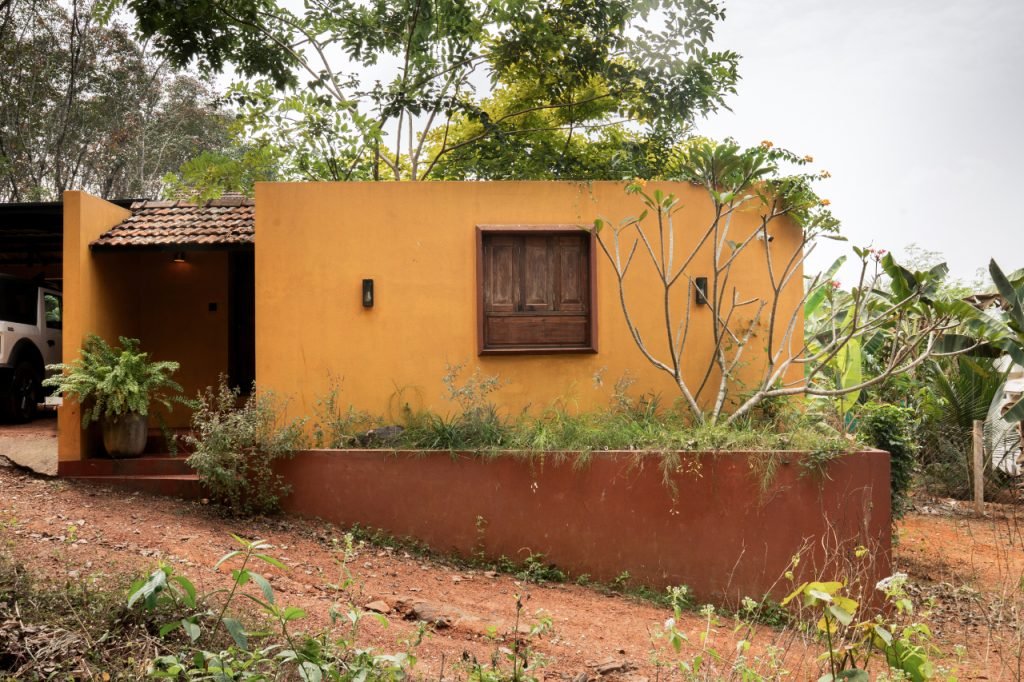
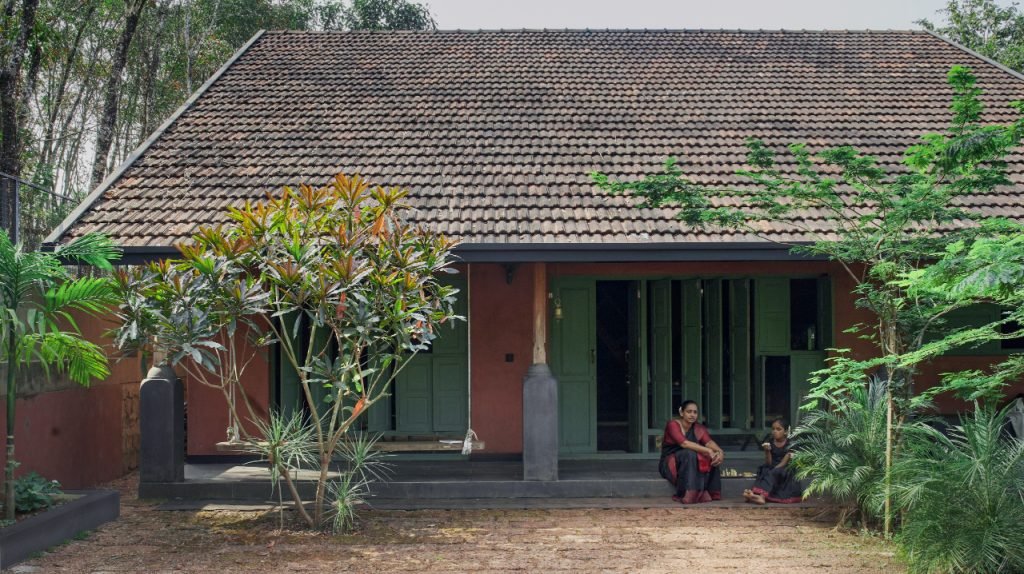
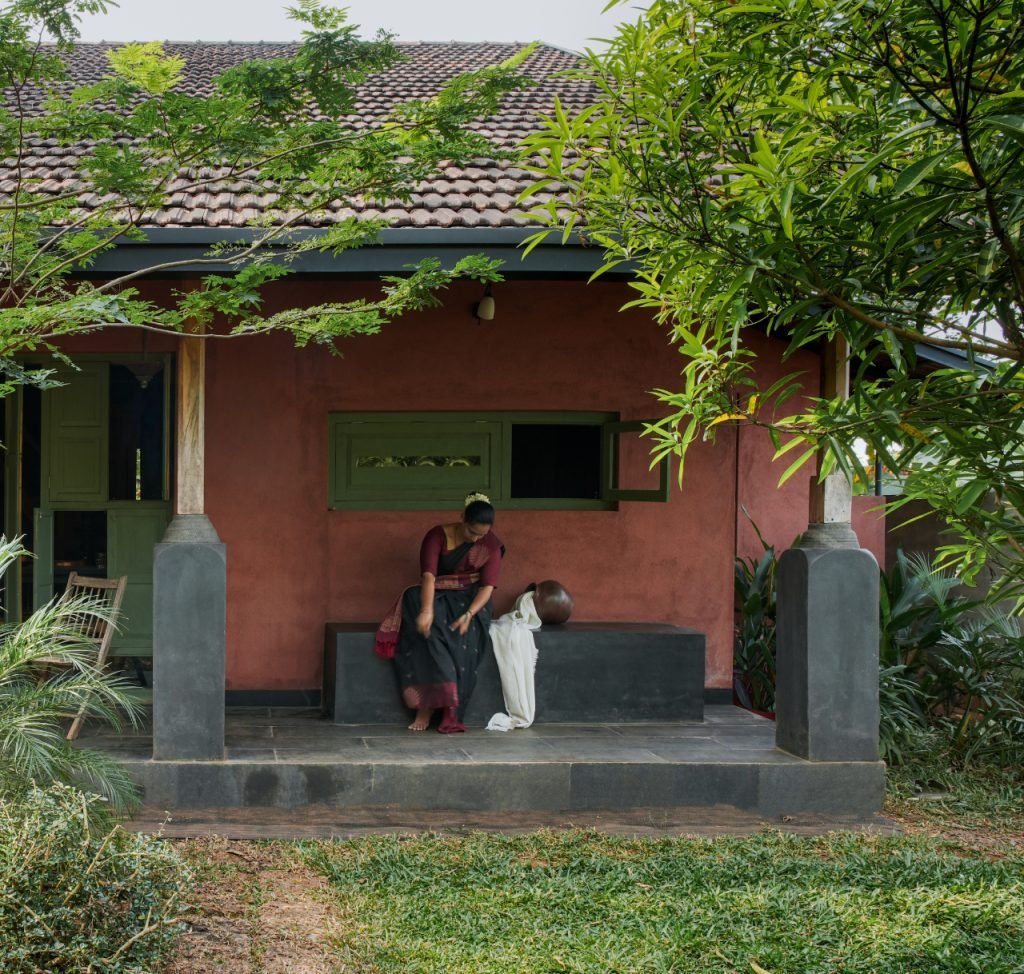
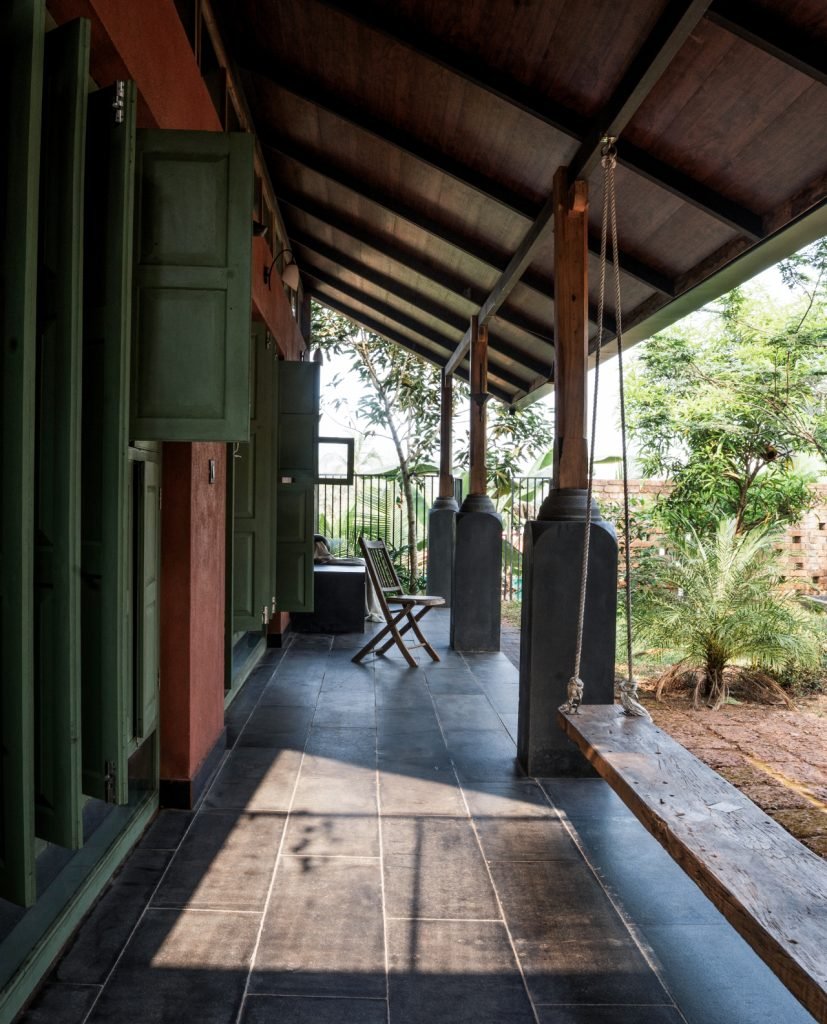
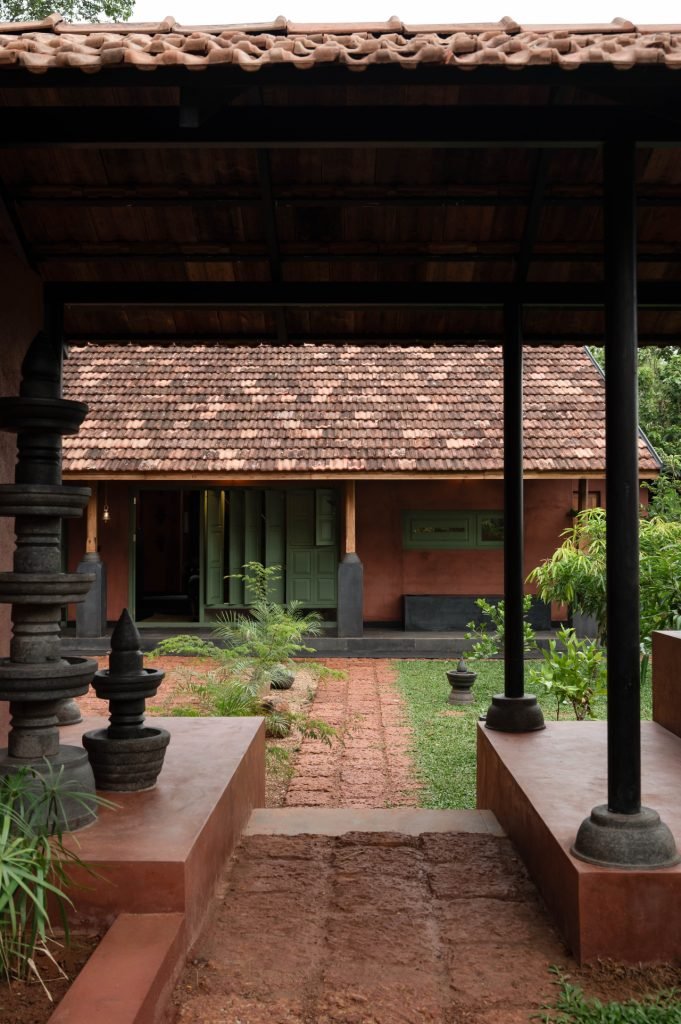
Approaching from the road, a low gate structure in ochre yellow sits at the entrance under its own small Mangalore tile roof, a red iron gate set into it, coconut palms and tropical trees rising on either side. The red oxide driveway leads through, and the main house comes into view, a long low form under a hip Mangalore tile roof with wide overhangs that shade the rust red lime plaster walls through the hottest hours of the day. The color of those walls is a warm, slightly irregular shade that lies somewhere between laterite stone and raw earth, and against them, the joinery—every door, window, and shutter throughout the entire house—is painted in a deep sage green. The column bases supporting the veranda roof are drum-shaped dark stone, reclaimed from an older structure, their carved profiles sitting comfortably between new construction and centuries-old craft. A rope swing made from a thick wooden plank hangs between two of these columns on the veranda, which has dark stone tile flooring and an exposed timber ceiling following the pitch of the roof. The garden presses right up to the edge of the tiled floor, dense and uncontrolled in the best sense, the way a Kaavu would be.
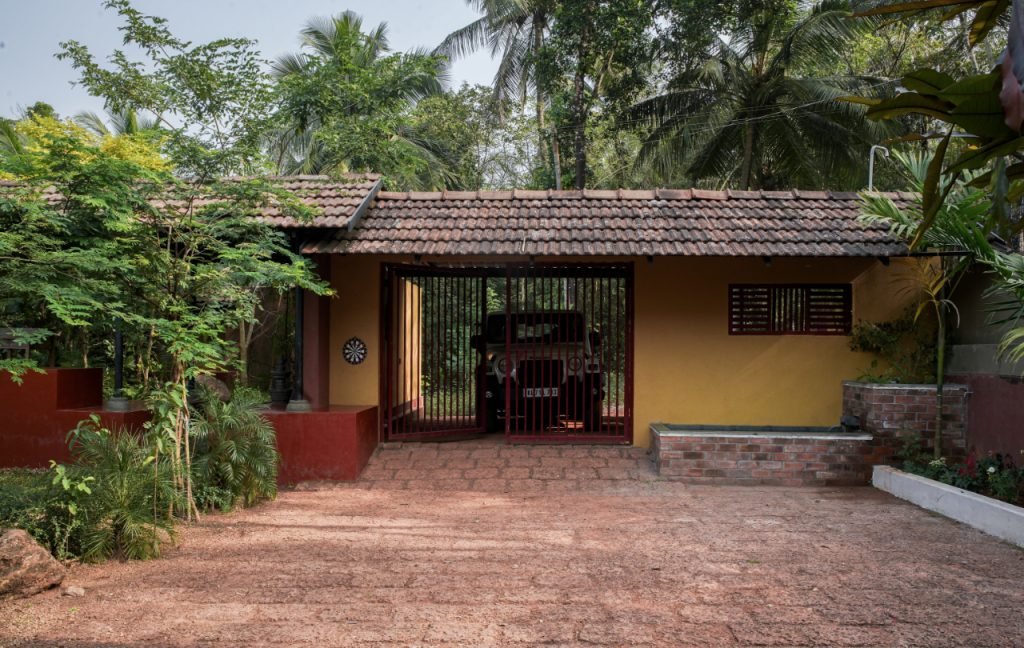
The practice extended the Kaavu philosophy beyond built form to shape every ecological decision in the project. The existing trees were preserved, and the site contours were left largely undisturbed. Biodiversity and the accommodation of non-human life were treated as integral to the design rather than incidental to it. The terracotta hexagonal paving stones in the forecourt carry the same red tone as the walls, river stones, and rocks placed among the young plants, as if the garden is still becoming itself. A covered walkway with black steel columns and a Mangalore tile roof moves through the eastern side of the garden, terracotta raised platforms flanking it, the path leading toward a sitting area where a figure is visible in the distance among the trees. This is a garden designed to be inhabited slowly, a place where the line between architecture and landscape is genuinely unclear.
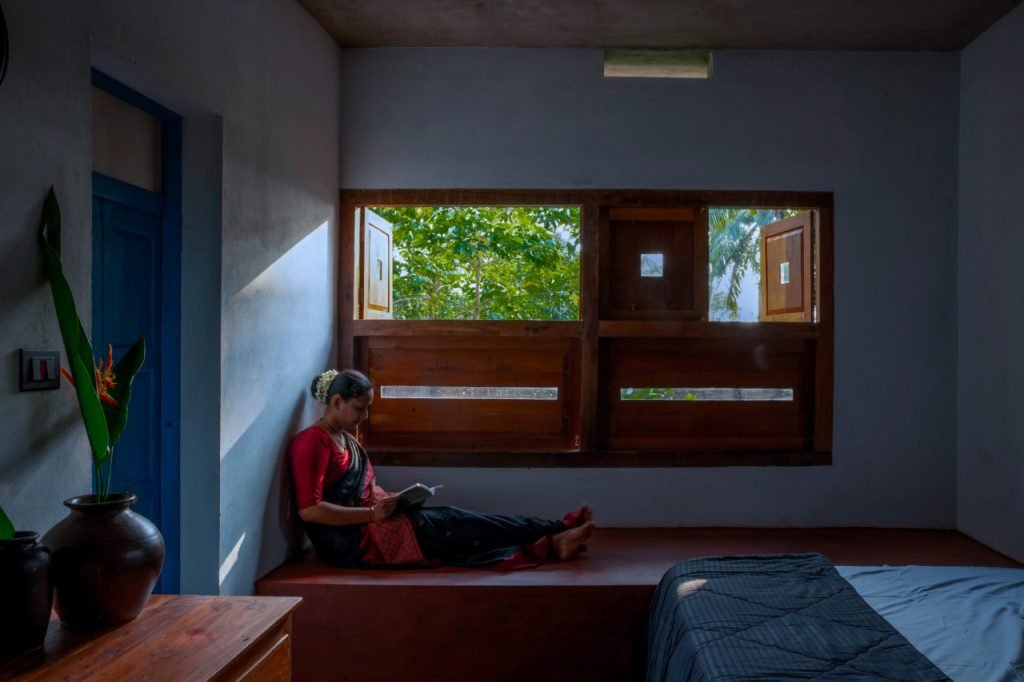
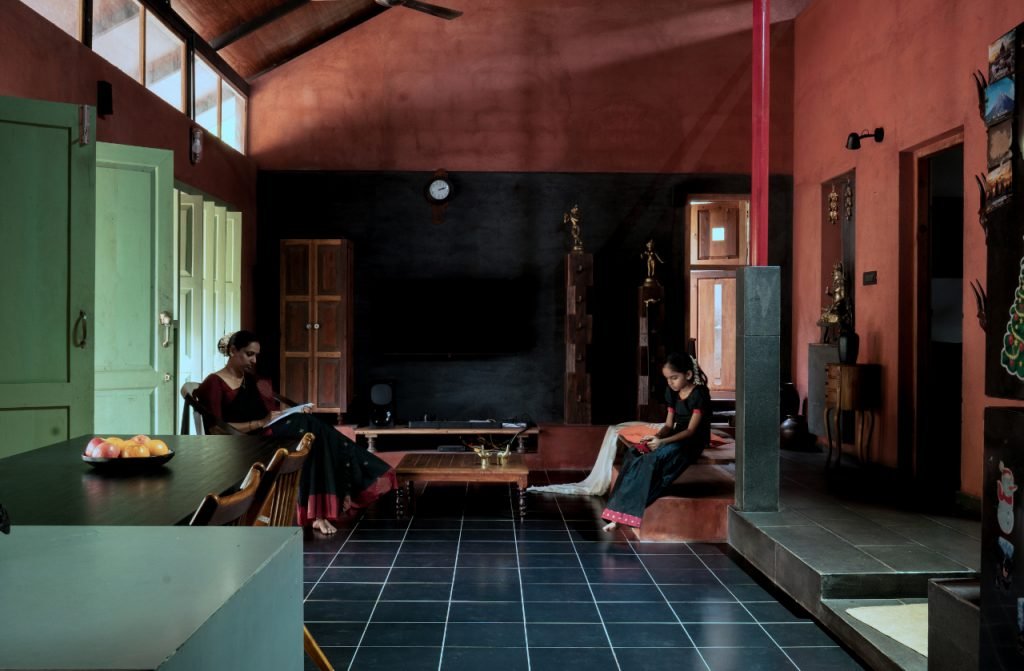
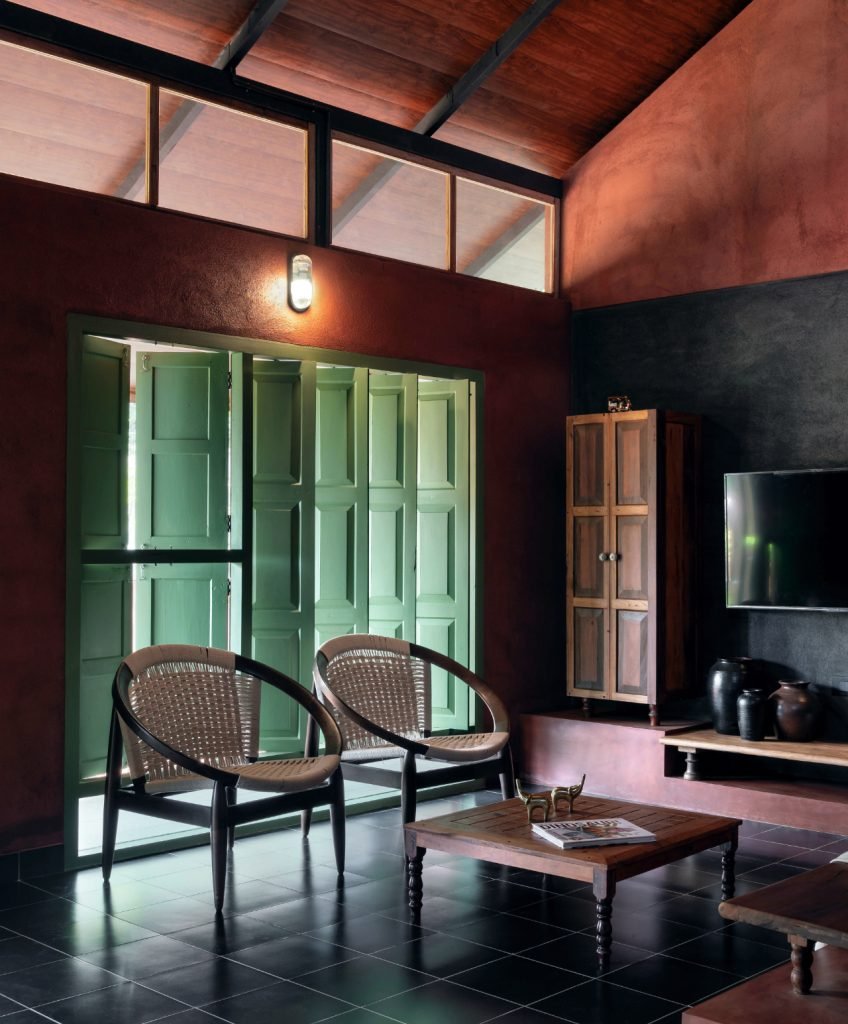
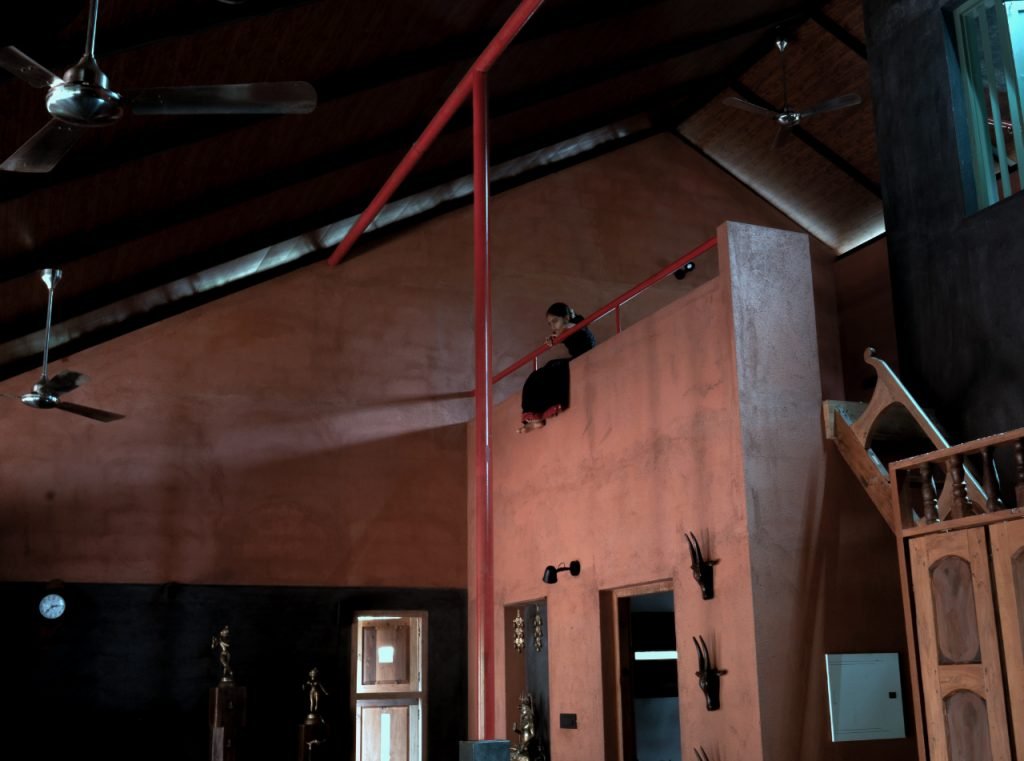
Inside, darkness is valued as a spatial condition that softens light, enhances thermal comfort, and creates an emotional stillness unattainable in brighter rooms. The main living and dining space has rust red walls on three sides and a deep charcoal black accent wall on the fourth, with the pitched timber ceiling visible overhead and a band of clerestory glazing running along the ridge that admits diffuse light from above without ever allowing the room to feel conventionally bright. A ceiling fan turns slowly.
Objects and artifacts collected over a lifetime sit on surfaces and shelves without any curatorial self-consciousness. Black oxide tiles cover the floor, cool underfoot and absorbing rather than reflecting the available light. The green shuttered doors fold back entirely to open the living space to the veranda, and through them, the garden is immediately present, banana palms and tropical trees filling the frame. A mother and her daughter sit in the room separately, each absorbed in something, the quality of the light and the scale of the space making both feel entirely at ease.
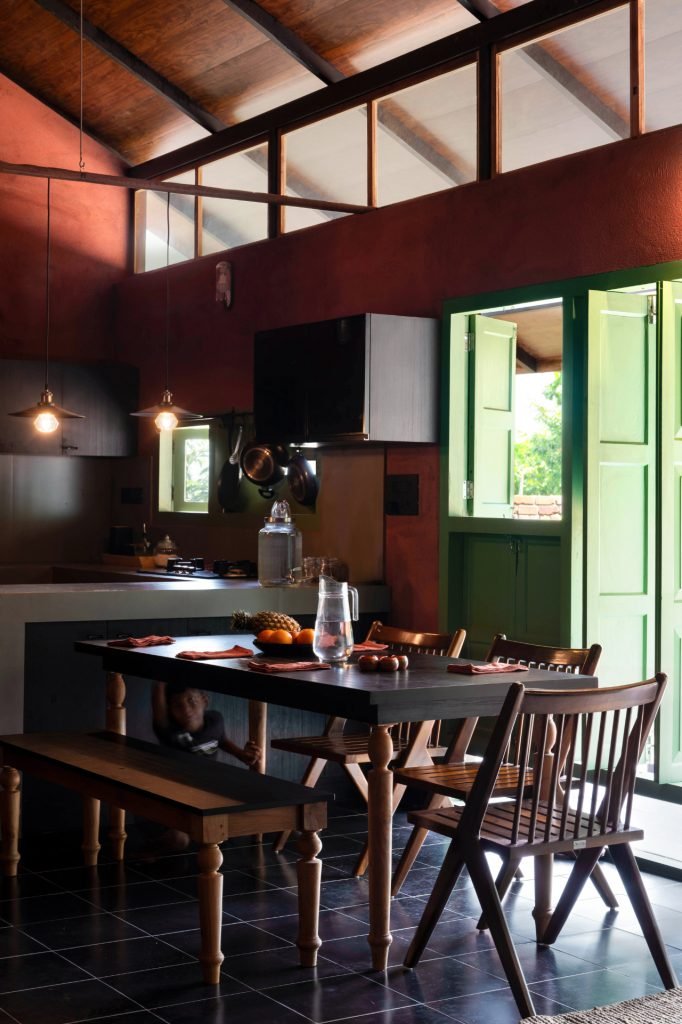
The kitchen and dining area continue without interruption in palette and feeling. The same red walls, the same timber pitched ceiling with its clerestory glass panels overhead, the same black tile floor. A dining table with a wooden bench on one side and individual wooden chairs on the other occupies the center, with two pendant lights hanging low above it. The green folding doors that open this room to the exterior are salvaged; their proportions and hardware belong to a different era, and they fit the room as if the room were built for them, which, in a meaningful sense, it was. The kitchen is restrained and functional behind the dining area, dark cabinetry receding behind the quality of the space.
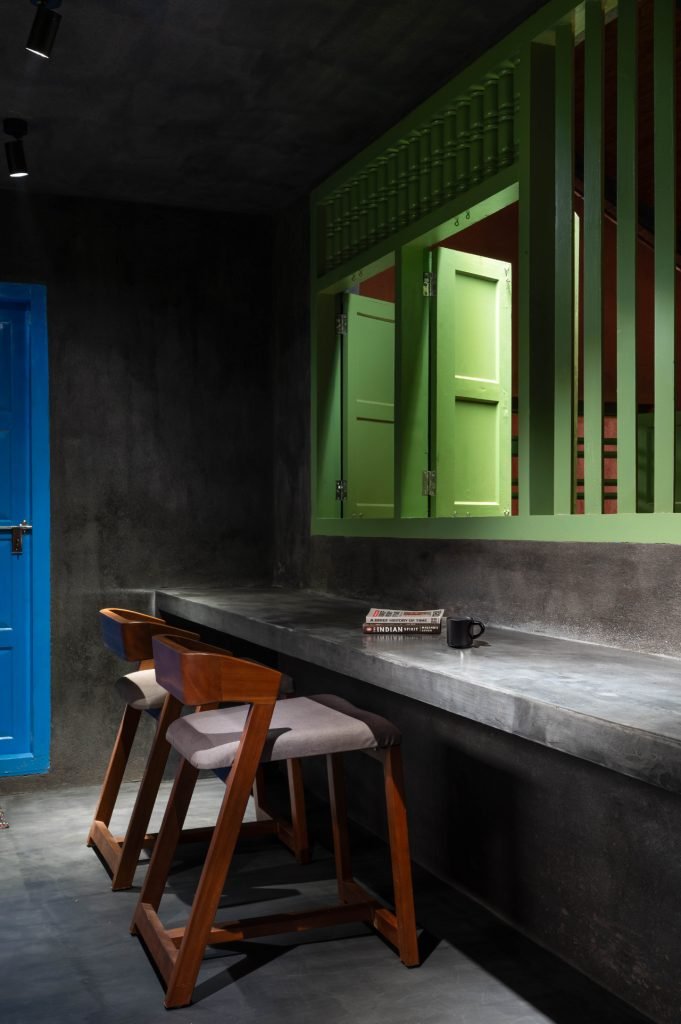
One of the more arresting rooms in EMA is a bar and studio space where the walls and ceiling are entirely charcoal black, the room deliberately nocturnal in character against the warmth of everything else in the house. A long concrete counter runs the length of one wall with wooden bar stools pulled up to it, a coffee cup, and a few magazines on the surface. Above the counter, a reclaimed green-painted wooden window with spindle detailing folds open to reveal the rust-red room beyond, framing it in vivid contrast as though it were a view into another world entirely. A blue door on the adjacent wall completes the composition. The color choices in EMA—rust red, charcoal black, sage green, and occasional blue—affect the room’s temperature and mood rather than serve merely as decoration.
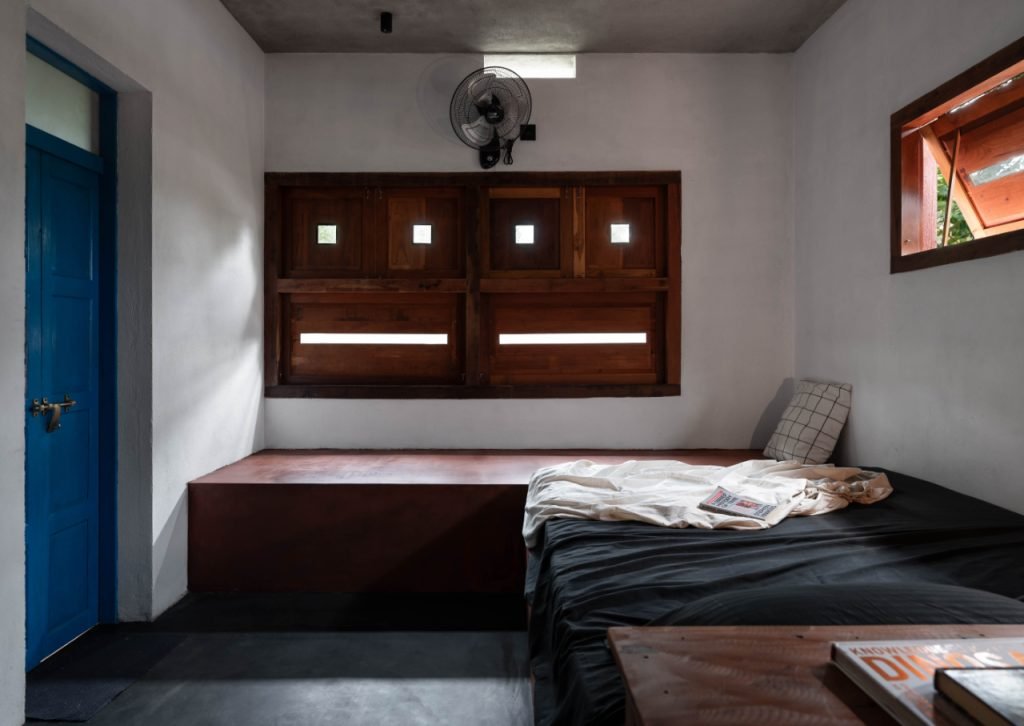
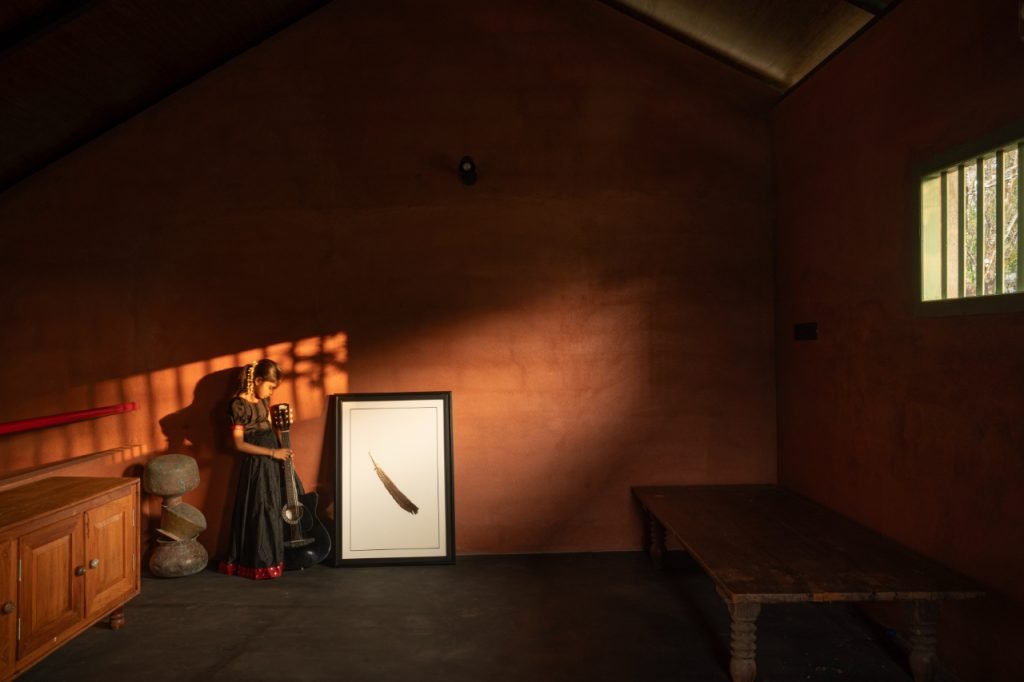
The second bedroom is a room of deep rust red walls and a sloped ceiling that follows the roofline, small barred windows admitting raking light at particular hours that falls across the textured plaster surface in long diagonals. In one photograph, a child in a black dress stands in this room holding a guitar, a framed artwork leaning against the wall beside her, the afternoon light from the window falling exactly on her. The room has the quality of a space where concentration comes naturally, where the enclosure and the warmth of the surfaces create the kind of stillness the project describes as a spatial virtue.
The attic, designed for work and fitness, is accessed not by a conventional staircase but by a steep reclaimed timber ladder that rises at a sharp angle from the living space below. It is one of the more memorable moments of movement in the house, the act of climbing it making the transition between the levels feel deliberate rather than incidental. A small green-framed opening in the attic floor looks down into the living space below, and in the photographs a figure leans through it looking down; the section of the house is suddenly readable as a series of connected levels with genuine spatial relationships between them.
Passive cooling runs through every decision in EMA without ever becoming the story in itself. The deep roof overhangs shade the walls through the hottest hours. The lime plaster walls breathe and regulate surface temperature in a way that synthetic renders do not. The oxide flooring stays cool. The built-in masonry platforms and benches and counters absorb and release heat slowly through the day. The deliberate and measured openings draw cross-ventilation through the rooms while the darkness of the interiors prevents solar gain. The seasonal summer bedroom is designed to function without mechanical cooling, a significant commitment in Malappuram.
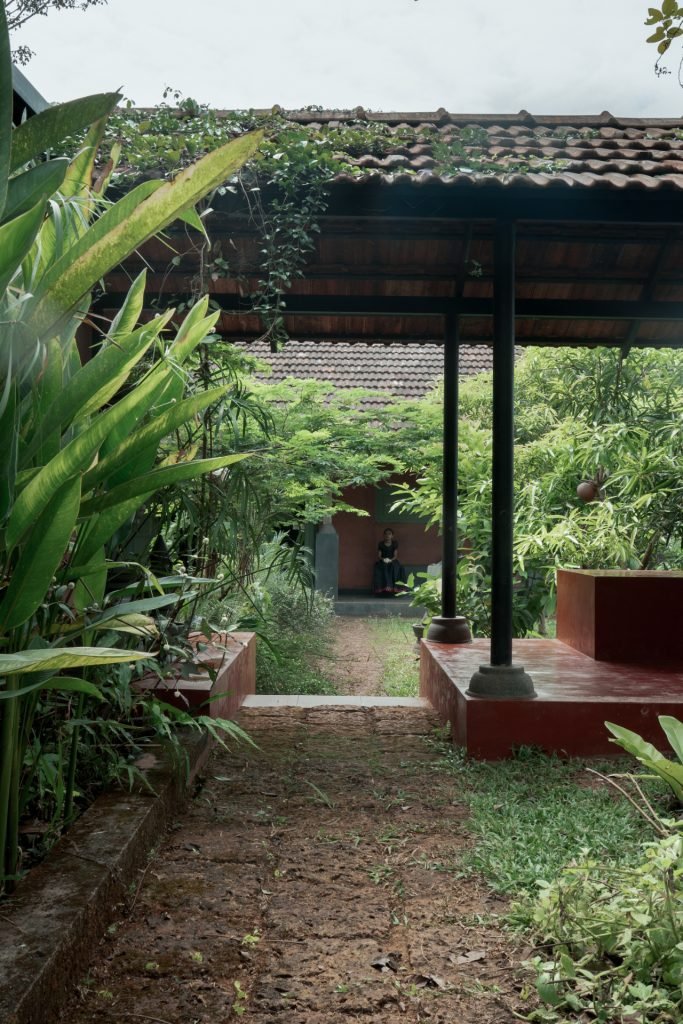
Yuuga Design Collective describes EMA as a house intended to age gracefully. The lime plaster will gather patina. The Mangalore tiles will mottle with moss through the monsoon seasons. The reclaimed timber, already weathered when it arrived on site, will continue to the condition of the older buildings it came from. Time is treated not as an adversary to be resisted but as a collaborator that deepens character and meaning. The house records the rhythms of monsoon, heat, and daily inhabitation in its surfaces, and that recording is the point. EMA proposes a way of building that is less about creation and more about continuity, shaped by memory, sustained through ecology and enriched by craft. In 1,700 square feet in Malappuram, it makes that case quietly and completely.
Fact File
Project Name: EMA
Location: Malappuram, Kerala, India
Architect: Yuuga Design Collective
Principal Architects: Mithun Balan, Arun
Project Type: Private Residence
Project Size: 1,700 sq ft
Year of Completion: 2025
Photography: Shamil, Sanjay P
Creative Direction (Photography): Arshad Ashraf, Asfar
Instagram: @yuugadesigns
