
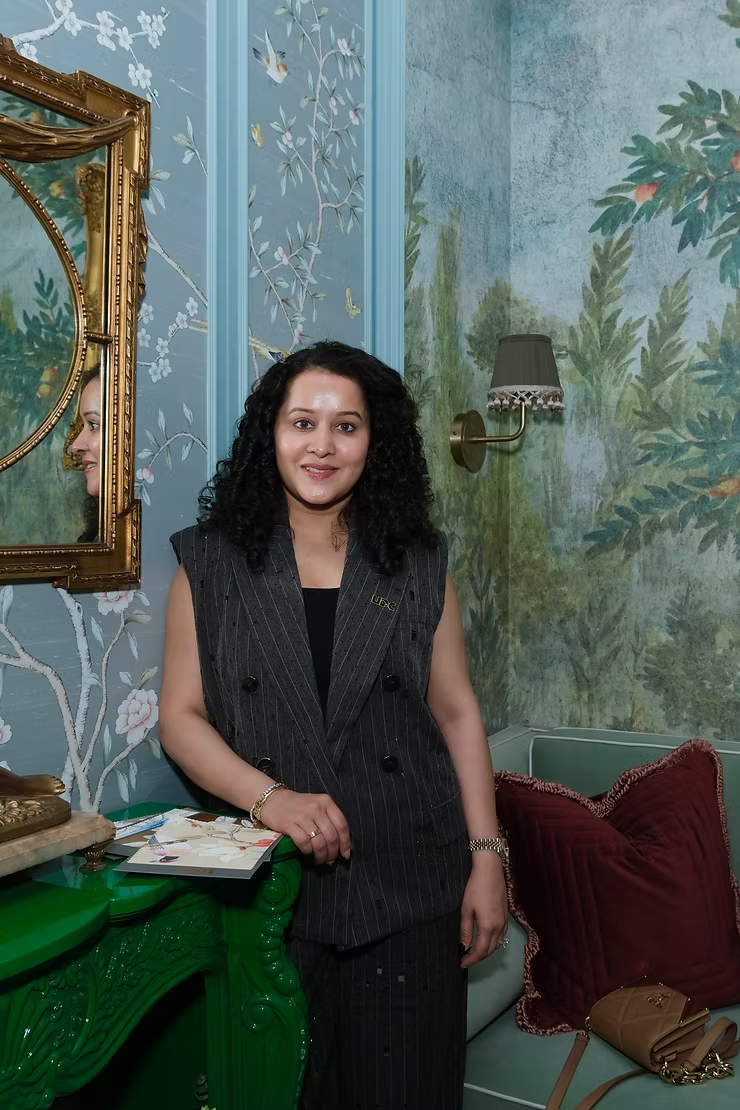
She read economics at Warwick and spent years in financial analysis before walking into the décor business and quietly rebuilding it. Neha Jain, co-founder of UDC Homes, talks to Design Diary International about turning a paint retailer into a wall covering brand and why she treats a wall the way an engineer treats a load-bearing beam.
Neha Jain did not come to design the usual way. No design school, no apprenticeship in someone else’s studio. She came from spreadsheets, with a degree in economics and finance from Warwick Business School and a habit of spotting gaps in a market before they became obvious. In 2014, she pointed that habit at her family’s paint business.
UDC Homes had been selling color to Indian homes for twenty-five years. It was one of the country’s larger paint retailers, with the kind of reputation that takes decades to build. Jain’s idea was to stop selling other people’s surfaces and start designing their own. The company moved into wall coverings.
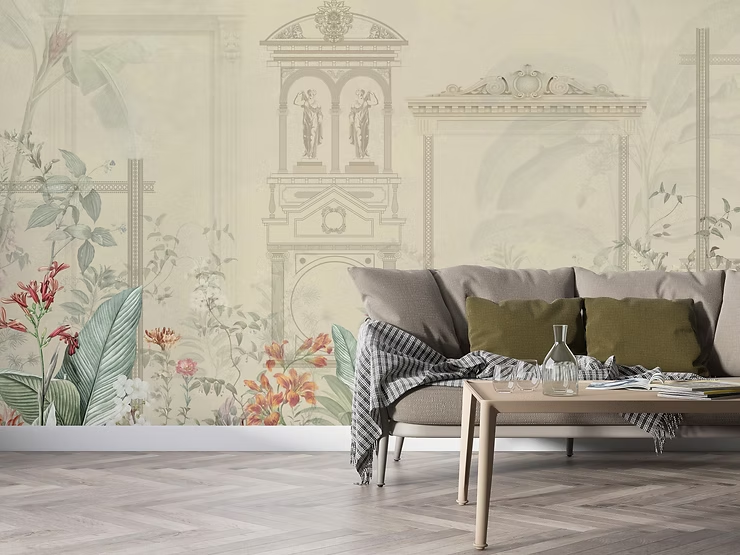
The gap she saw was specific. “There was a clear gap in the market for customized, premium wall coverings that matched both global standards and Indian design sensibilities,” she says. India had paint. It had imported wallpaper at prices most buyers couldn’t reach. What it didn’t have was premium, made-in-India wall coverings built for Indian homes and Indian weather. Clients, she noticed, had stopped treating walls as backgrounds. They wanted them to do something.
What she describes next is the part that gives away her background. Jain talks about a wall the way a structural engineer talks about a beam, as the thing that sets the proportion and mood of a room before anything else is decided. “In many of our projects, the wall sets the tone before furniture or décor is added,” she says.
The wall comes first; everything else answers to it. In her account, wallpaper isn’t ornament. It’s architecture expressed through surface.
That belief shows up in how UDC develops a collection. A single design moves through six to eight stages before it reaches a buyer: research into trends and architecture and culture, then sketches and digital artwork, then the slow business of fixing scale, palette, and repeat, then material selection, surface testing, physical samples, prototypes, and rounds of quality checks. Only after performance testing does anything go into production. It is the testing instinct of a former analyst, transplanted into a design studio.
Performance is not a footnote for her, because in India it is a real problem. Humidity, temperature swings, the adhesion quirks of older walls, and the wear of an ordinary household—all of it gets built into material choices from the start. “Durability, texture, finish, and ease of installation are essential to luxury. They are never secondary,” she says. A wall covering that fails after three Indian summers, however good it looks in a photograph, is not a luxury product in her view.
The harder question is cultural, and it is where she is most careful. Indian motifs can be slapped onto a surface like a costume or scrubbed away entirely to chase an international blandness that belongs nowhere. Jain tries to do neither. Sometimes the reference is direct, she explains, a deliberate reworking of a heritage art form or a piece of traditional architecture. Sometimes it sits quietly in a color palette or a rhythm of pattern. “Culture does not always need to be loud to be meaningful,” she says. The aim is work that knows where it comes from without being trapped by it.
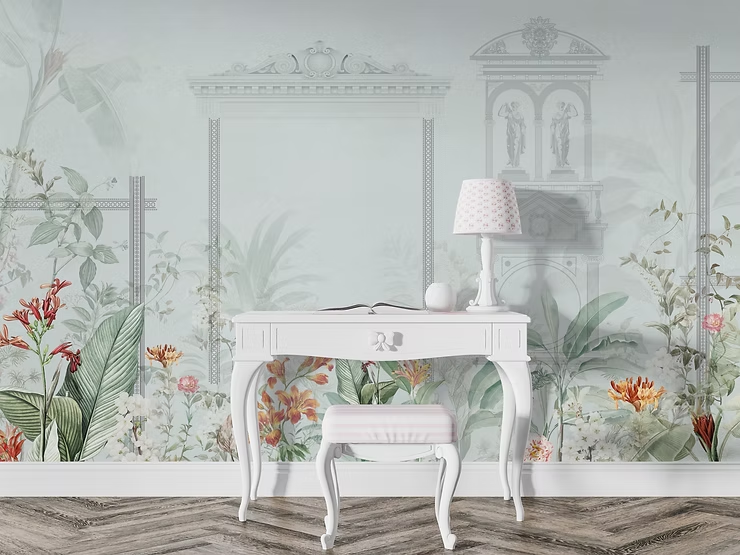
That tension sharpened in 2023, when UDC began exporting wallpaper to the United States and Dubai. Designing for several markets pulls everything toward the safely generic. Her answer has been to anchor collections in themes that travel, nature, texture, and architecture, while keeping a sensibility specific enough to be recognizably theirs. The collection she points to as the clearest expression of the brand is Roman Imperial, drawn from classical European art and structure and reworked for a contemporary room. “Instead of chasing fast trends, we aim to create designs that feel relevant for years,” she says.
There is an analyst’s logic running underneath all of it. Manufacturing limits, she has found, often produce a better design than the original unconstrained idea; a constraint in texture or scale forces a simplification the concept would never have reached on its own. So her design and production teams work as one conversation rather than two departments, makers in the room from the start, not consulted at the end when the only response left is compromise.
Ask her where the field is going, and she describes more immersion, more intelligence, more material sophistication, digital precision sitting alongside handcraft, sustainable substrates becoming standard rather than premium, and walls understood as personal expression rather than a finish picked from a sample book. Through all of it, she insists, craftsmanship stays central, the thing that keeps a surface tied to the room and the person standing in front of it.
Her advice to designers entering the field reads like a description of her own twelve years. Understand architecture before pattern. Study materials as seriously as you study design. Don’t chase trends. Build from concept and proportion. Learn from the people who make the work, because they will teach you what survives contact with reality. “Great surface design comes from observation, experimentation, and a genuine passion for detail,” she says. For someone who came here from financial markets and rebuilt a category along the way, this is less a slogan than a working method.
Interview by Design Diary International
