
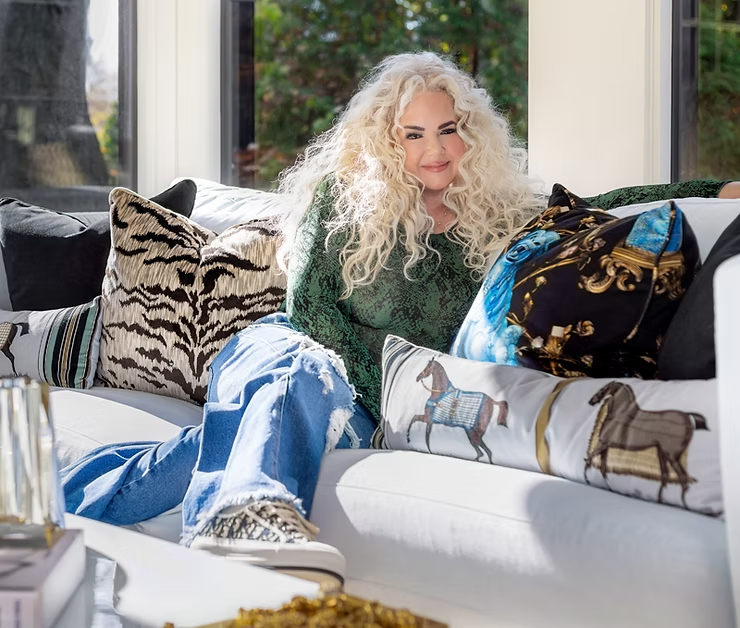
While the design world spent decades apologizing for richness, Lori Morris kept building rooms that were layered, personal, and emotionally alive. Shweta of Design Diary International speaks with the founder of House of LMD about originality, obsession, and what it really means for a home to hold you.
She wrote it in an email, in response to a question about the long, minimalist years, and what was striking about it was not what she said but the temperature of it. Completely calm. No score to settle, no edge of vindication in it. Just a woman stating something so thoroughly resolved within herself that the argument had ended a long time ago and what remained was simply the work, how she has always done it, and how she will keep doing it, wherever the broader conversation decides to go next.
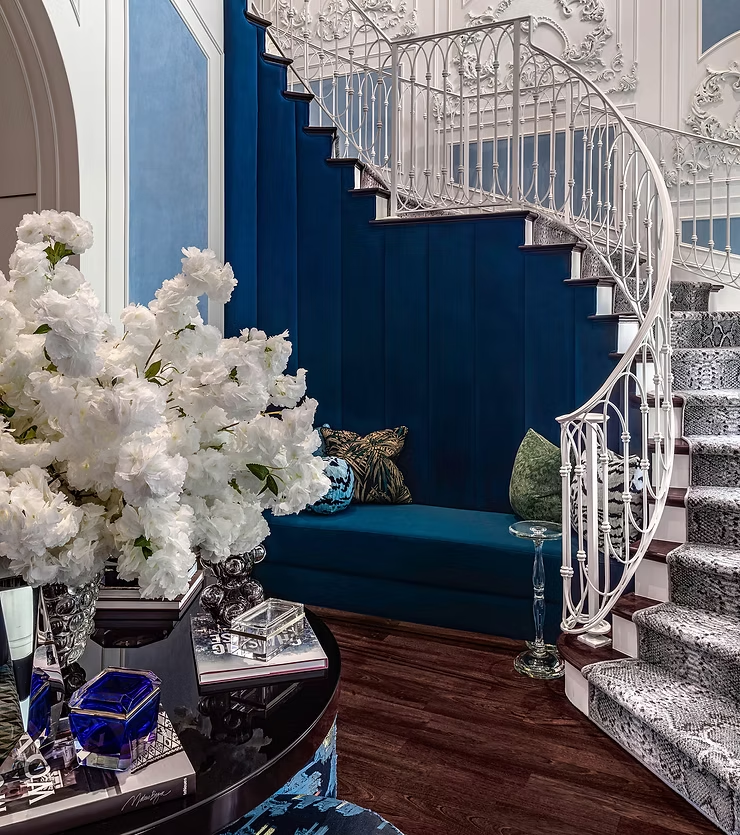
Lori Morris is the founder of House of LMD, a Toronto-based practice that has spent more than three decades building interiors of a particular and demanding kind. Rooms that are layered. Rooms that are specific. Rooms that are emotionally loaded in a way that makes you feel something before you have understood what you are looking at. Custom furniture designed to the exact proportion of each space. Carpets conceived for a precise atmosphere. Seating scaled to an architecture that nothing in any showroom could ever answer. When it works, and it does, you feel it the moment you cross the threshold. That is not an accident. It is the entire point.
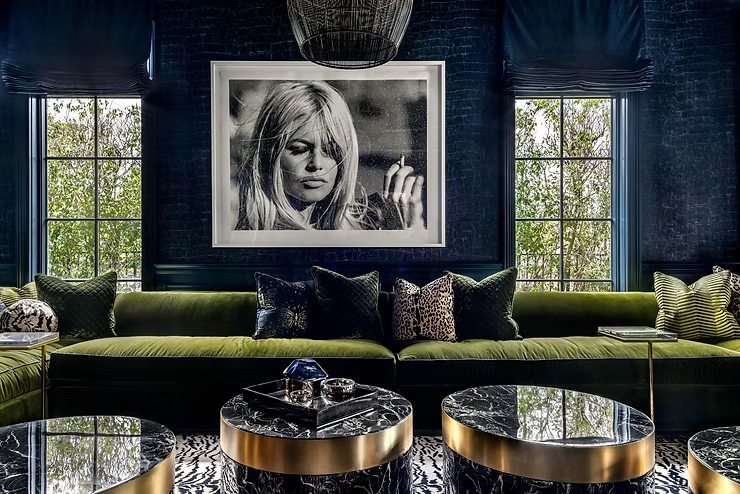
We put a series of questions to Morris over email, and what came back was not the carefully managed language of someone protecting a brand. It was something more interesting than that. The voice of a woman who has never once looked sideways to check what the rest of the room is doing, who decided early that originality was not a strategy but a position, and who has spent every year since simply following through on that with greater confidence, greater scale, and what she describes, without any apparent vanity, as getting better with age.
Designers often face the question of whether a space should evolve or remain fixed as a moment in time; however, this question doesn’t apply to Morris’s work. Her interiors are not trying to be timeless in the neutral, inoffensive, safe-for-whoever-comes-next way that word usually implies. They are trying to be specific. This person. This life. This particular way of moving through a home. And specificity, by its nature, does not date the way fashionable things date. It simply becomes more itself over time, more settled, more exactly what it always was.
She is direct about this when the subject comes up. A room should carry a story that you feel the moment you step inside, and she uses the word “story” not in the vague, mood-board sense it has been worn down to mean in recent years but in the precise sense of a narrative with a logic and an emotional destination. Something that begins with a client and their personality and their daily life and their private dream of how a home might make them feel and ends with a room that could not belong to anyone else. So particular, so complete in its expression of one life, that placing anyone else inside it would feel like a category error.
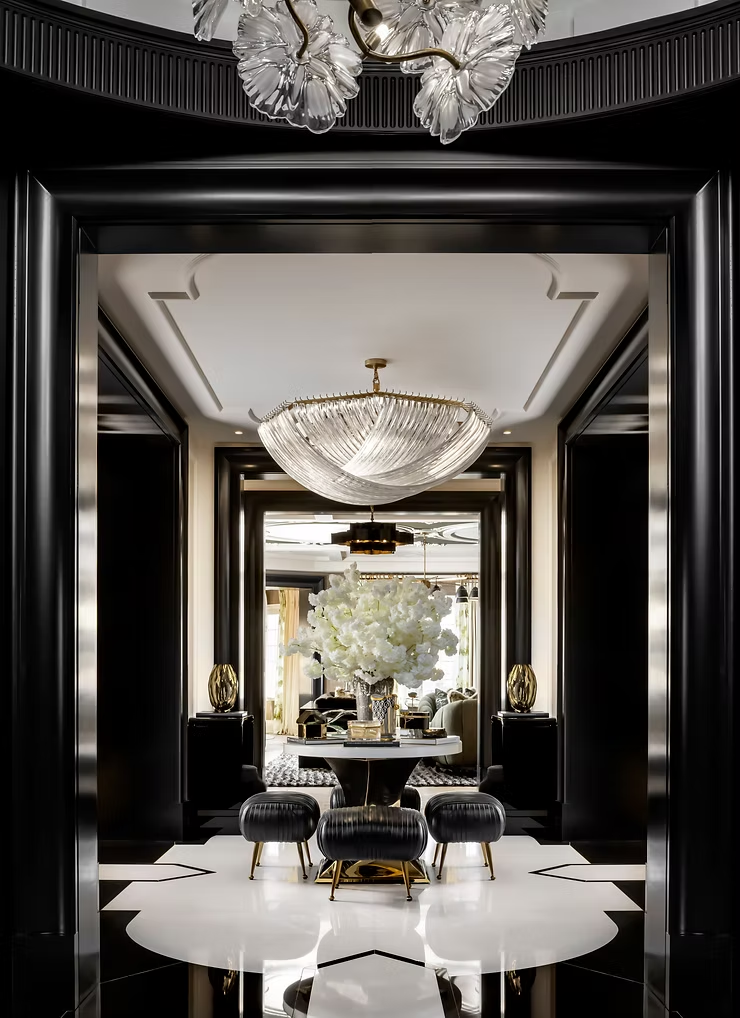
Every design should carry surprise and personality, she writes. When you walk into a room, you should feel something. The space should say something to you, because if it does not, you simply walk right past it. The way she phrases that, the walking right past it, suggests a failure so total that it renders everything else about the room beside the point. Materials, scale, craftsmanship—all of it is meaningless if the emotional charge is absent. Which tells you something important about how Morris understands her own work. Not as decoration applied to a surface that was already resolved, but as the creation of an atmosphere that is itself the architecture. The feeling and the space are inseparable from each other, built together from the start.
A well-designed space, she adds, feels seamless and cohesive to the eye. When everything works in harmony, the beauty lands before the brain has had time to process the individual parts. That instinctive recognition is for her the signal that the design has done what it was supposed to do. Not admiration exactly, but something more immediate than that, something closer to the feeling of being held by a space that was built entirely around you.
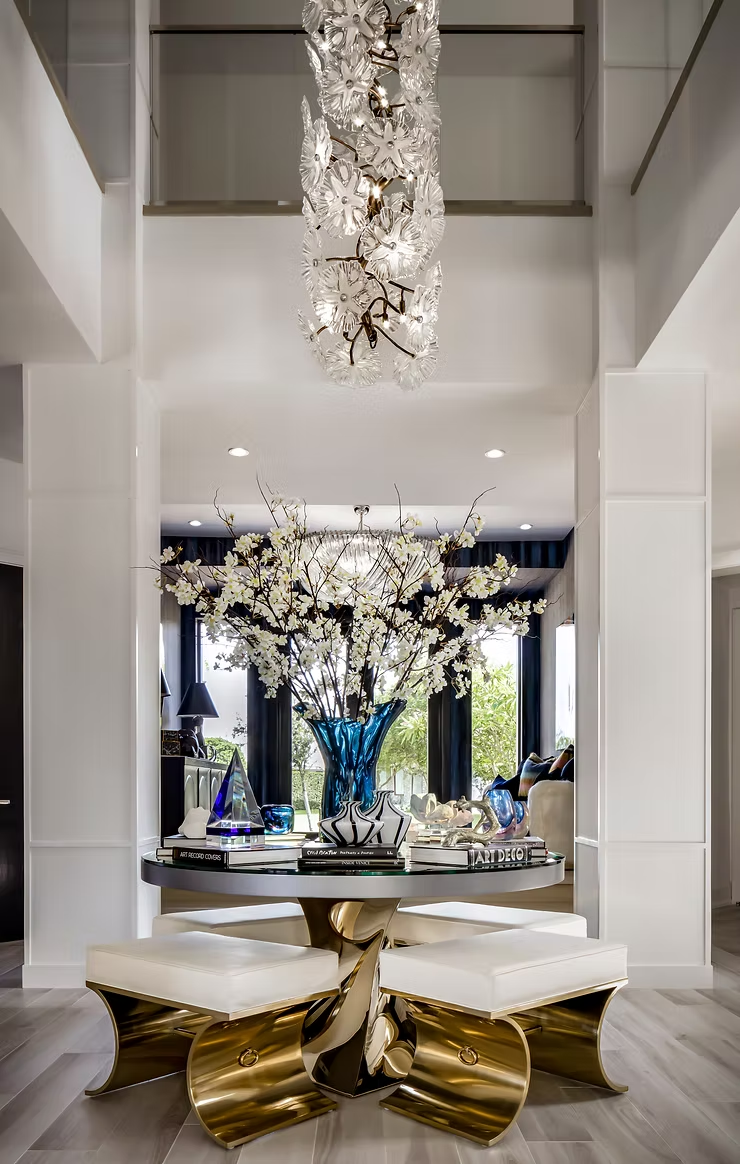
“When you walk into a room, you should feel something. The space should say something to you, because if it does not, you simply walk right past it.”
When the conversation turns to process, to where a project actually begins, what comes back sounds less like a design methodology and more like a form of inner sight. The finished room arrives in her mind whole and complete before a sketch has been made, before a material has been chosen, before a single conversation with a contractor has taken place. She is matter of fact about this in a way that makes it sound entirely ordinary, which perhaps for her it is. If you are building a house from scratch, she explains, the process begins with the architecture. But the concept is always client-driven. She needs to understand what style they love, what they want the home to feel like, and how they live day to day, because gathering all of that is the foundation of the story she is going to tell through the design. Once that foundation is laid, the project begins with a sketch of what she already sees in her head. She usually envisions the finished room before it has even started, and everything that follows is a matter of working back from that vision. Her team builds out the full design package from a concept that already exists, complete somewhere ahead of them.
It is worth sitting with that image for a moment. A designer working backwards from a finished interior that exists first only in the mind. It goes a long way toward explaining why her spaces feel the way they do. Resolved. Inevitable. Specific in a way that has nothing to do with trends and everything to do with a singular point of view held consistently over a very long time, a point of view that never needed the external world to confirm it before it felt justified in proceeding.
“I usually see the finished product before it has even started. That vision becomes the starting point. Then our team works back from there.”
She talks about furniture the way an architect talks about load-bearing structure. Not as objects placed within a space to make it feel inhabited, but as extensions of the architecture itself. Pieces that could not exist anywhere else because they were conceived for this room and this room only. It was scaled to its exact proportion, weighted to its exact atmosphere, colored, and textured to complete a vision that was already whole before the first measurement was taken. In many of the homes we design, she writes, the rooms are quite significant in size, and you simply cannot walk into a store and find a piece of furniture that fits the scale or proportion or feeling we are trying to achieve. And so they design the pieces themselves. Seating areas, coffee tables, carpets, and a great many other elements, all custom-made and all resolved down to the last detail. This is not a luxury in the sense of an added extra. It is a necessity because the final vision exists first in her head, and that vision is not something you can buy off a showroom floor. It has to be brought into existence so that it fits seamlessly into the architecture and the atmosphere of the home, so that it could not be anywhere else and nothing else could be there instead.
There is something almost obsessive in this level of specificity, and Morris does not shy away from it. The obsession is the work. The refusal to approximate is the philosophy. A room in which even one element has been settled for rather than conceived is a room in which the vision has been compromised, and compromising the vision is not something she appears to have any particular talent for.
Luxury is a word the design world has been renegotiating for years, pulling it away from excess and toward discretion, away from ornamentation and toward material purity. Morris listens to none of it, not because she is unaware of the conversation but because she has her own definition and it is more useful than the one currently in circulation. Luxury in design can mean different things to different people, she writes. Some define it by size and scale, by square footage or intricate detail or expensive materials. But for her, luxury is really about a feeling. A home that hugs you and wraps around you, creating the sense that you are in a space that is opulent and beautiful and completely yours. And she is equally clear that none of this requires formality or stiffness, because true luxury does not have to be formal or overly fancy; that is often a misconception. It can be organic and natural, calm and Zen-like, or light and monochromatic, or it can be an explosion of magical LMD color. What matters in every case is the atmosphere, the enchantment, the refinement, the comfort, and the serenity a space creates when everything has finally come together exactly as it should.
“Luxury is the feeling of enchantment, refinement, comfort, and serenity that a space creates when everything comes together perfectly.”
She wants clients to be overwhelmed when they walk through the door of a finished home for the first time, overwhelmed in the best sense, that particular and unrepeatable sensation of a dream being returned to you more complete than you had imagined it. After all the time and energy and investment they have put in, she writes, the goal is for them to feel it was all worth it, that the result is even better than they imagined. The emotional connection that it produces is what makes her happiest. Because the feeling a room gives you is ultimately what the space expresses through its design, and that feeling was the point before any material was chosen or any furniture was designed. It was always the point. It is the only point that matters when the work is finally standing in front of you asking to be felt.
She wants the rooms to hug you forever, she writes at one point. Not just to impress on first encounter but to keep working on you, to welcome you back every time you come through the door. It is perhaps the most honest and most demanding definition of what a home should do that you will find anywhere in contemporary design culture, and it makes most of what passes for luxury residential design look like it has been aiming at the wrong target entirely.
The conversation around maximalism has been loud in recent years, the design press welcoming it back with considerable enthusiasm, treating its return as a cultural moment worth marking. Morris receives all of this with the equanimity of someone watching a party form around a place she has been standing quietly for thirty years. Because she never left. This has always been the style. And the broader culture catching up to it does not change anything about how she works. No, it does not feel different, she writes, because we never left that approach. This has always been our design style. Rather than following trends, we create our own and have always stayed true to that direction. There is something almost clarifying about the plainness of that statement. The refusal to perform excitement about a vindication she never needed. For Morris, validation was irrelevant, and its absence was not a problem. She was going to make these rooms regardless.
“Rather than following trends, we create our own, and we have always stayed true to that direction.”
She is frank about the fact that clients today are more engaged with their homes than they have ever been. More specific about how they want to live, less concerned with whether a room follows traditional rules and more focused on whether the space will actually support them and their family in the way they need. She brings to that conversation a confidence she describes as something she carries into the room, a confidence that gives clients confidence, that creates the conditions in which genuine creativity becomes possible because the fear of getting it wrong has been quietly removed before anyone has sat down. When a client comes to the House of LMD, she writes, they are usually ready for something original and open to creativity and individuality, and her role is to guide them through that process and help bring their vision to life in a way that feels authentic and truly personal. Which sounds simple until you consider what it actually requires: the ability to hear what a person wants their life to feel like and then build the physical environment that produces exactly that feeling, custom and complete and entirely specific to them, down to the last piece of furniture and the last square yard of carpet.
There is a version of a long career in which early instincts calcify into habit, the vision narrows, and the work becomes more refined but also smaller. Morris describes something that sounds like the precise opposite. A career in which the confidence to execute has been catching up steadily to the scale of what she could already see, closing the gap between the finished room in her head and the finished room in the world so that the work now is bolder and more complete than it has ever been, not because the vision has changed but because the ability to deliver on it has grown deeper and surer. My style has evolved in the sense that I have simply become better with age, she writes. The originality and creativity have always been there, the artistic approach, the no-rules attitude, and the rebellious sense of luxury; all of that has always been part of the work. What has really changed is the level of confidence in what I can achieve. Earlier in her career she could see the vision clearly but was sometimes still working out exactly how to bring it together. Today that confidence is much stronger. The ideas are more expressive, the execution more complete, and the homes larger and more ambitious.
She is better, she says, and she says it the way someone reports an observation rather than makes a claim. The way a person states something they have simply noticed to be true after a long time of paying close attention. It lands not as arrogance but as something more interesting than that. Evidence of a career that has rewarded consistency not with comfort but with greater capacity, greater range, and greater ability to deliver on a vision that was always this large and always this certain of its direction.
“The work has become bolder, more adventurous, and more refined over time. Everyone wants to see what we can create, and we are here to deliver.”
When the conversation turns to legacy, Morris returns as she does throughout this exchange to the idea of intention. The full artistry of every element brought together like pieces of a puzzle, each one placed with care and deliberateness toward the completion of a whole that is more than the sum of its decisions. She is clear that even though the work may appear very complex, it is all very intentional. Nothing arbitrary. Nothing decorative in the shallow sense. Everything was aimed at something specific, and everything arrived there. She wants to be remembered as an innovative and creative and artistic designer who set her own trends and created a distinct point of view that was always true to herself, who built a style so recognizable that you can identify it immediately, walk into a room, and know without being told whose work you are standing inside.
Given what the past three decades have actually produced, that is not an ambition. It is already a fact.
The style is something very original, she writes, something that had not been seen before, and I would like to be remembered as an original innovator in design because that is truly what I have always set out to do. Reading it back, you realize the text is not a statement about the future at all. It is a description of what has already happened, of a career built entirely on that premise and delivered on entirely. The only question that remains is what comes next, which, knowing Morris, is probably already finished and complete somewhere in her head, fully formed, waiting patiently for the rest of the world to catch up.
