
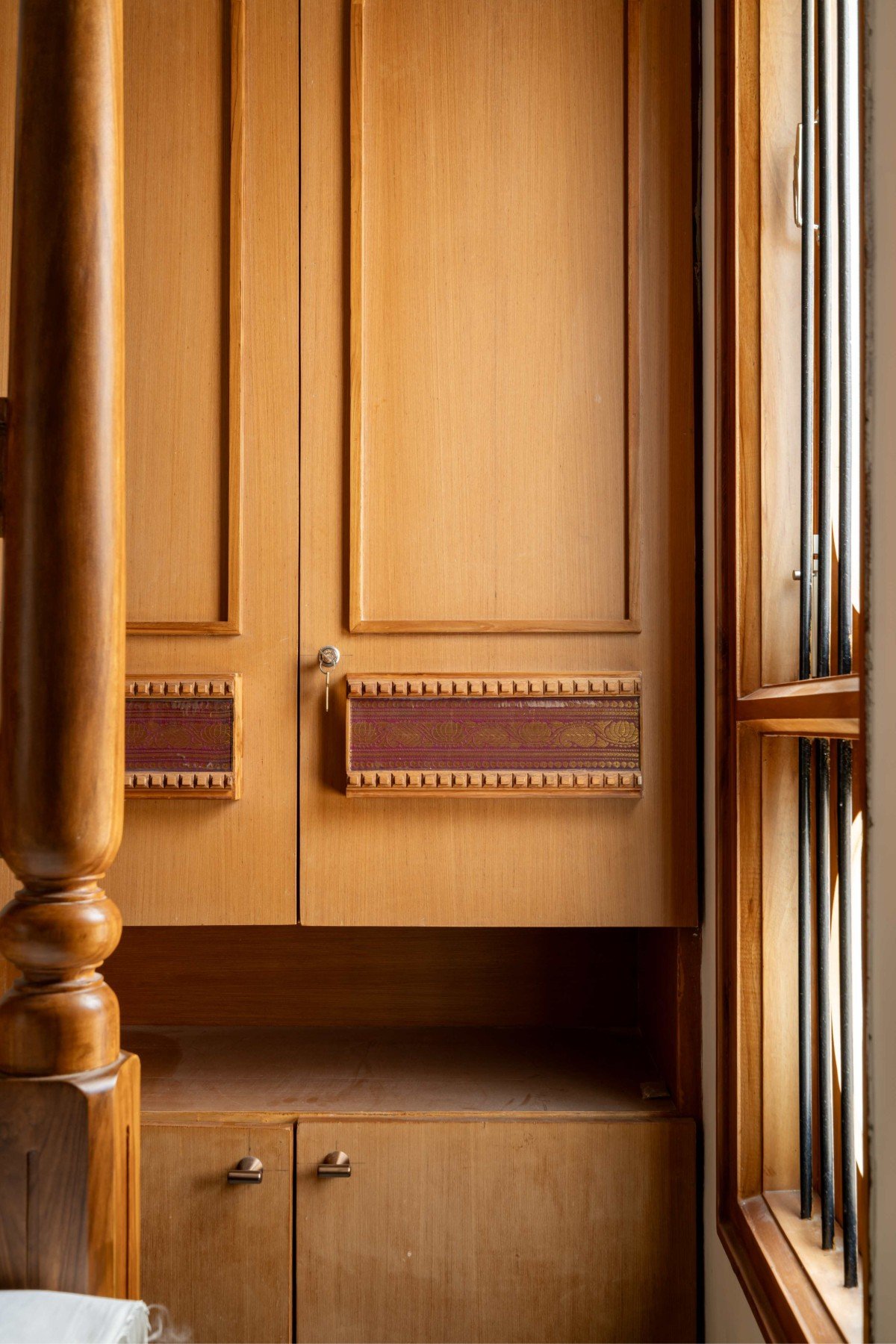
In the wardrobe of the traditional bedroom of this 2,100-square-foot home in Madurai, the door panels carry an inlaid strip of deep purple silk with a gold border running across their middle, the fabric held between two wooden moldings the way a painting sits within a frame, and it is this detail more than any other that tells you what Ar. Porchezhiyan of Yegam Studio was thinking about when he designed Balaji Abode, a two-floor residence built above an existing ground floor in a city whose history is layered enough that you can reach into almost any part of it and come back with something worth using.
The brief was direct: an old-school traditional home, and the response was equally so, almost every component custom-built on site so that the design language remained under continuous control from the first decision to the last. The home carries a foyer, a living area, a dining room and kitchen, and three bedrooms, the shared spaces and one bedroom held within a cohesive traditional aesthetic, and the remaining two given entirely different identities shaped by the people who occupy them.
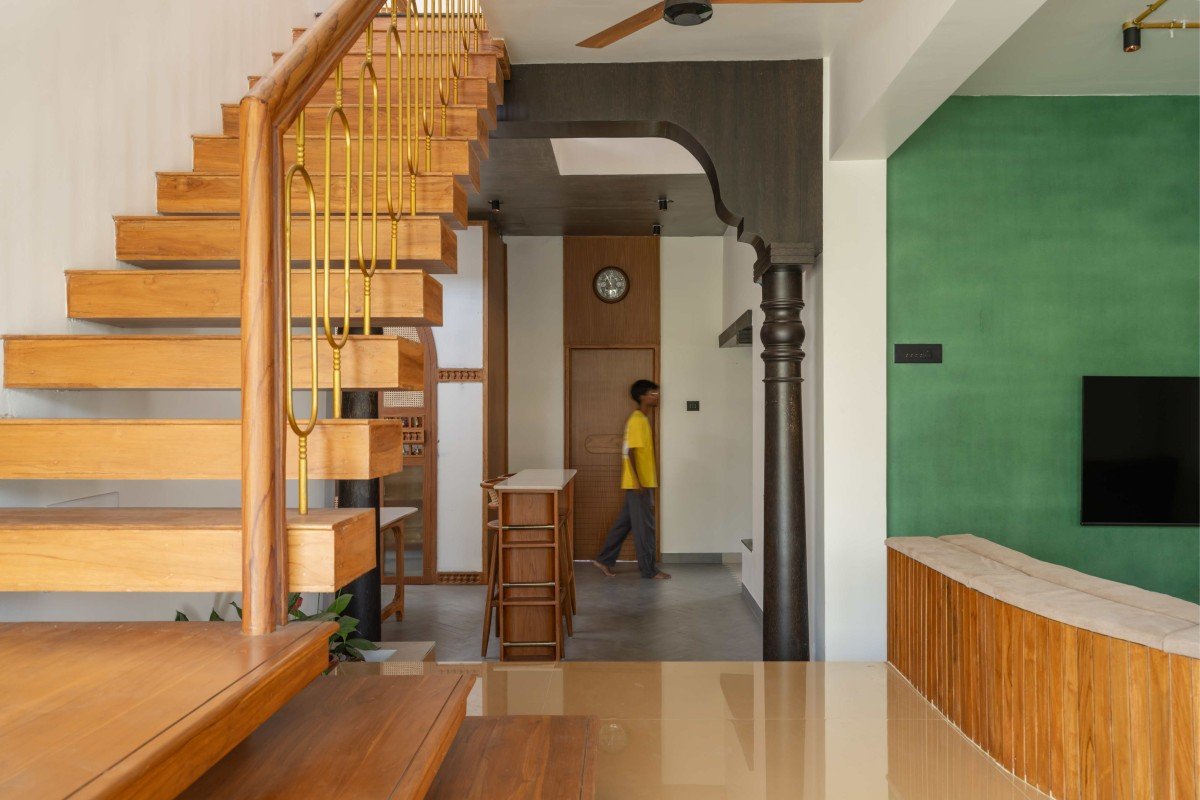
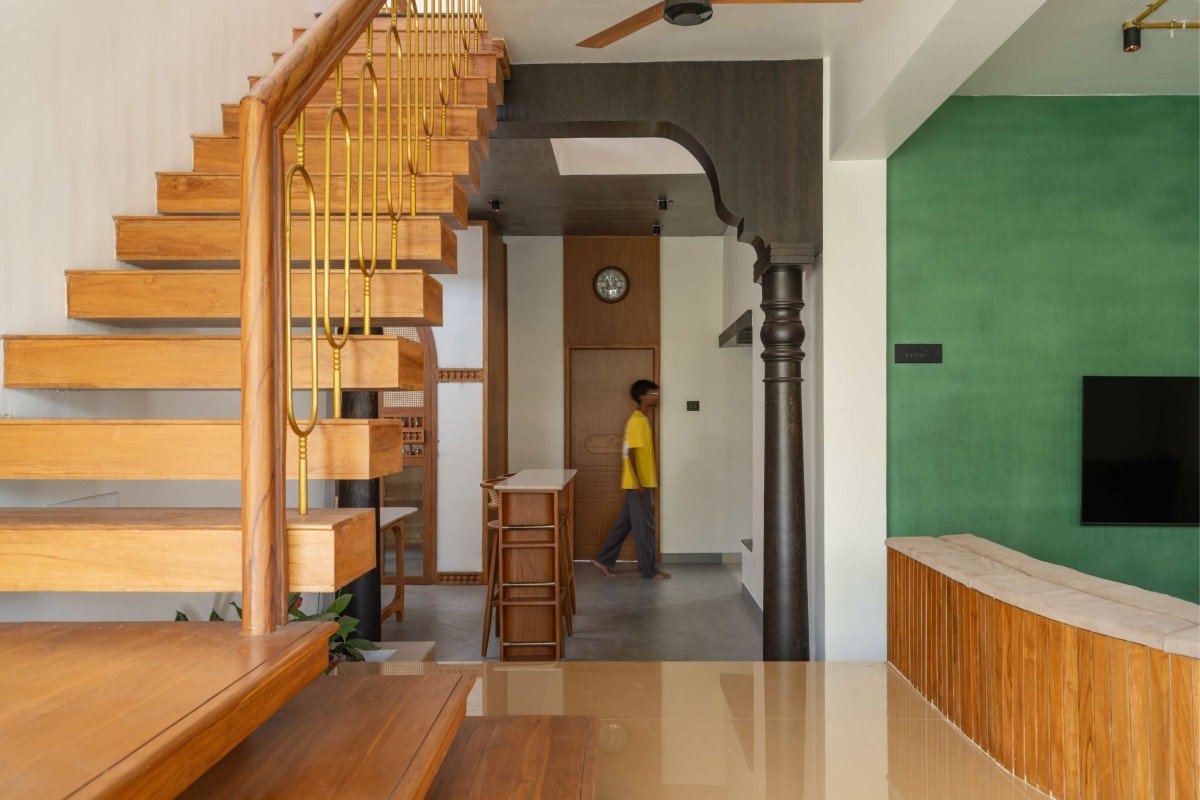
The ground floor announces the house’s intentions at its threshold. A turned wooden column in very dark stained timber, heavy and classical in its proportions, stands in the foyer as a reference to the carved pillars of Madurai’s temples, and steps lead up to a split-level living area where a curved built-in sofa in grey-beige upholstery wraps around a raised platform, its front panel clad in vertical timber slats, the form of the seat gathered inward rather than placed against the walls.
A large arched double-leafed door in warm teak occupies the wall behind it, its curved top panels plain and tall, and a window with turned vertical bars brings light across the polished floor. A brass pipe track runs along the ceiling carrying small directional lights, the detail contemporary in its form and entirely untroubled by the traditional timber and masonry language around it.
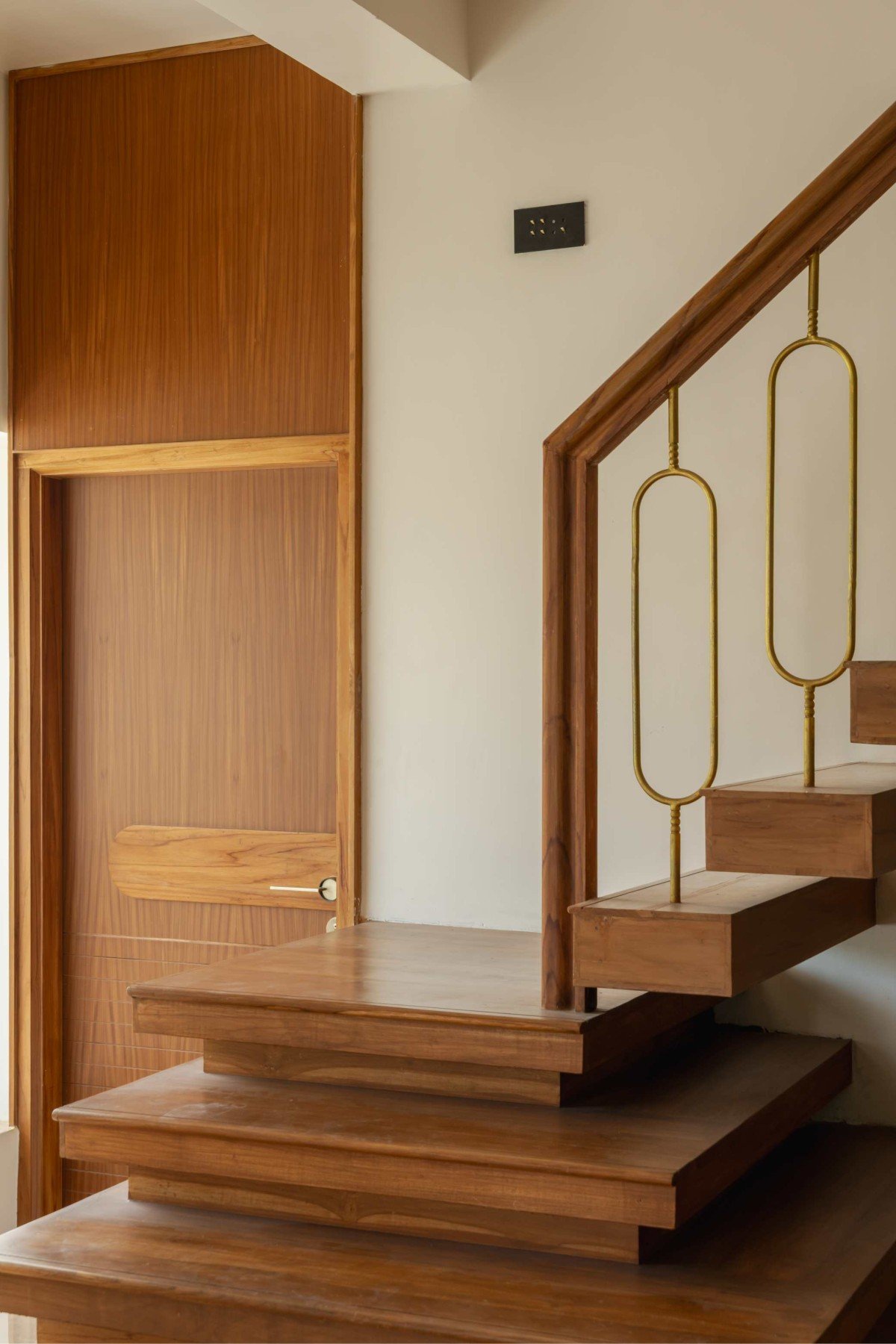
The staircase is the ground floor’s most considered piece of joinery: floating teak treads cantilevered from the wall, the brass balustrade running alongside carrying elongated pill-shaped oval forms as its balusters, each form clean and repetitive, the brass warm against the honey of the teak handrail above, the whole run rising to the upper floor with the confidence of something designed as furniture rather than as structure. Below the first flight, a bench seat built into the underside of the stair carries the same vertical slatted teak paneling as the sofa platform, the detail repeated in a smaller key.
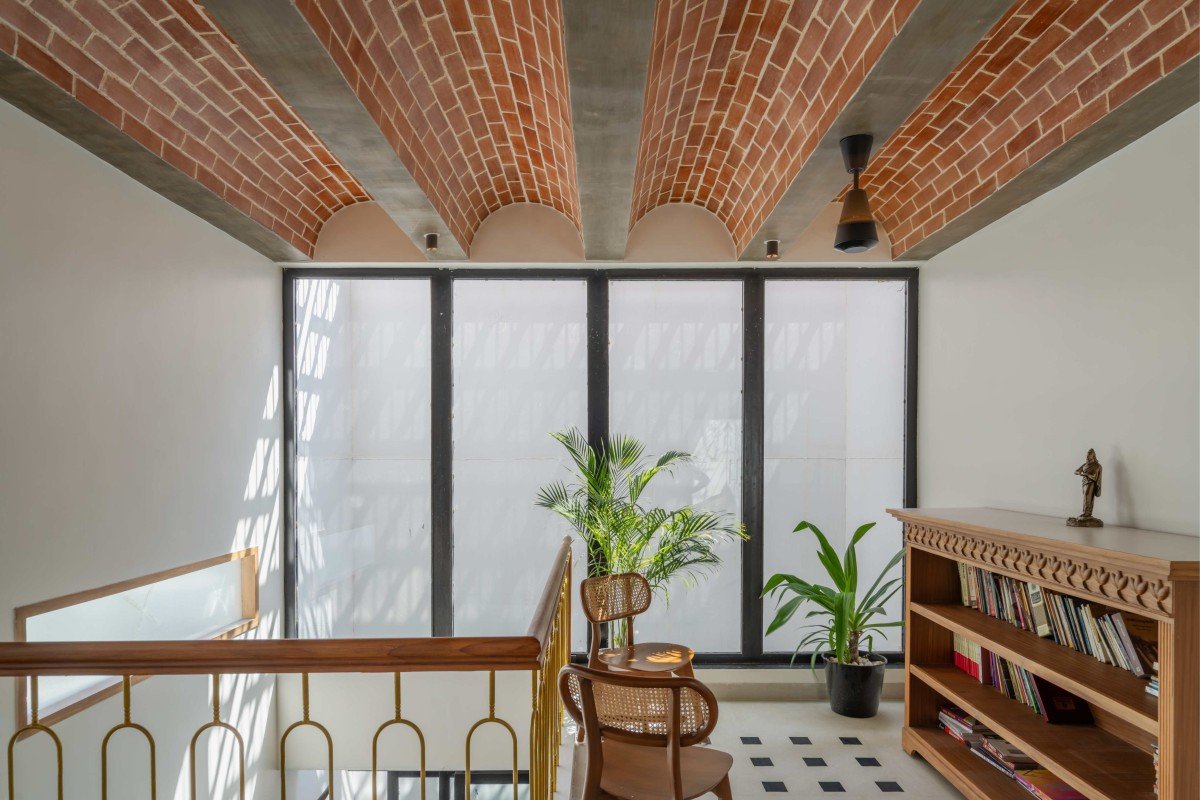
The upper landing is where the house’s defining structural gesture reveals itself. A reverse filler slab ceiling runs the full width of the space in a series of parallel barrel vault arches in terracotta brick, the red tile laid upside down over a temporary arch and cast in concrete, the shuttering removed to leave the raw brick underside of each vault exposed, the concrete beams between them equally unfinished, the whole ceiling warm and tactile and carrying the weight of its own making in a way that a plastered surface would have concealed entirely.
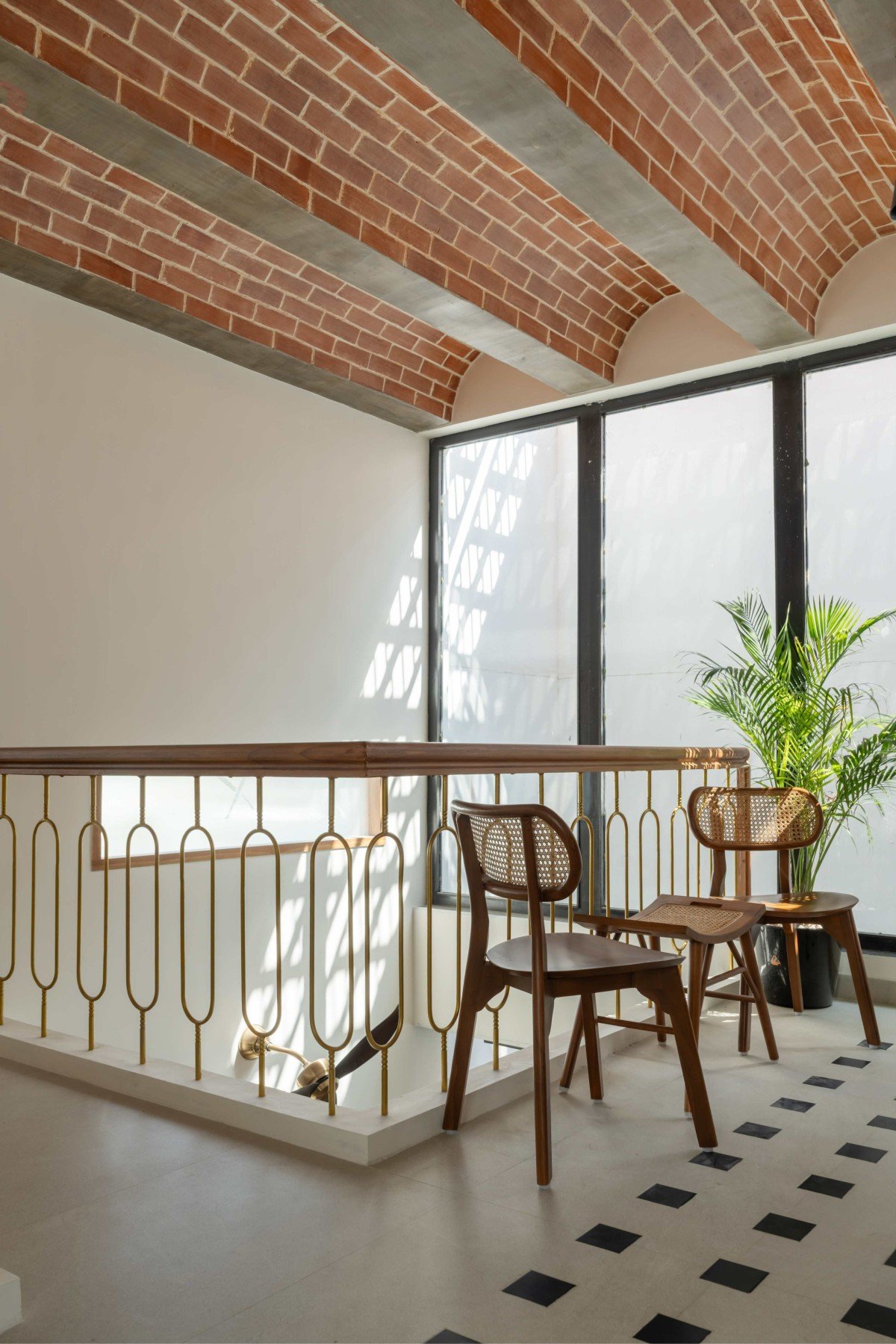
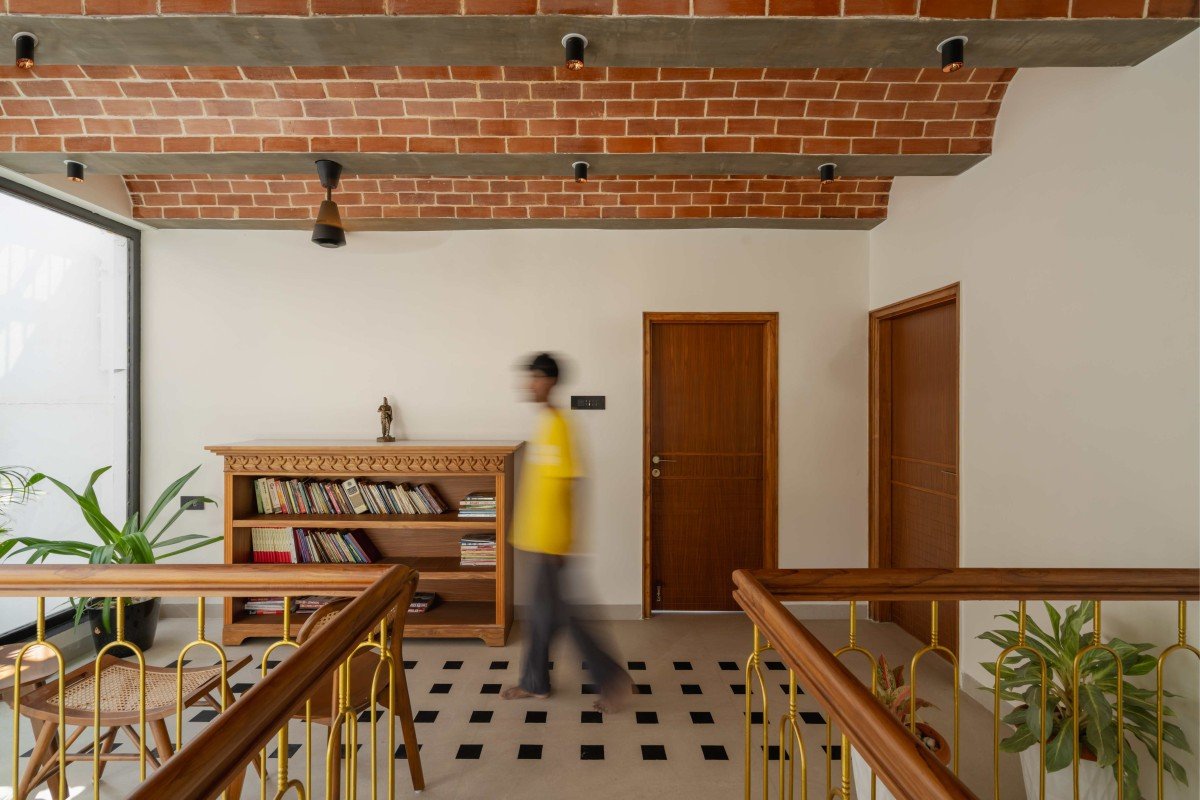
The landing beneath it, flooded with morning light through large black-framed glass panels through which tree shadow falls across the floor in slow-moving patterns, carries two rattan-backed chairs, a carved teak bookshelf with a traditional frieze running along its top edge and a small bronze figurine on its surface, plants arranged at the balcony railing, and the same brass balustrade continuing from the staircase around the landing’s edge, the oval balusters standing against the white wall and the brick vault above them in a combination that sits between traditional and contemporary without resolving itself into either.
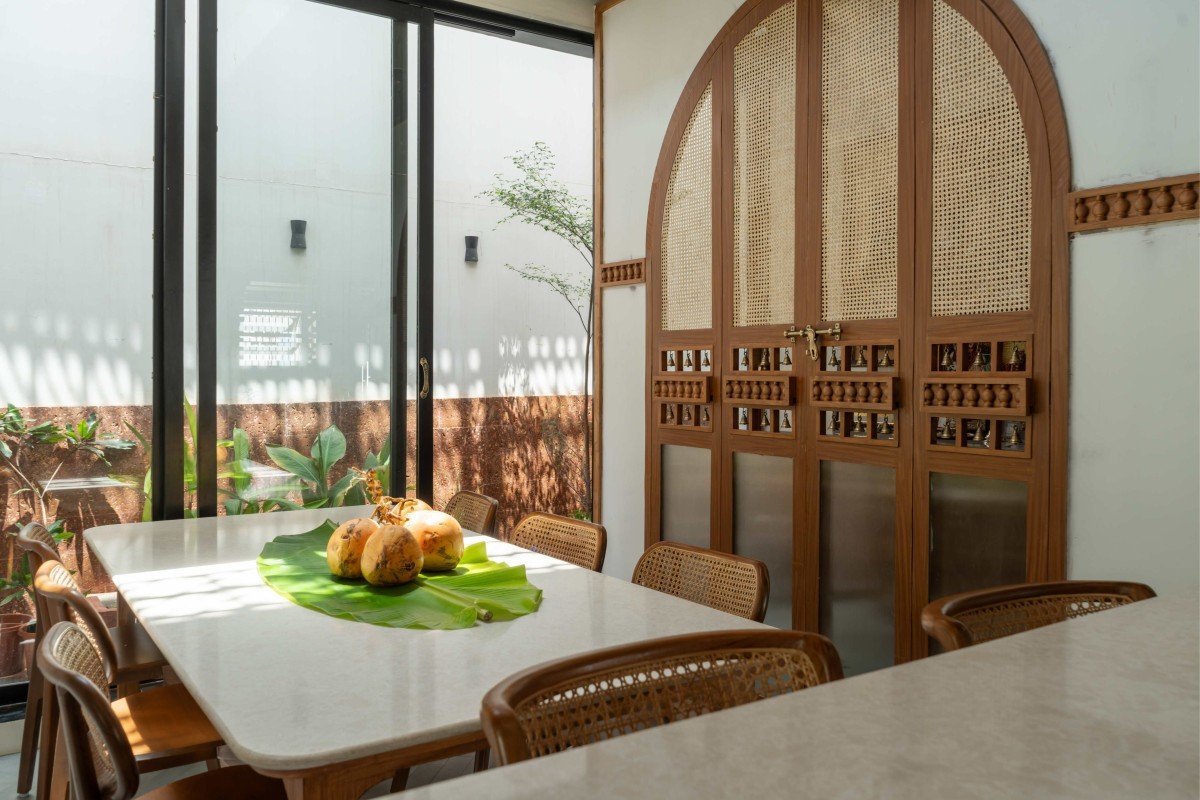
The dining room below is organized around two objects in particular. The table is a custom piece, a white stone rectangular top with soft rounded corners on teak legs whose junction with the top surface is worked into a carved arched bracket, the leg not simply meeting the top but making a small architectural event of the connection, rattan-backed chairs around it, and a banana leaf laid across the stone with fruit placed on it as though the room was ready before it was photographed. Against the wall, an arched cabinet in warm teak, its arch filled with cane panels and its lower portion carrying rows of small brass bells across each panel, functions as a prayer and display piece at dining room scale, its bells and carved detailing a direct reference to Madurai’s temple architecture brought indoors, and through the full-height glass wall beside it, a small courtyard planted with broad-leaved tropicals and a terracotta-tiled back wall brings light and greenery into the room from one side while the cabinet holds the cultural weight on the other.
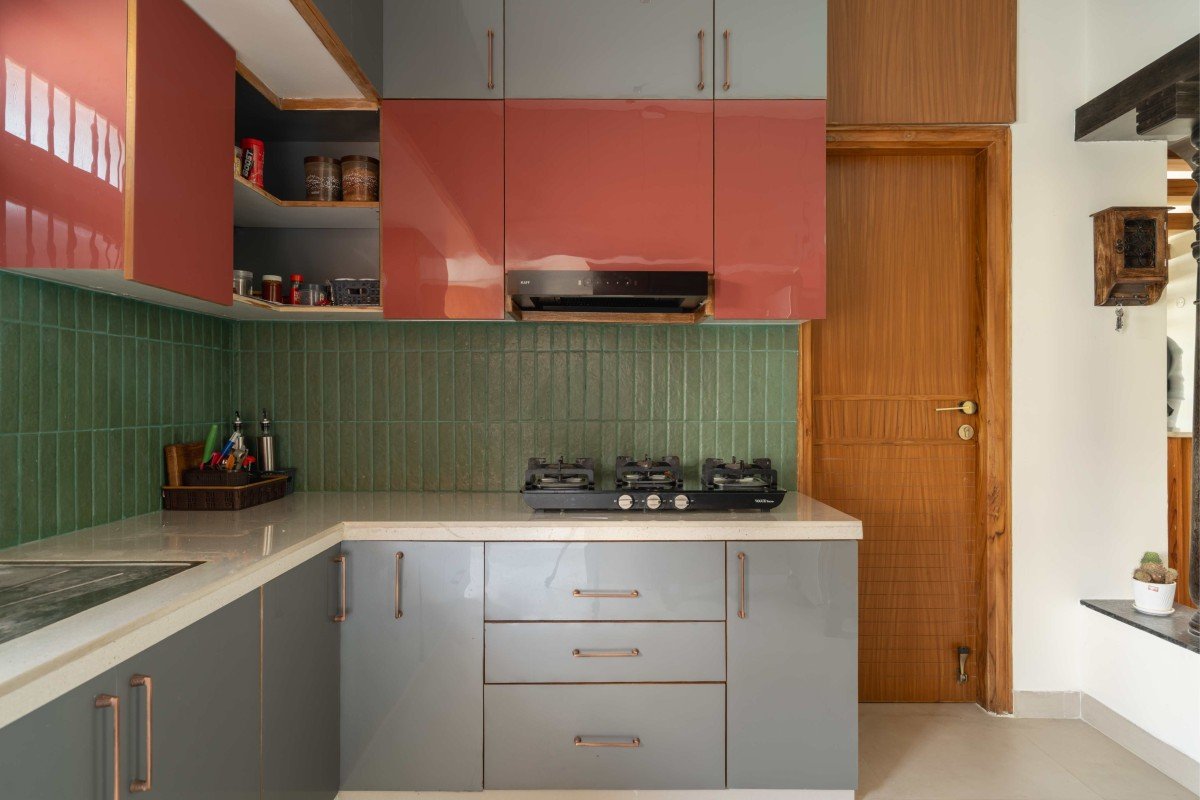
The kitchen works in a different register; its palette is direct and unambiguous: grey high-gloss lower cabinets with copper-finish handles, burgundy-red upper cabinets with open shelving, a backsplash of vertical green glazed tiles in a rich deep tone, a white stone counter running the full length of the wall, and a teak door set into the far end alongside an antique wooden wall cabinet that is the only piece in the room recalling the traditional language of the spaces beyond it. The kitchen island with its white stone top carries shelving in its body with brass rod rails across each shelf, rattan-backed bar stools pulling up alongside.
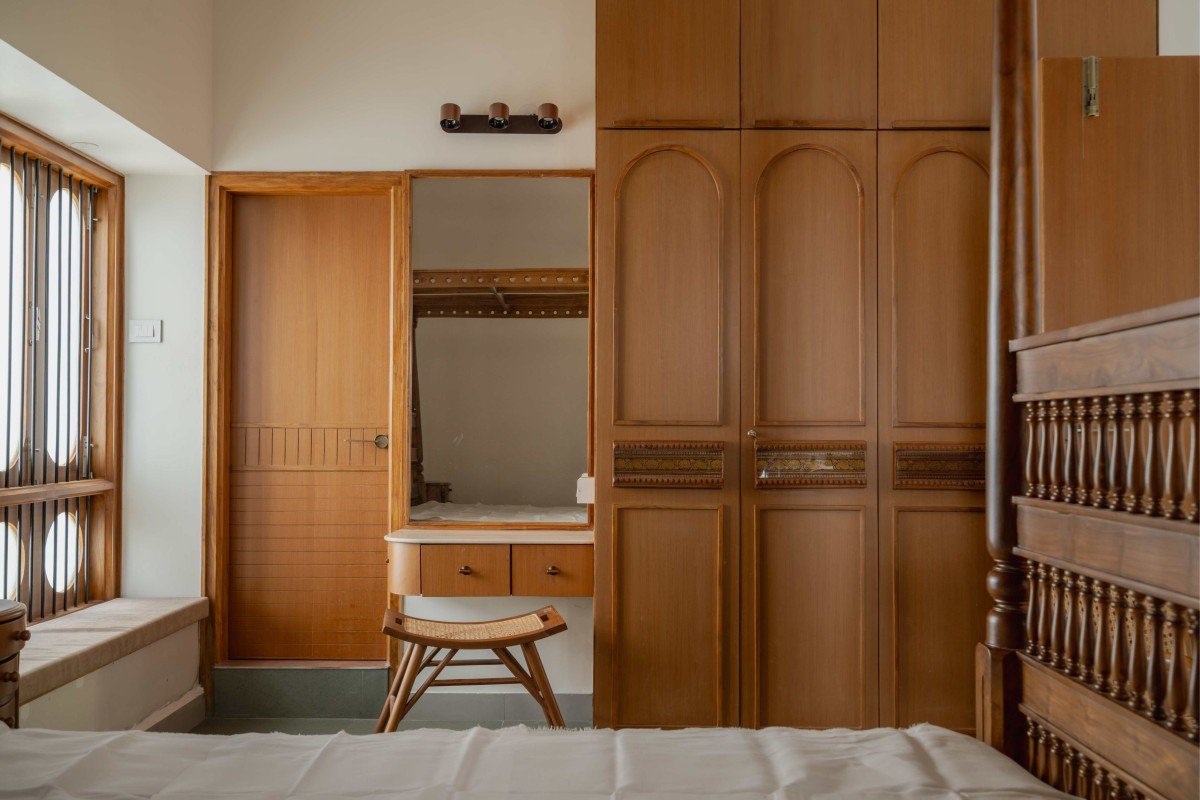
The three bedrooms divide clearly between their identities. The traditional room features full-height teak wardrobes with arched panel doors, a design detail inspired by temple architecture and repeated across the entire run. It also includes a dressing table with a mirror and drawers fitted with turned brass hardware, a rattan stool in front, and a four-poster bed made of dark turned wood at the center of the room. The wardrobe panels showcase a strip of Madurai saree silk, with the purple and gold of the fabric being the only color in a room that is otherwise entirely in shades of honey and dark teak.
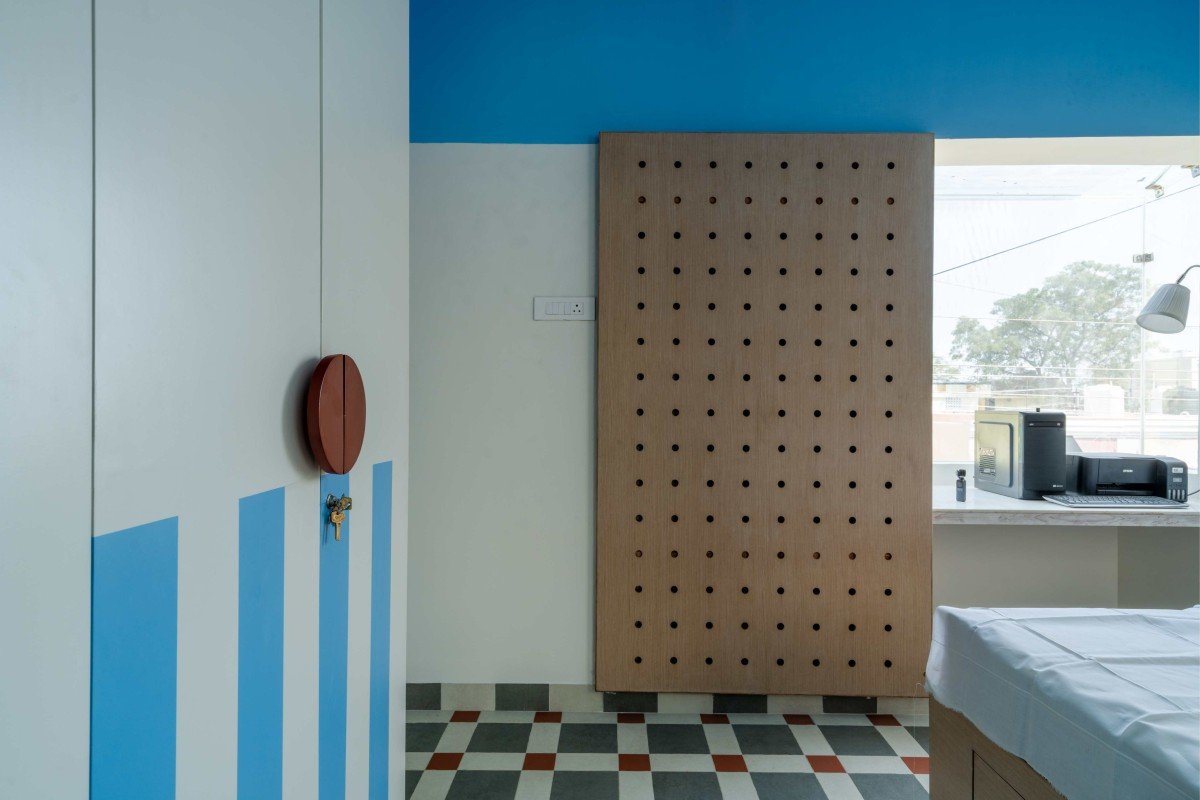
The second bedroom works in blue and white and grey; its wardrobe is painted with blue stripe details, its floor is in a multicolored checkerboard of grey and terracotta tile, there is a perforated wood panel against the wall, and there is a red oval form mounted beside it. The room belongs unmistakably to someone whose taste runs toward the graphic and the contemporary. The third carries an iron bed frame in grey-black, its walls white, a wire grid above the headboard pinned with music and film posters, the room’s accumulation of personal references as deliberate as any of the custom joinery in the spaces below it, the same principle of intent applied in an entirely different vocabulary.
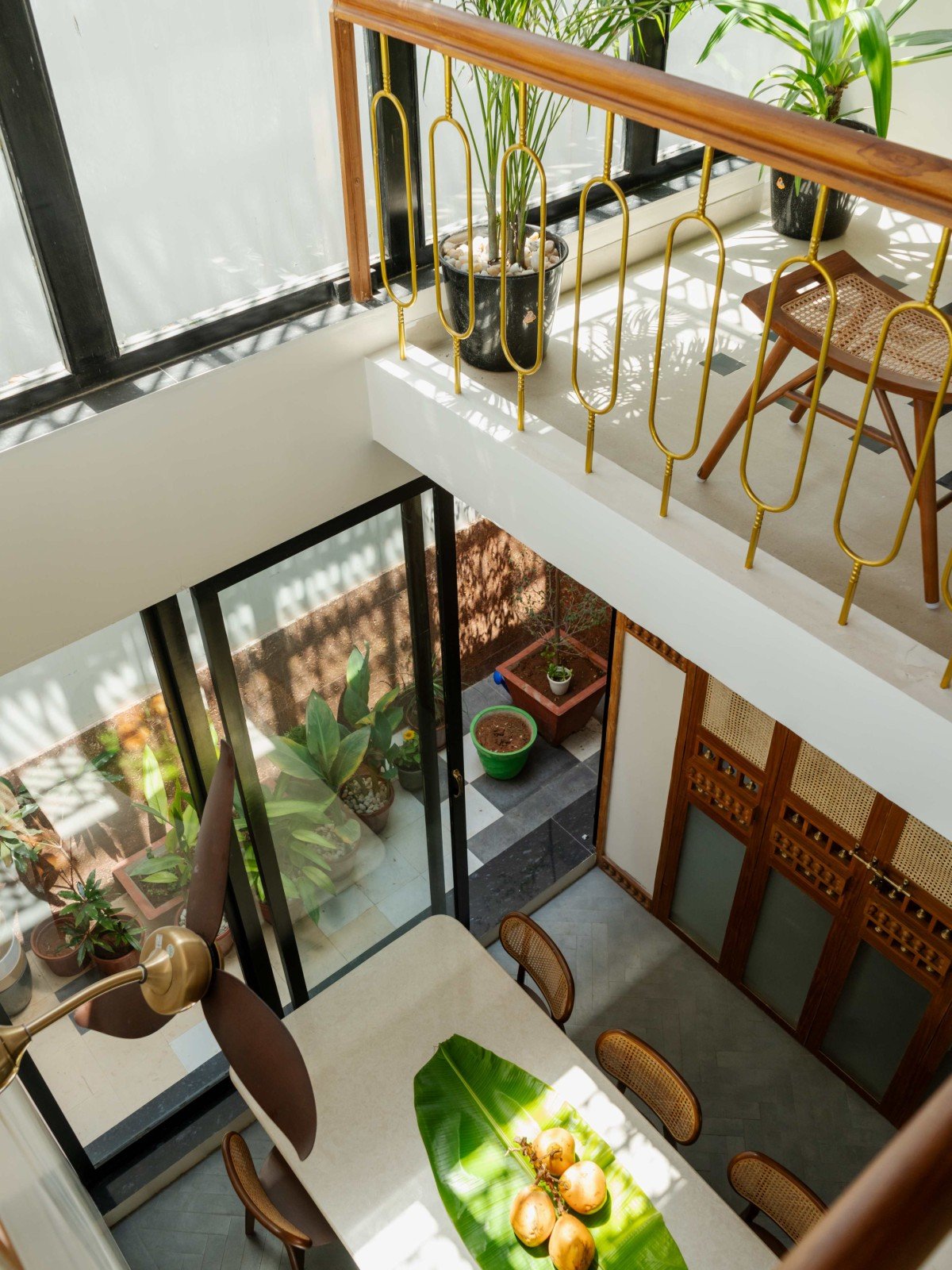
The brick vault ceiling on the upper landing holds the morning light the way it has since the shuttering came away, the raw terracotta and concrete unchanged, the arches as they were when they first came into view, every hour of sun crossing them differently as the shadow of the trees outside shifts slowly across the glass.
Fact File
Project Name: Balaji Abode
Location: Madurai, Tamil Nadu, India
Architects: Yegam Studio
Lead Architect Designer: Ar. Porchezhiyan
Civil Consultant: Modern
Builders Area: 2,100 sq ft
Year of Completion: 2025
Photograph: Studio Taniga Instagram: @yegam_studio
