
The London Solar House in Primrose Hill is a renovation and vertical extension of a century-old two-story solid masonry brick townhouse, carried out by New York-based firm Archi-Tectonics under principal architect Winka Dubbeldam. The project doubles the original building’s floor area to 2,250 square feet within an existing constrained plot on a private mews lane, adding an upper-level zinc-and-glass volume and a series of cantilevered projections onto the existing brick structure. The original building was retained intact as the structural base for all new work. The completed house accommodates a family of four.
The Exterior and the Addition
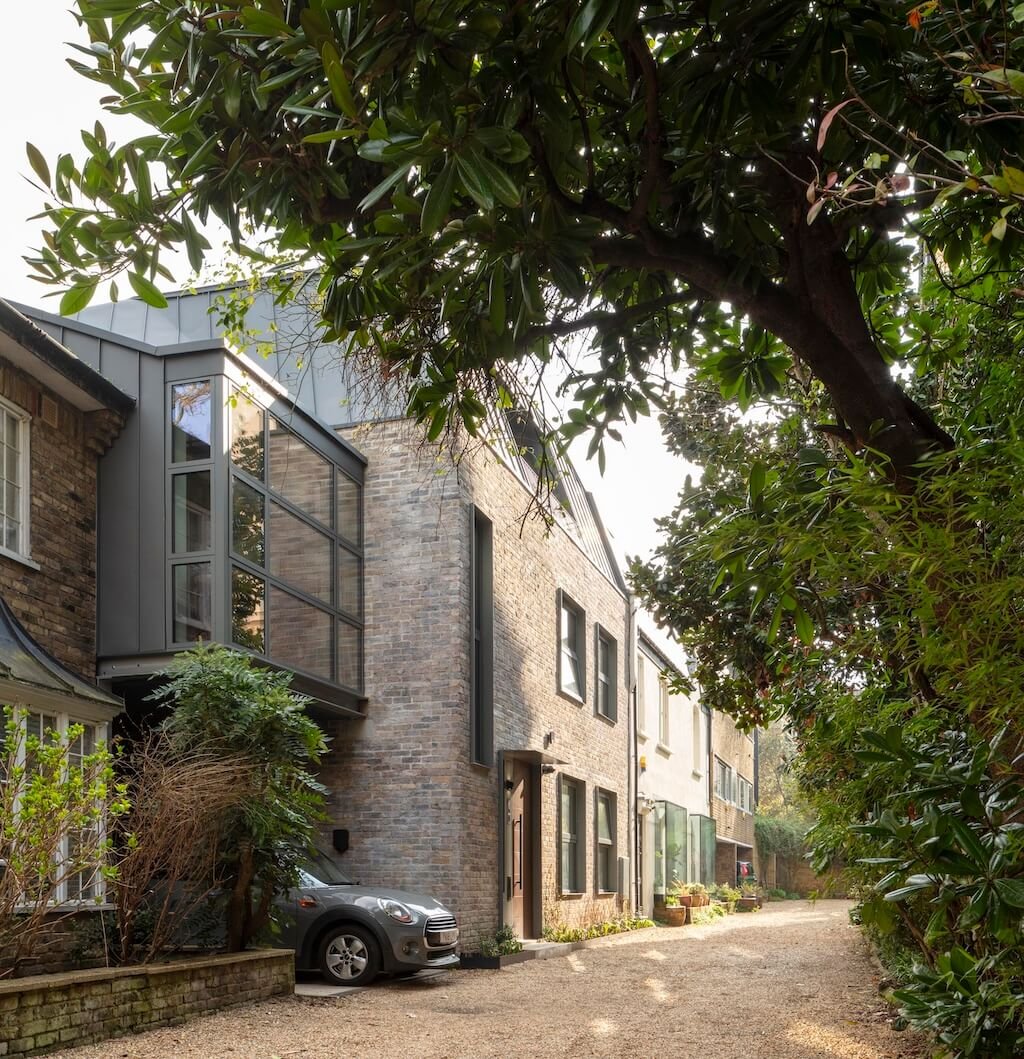
From the mews lane, the house presents two distinct architectural conditions in direct contact. The lower portion is the original London stock brick of the existing townhouse, its coursing and warm grey-brown tone unchanged, sitting within the established scale of the lane and its neighboring structures. Above it, a new zinc-clad upper volume and a large multi-pane steel-framed glazed bay cantilever forward over the existing brick, its dark metal framing and angled geometry making no attempt to replicate the material or proportion of what sits below. The junction between old brick and new zinc is unmediated. The roof plane of the addition is clad in green zinc sheeting across the upper volume, and fully integrated photovoltaic panels are incorporated across its surface.
The mews photographs, taken in full leaf with mature overhanging trees, show the house in a context that is dense and tightly bound to its neighbors on both sides. The cantilevered glazed bay projects from the upper level toward the lane, its grid of steel-framed panes bringing the interior into visual connection with the tree canopy outside. The intersection between the folded zinc-and-glass envelope and the existing brick generates several distinctly formed apertures: a pyramidal skylight in the kitchen, a glass slit in the living room exposing the narrow rear yard, and a fully glazed window framing the view of the streetscape below through the old-growth tree on the mews.
The Staircase
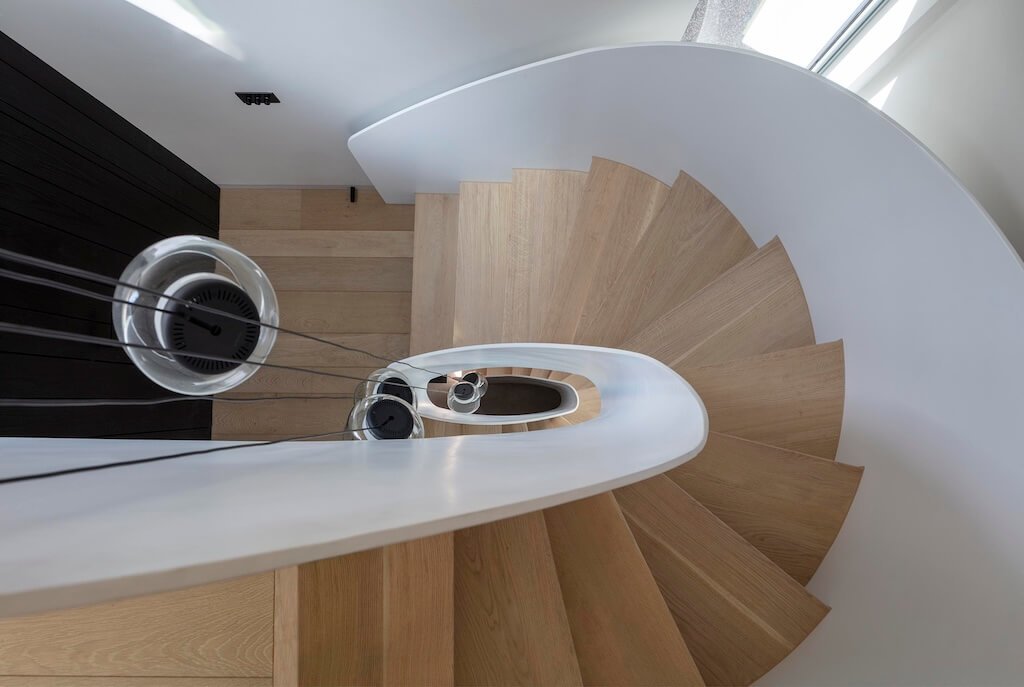
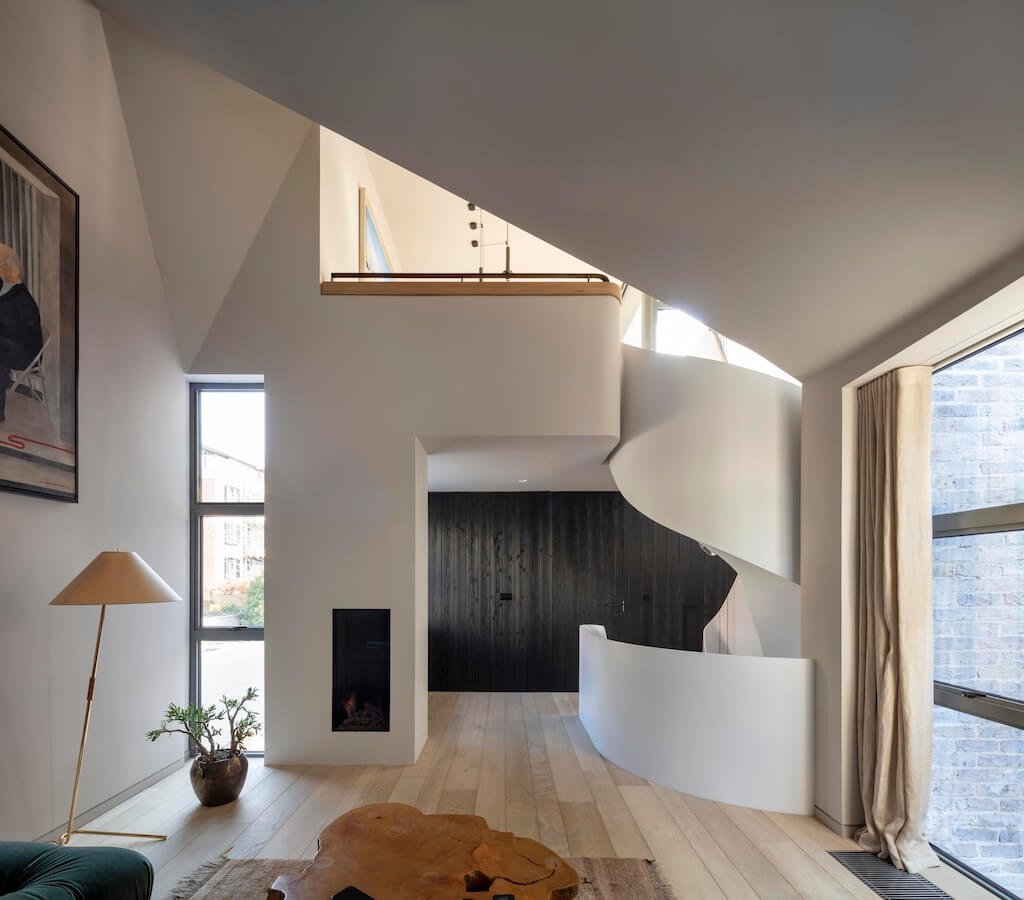
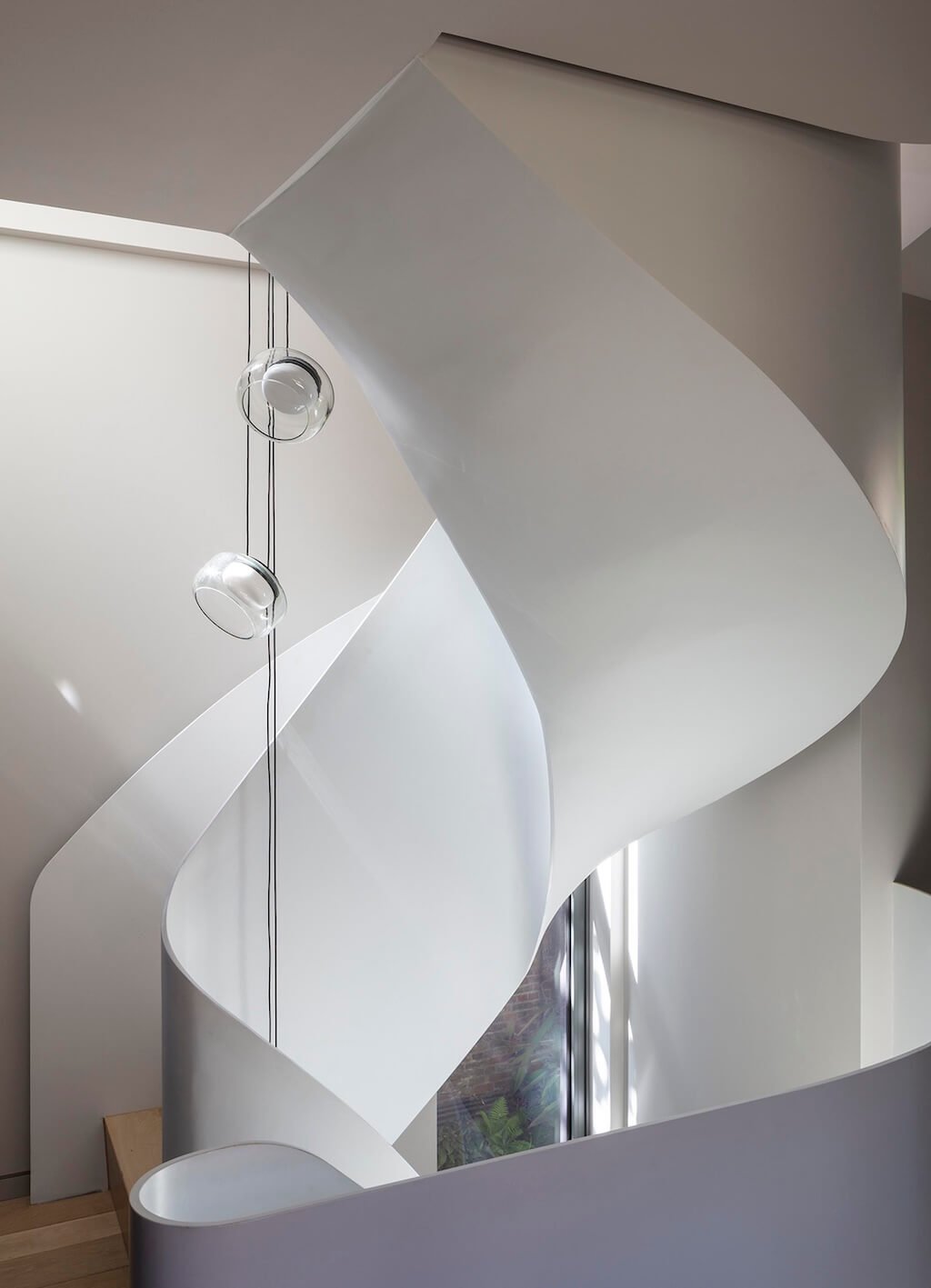
The custom winding staircase at the center of the house connects the entrance floor, the double-height living level, and the kitchen and dining level at the top in a single continuous sweep. It is a solid-steel helix form finished in white, and there is no conventional balustrade. The staircase enclosure, the handrail, and the curved wall of the stair void are one continuous white surface, smooth and uninterrupted, the curves shifting plane as the stair rises through the building.
Seen from directly above, the pale oak treads fan outward from the center of the helix as the eye descends floor by floor, with glass globe pendant lights suspended on thin cables at different heights through the void. Seen from below, the white form twists and folds against itself, the curves overlapping as a single compressed geometric object lit by daylight falling through a glazed opening at the base, where the original brick wall of the existing structure remains visible. From the ground-floor level, the staircase reads as a cylindrical white column at its base, the helix rising above it while the living room opens beyond with pale oak floors running continuously from the stair landing.
The Living Room
The living room occupies the double-height level above the entrance floor. Pale oak floors run continuously from the stair landing across the full space. White walls and natural daylight from the windows on the street-facing elevation define the room. A green modular sofa sits on a natural-fiber rug with a wooden coffee table in front of it. The room reads as open and light-filled against the darker, more material-heavy character of the floors below and above.
The Bedrooms
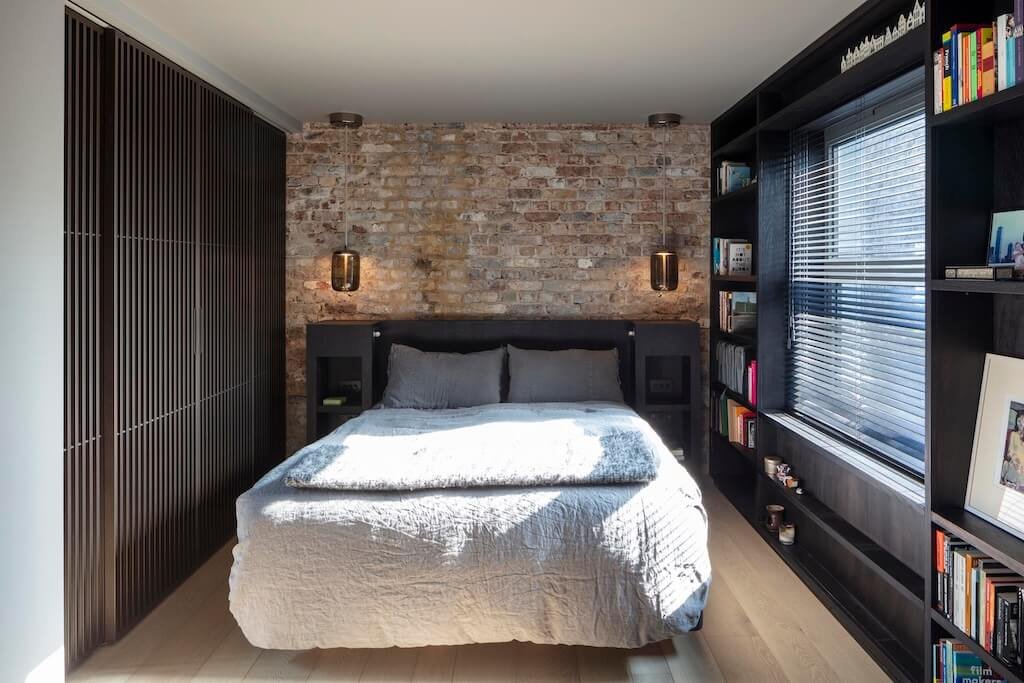
The bedroom photographs show a palette built around high contrast. The headboard wall is the exposed original brick of the townhouse, its coursing unplastered and irregular, retained without intervention. Against it, a black built-in bed frame with integrated side tables sits centered in the room. A full-height bookshelf unit in black runs the length of the window wall, with venetian blinds fitted behind the shelves. A dark slatted wardrobe occupies the full height of the wall to the left. The floor is pale oak. Two warm glass pendant lights hang on either side of the bed, their amber tone registering against the brick behind them.
The Bathroom
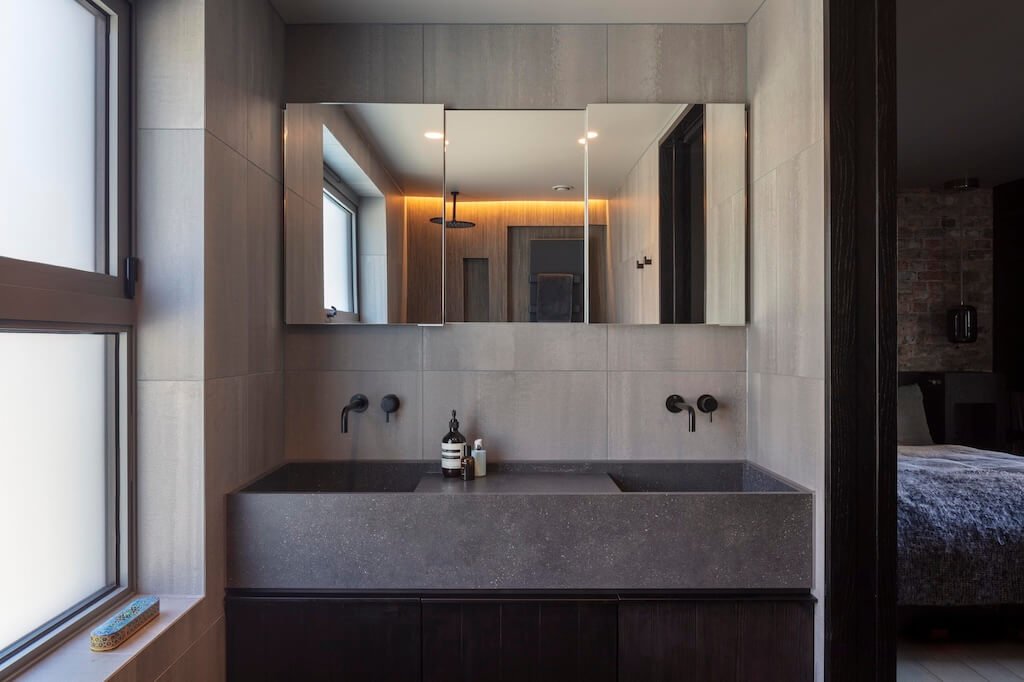
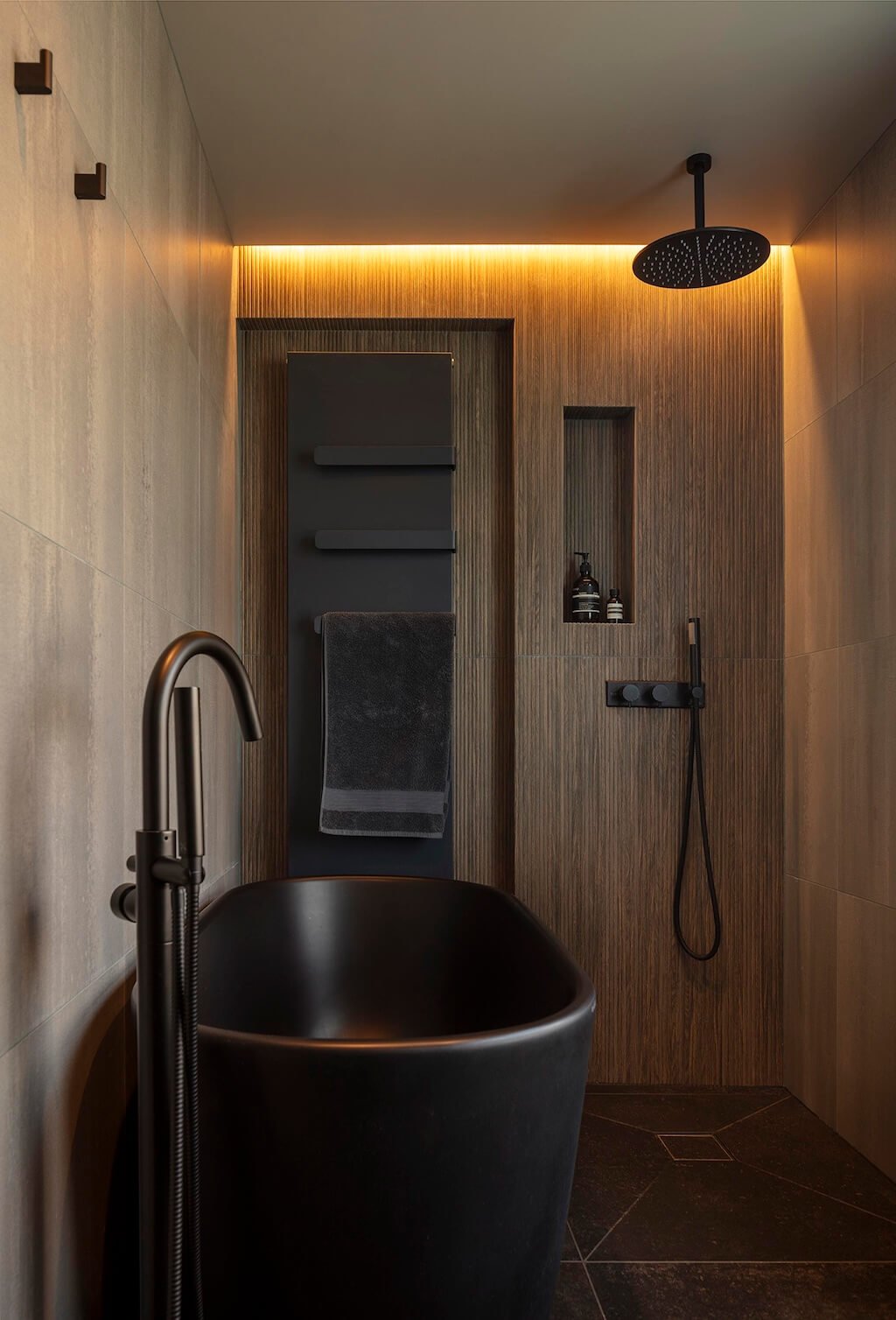
The bathroom works within the same dark, high-contrast register as the rest of the house. A matte black freestanding tub with a black floor-mounted faucet sits in front of large-format gray stone-effect wall tiles. A ribbed wood-effect panel with an integrated niche runs floor to ceiling in the shower zone, framed in black, with a black ceiling-mounted rain showerhead, black handheld shower fittings, and a black towel radiator set behind the ribbed panel. A warm amber LED cove runs along the top of the shower enclosure at the ceiling line. The vanity area shows a double sink in dark speckled stone with two black wall-mounted faucets and a wide mirror cabinet above. A separate powder room features a circular brass vessel sink on a dark wood floating vanity, with the back wall of the niche covered entirely in small-format gold glass mosaic tiles lit from above by a concealed warm light source, and a round black-framed mirror centered above the sink.
Systems
The roof carries fully integrated photovoltaic panels that provide the building with baseline electricity sufficient to run heat pumps, the hot water supply, and lighting. A 13 kW Tesla battery stores surplus energy and supports electric car charging. The combination of PV generation and battery storage brings the house close to off-grid operation for its primary energy needs.
Project Details
Project name: London Solar House. Architecture firm: Archi-Tectonics NYC LLC. Location: Primrose Hill, London, United Kingdom. Photography: Nick Kane. Principal architect: Winka Dubbeldam. Design team: Justin Korhammer, Max Boerman, Wouter van der Heuvel, Mattia Gola, Santiago Herrera. Collaborators: Architect of Record: Anthony Boulanger, AY Architects. Built area: 2,250 ft². Structural engineer: AKTII. Environmental and MEP: WSP London. Lighting: Lana Lenar. Construction: Philiam. Material: Concrete, Wood, Glass, Metal. Budget: Undisclosed. Client: Private. Status: Completed. Typology: Residential, House.
