
Rocky Point is a single-story residential compound in Palos Verdes Estates, California, designed by Joseph Spierer Architects and completed in 2025. The house covers 4,237 square feet on a site of 5,183 square feet on the coastal bluff, with interior design by Tim Clarke Designs, landscape by Robin Benezra Studio, and lighting by KGM Lighting. Construction was carried out by Tyler Development. To preserve the natural coastline and avoid disrupting erosion patterns, the foundation is anchored by fourteen caissons, each 120 feet deep. Construction took place during the COVID period, requiring phased material delivery and installation.
The Site and Its Constraints
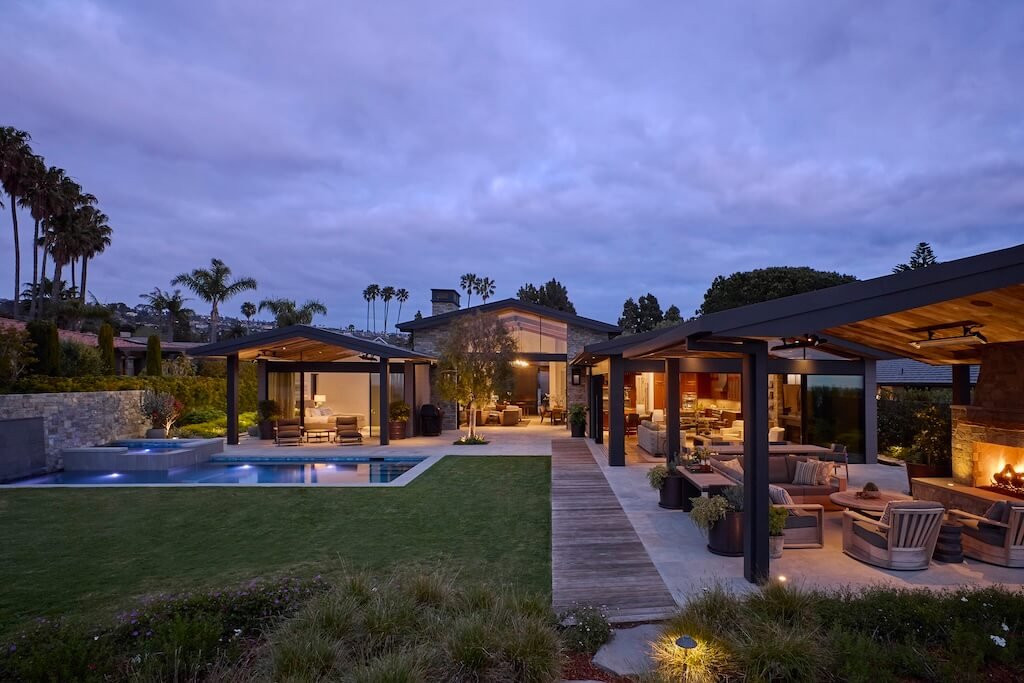
The project navigated strict coastal regulations, an HOA review process, and neighboring concerns related to protected views. The building’s low horizontal profile and its organization as a series of connected pavilion-like volumes, rather than a single massive structure, reflect the site constraints as much as the design intent. The dusk photographs, taken from the garden looking back toward the house across the lawn and pool, show how the volumes are arranged around a central outdoor space, each wing stepping back at a low roofline that does not interrupt the view corridor from neighboring properties. The ocean is visible at the horizon beyond the bluff edge in every exterior photograph taken from the garden’s side.
The Exterior
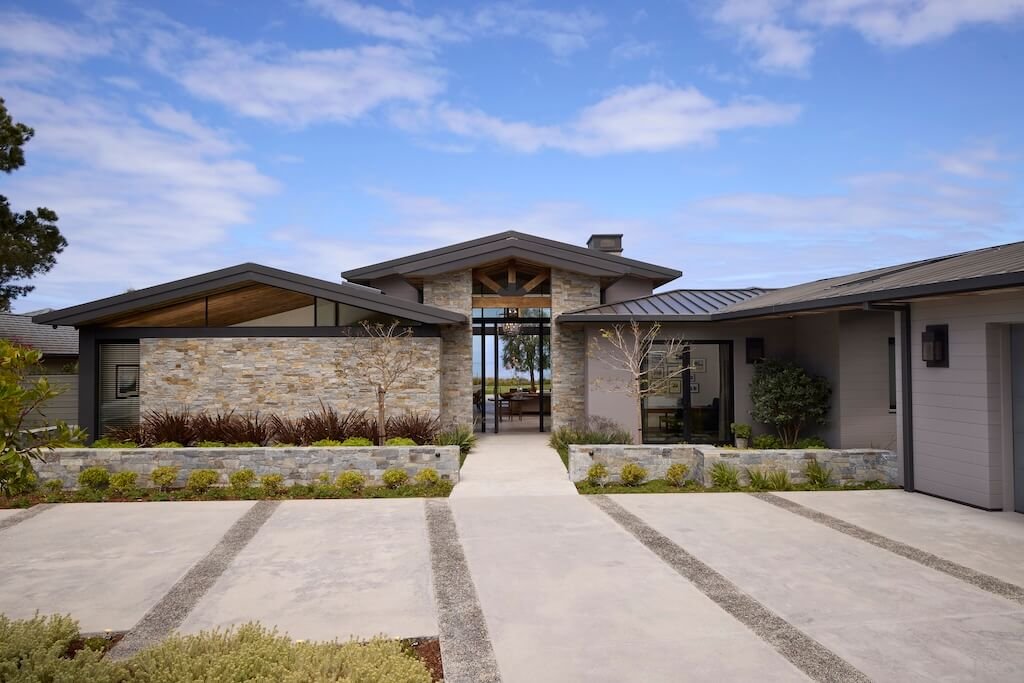
The street-facing facade is horizontal and restrained. Stacked natural stone walls run the full length of the front elevation at a low height, with dark steel-framed pitched roofs above carrying exposed reclaimed wood soffits on the underside. An entry portal at the center of the facade, formed by two stone piers supporting a steel-framed roof section with a timber ceiling, frames a direct view through the house to the ocean beyond. The driveway is concrete with gravel expansion strips, and low plantings fill the front beds between the stone retaining walls. From the street, the house reads as a series of horizontal layers: concrete, stone, dark steel, and timber, all held below the rooflines of the neighboring structures.
From the garden at dusk, the compound reads differently. The full-width glass walls of the main living areas glow from within, and the covered outdoor living pavilion to the right of the garden carries its own stone fireplace and reclaimed wood ceiling. A pool sits to the left of the lawn, its underwater lighting visible in the evening photographs. A timber deck path runs through the backyard, connecting the different outdoor zones.
The Entry
The entry hall shows stacked stone covering the full height of the interior wall, its irregular coursing and warm gray-brown tones consistent with the exterior stone. A large pivot door in dark stained wood set in a black steel frame opens into the space. A round dark wood table on brass legs sits in the foreground of the photograph, with a wooden bowl and a branch of cherry blossoms in a glass vase on its surface. A large black iron lantern pendant is partially visible above. The stone wall, the dark wood door, and the stone tile floor establish the material register that carries through the main public spaces of the house.
The Living and Dining Spaces
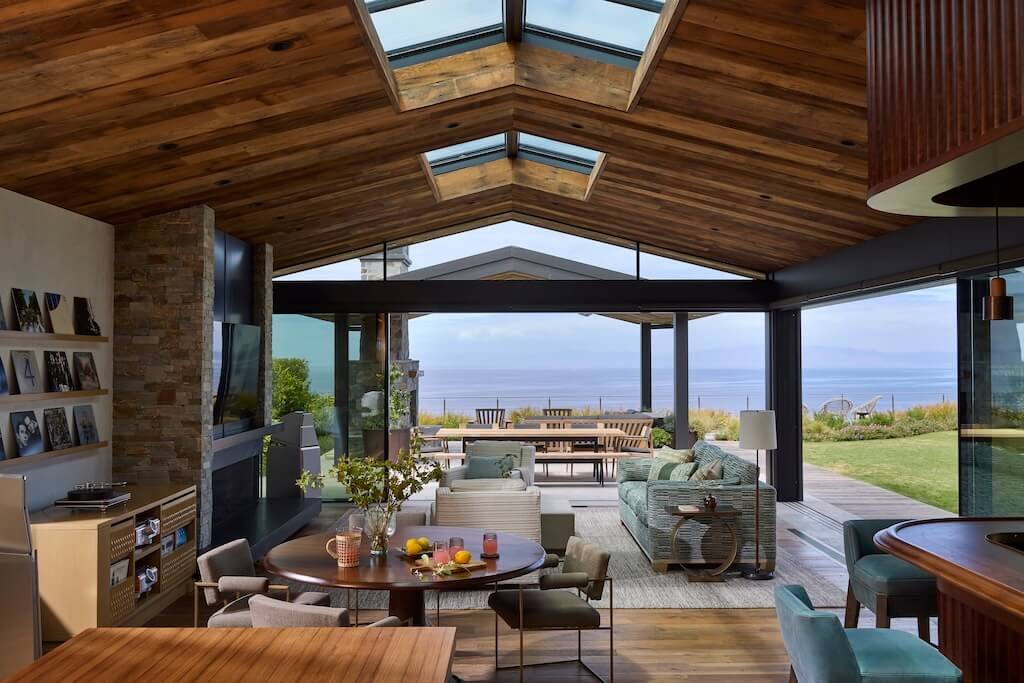
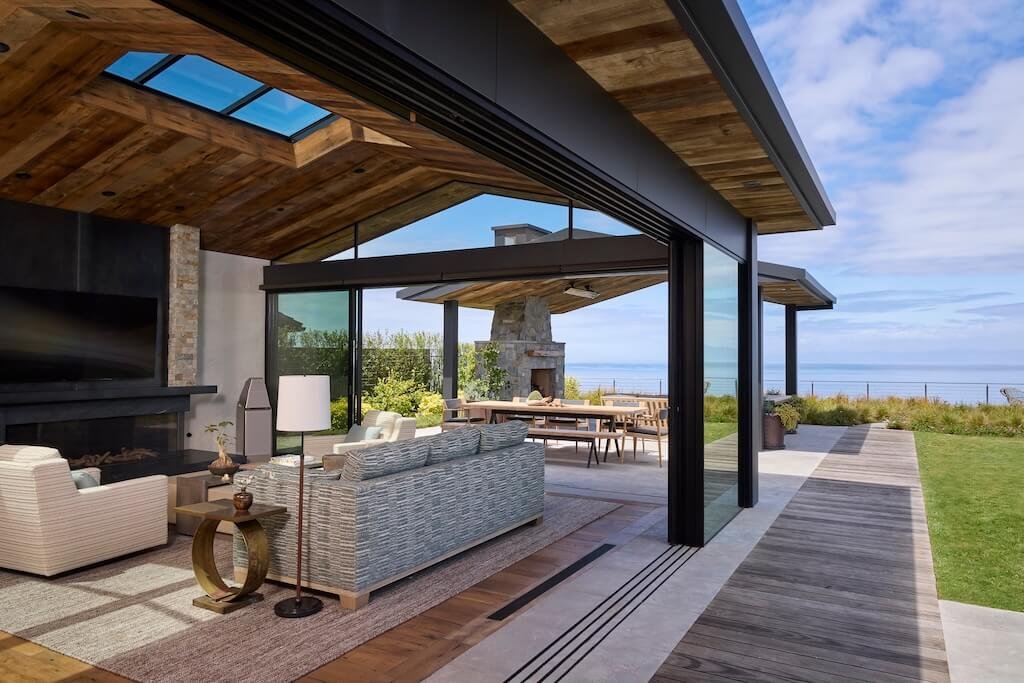
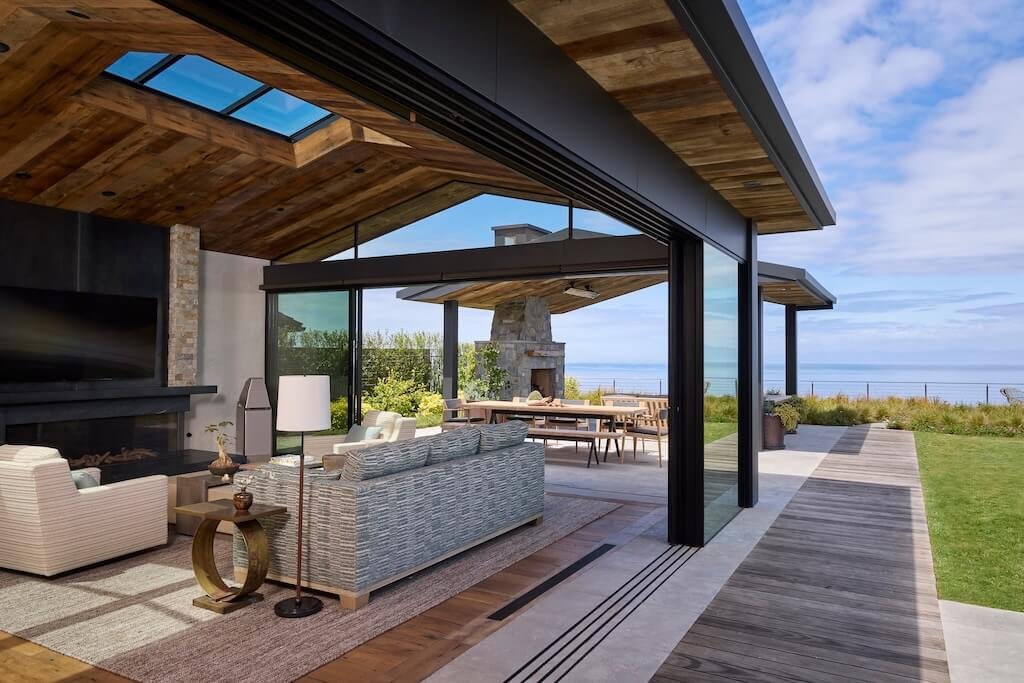
The main living and dining areas occupy a single large volume with a pitched reclaimed wood ceiling that runs from the ridge down to the glass wall on the ocean side. Multiple Velux skylights are cut into the ceiling plane along the ridge, their black-framed openings letting daylight fall directly onto the timber ceiling boards below and onto the floor. The glass walls on the ocean elevation are full-width and fully operable, with the dark steel frames of the sliding and folding panels stacking to the sides when open so that the interior and the ocean-facing terrace become a single continuous space.
In the dining room photograph, the double-height section of the entry volume is visible: a large black iron lantern pendant hangs over a long walnut dining table with leather dining chairs. The stone wall rises behind them. A stone fireplace occupies the right side of the room. Large sliding doors are open to the garden, with a tree and the pool visible beyond and the ocean on the horizon.
In the living room photographs, a green and sage patterned sofa and a round dining table with chairs occupy the main floor space, with the bar area visible to the right. When the glass walls fully open, the living room and ocean terrace merge into one space, with the timber ceiling extending outdoors and the ocean horizon visible from every seat.
The Kitchen and Bar
The kitchen and bar occupy an adjacent space that shares the same reclaimed wood ceiling with multiple skylights. The kitchen cabinetry is walnut throughout, with upper and lower cabinets in the same dark warm-toned wood. The kitchen island is painted in a teal or duck-egg blue, its top finished in butcher block. A patinated brass or zinc range hood sits above the cooking station, and the backsplash behind the range is covered in a dark green mosaic tile. The kitchen connects directly to the dining table and to the bar without a physical threshold between the three areas.
The bar is curved in plan, its front faced in fluted walnut panels that curve from the bar top down to the floor. The countertop and backsplash are in dark marble or stone with gold veining, and a brass faucet is mounted at the bar sink. The barback carries open shelving for glassware and bottles, with small framed paintings hung above. Three blue upholstered bar stools with brass legs sit at the counter. The entire bar unit is framed by the reclaimed wood ceiling and the skylights above, which bring direct daylight onto the curved walnut surface throughout the day.
The Bedrooms
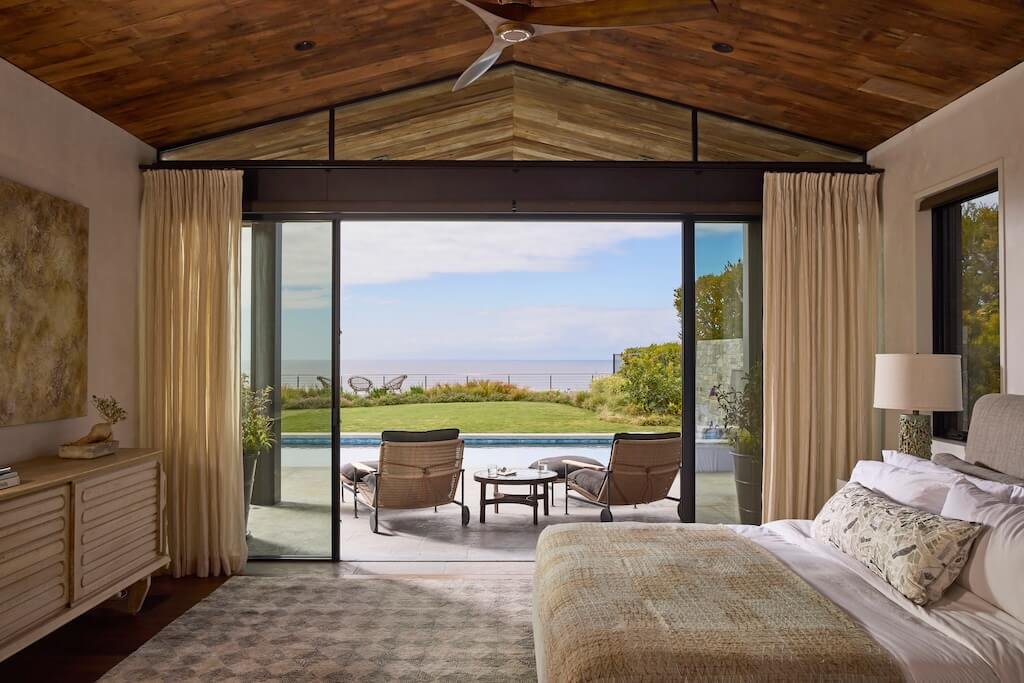
Two bedrooms are visible in the photographs. The primary bedroom has a pitched reclaimed wood ceiling with a ceiling fan and a full-width dark steel-framed sliding glass door that opens directly onto the terrace where the pool is visible and the ocean sits at the horizon beyond. Linen curtains hang on either side of the glass wall. A ribbed or fluted light-toned dresser sits to the left of the bed. The bedding is neutral, and the overall room tone is quiet and pale against the warm wood ceiling above.
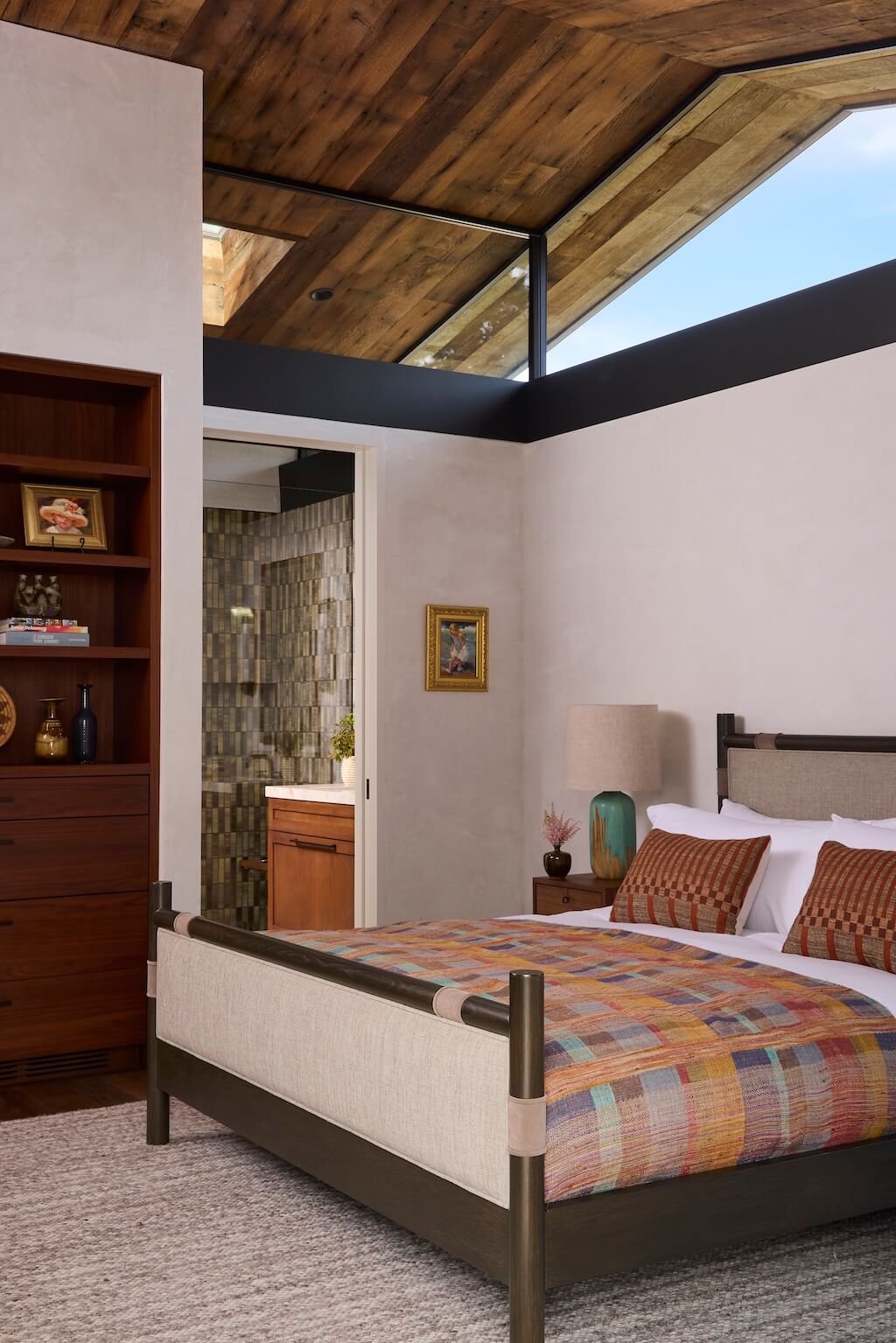
A second bedroom shows the same reclaimed wood ceiling at a steeper pitch, with a skylight opening cut into it. The bed frame is in dark bronze-toned steel with a linen-upholstered panel and matching footboard. A colorful woven quilt covers the bed. A walnut open bookshelf unit sits to the left. Through the open door, a bathroom is visible, its walls covered in a dark green mosaic tile.
The Outdoor Living
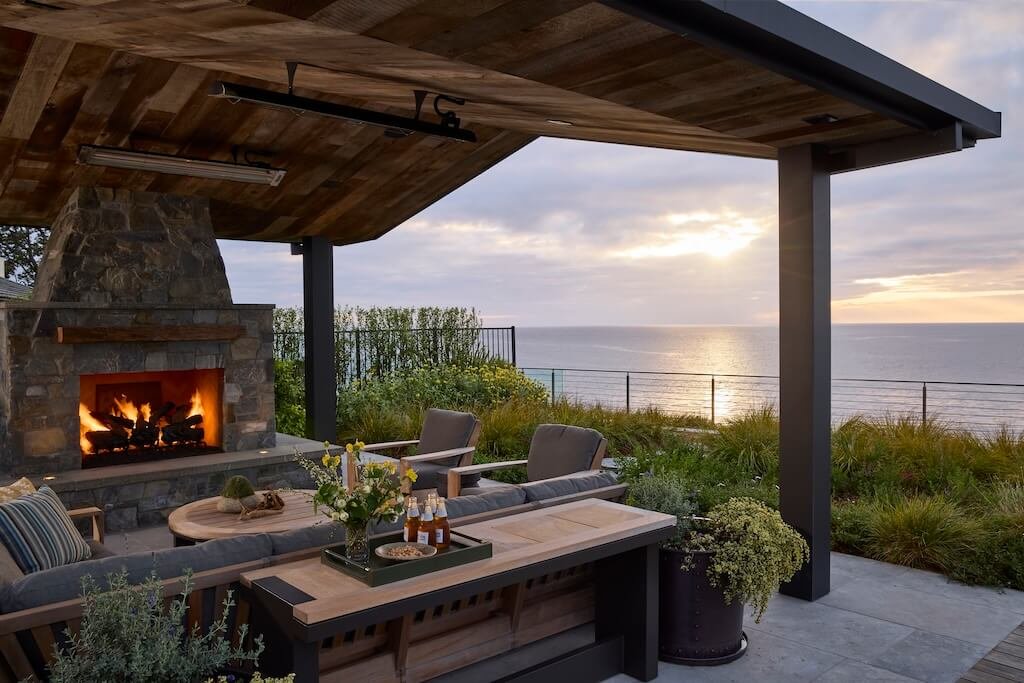
A covered outdoor pavilion sits to the ocean side of the main living areas, separate from but visually connected to the interior. It has a reclaimed wood ceiling on a dark steel structure, open on three sides to the garden and the ocean beyond. A stone fireplace with an active fire occupies one end of the pavilion, its chimney constructed in the same stacked stone as the interior entry wall and the exterior facade. Teak or similar wooden outdoor furniture sits beneath the ceiling: a long table, sofas, and chairs arranged around the fireplace. The cable rail fence at the bluff edge is visible beyond the native coastal planting, and the Pacific Ocean and horizon fill the view.
Project Details
Project name: Rocky Point. Architecture firm: Joseph Spierer Architects, Inc. Location: Palos Verdes Estates, California, USA. Photography: Noah Webb. Principal architect: Joseph Spierer. Interior design: Tim Clarke Designs. Built area: 4,237 ft². Site area: 5,183 ft². Completion year: 2025. Landscape: Robin Benezra Studio. Lighting: KGM Lighting. Construction: Tyler Development. Material: Otiima Windows, Velux Skylights, Kolbe Windows and Doors. Budget: Undisclosed. Client: Private. Status: Built. Typology: Residential, House.
