
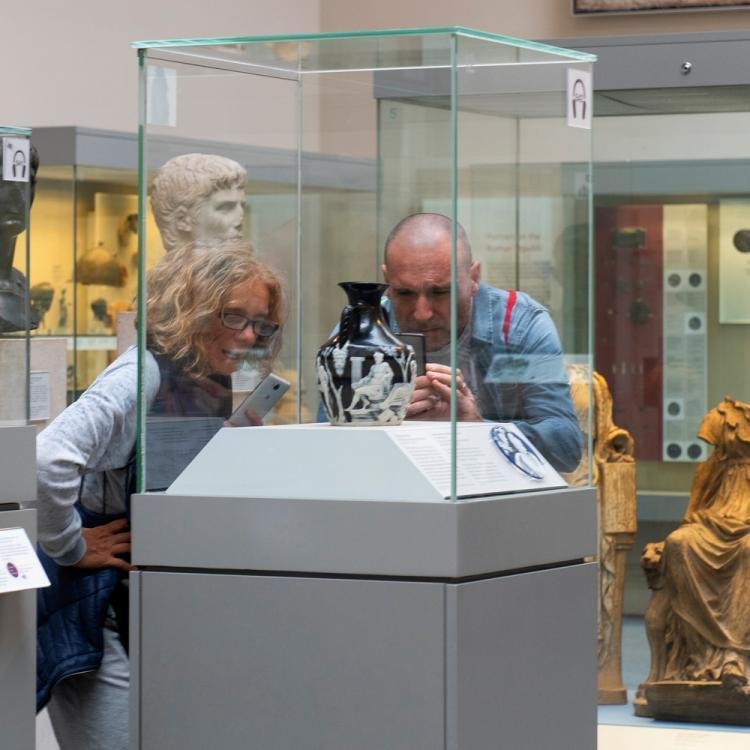
The Portland Vase. Roman, 1 to 25 AD. Cameo glass. Height 24.5 cm, diameter 17.7 cm. British Museum, London, Room 70.
It is smaller than you expect. Standing in Room 70 of the British Museum, looking at the object that has been called the finest piece of glass ever made, the first thing that registers is not the grandeur of a ceremonial vessel but the intimacy of something that could be held in two hands, a dark cobalt blue amphora of 24.5 centimetres in height and 17.7 centimetres at its widest point, its surface carrying a continuous band of white carved relief figures moving through a scene that scholars have been arguing about for four centuries without reaching agreement, the figures themselves serene in the way that objects made with absolute conviction tend to be serene, indifferent to the centuries of interpretation that have accumulated around them and to the extraordinary technical achievement that produced them, which is one of the most sustained acts of craft skill in the history of any material in any civilisation.
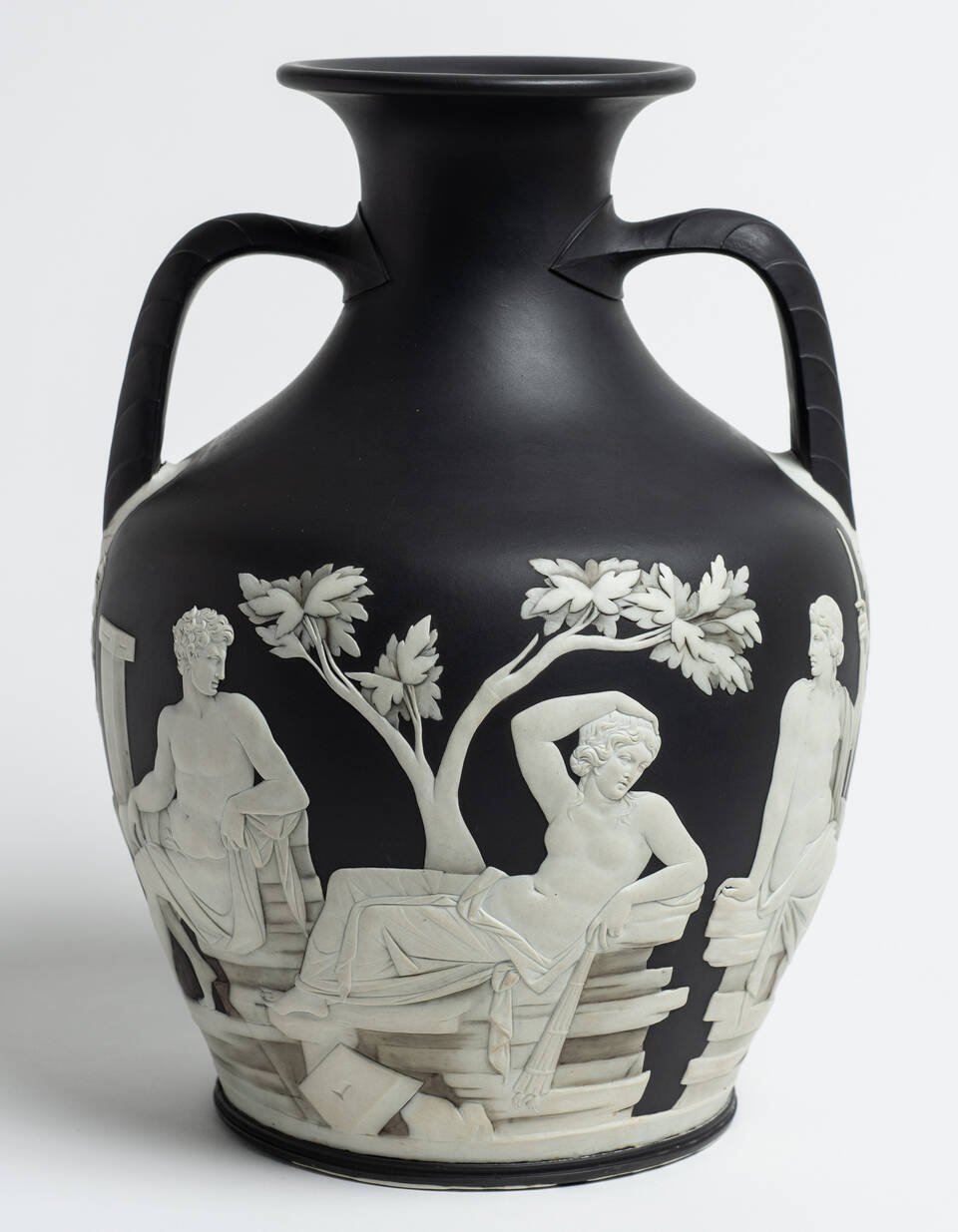
The technique that produced those white figures against that dark ground is called cameo glass, and it was practised in the Roman world for approximately two generations, from around 50 BC to around 50 AD, a window of perhaps a century during which a small number of workshops in the ancient world understood how to do something that nobody before them had done and that nobody after them would fully recover for more than a thousand years. The Portland Vase is the finest surviving example of this technique, the largest and the most completely resolved, and it is also the most studied single object in the history of glassmaking, with research consistently producing both technical admiration and continued uncertainty, because the vase is an object that reveals the more clearly you look at it how much remains unknown about who made it, when exactly, for whom, what the scenes on its surface depict, and by what precise sequence of operations a workshop in the ancient world produced a surface of this quality in a material as unforgiving as glass.
The making begins with the dark blue glass itself, a cobalt-rich silicate of a depth and purity that the Roman glassmakers achieved through the addition of specific mineral compounds to the molten batch in proportions that varied by workshop and period and that were not written down in any surviving text. Recent research by Associate Professor Richard Whiteley of the Australian National University has challenged the long-held classification of the Portland Vase as blown glass, presenting evidence that it may have been cast rather than blown, a distinction that would significantly alter the understood sequence of its making. What is not disputed is the dip-overlay method by which the dark blue vessel was partially submerged in molten opaque white glass while still hot, the white layer adhering to the surface of the blue and cooling with it into a compound object of two colours fused together, the evenness of that white layer across a vessel of this size representing a technical achievement whose difficulty anyone who has worked with glass will understand and anyone who has not will tend to underestimate, because glass at the temperature required for fusion is a material of extremely narrow tolerance and the margin between the white layer adhering correctly and the entire object cracking from thermal stress is not wide.
Once cooled, the white layer was given to a carver, and it is here that the making of the Portland Vase becomes something that the distinction between craft and art was invented to describe and cannot finally contain. The carver’s task was to remove the white glass wherever it was not required, leaving raised figures in relief against the dark blue ground that showed through wherever the white had been taken away, using metal points and abrasive wheels of the kind used by gem engravers, grinding the surface fraction by fraction in a process of such precision and such slowness that the figures which remain tell you almost nothing about the effort of their removal. The raised areas vary in height across the surface of the vessel, the deepest relief giving the foreground figures their three-dimensionality, the shallower carving suggesting recession and atmosphere in a material that contains no middle distance of its own. The modelling of the flesh, the drapery falling across the figures, the musculature of the male forms and the softness of the female, the snake that appears between the two scenes, all of it is achieved through the removal of glass rather than its addition, through a process of controlled subtraction that is as close to sculpture as to craft and as close to drawing as to either.
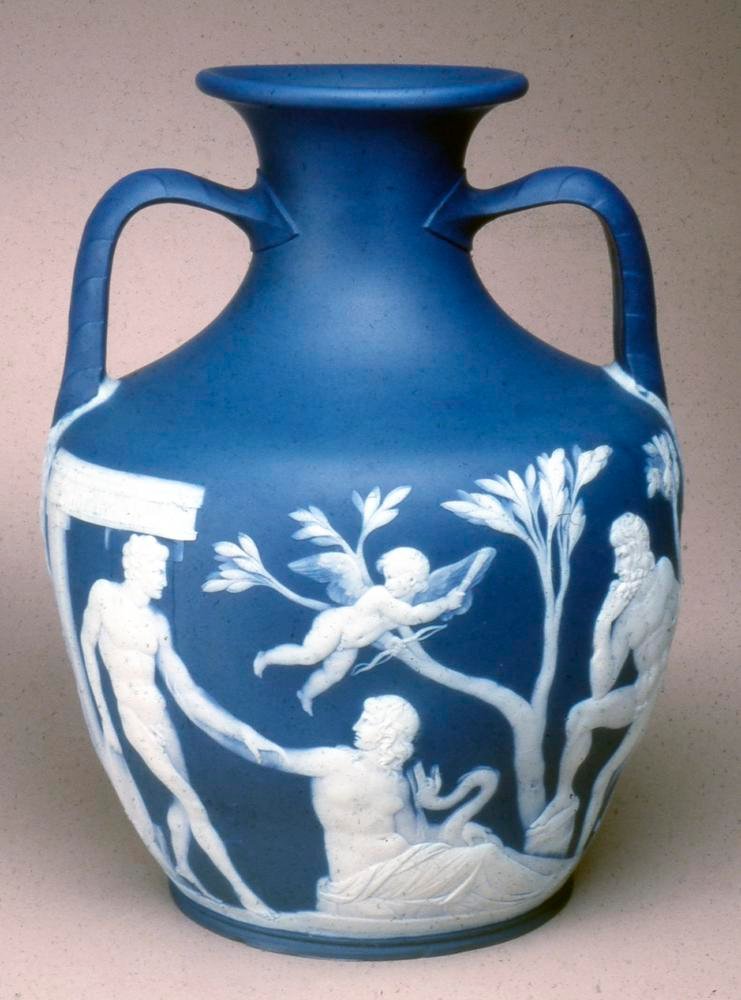
Seven figures appear across the two scenes separated by bearded horned heads below the handles, arranged in a composition of considerable pictorial intelligence, their relationships implied through gesture and gaze rather than stated explicitly. The most widely accepted identification is the marriage of Peleus and Thetis, the mortal king and the sea goddess whose union produced Achilles, with the deity Oceanus presiding from one side. Other scholars have proposed the story of Mark Antony and Octavia, or an allegory of the afterlife connected to the Eleusinian mysteries. None of these identifications has been conclusively established, and the vase keeps its narrative to itself with the same opacity that the dark blue glass keeps its depth.
The vase was found in Rome at the beginning of the seventeenth century, in a tomb on the Monte del Grano that was believed at the time to be that of the Emperor Alexander Severus, though this attribution has not been confirmed. Its first recorded appearance in a collection is in a letter from the French scholar Nicolas-Claude Fabri de Peiresc, who noted it in 1600-1601 in the possession of Cardinal Francesco Maria Del Monte, one of the most significant collectors of the Roman Renaissance and a man whose eye for quality was so consistently reliable that the vase’s presence in his collection was itself a form of authentication. From Del Monte it passed to the Barberini family, who held it for approximately 150 years, during which period it became known as the Barberini Vase, its reputation as the supreme example of ancient glass established through a combination of genuine technical admiration and the social currency that attached to ownership of an object this universally acknowledged to be exceptional. Peter Paul Rubens saw it and wrote about it. Its fame spread through Europe by word of mouth and through the letters of connoisseurs, and it was this accumulated reputation, built over a century and a half of Barberini ownership, that gave the vase the cultural weight it carried when it left Rome under the most undignified circumstances imaginable, because it was lost in a card game. Sometime before 1778, Princess Cordelia Barberini-Colonna sat down to a game of cards and came away without the vase, which passed to a Scottish art dealer as settlement of her debt, beginning the journey that would bring it to England.
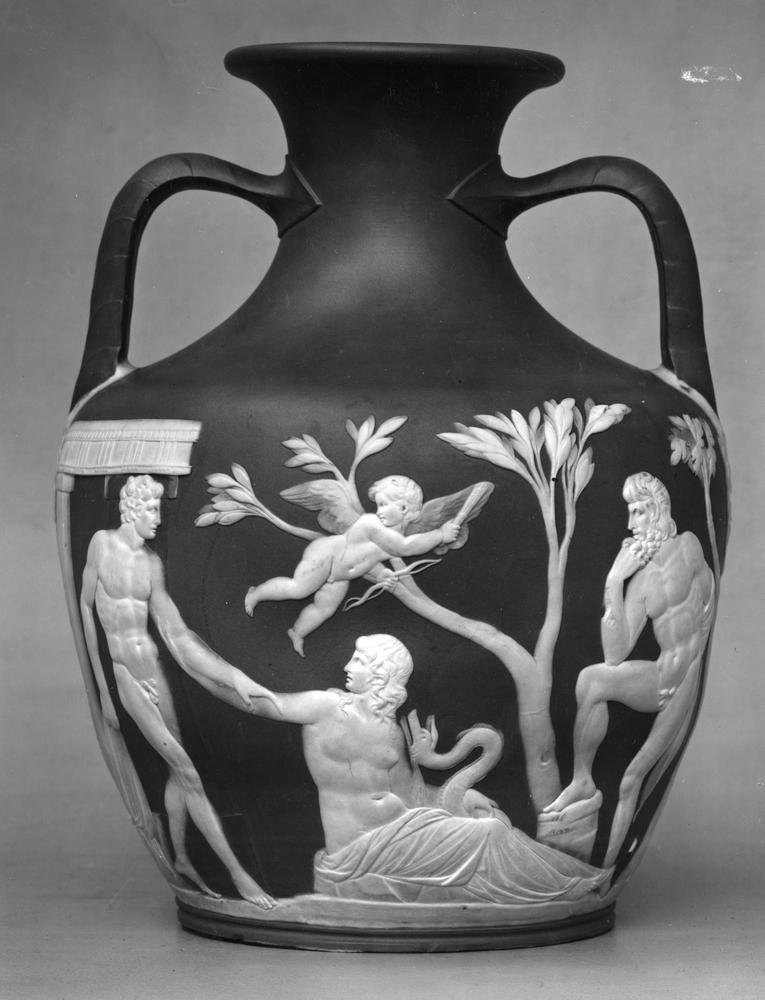
In 1778 it was purchased by Sir William Hamilton, the British Ambassador at the Court of Naples, whose collection of antiquities was among the most significant private collections of the period, and who brought it to England and sold it in 1784 to Margaret, the Dowager Duchess of Portland, for a considerable sum, after whom it takes the name by which it is now universally known. Two years after the Duchess’s death, her son the third Duke of Portland made the decision that would determine the vase’s subsequent cultural history more than any other act of ownership, lending it to Josiah Wedgwood, who had been attempting to produce a replica in his newly developed jasperware and who understood the Portland Vase well enough to know how far he was from achieving it. The project consumed four years of his most intense effort, repeated visits to study the surface, trial pieces, refined jasper bodies, rejected results that a less exacting practitioner would have accepted, until he finally produced in 1790 what he considered a satisfactory copy and offered the first edition of fifty pieces at fifty guineas each, an extraordinary price that reflected his own assessment of what he had achieved. Those first-edition Wedgwood Portland Vases are now in museum collections across the world, their value a function of both their own quality and the quality of the object that inspired them, the copies made precious by proximity to the original in a way that makes no logical sense and perfect cultural sense simultaneously.
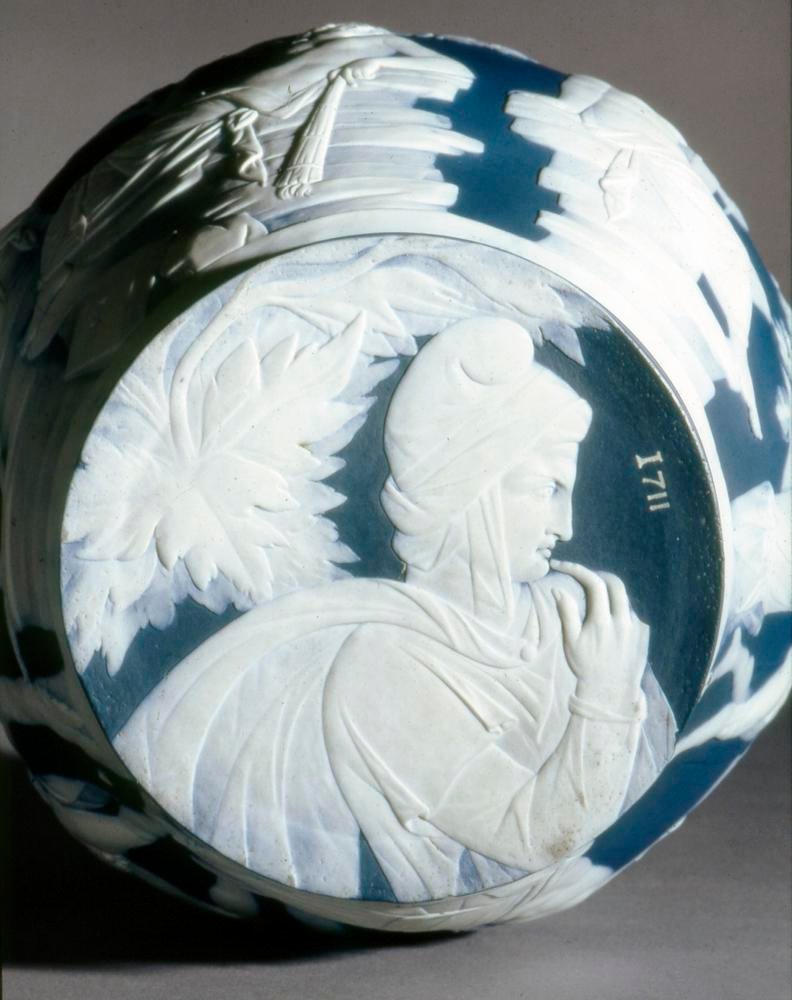
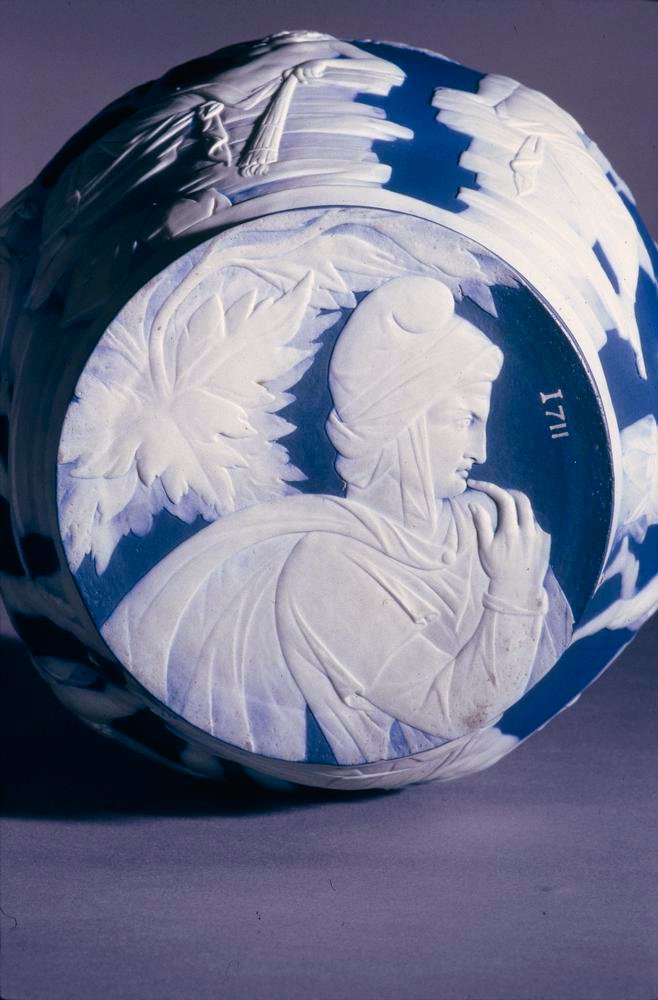
The vase was deposited in the British Museum by the fourth Duke of Portland in 1810 and remained on loan from the Portland family for over a century, displayed and studied and copied and argued about, until the seventh Duke sold it to the museum in 1945 for a sum that has never been made public. On 7 February 1845, an Irish visitor named William Lloyd entered the museum and threw a nearby Assyrian stone sculpture against the case containing the vase, shattering it into more than two hundred fragments. The popular legend that Lloyd was drunk when he did this has been repeated so consistently that it has acquired the authority of fact, but contemporary accounts do not conclusively support it. What is clear is that the fragments were gathered, the first restoration was attempted in the same year, a second restoration followed in 1948, and by 1986 the joints of that second restoration rattled when the vase was gently tapped. The third and current reconstruction was completed in 1987 by a new generation of conservators using new adhesives and a new understanding of the object’s physical history, and the Portland Vase as it stands in Room 70 today is the product of this third reconstruction, with a small number of fragments that could not be placed stored separately, and the cameo glass disc showing a pensive figure in a Phrygian cap that was attached to the base from at least 1826 displayed independently, its original relationship to the vase still an open question.
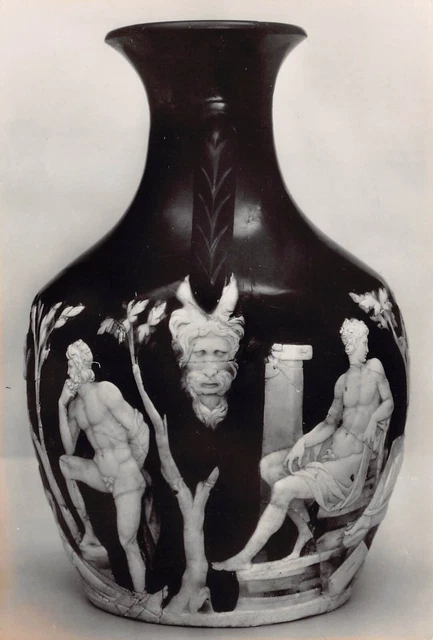
The shattering and the restoration enhanced rather than diminished the vase’s reputation, in the way that the breaking and mending of significant objects sometimes does, by adding to their story a chapter of vulnerability and survival that makes them feel more human than objects of pure perfection can ever feel. The Victorian period that followed the 1845 restoration saw the Portland Vase become the inspiration for an entire craft revival, when Benjamin Richardson of the Red House Glassworks at Wordsley offered £1000 to anyone who could reproduce it in cameo glass. The challenge was taken up by Philip Pargeter, who in 1873 supervised the production of the first cased glass blank shaped like the vase, blown by Daniel Hancock, and by John Northwood, who between 1873 and 1876 carved one of Pargeter’s blanks into the first modern glass replica made by the cameo technique, an achievement that led to a flood of commissions and a Victorian vogue for cameo glass that lasted until the end of the century and produced some of the finest decorative glass made in England before or since. Northwood’s replica is now held at the Corning Museum of Glass in New York, a copy of the original that is itself now a museum object, the replica acquiring the dignity of the thing it replicated through the quality of its own making.
The contemporary world has not lost interest. In 2024, the Crocker Art Museum in Sacramento mounted an exhibition titled The Portland Vase: Mania and Muse, featuring more than sixty works by contemporary artists including Viola Frey, Squeak Carnwath, Hitomi Hosono, Clare Twomey, Roberto Lugo, and Michael Eden, each engaging with the vase as both a historical object and a cultural provocation, questioning why a single ancient vessel continues to exert such authority over the artistic imagination more than two thousand years after it was made. In 2012, the Stourbridge glass community produced a twenty-first century cameo glass replica of the Portland Vase to celebrate four hundred years of glassmaking in the region, with support from the British Museum’s own curators, an act of homage that demonstrated how completely the vase had become the benchmark against which the entire tradition of cameo glass measures itself. The words Portland Vase yield over sixteen million results in a Google search, appearing as aspirational photographs, tattoos, non-fungible tokens, and commercial replicas in every material and at every price point, a measure of how thoroughly a Roman workshop’s achievement between the years of 1 and 25 AD has penetrated the visual culture of a world that did not exist when it was made.
What made it museum worthy, to answer the question that the museum is always implicitly being asked to answer about every object in its collection, is not its age alone, nor its survival, nor even the undisputed beauty of its surface, though all of these contribute to its standing. What made it museum worthy is the convergence of qualities that very rarely appear together in a single object: a technical achievement so complete that it has never been fully surpassed in the same material, a pictorial intelligence that rewards sustained attention without yielding to it entirely, a history of ownership and influence that encompasses some of the most significant figures in the history of art and craft across four centuries, a destruction and restoration that added to its meaning rather than subtracting from it, and a continuing capacity to inspire, provoke, and instruct makers across every medium who encounter it in the glass case where it has been standing since 1810. The Romans who made it between the first century before and the first century after the common era could not have anticipated, even in their most ambitious conception of their own work, that two thousand years later it would be in a museum in a city that did not yet exist, generating sixteen million search results in a technology that lay further in the future than Troy was in their past, still debated, still studied, still copied, still the object by which glassmakers measure the distance between what they can do and what has already been done.
The Portland Vase is on permanent display in Room 70 of the British Museum, Great Russell Street, London. britishmuseum.org
