
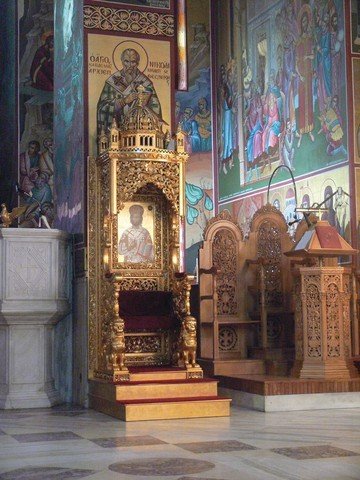
The medieval throne chair did not evolve from domestic seating. It emerged separately, shaped by ceremony rather than comfort and by permanence rather than use. Between the 12th and 15th centuries, across royal courts and ecclesiastical spaces in Europe, the throne existed as a fixed point within architecture, not as an object meant to circulate within it.
Most early examples were carved from solid oak or stone, materials chosen for durability and symbolic weight. Oak was slow-grown, dense, and resistant to movement. Stone, when used, eliminated the possibility of relocation altogether. These chairs were intentionally heavy. Some were built directly into raised platforms or apse walls; others were simply too massive to be moved without dismantling. The throne was not designed to follow its occupant. Authority was expected to come to it.
Formally, medieval thrones borrowed directly from the architectural language surrounding them. Tall backs rose vertically, often echoing the proportions of nave walls or choir screens. Armrests were squared, rigid, and structural rather than sculptural. Bases were broad and grounded, reinforcing visual stability. There was little interest in refinement. What mattered was presence. The chair needed to be seen from across a hall and read instantly as immovable.
Comfort was deliberately secondary. Seats were narrow, backs upright, angles uncompromising. Upholstery was largely absent. Wood and stone remained exposed. The physical experience of sitting reinforced the psychological weight of the role. To occupy the throne was to remain alert, restrained, and publicly visible. Sitting was not private or casual; it was performative and witnessed.
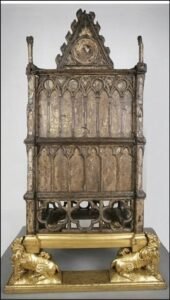
In religious settings, this logic reached its clearest expression in the cathedra, the bishop’s throne. Positioned within the apse of a cathedral, the cathedra established spiritual authority through placement rather than ornament. The word “cathedral” itself derives from this chair, underscoring how completely the seat defined the space around it. Decorative carving, when present, tended to be symbolic and controlled: crosses, geometric rhythms, or restrained figural references tied to doctrine. Excess was avoided.
Secular thrones followed parallel principles. In grand halls, the throne occupied the visual center, often raised on a dais. Everyone else stood, knelt, or remained physically lower. Hierarchy was enforced spatially before a word was spoken. Unlike later Renaissance seating, there was no attempt to soften or personalize the chair. It stood for the office, not the individual.
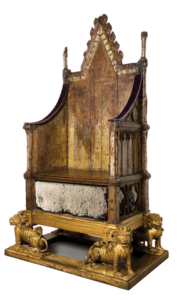
Surviving medieval throne chairs are rare. Many were altered, destroyed, or replaced during political upheavals, religious reformations, or later stylistic revivals. Others were worn down by centuries of ceremonial use. Those that remain are typically found in cathedrals, abbeys, or long-held royal collections, often with clear institutional records rather than private provenance. Their value lies less in craftsmanship alone and more in continuity of place.
The throne’s influence did not end with the medieval period. Its core principles remain visible today. Elevated seating in courts, parliamentary chambers, and ceremonial settings continues to signal authority through height, centrality, and immobility. Even contemporary leadership spaces quietly follow this logic. Where one sits still matters.
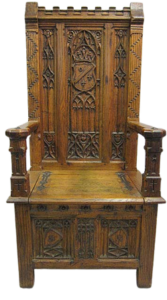
For Design Diary International, the medieval throne chair is not a historical curiosity. It is a reminder of a time when furniture was designed to shape behavior, enforce hierarchy, and anchor institutions. Long before flexibility and comfort became design virtues, the throne defined an opposing idea: that a chair could govern.
Collector’s Guide: Identifying an Authentic Medieval Throne Chair
Material. Primarily solid oak or stone. Oak should display dense grain, weight, and natural age-related shrinkage. Stone examples are uncommon and typically ecclesiastical.
Construction. Simple plank construction with pegged joints. Joinery is functional rather than refined. Sophisticated mortise-and-tenon detailing usually indicates later periods.
Fixity. Evidence of immobility is common. Look for bases designed to sit on platforms, irregular undersides, or signs of long-term placement.
Surface. Original medieval thrones were not upholstered. Surfaces show wear consistent with ceremonial use rather than daily domestic sitting.
Carving. Minimal and symbolic. Crosses, geometric patterns, or restrained heraldic elements. Overly ornate carving often points to Gothic Revival reinterpretations.
Proportions. High backs relative to seat depth. Narrow seating intended to enforce upright posture.
Patina. Deep oxidation, softened edges, and visible tool marks. Uniform finishes usually suggest restoration or reproduction.
Provenance. Most documented examples are tied to specific cathedrals, abbeys, or royal sites. Clear institutional records are essential.
