
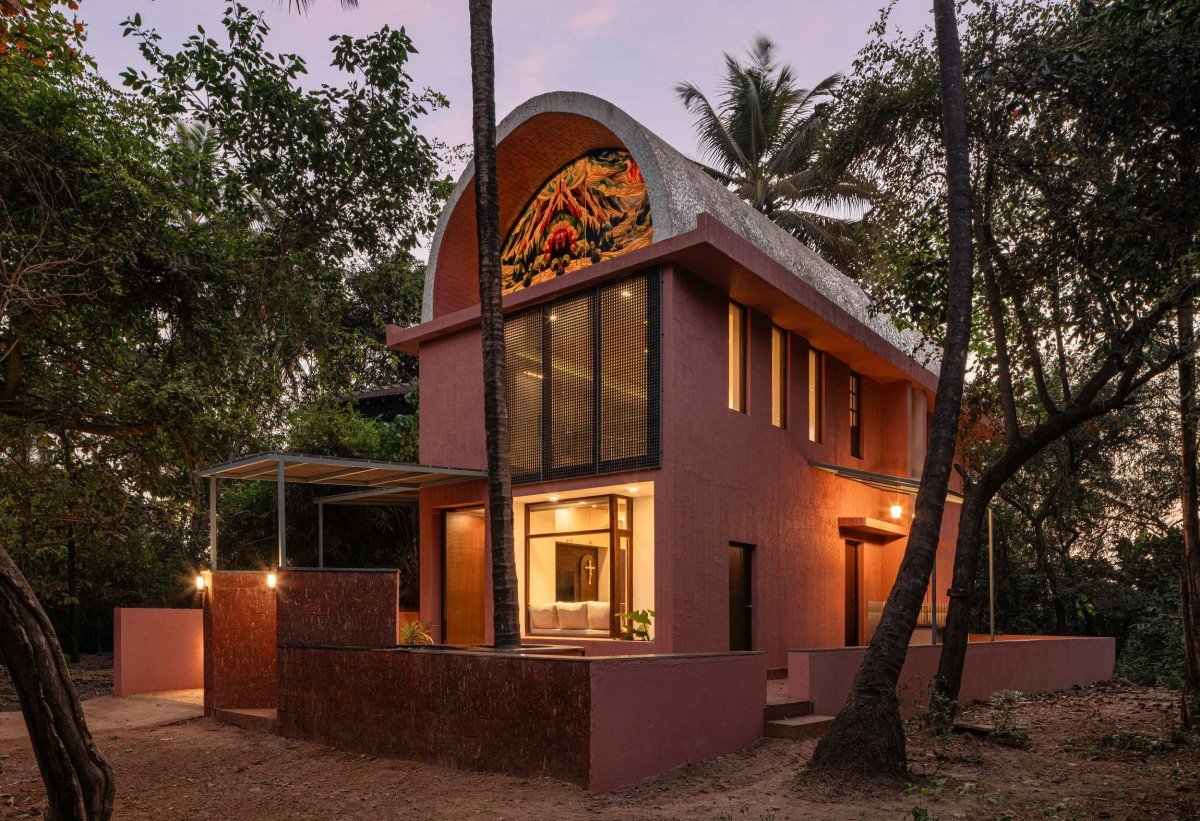
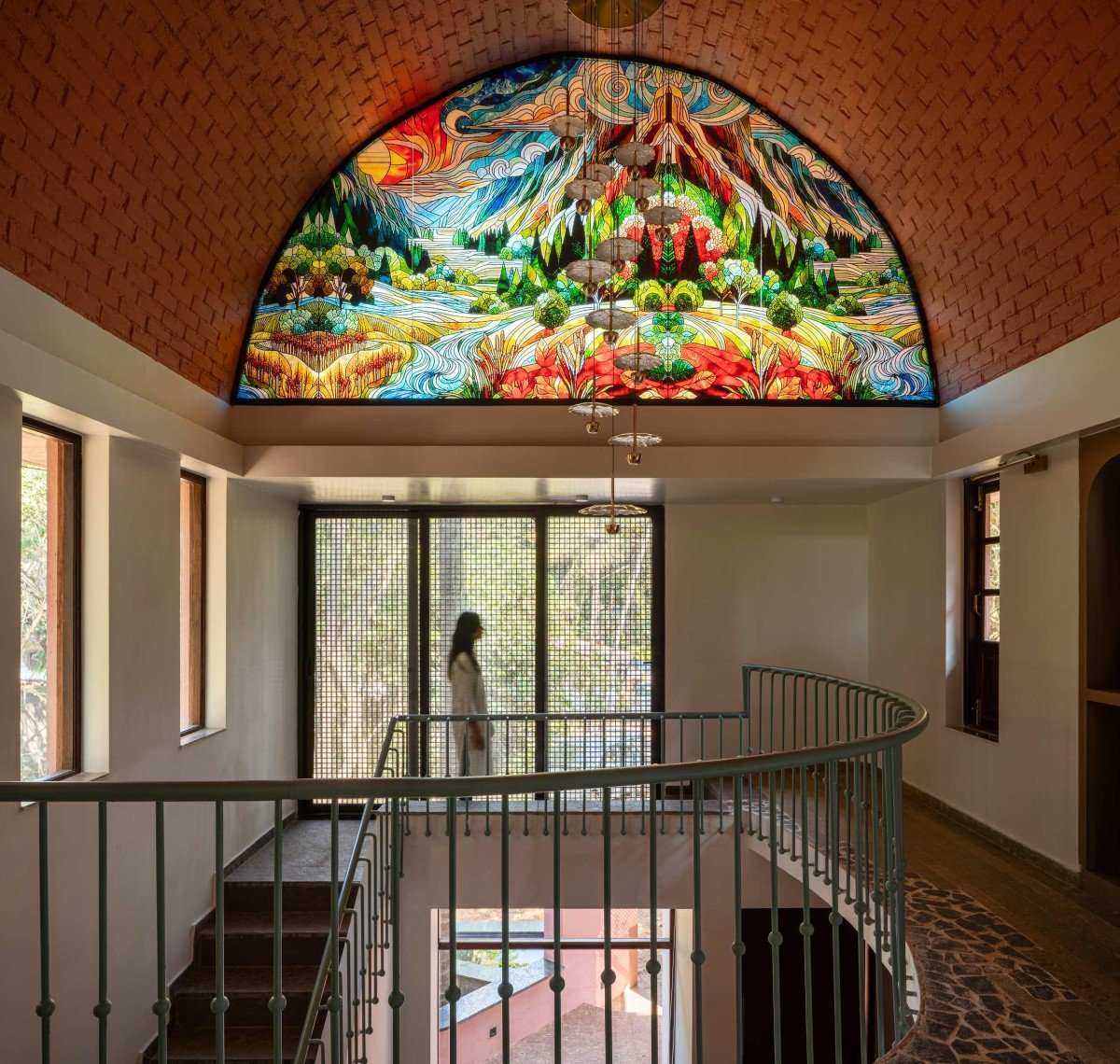
The stained glass that fills the semicircular arch on the front facade of this two-storey laterite house in Anjuna, Goa, is not decorative in any conventional sense; its scale alone rules that out: a full half-circle of leaded glass set into the brick vault at the building’s crown, depicting a landscape of mountains, rivers, tropical trees, and a blazing sky in reds, oranges, yellows, blues, and greens dense enough that from a distance, through the palm grove surrounding the house, it reads less like a window and more like a painting hung high on a terracotta wall, and it is this detail more than any other that tells you what the architects at 19 Dot were thinking about when they designed Arch in the Grove, which is that a house sitting in a Goa grove a short walk from the beach can carry one element that operates entirely outside the logic of its materials and its program and is made more itself for having it.
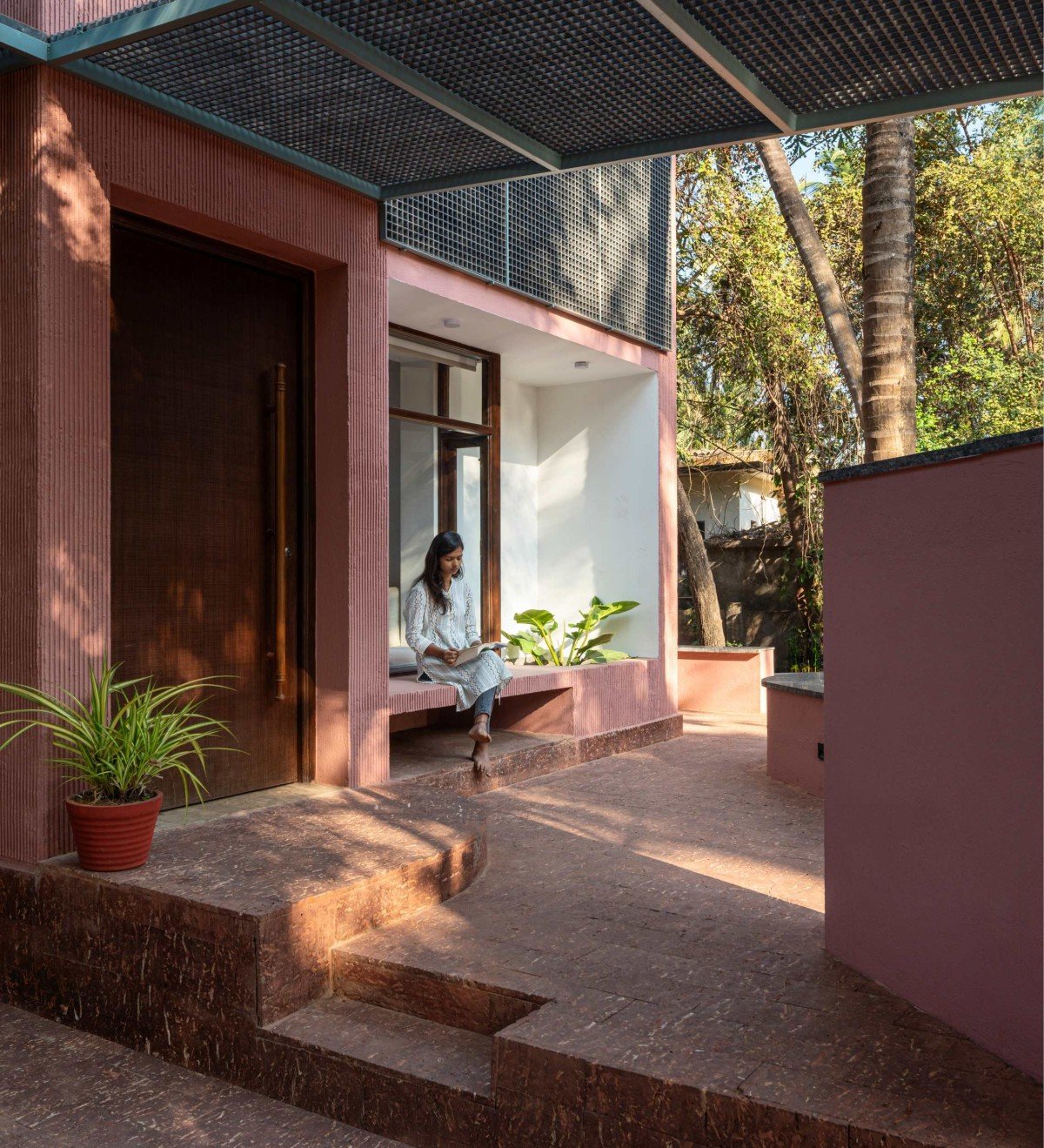
The building from the outside is deep salmon pink, the laterite blocks in their natural earthy tone sitting solidly in the Goa light, a canopy extending over the parking bay to one side, a small pool at the base of the entrance facade, and, above the ground floor, a large metal mesh screen covering the double-height void of the staircase before the vault rises beyond it to the arch and the glass. A verandah at the entrance offers the first moment of cover before the interior, the threshold between the grove and the house unhurried. At dusk the whole building changes: interior light pushes warm amber through the ground-floor glazing, the stained glass catches the last of the sky, and the palm trunks around it go dark against all of it, the house sitting in the grove as though it has always been there.
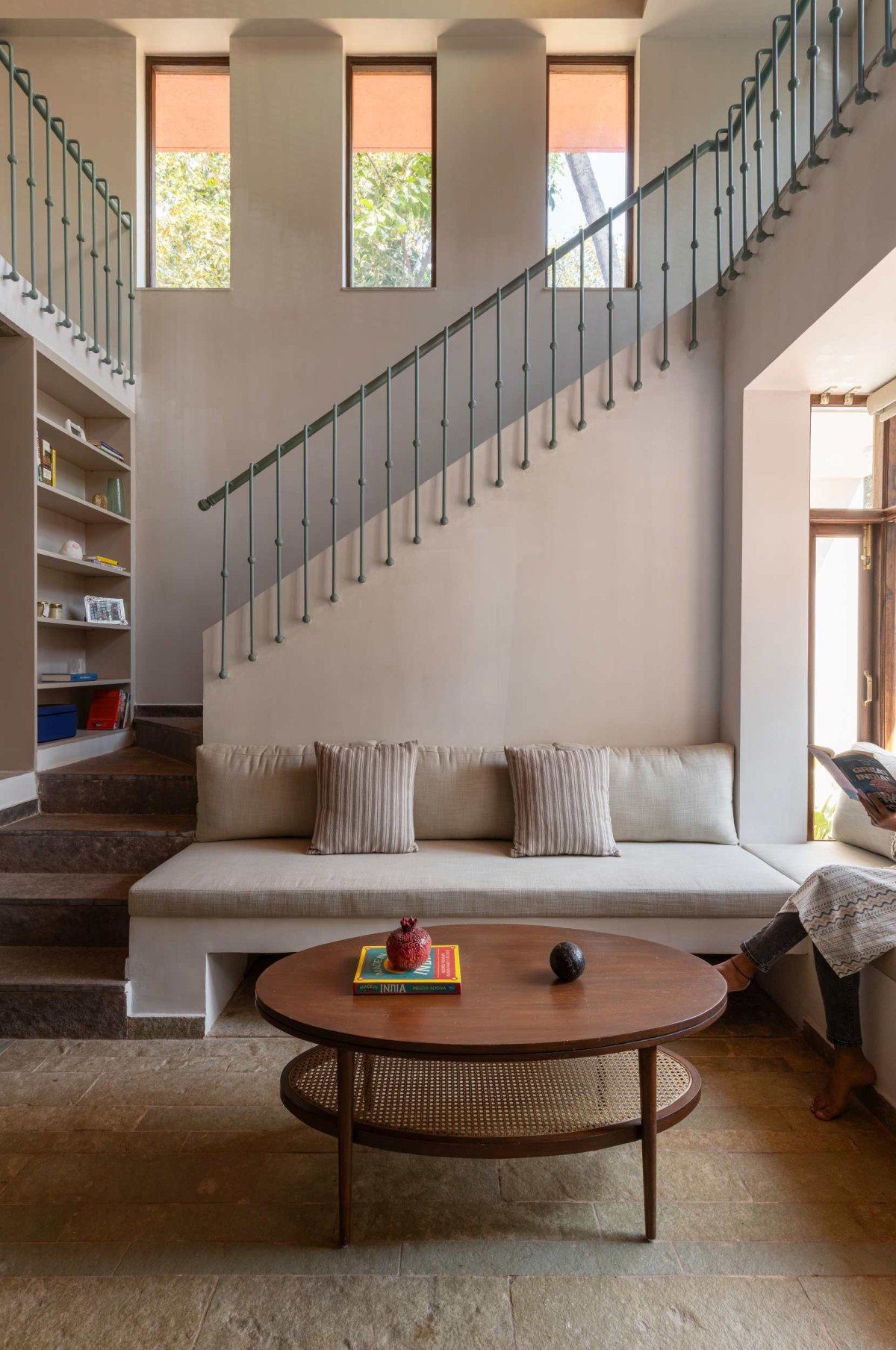
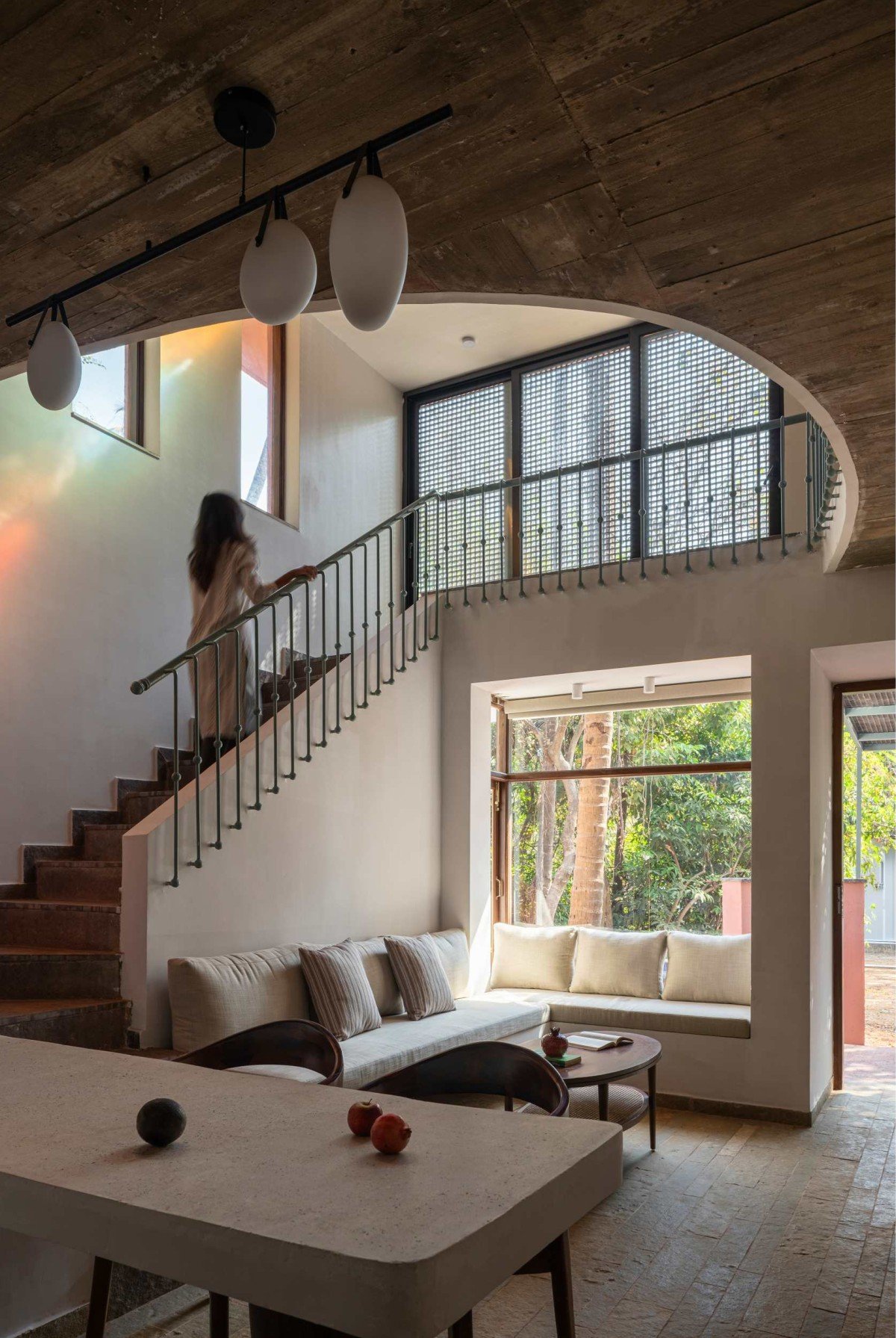
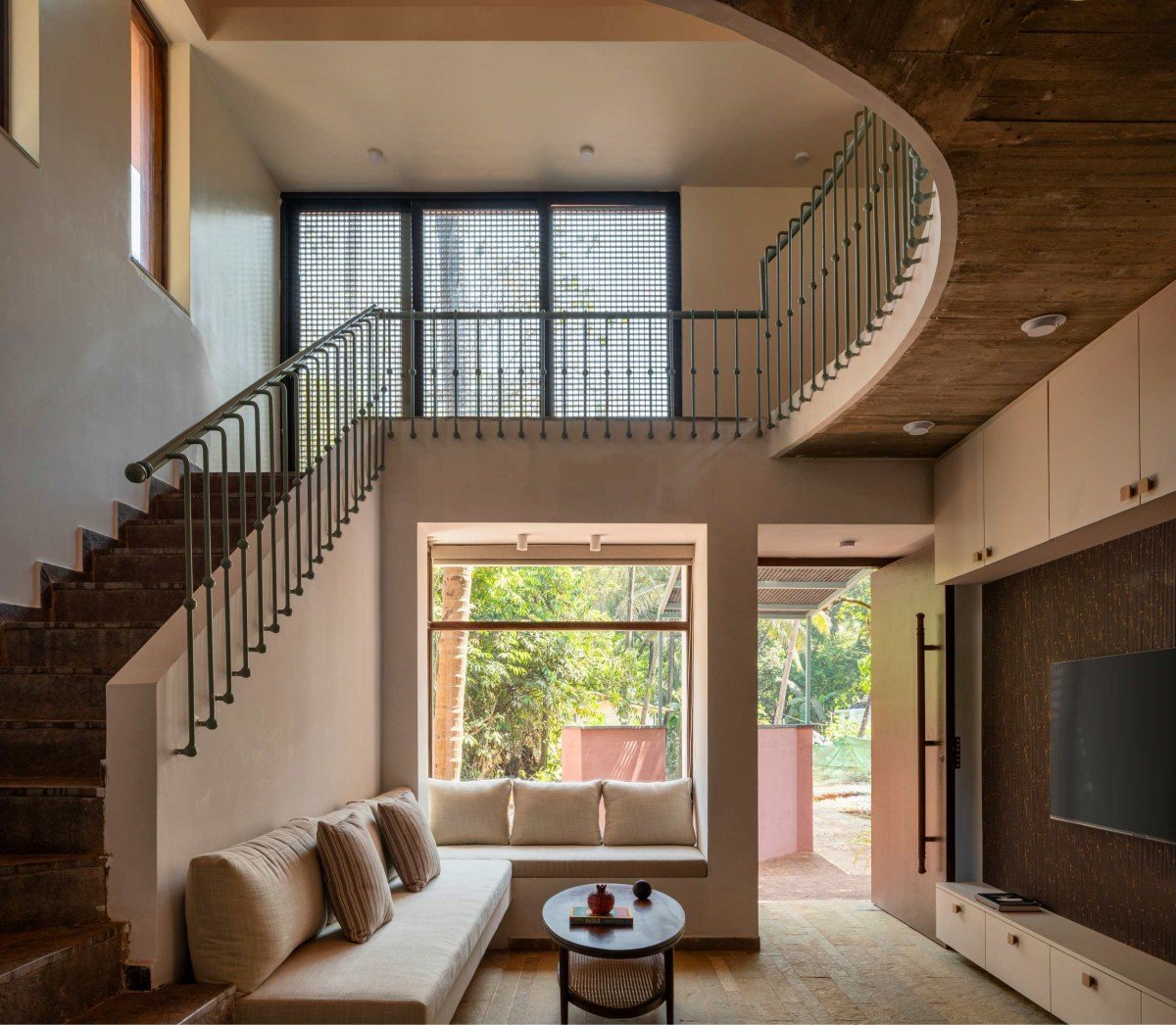
Inside at the ground floor, the double-height living area opens directly from the entrance, and the staircase is the first thing that describes the space’s full range: a curved run of kota stone treads with a teal-painted metal balustrade running alongside, the baluster rods each ending in a small ball finial, the handrail continuous and smooth, rising against one wall and curving at the top to meet the upper landing, and alongside its base a built-in sofa in off-white upholstery is set into the curve of the staircase wall, with striped cushions on it, a round timber coffee table with a cane lower shelf in front, and books and small objects on both, so that the staircase and the seating exist as a single connected thing rather than as circulation alongside furniture. Three tall narrow windows cut into the wall above, their terracotta brick surrounds visible through the glass, tree foliage pressing close outside, and open bookshelves built into the wall under the stairhold books and objects accumulated over time, the shelves neither styled nor sparse.
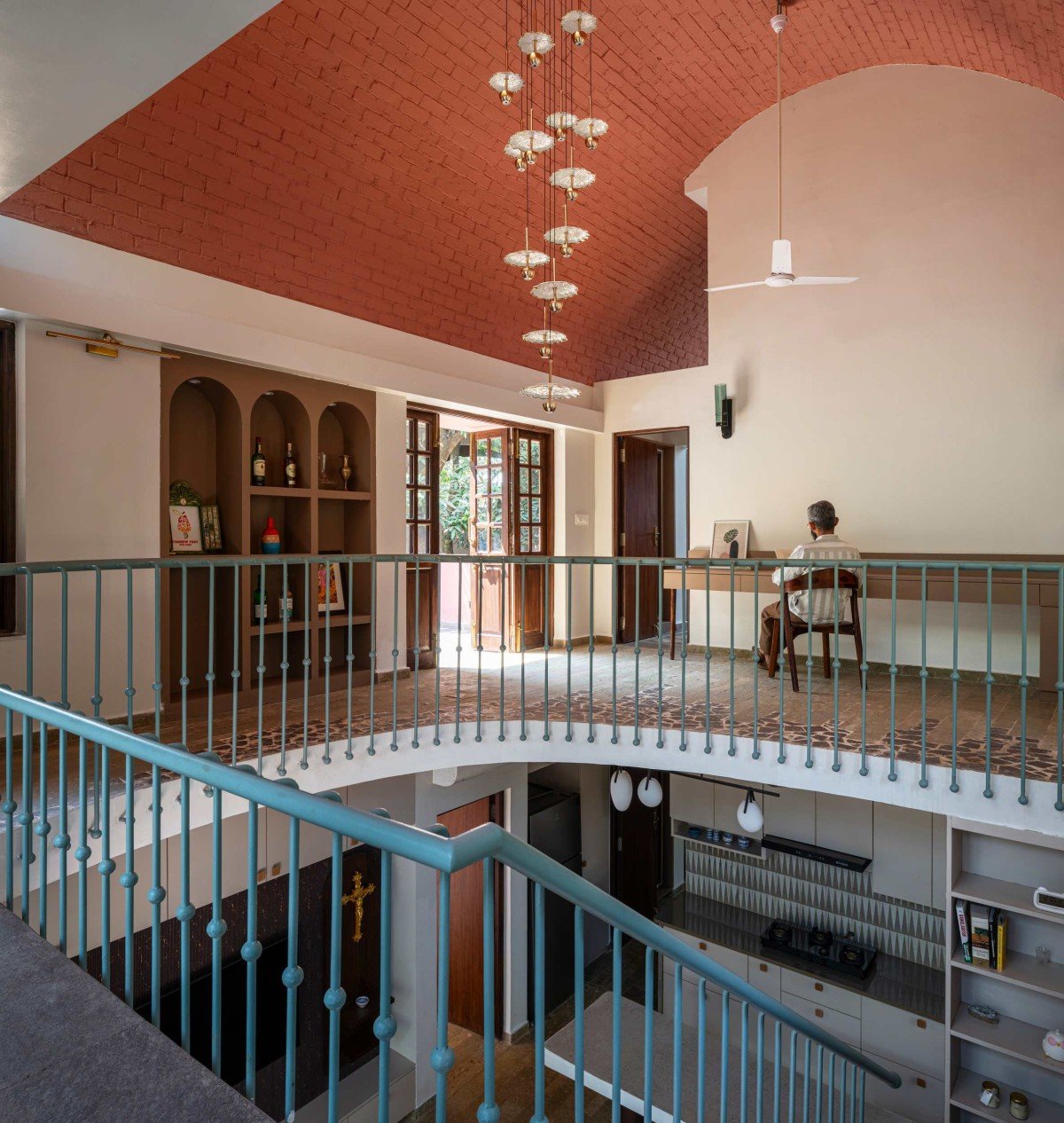
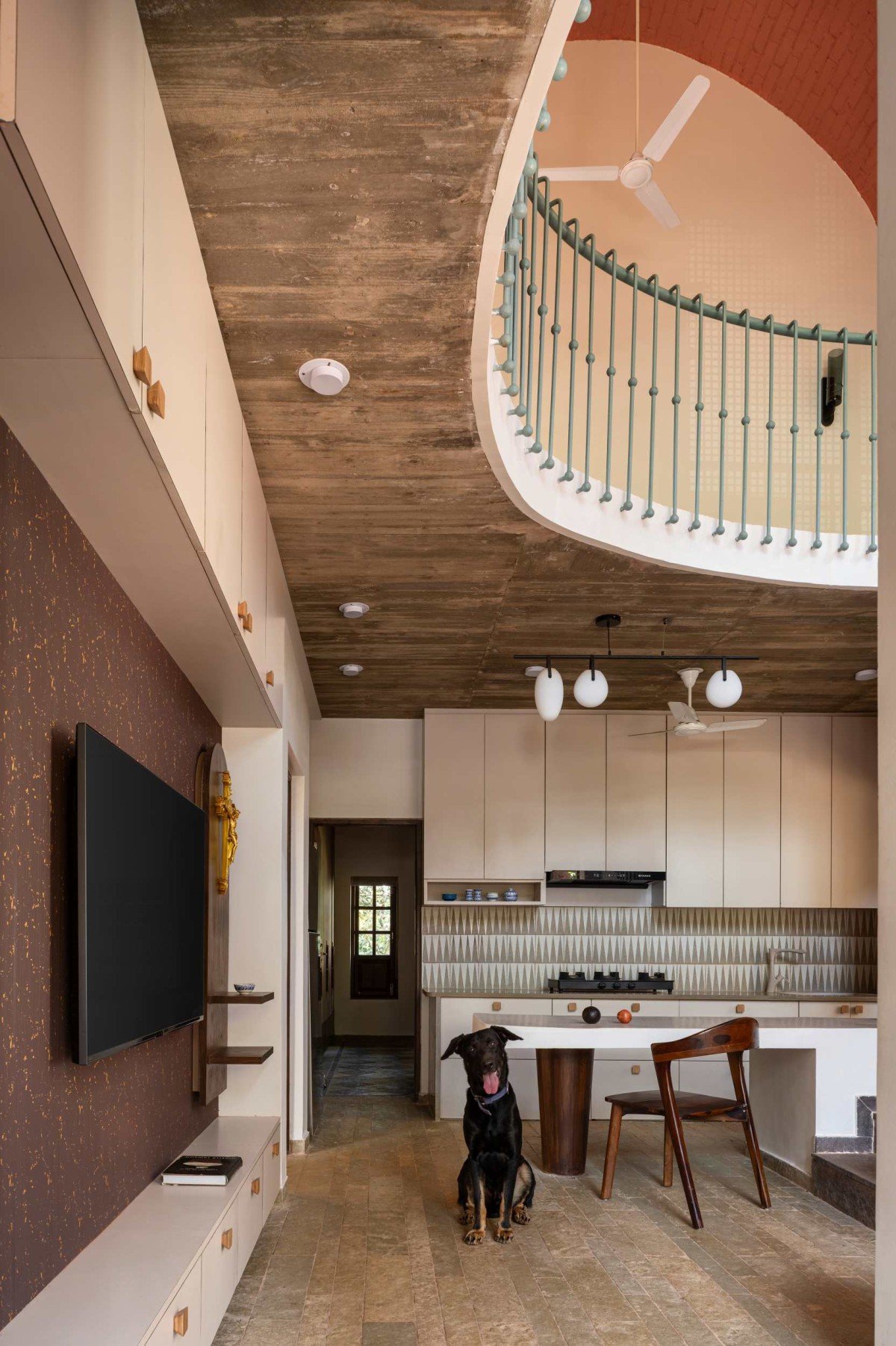
The living area extends to a window seat built flush with a large square window looking onto the back garden, its cushions in the same off-white as the sofa, the coconut palms and broad-leafed trees pressing up against the glass so that the seasons arrive in this room through color and density rather than temperature. The kitchen is open to the room without a partition, its flat-front cream cabinets running the length of the back wall with a geometric triangular-pattern tile backsplash in grey-green, globe pendant lights on a black track rail above the island, and a dark timber chair at the peninsula, the whole kitchen visible from the sofa as part of the same continuous floor, the ceiling above it in rough exposed timber and concrete that reads as the honest underside of the floor above rather than a finished surface.
On the living room wall opposite, a television is mounted on a surface in dark, heavily-grained material flecked with gold, and a white TV cabinet is below with small brass pulls and a gilded figure on the wall alongside. The floor throughout is kota stone in large, irregular pieces laid close.
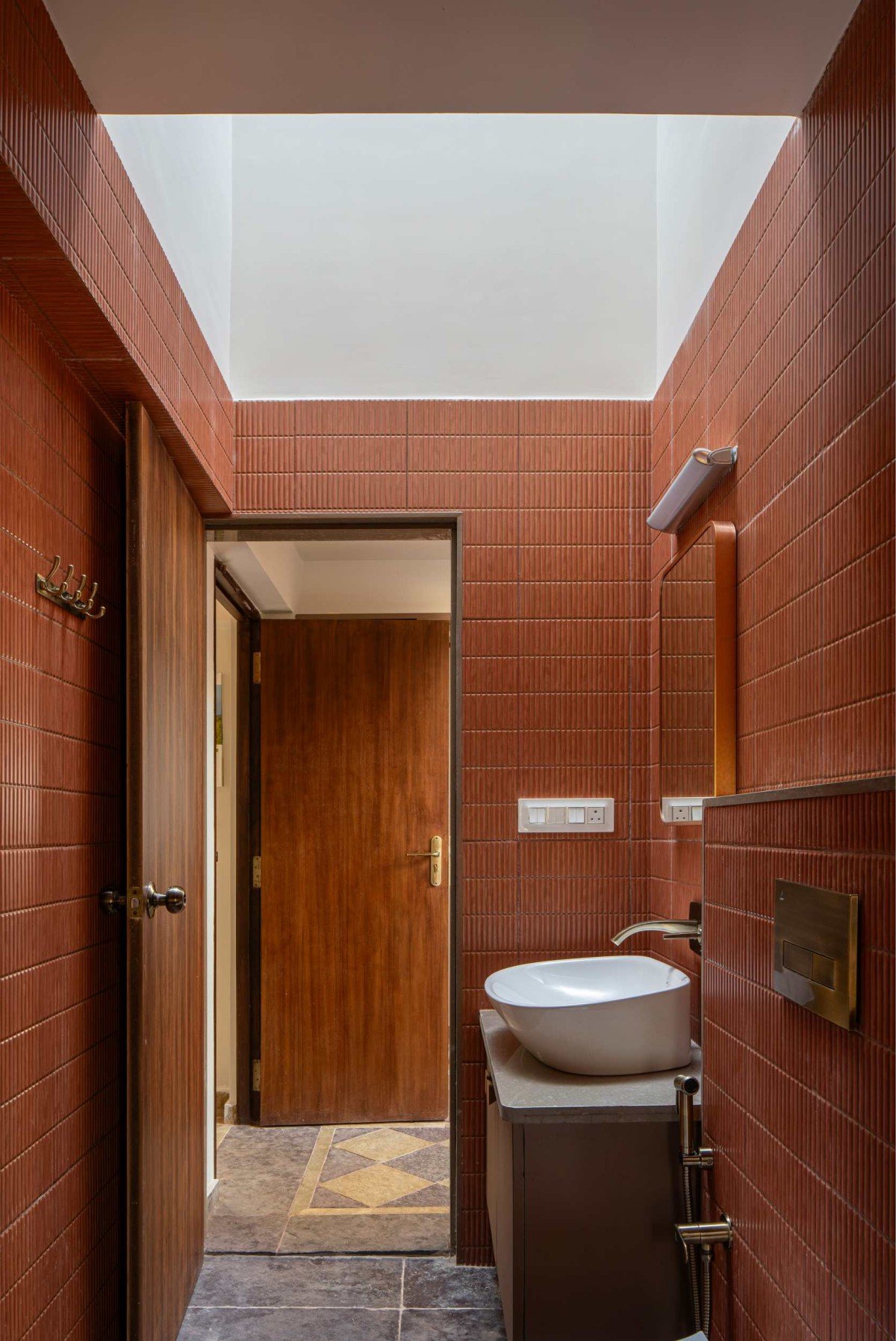
The bathroom on the ground floor is the house’s most enclosed interior moment and its most considered one: walls, ceiling, and surround are entirely clad in small ribbed terracotta-red tiles running in horizontal courses, their glazed ridged surface carrying the same deep clay tone as the exterior laterite so that the color of the building comes inside in a different material register without any announcement.
A rectangular skylight cut into the ceiling opens the room directly to the sky above, the white light falling down between the red tile walls and landing on the kota stone floor with its small diamond inset in ochre yellow, the white vessel sink on its compact vanity, and the warm timber door with a brass handle. The detail that makes the room is the one that costs nothing: the skylight and the tile together, the open sky above the most enclosed space in the house.
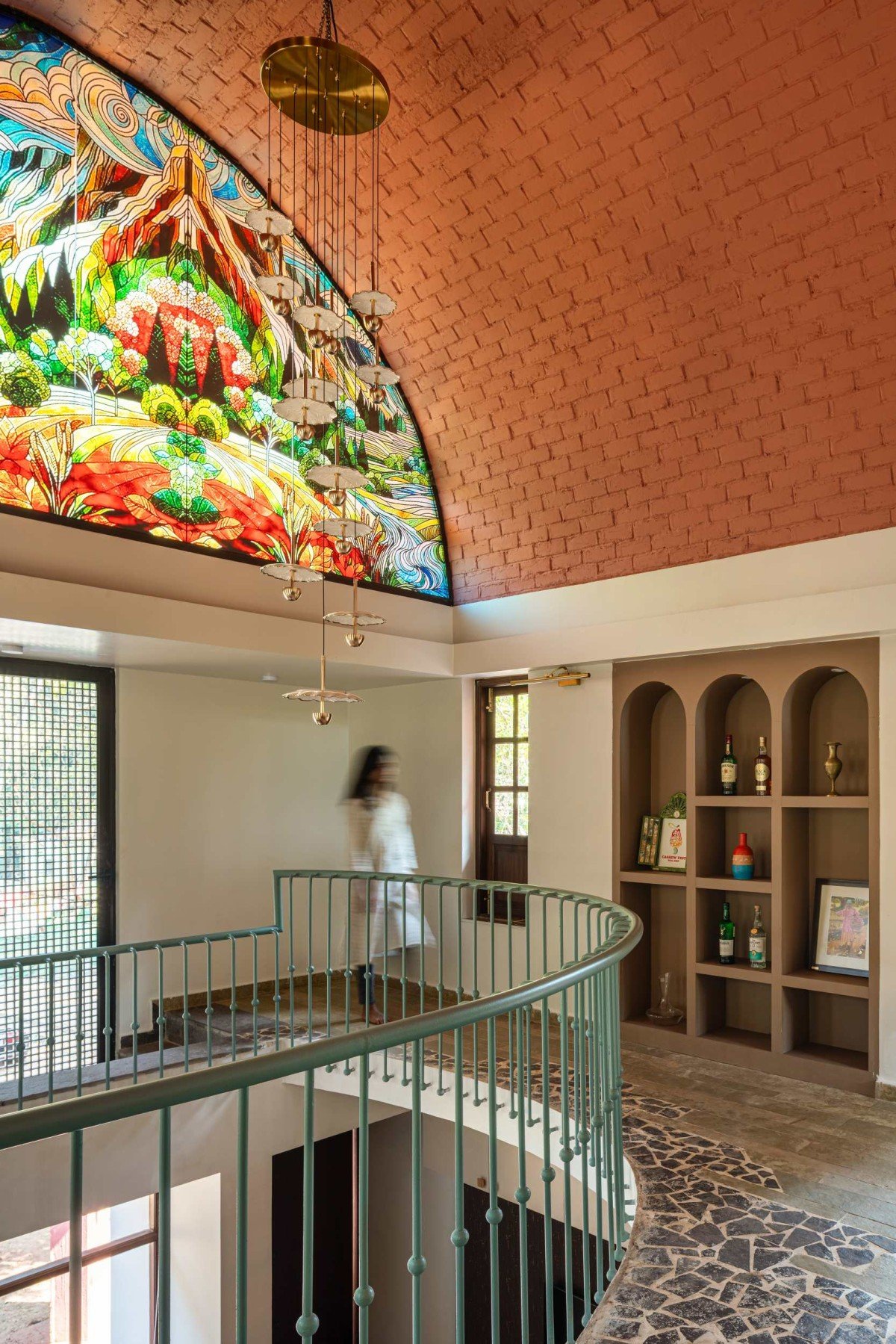
The staircase arrives at the upper level at the full height of the vault, and this is where the stained glass becomes something you are inside rather than looking at from the street. It fills the entire semicircular arch above the void, the mountain landscape, and the river and the trees in orange and green and red and blue leaded glass, sending colored light across the brick vault ceiling and the teal railing and the kota stone floor below through the morning, the quality of the interior shifting depending entirely on the angle of the sun, the glass doing what it was placed to do, which is to make the house impossible to describe without beginning there. The chandelier hanging through the void on a long brass chain, its multiple glass disc pendants cascading downward, catches and redistributes the colored light further into the space. At the upper landing a curved balcony railing in the same teal metal extends the line of the staircase balustrade; arched niches in the wall behind hold bottles and small objects, and wooden French doors open to the trees.
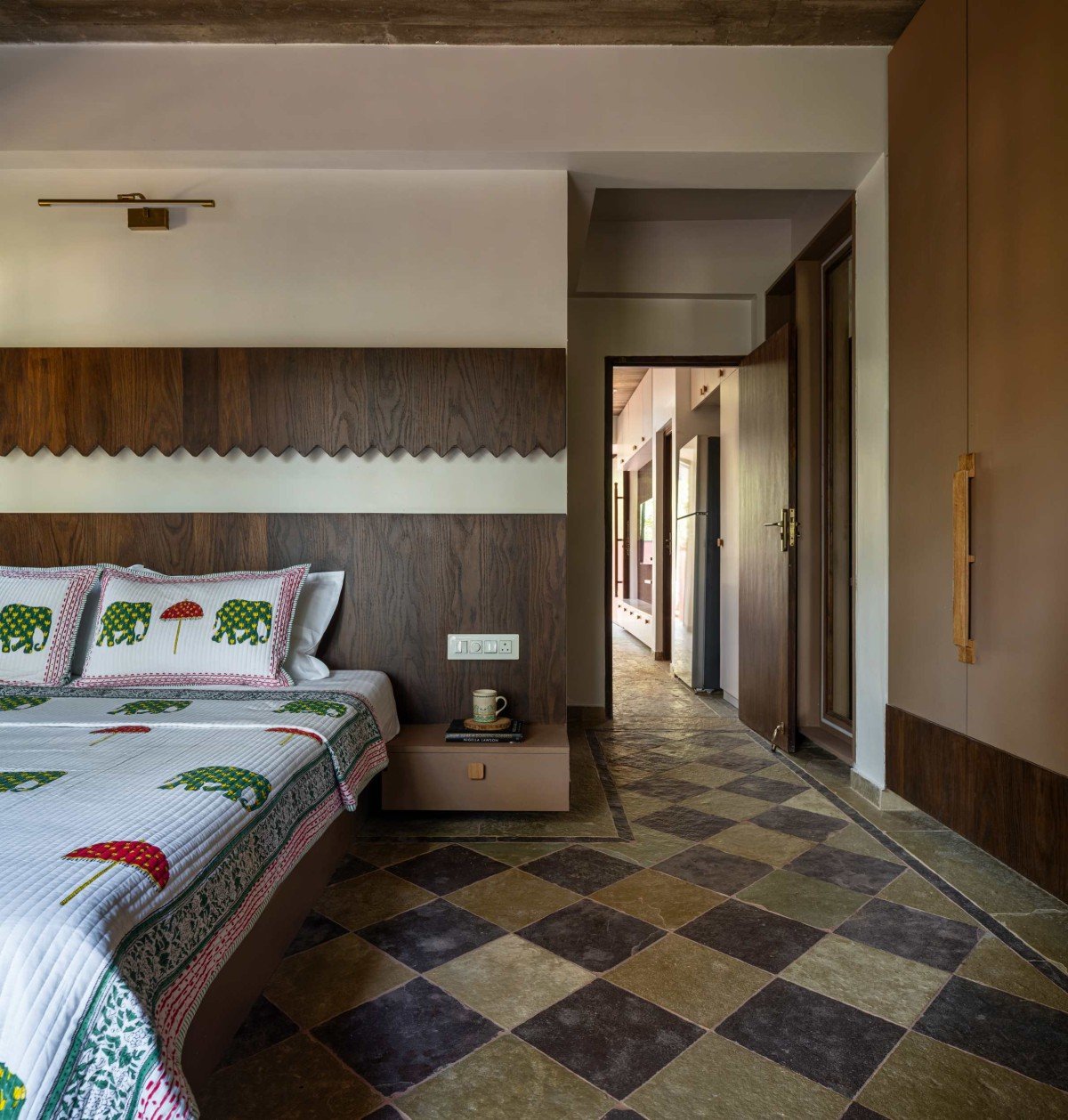
The two bedrooms are positioned at the rear of the house for quiet and for the views of the green landscape that the clear glass at the back was placed to deliver, the contrast between this and the stained glass at the front being the house’s underlying logic: color and opacity toward the street, transparency and natural light toward the garden.
The upper bedroom sits under the vault, its ceiling in exposed red brick curving above the bed on one side and a white plaster wall on the other, the two surfaces making no attempt to meet, the brick warm and irregular, the plaster flat and cool, morning light from a timber-framed window falling across the white wall in patterns of shadow from the trees outside.
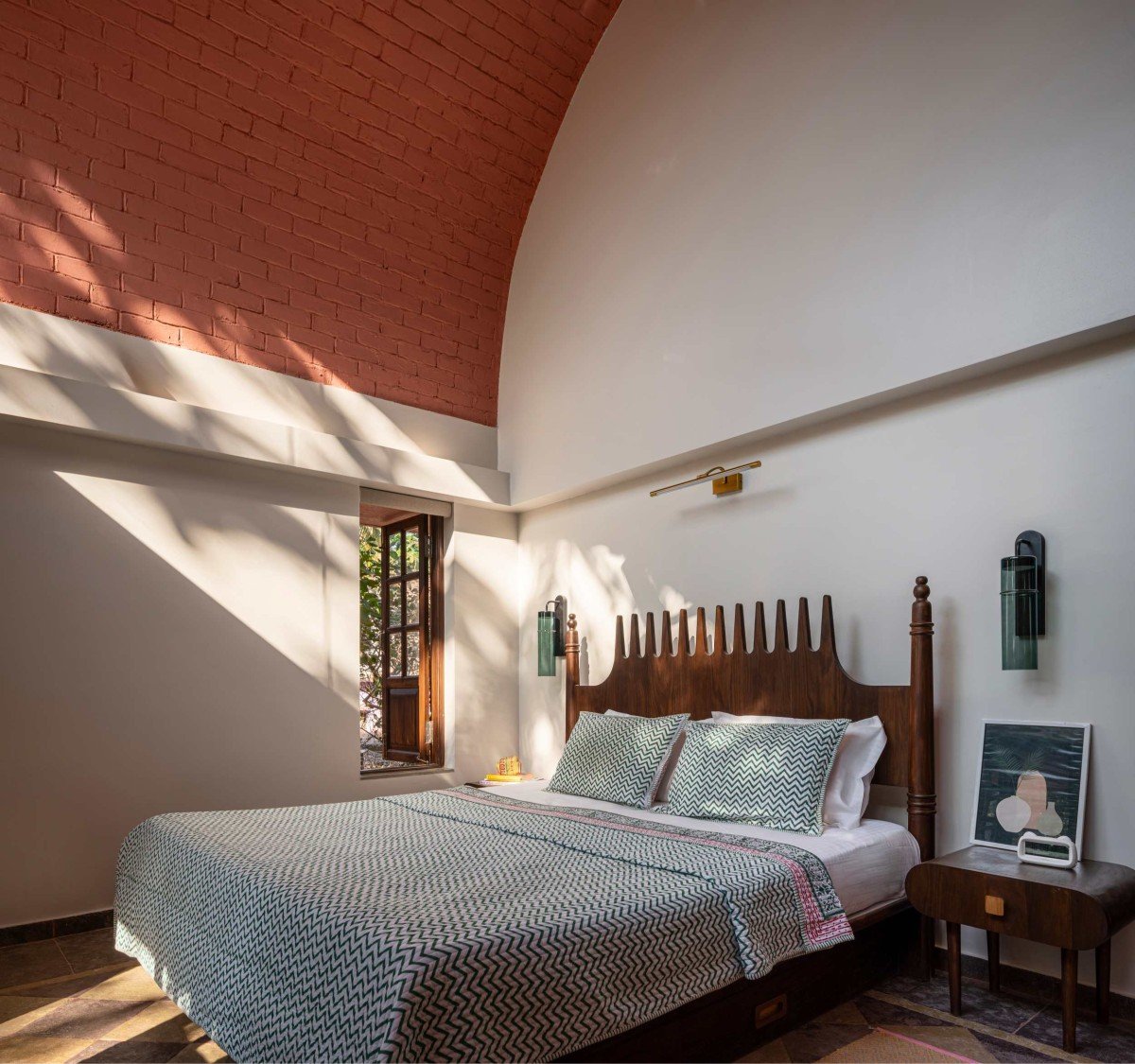
A substantial dark timber bed with a tall carved slotted headboard carries a block-printed cotton in blue-green chevron, a dark timber bedside table alongside, two wall sconces in different forms flanking the headboard, a brass picture light above, a small framed print leaning against the skirting, and the kota stone floor in a two-tone diamond pattern. The ground floor bedroom repeats the same checkered stone underfoot, a dark wood-paneled headboard wall with a scalloped top edge running its full width, and the block-printed bedcover here in a green elephant print, making the room lower and quieter than the one above it.
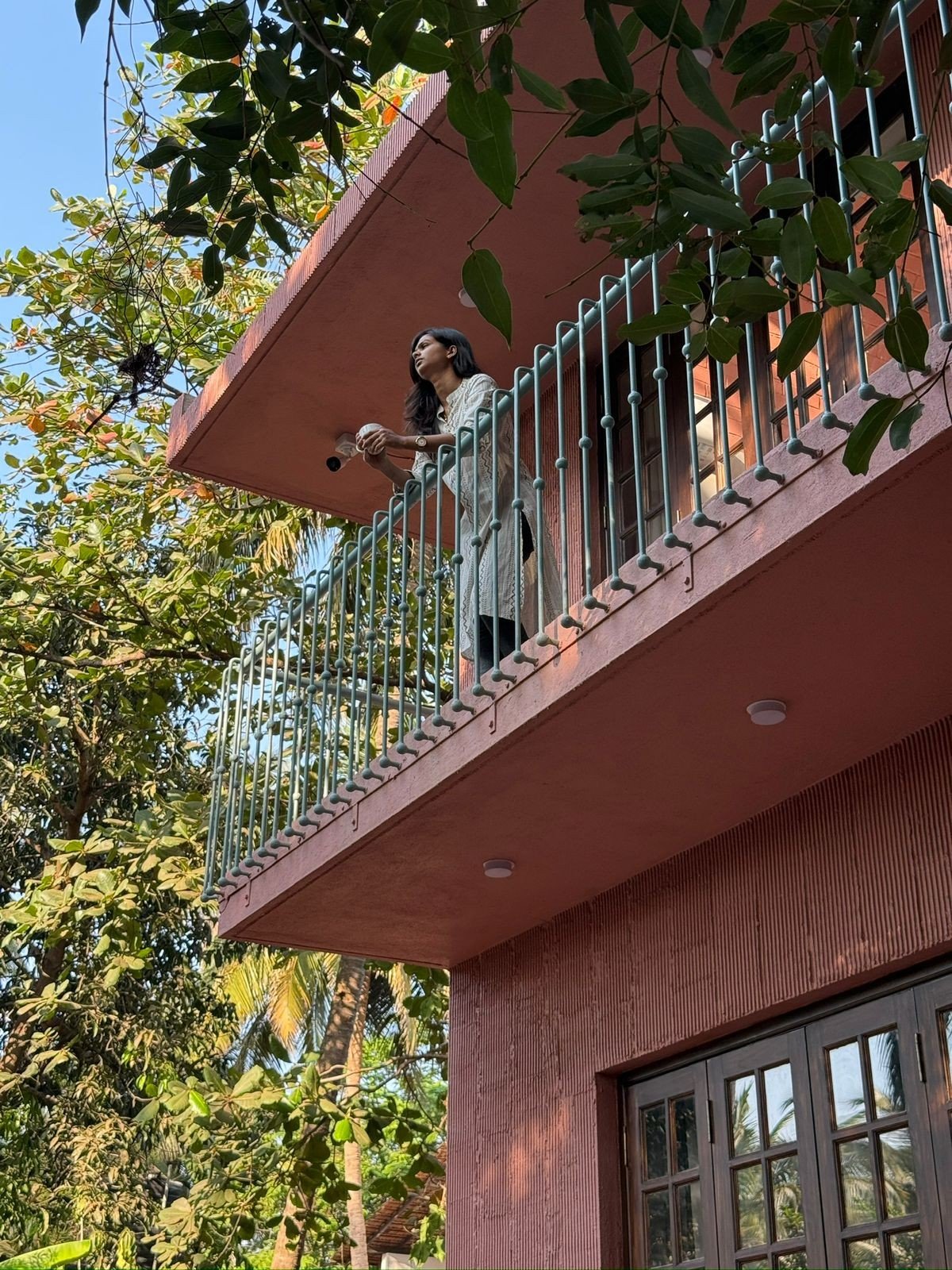
The balcony off the upper bedroom extends into the grove on a cantilevered slab, the teal balustrade with its ball finials carrying the interior railing detail to the exterior edge, the palms and the broad-leafed trees at eye level from here, and the morning light coming through them in the same way it comes through the stained glass inside, differently colored and differently filtered, the same house, the same grove, the same light.
Fact File
Project Name: Arch in the Grove
Location: Anjuna, Goa, India
Architects: 19 Dot Architects
Area: 1,668.41 sq ft
Year of Completion: 2026
Website: instagram.com/19dotarchitects
Photograph: Manthan Yadav
