
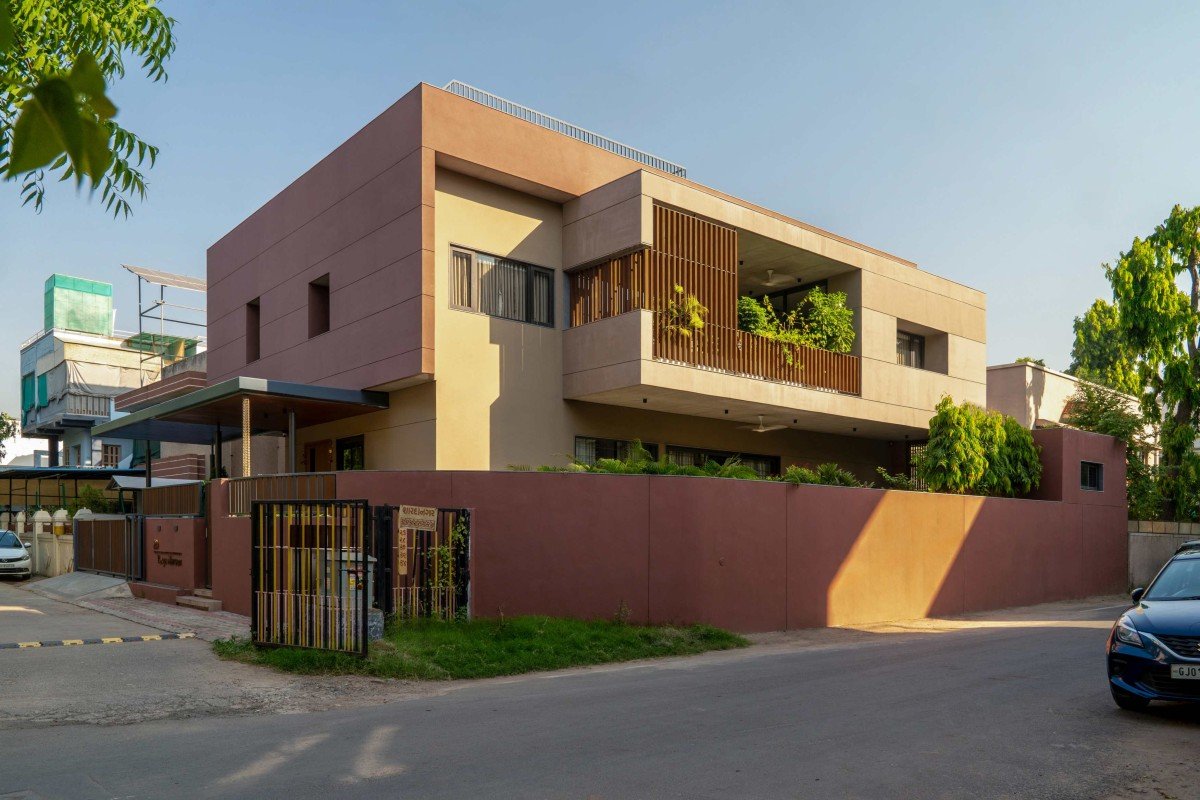
Located at the corner of two streets in Ahmedabad, The Breeze Court House by Studio Blank Canvas is designed as a private residence for an intergenerational family of five. The project responds directly to Ahmedabad’s climate while negotiating the challenge of openness and privacy within a dense residential setting. Rather than relying on decorative gestures, the house builds its identity through proportion, materiality, filtered light, and carefully layered spaces.
From the outside, the house appears as a composed and robust built mass. Large planar surfaces, deep projections, exposed RCC finishes, and earthy textured walls give the structure a grounded presence against the street. The west facade remains largely closed to reduce heat gain, while the southern edge opens more selectively through recessed balconies and custom-designed metal and wooden screens. These screens soften the geometry of the facade while filtering sunlight into the interior spaces throughout the day.
Being positioned on a corner plot allowed the architects to create a peripheral layer of landscape around the house. Greens are not treated as leftover pockets but as an active buffer between the built form and the street. This layer helps soften noise, reduce visual exposure, and create a gradual transition from public to private space.
The entrance begins through a modest vestibule that acts as a pause before entering the main living areas. Inside, the spatial planning is intentionally fluid. The living, dining, and kitchen spaces remain visually connected, yet each area can function independently when required. Large sliding glass openings extend these spaces toward the outdoor deck and landscaped sit-out, maintaining a continuous relationship with natural light and greenery.
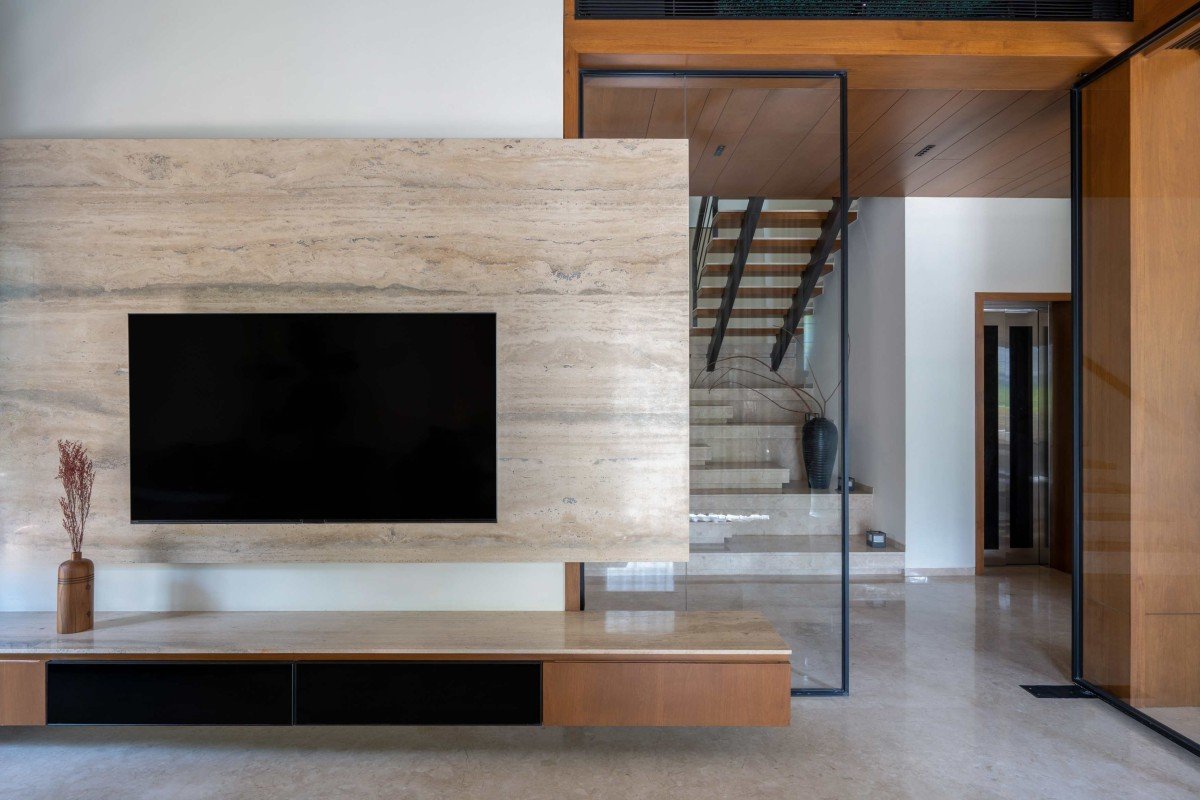
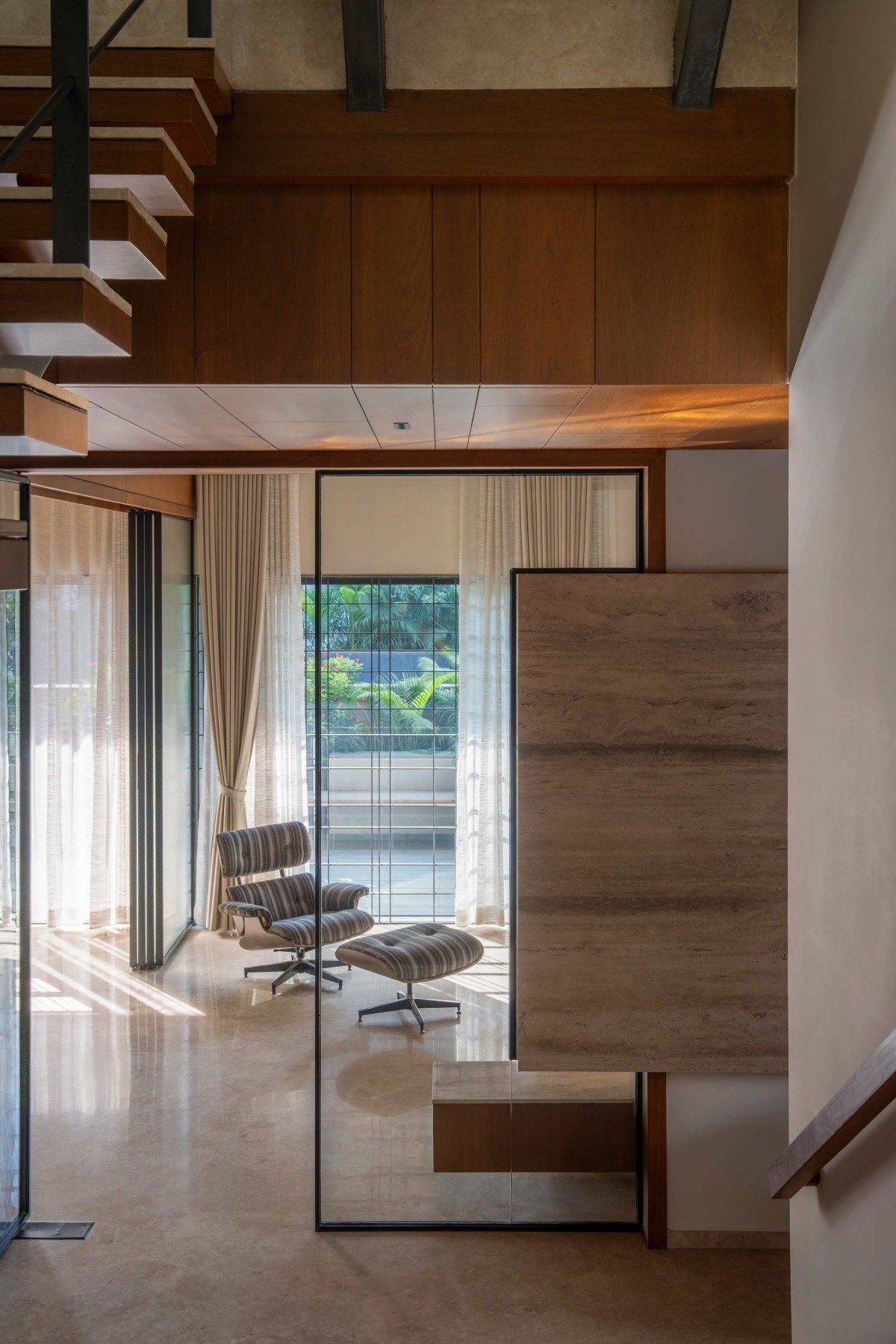
The interior palette is restrained and warm. Beige marble surfaces, wood-lined ceilings, exposed concrete, and slim black metal sections create a language that feels minimal without becoming cold. One of the strongest visual elements within the living area is the suspended stone-clad television partition. Instead of being treated as a solid wall, it appears to float lightly within the space, subtly dividing functions while preserving openness and visual continuity.
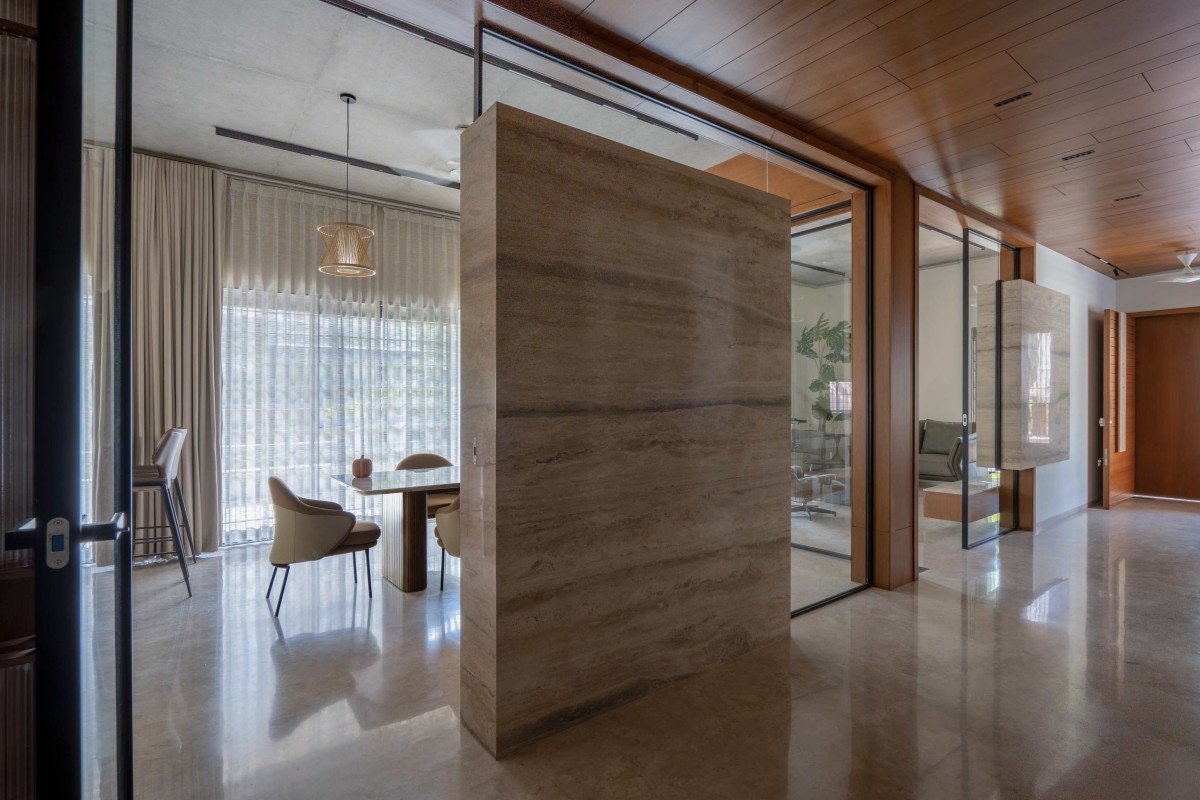
Throughout the house, transitions are handled with unusual clarity. Passageways are not reduced to circulation corridors but become spatial experiences in themselves. The movement from the foyer toward the dining area is framed by full-height glass partitions, warm timber surfaces, and carefully controlled natural light. These layers create changing reflections and transparency throughout the day, giving even quieter spaces within the house a sense of depth.
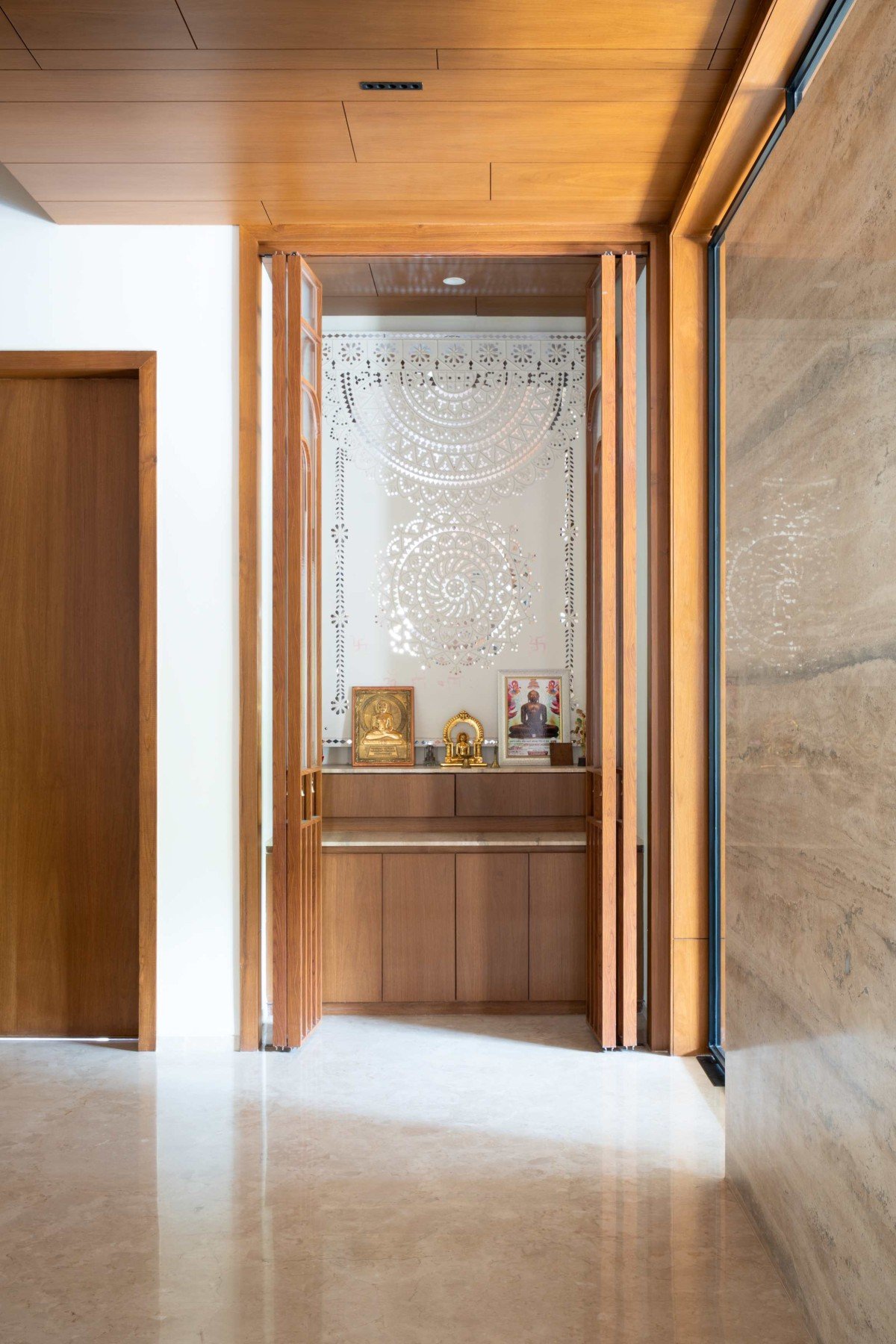
The pooja space continues the restrained material approach seen elsewhere in the home. Enclosed within foldable wooden doors, the space remains visually understated while carrying a strong sense of presence. A delicately patterned backdrop catches light softly during the day, allowing the focus to remain on ritual and stillness rather than ornamentation.
At the center of the house, the staircase becomes both a functional and sculptural element. Locally sourced marble forms the heavier base of the staircase, while the fabricated metal structure above introduces visual lightness. A skylight positioned overhead draws natural light into the vertical core of the house, transforming what is typically a purely utilitarian zone into one of the most spatially dynamic parts of the residence. From certain angles, the staircase frames views back into the living spaces and landscape outside, reinforcing the sense of openness that runs throughout the project.
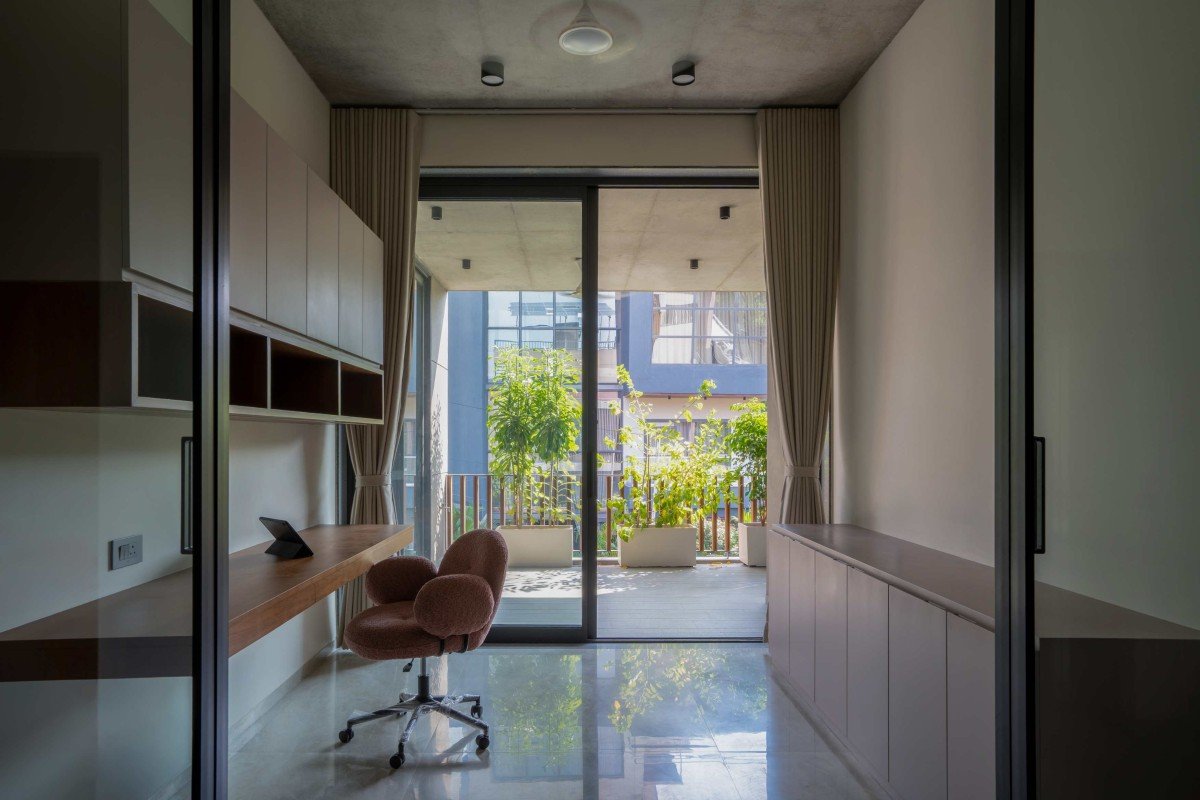
The upper floor follows a more practical layout with bedrooms and a shared study area. However, the defining feature here is the large common balcony screened with vertical wooden and metal members. Lined with planters and open to filtered sunlight, the balcony functions as an informal family space rather than just an extension of the rooms. The study area opens directly toward this terrace, allowing daylight and greenery to become part of the everyday working environment.
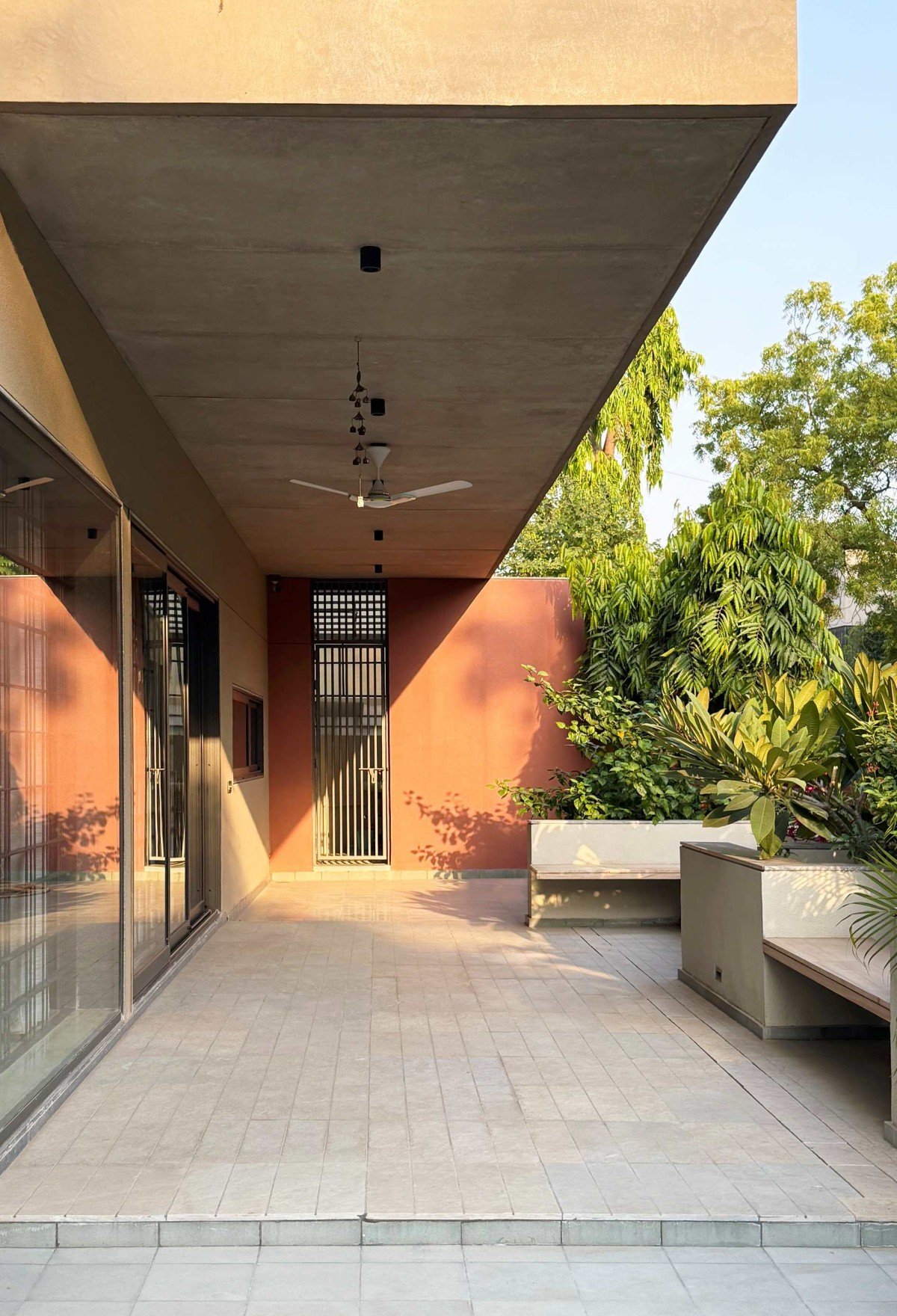
The sit-out spaces across the house further strengthen the relationship between architecture and climate. Deep overhangs protect these semi-open areas from direct sun while allowing airflow to move freely through the house. The outdoor seating edges, integrated planters, and shaded decks create quieter moments within the larger built form, softening the otherwise strong architectural geometry.
What makes The Breeze Court House compelling is the discipline with which the project handles restraint. The house does not depend on excessive material variation or visual drama. Instead, it focuses on balance: openness without exposure, solidity without heaviness, and minimalism without sterility. Every architectural move, from the puncture-less western wall to the screened balconies and layered interiors, feels tied to climate, privacy, and everyday family life rather than stylistic display.
Fact File
Project Name: The Breeze Court House
Location: Ahmedabad, Gujarat, India
Typology: Private Residence
Architects: Studio Blank Canvas
Lead Architect Designer: Ar. Khyati Pankhania
Design Team: Jaydeep Rathod, Akshay Jain
Area: 4800 sq. ft.
Year of Completion: 2025
