
The first thing you see at Vaikunth is a lotus, hammered in gold across the ceiling of the entrance passage, its petals pressed and textured and lit from within; a dark crystal chandelier hanging from its center above a pale sand double door flanked by yellow glass candle holders and a carved stone Buddha; the carpet underfoot patterned; and the walls on both sides in dark veined marble, and by the time you have registered all of this, you have not yet stepped inside, which is precisely the point of an entrance designed this deliberately, this completely, in a home that takes its name from the eternal dwelling of Vishnu and intends to live up to it.
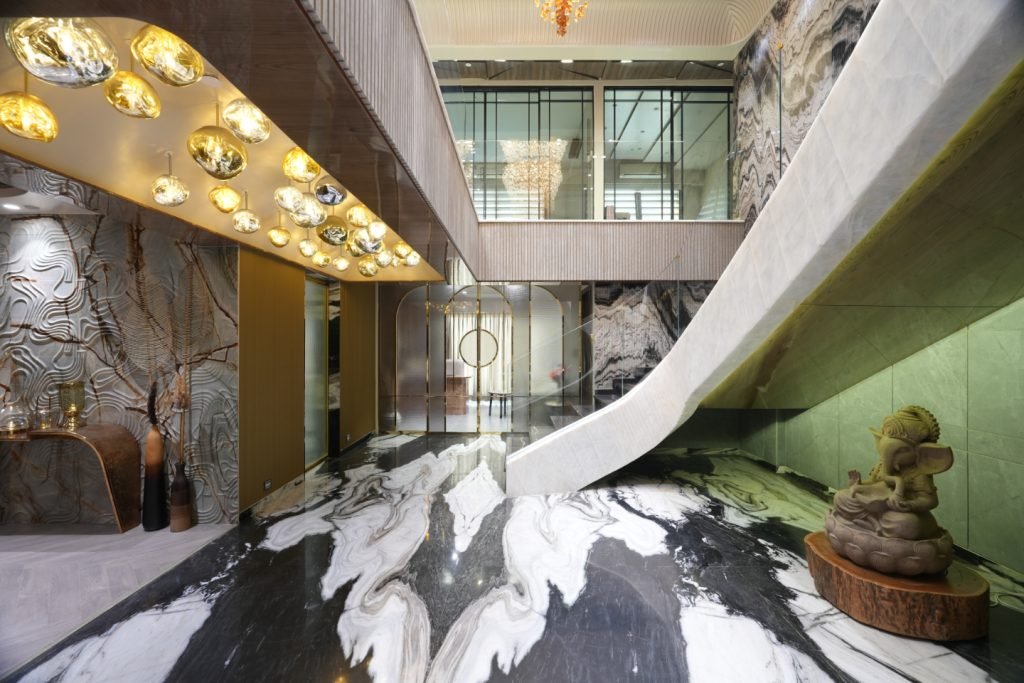
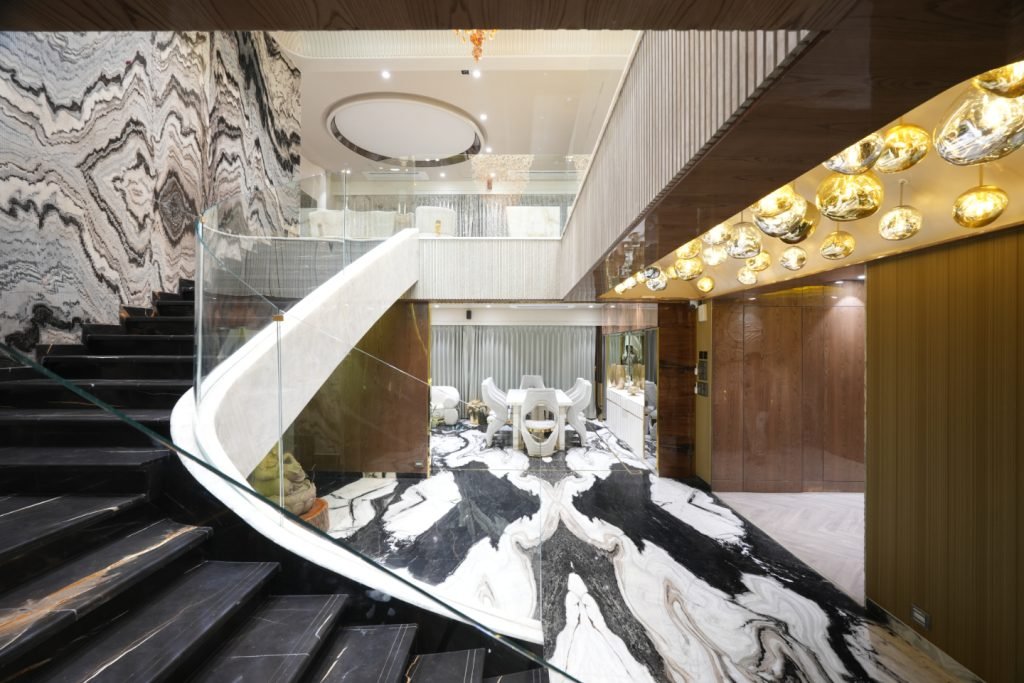
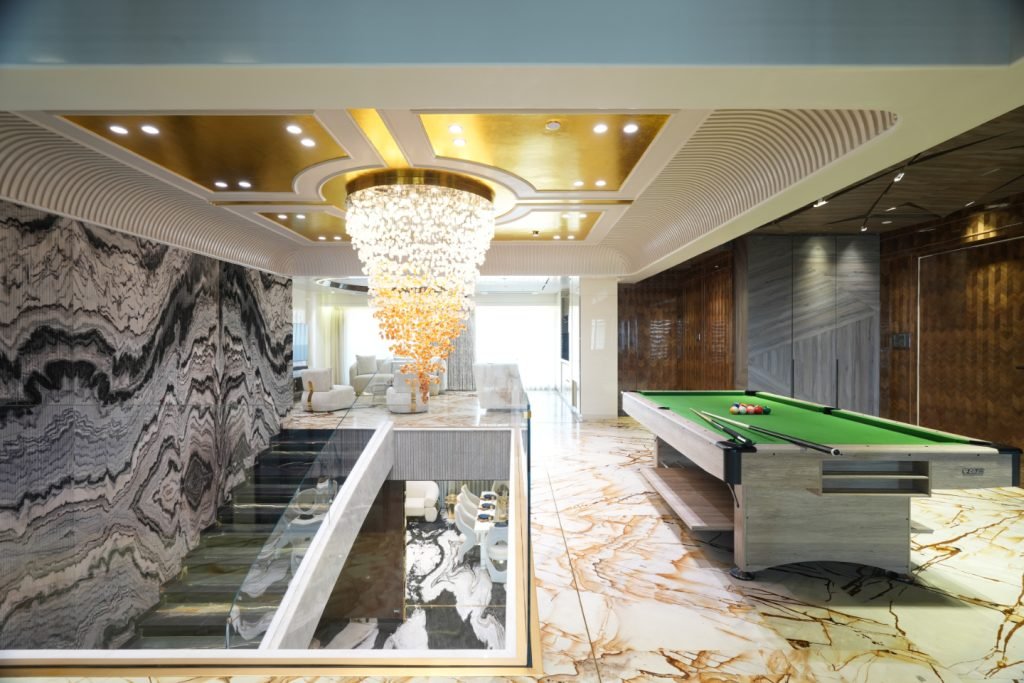
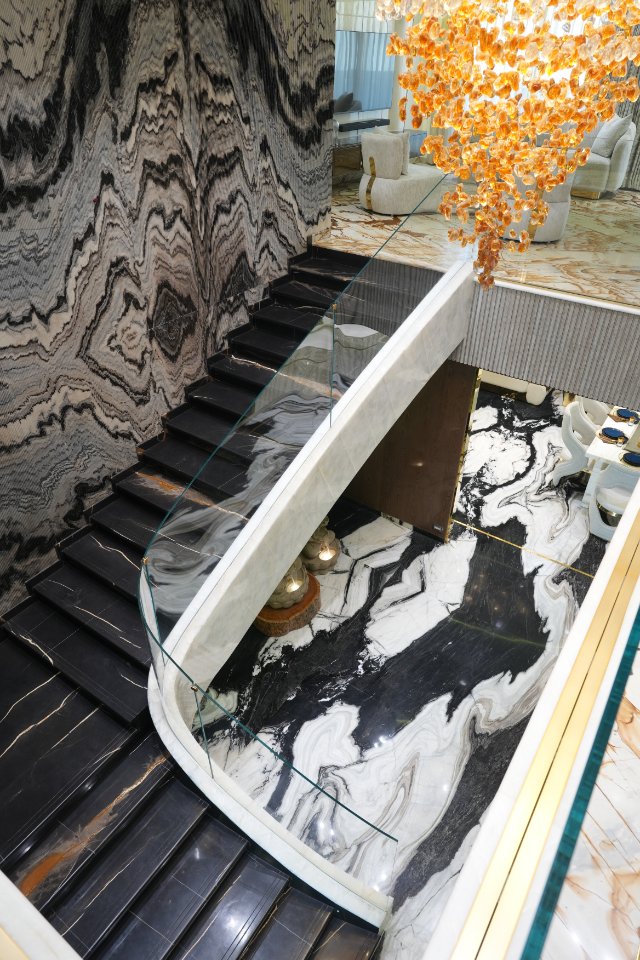
Beyond the door, the foyer is lined in onyx whose cream ground carries rust and grey veining in slow organic patterns that shift as you move past them, the stone so particular it reads as something uncovered rather than specified, and a circular gold textured ceiling recess glows above a dark console holding candles and gold vessels before the passage opens through a curved archway onto the staircase, where the full ambition of the house reveals itself at once: black marble treads descending alongside a full-height wall of dramatically swirling black and white marble, a curved white newel with a glass balustrade, an amber orange chandelier cascading the full height of the double void, and at the base of the stair, on a raw wooden log, a Ganesha sculpture sitting in the black and white marble floor with the ease of something that has always been there and always will be.
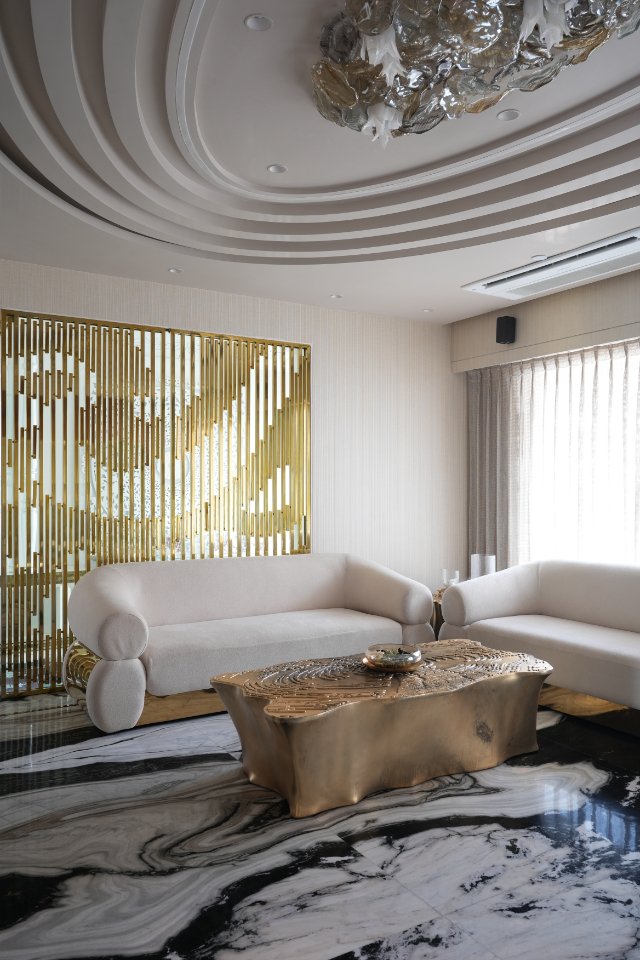
The living and dining floor is built around that same black and white marble, which covers the entire ground floor in vigorous swirling veining that does the compositional work of a large abstract painting and makes the room feel resolved before the furniture enters it, and the furniture that enters it is equal to the task: sculptural white dining chairs with organic cutout voids in their backs and gold bases arranged around a white marble table beneath a concentric oval ceiling of multiple cove-lit rings holding a chandelier of irregular glass and shell-like pieces in pale gold at the centre, and in the living zone a blush rounded sofa before a cast brass coffee table whose entire surface is worked in topographic contour lines as though a geological survey has been frozen in metal, with a large gold brass geometric screen of vertical tubes occupying the wall behind it, the dining room mirror doubling the depth of the space and the chandelier and the ceiling detail within it so that the room exists as itself and simultaneously as its own reflection.
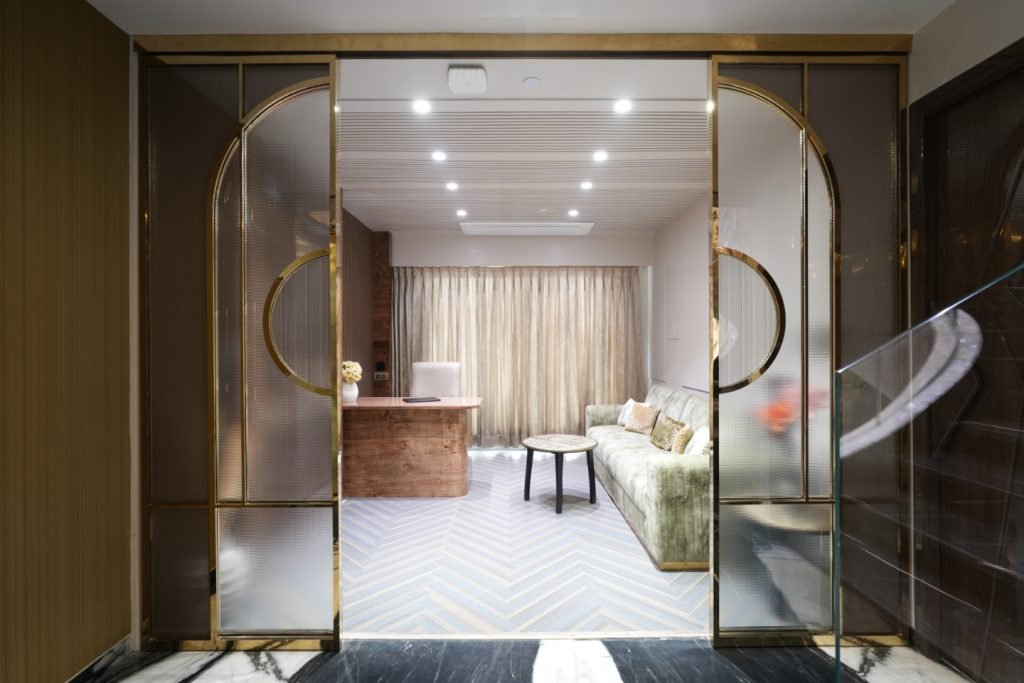
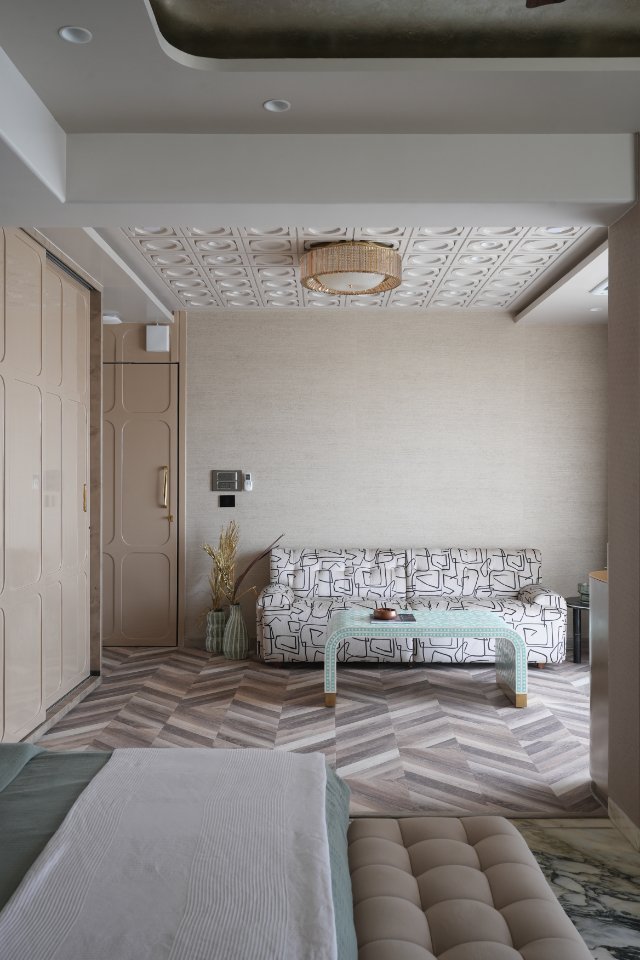
The study, seen through profile doors carrying brass arched panels with circular ring motifs on frosted glass that make the threshold feel ceremonial without heaviness, shifts immediately to a chevron-patterned light wood floor and a green velvet sofa and warm curtains and a wood desk, the room belonging clearly to someone in the way that the social spaces below, for all their material richness, deliberately do not.
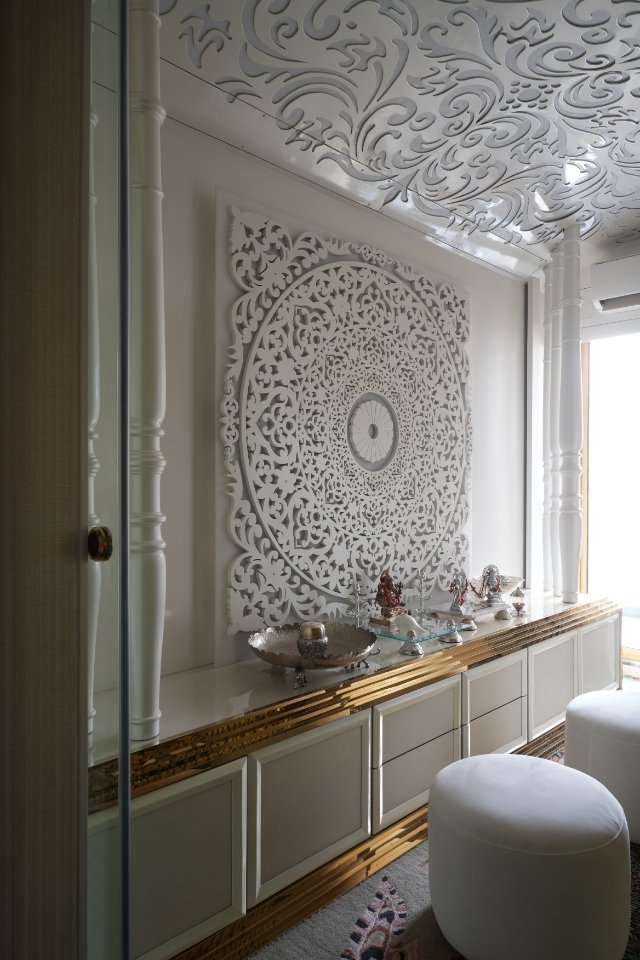
What stops you in the pooja room is the ceiling, an ornate white plasterwork surface of scrolling floral forms covering every inch overhead with the kind of unhurried precision that exists in a different relationship to time than the contemporary luxury surrounding it, and beneath it a full-scale white mandala panel of carved geometric and floral forms fills the wall above a gold-fronted cabinet holding figurines and silver vessels and offerings, the room earning its devotional character through craft rather than through separation from the rest of the house, the spiritual life of Vaikunth present throughout but concentrated here.
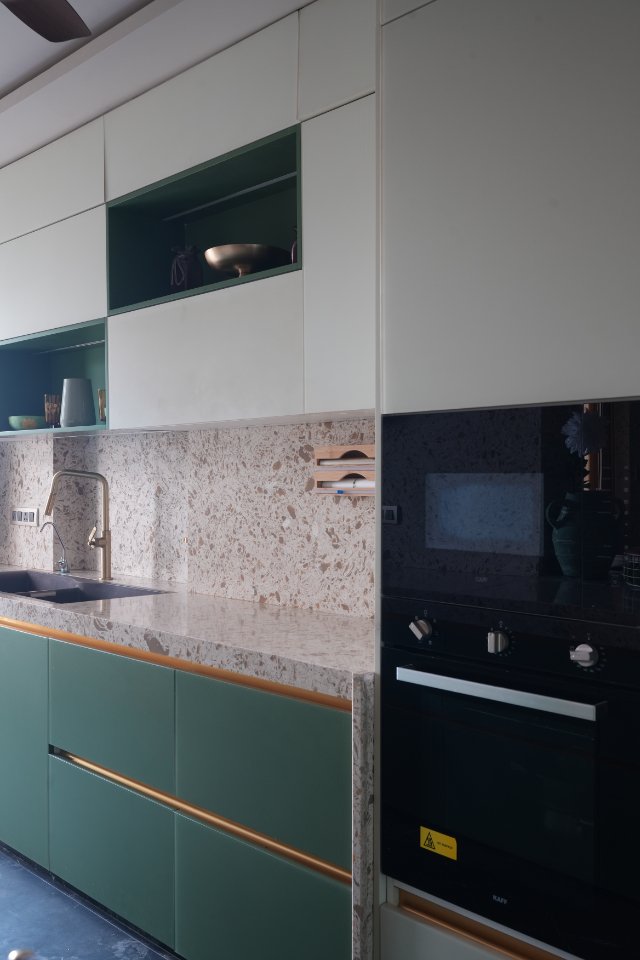
The kitchen runs forest green lower cabinetry with a brass pull rail at handle height against white uppers with a single open green-backed display shelf, the terrazzo-effect stone countertop and backsplash in warm white with brown and grey speckling sitting between the two in a combination confident enough to need no explanation, the black undermount sink, and the built-in oven handled with the same precision as everything else in a house where precision is the baseline rather than the achievement.
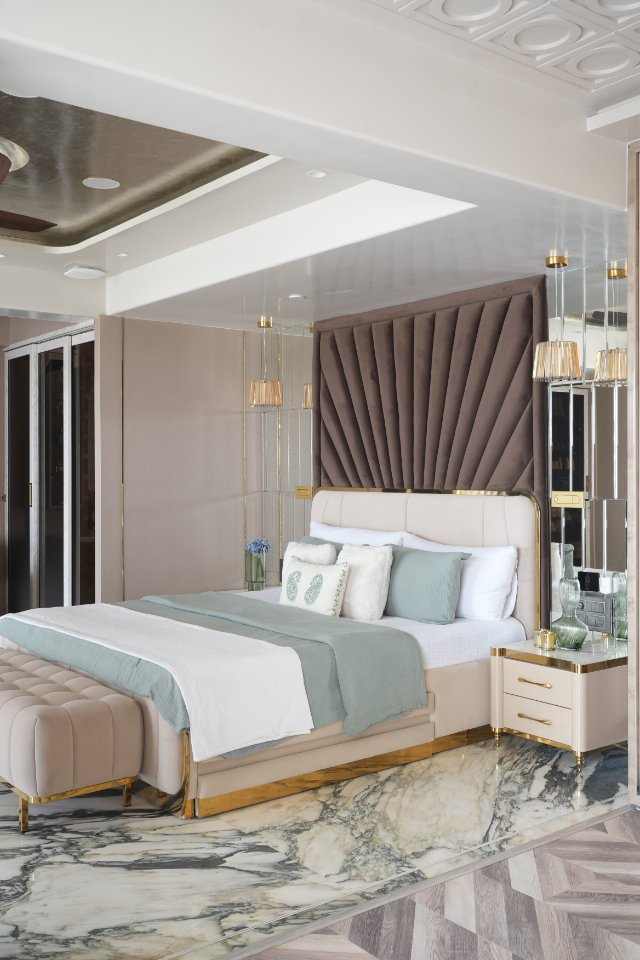
Upstairs the master bedroom gives the full wall behind the bed to a fan-pleated headboard in deep taupe velvet whose pleats radiate outward from the centre in a sunburst rising well above the bed, the velvet absorbing light rather than reflecting it so that the sculptural quality of the pleating reads entirely through texture, the blush bed frame and mint and white bedding providing the softness the wall demands, mirrored side panels with gold framing and a metallic silver ceiling above completing a room that commits to a singular idea and does not waver from it, and from this bedroom the dressing room carries a marble-topped vanity with an arched mirror circled in globe bulbs and a green velvet curved armchair pulled up to it, looking through to a walk-in wardrobe whose ceiling is covered entirely in a dense cloud of white globe lights hanging at varying heights, the teal tufted ottoman on the floor below the only furniture needed in a room that is already complete overhead, and the shower room beyond it is terracotta-red ribbed ceramic tiles on every surface floor to ceiling with brass fittings and a terrazzo floor, a decision so specific and so fully followed through that it earns the surprise it produces.
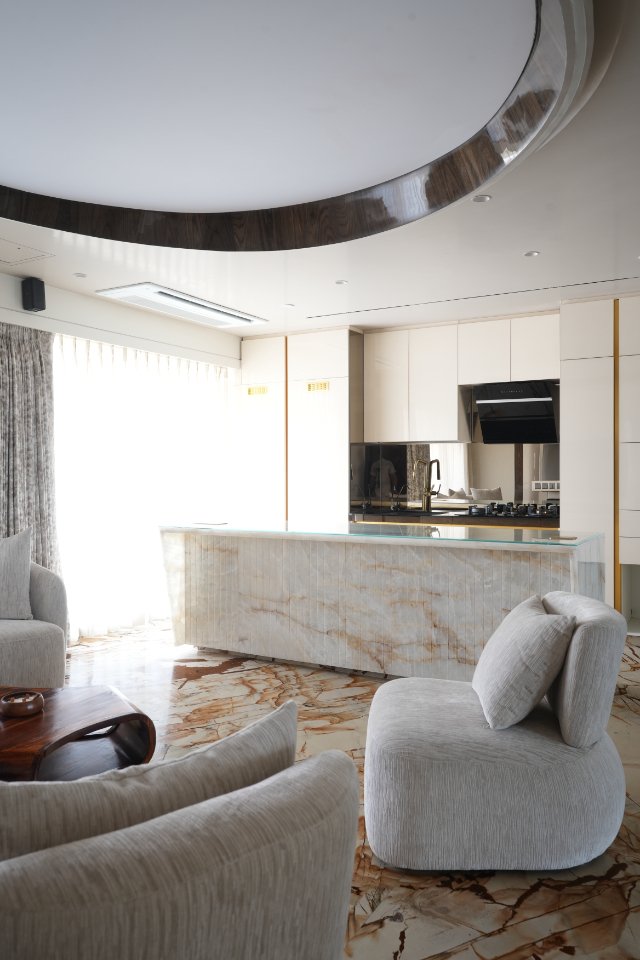
The upper family living area, its circular ceiling recess in dark veneer and polished chrome above two rounded grey bouclé armchairs on orange-veined cream marble, carries a warmth that the ground floor withholds by design, and it is in the distance between the two floors, between the drama of the black and white marble below and the quieter ease of the upper level, that Vaikunth reveals what it is actually about: a home large enough and considered enough to hold more than one version of itself at the same time.
Fact File
Designed by: Tanisha Bansal Interiors
Project Type: Residential Bungalow Design
Project Name: Vaikunt
Location: Chembur, Mumbai
Year Built: 2026
Project Size: 6,500 sq ft
Principal Designer: Tanisha Bansal
Team Design Credits: Anushka Jaisingh, Kirti Pardesi and Anjali Menezes
Photograph Courtesy: Studio Colourblind
Interior Styling: Tithi Sharma
Project Managers: Rushikesh Korade
