
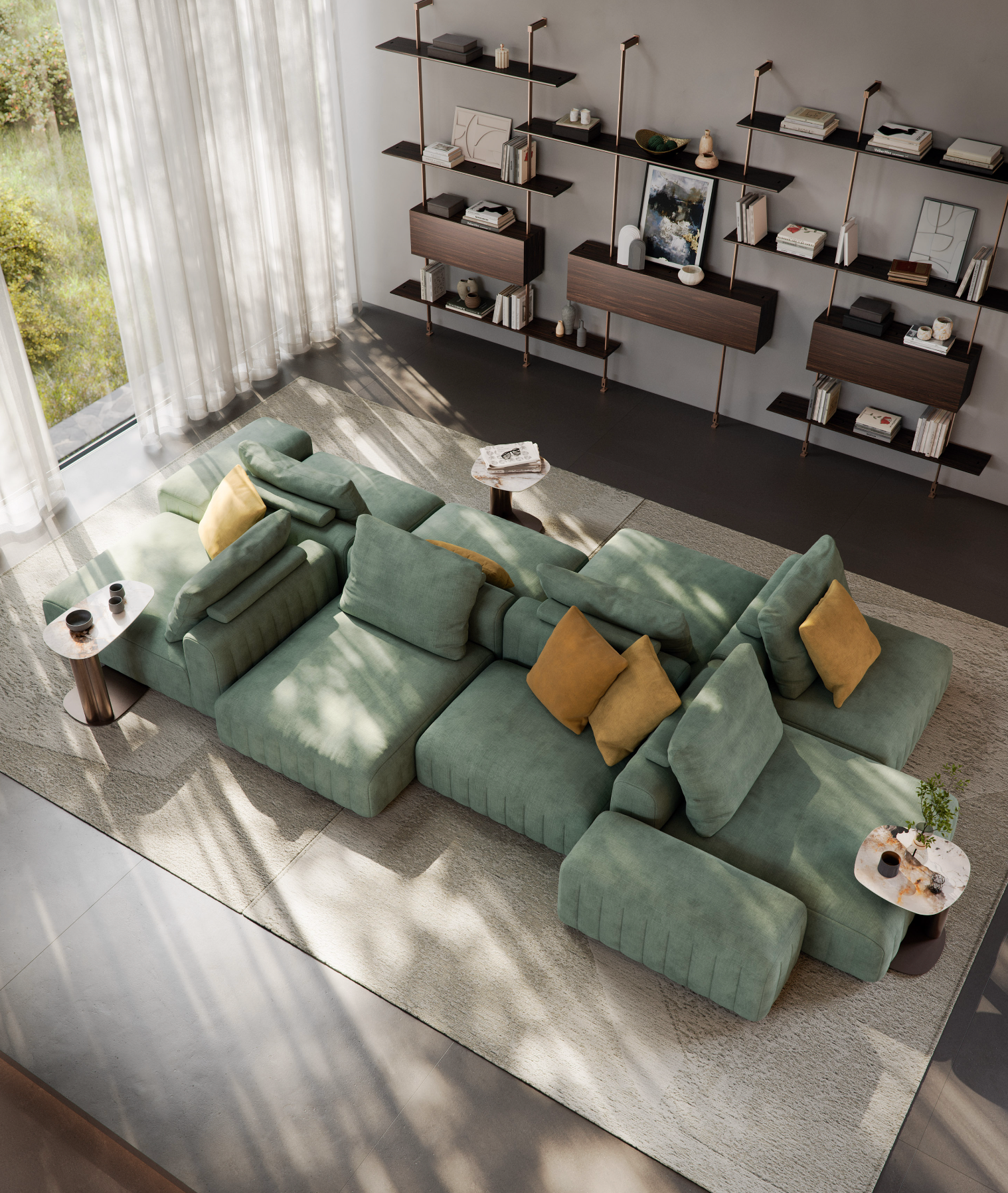
Sergio Bicego designed Gibson as a modular seating system made of independent upholstered volumes, where seats, backrests, and armrests aren’t fixed to a single configuration but can be moved and recombined within a space as needed. The idea runs through the whole system: a sofa doesn’t have to keep the same shape once it leaves the showroom.
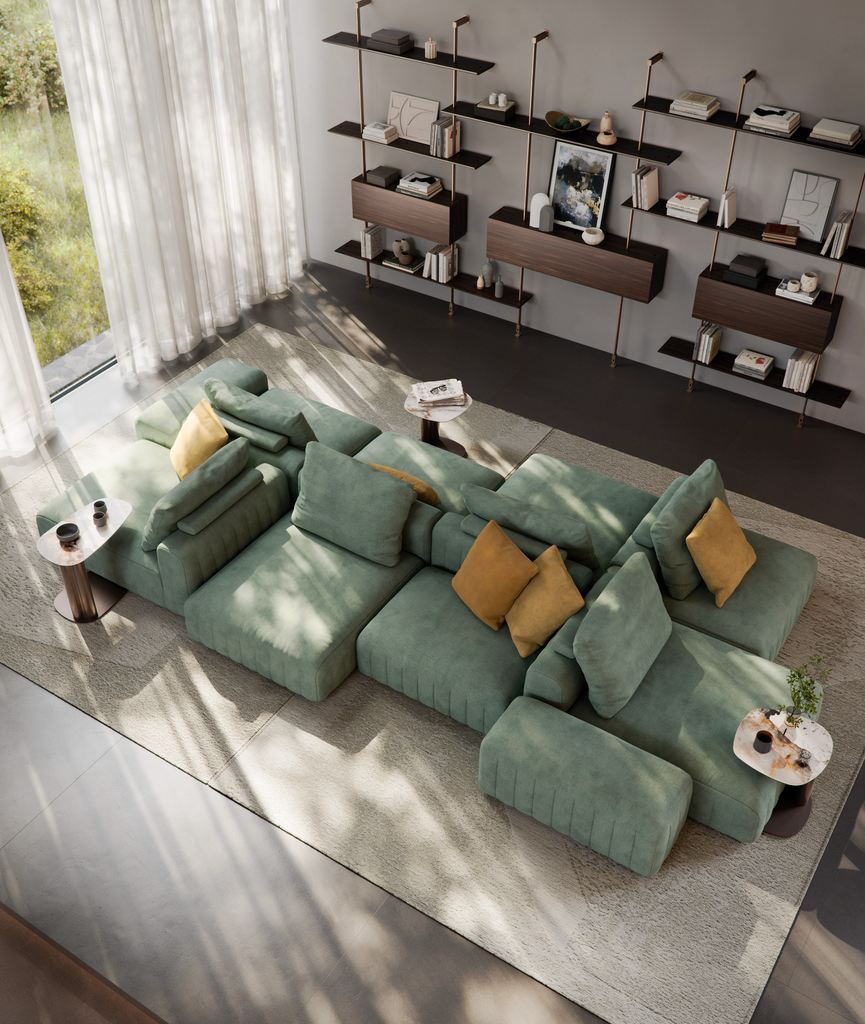
That shows most clearly in how Gibson treats the idea of a front and a back. The sofa is double-sided, and an armrest on one module can convert into a backrest, while additional modules extend the seat into a chaise longue. There’s no fixed orientation forcing the piece against a wall or into a single reading of the room. Bicego built the flexibility into the hardware itself, which makes Gibson equally suited to a home living room and to contract settings like hotel lobbies, retail floors, and hybrid workplaces, where furniture has to survive reconfiguration far more often than in a private residence.
In those commercial settings, Gibson functions less like a single piece of furniture and more like a way to organize a room without walls. Modules can be combined, rotated, and reset into different layouts, creating loose zones for conversation, waiting, or quieter moments within a larger open space, all without a partition in sight.
The name comes from music, and Bicego has leaned into that logic in how the modules relate to each other: individual pieces functioning like notes on a score, assembled according to open compositional rules rather than one correct arrangement. The seating itself is built deep, with rounded edges and quilted detailing that picks up the softness of the polyurethane padding underneath, giving the upholstery a noticeably tactile quality. A ceramic coffee table module extends the system further, and loose cushions come in the full Cattelan Italia fabric range, either contrasting against the base palette or staying close to it in a tone-on-tone treatment.
What Bicego seems to be after with Gibson is furniture that keeps functioning as a design decision long after installation, not a fixed object but something closer to an ongoing one, reshaped as a space’s requirements shift over time.
