
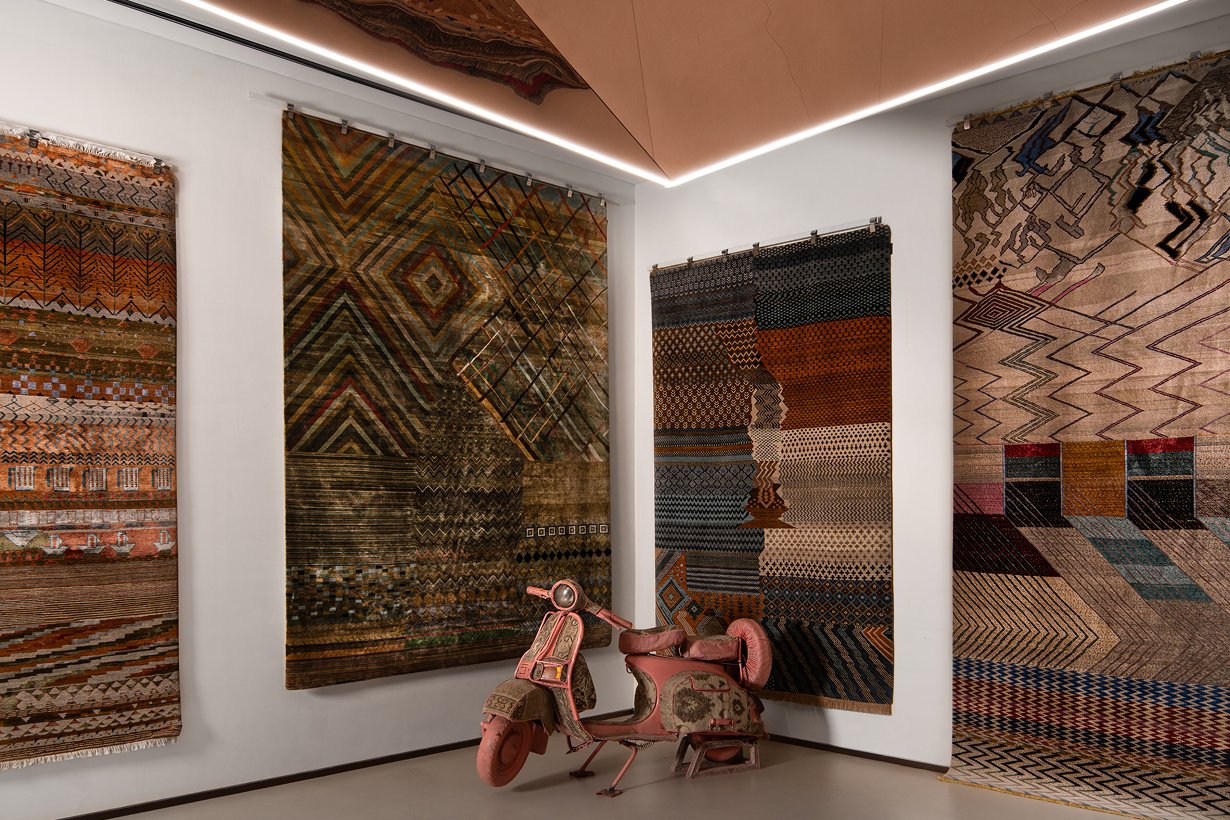
Jaipur Rugs has opened a 20,000-square-foot flagship at Mumbai’s Empire Mills, bringing its handmade collections, Manchaha rugs, heritage weaves and designer collaborations into a former industrial space in Lower Parel. Designed by Roar, the store is as much about showing how the rugs are made as it is about displaying them, with artisans weaving on site and a selection that places contemporary work alongside pieces rooted in the company’s long association with Indian craft.
The most interesting part of the store is the way it presents the rug as a design object rather than simply an interior accessory. That becomes particularly evident in the Manchaha collection, where individual weavers are given the freedom to develop their own compositions instead of reproducing an established pattern. The resulting pieces vary considerably in color, imagery and visual language, reflecting the experiences and ideas of the people who made them.
Manchaha was introduced by Jaipur Rugs in 2010 as a way of giving weavers greater creative authorship. Rather than receiving a fixed design to execute, the artisan develops the visual composition and then translates it through the loom. The approach has produced a body of one-of-a-kind rugs in which personal memories, landscapes, everyday observations and imagination become part of the design.
Some pieces draw on rain, flowers and familiar surroundings, while others reference journeys, village life, nature or childhood. The differences between them are important. Manchaha is not intended to look like a conventional coordinated collection, and its individuality is part of its value.
Freedom Manchaha takes the idea further by providing inmates with an opportunity to learn rug-making and create original designs. The collection brings another dimension to the question of authorship in craft, placing personal experience within the design process rather than treating the artisan only as the person responsible for production.
For collectors and interior designers, these pieces occupy an increasingly interesting position between textile, furniture and collectible design. Their scale makes them significant interior objects, but their individuality comes from the process behind them. The construction, material, technique and identity of the maker become part of the finished work.
The Mumbai flagship has been designed to allow those details to be seen. Rather than organizing the space as a conventional carpet showroom, Roar has created a sequence of display areas, stepped platforms, seating zones and larger installations. Rugs can be viewed from a distance and then examined more closely, which matters when the quality of a piece depends on the density of its weave, the handling of its surface and the precision of its construction.
The building itself provides the starting point. Empire Mills is part of Mumbai’s former textile district, an area shaped by the city’s mill industry. The existing Victorian steel structure, pitched roof and clerestory glazing have been retained, giving the new store an industrial framework rather than a newly constructed retail shell.
Roar’s intervention introduces a more contemporary vocabulary. Repetition, rhythm and fractal geometry inform the stepped forms and display structures, while the architecture also draws on the visual language of Rajasthan’s traditional stepwells. The reference is abstract rather than literal, appearing through levels, platforms and changes in height across the store.
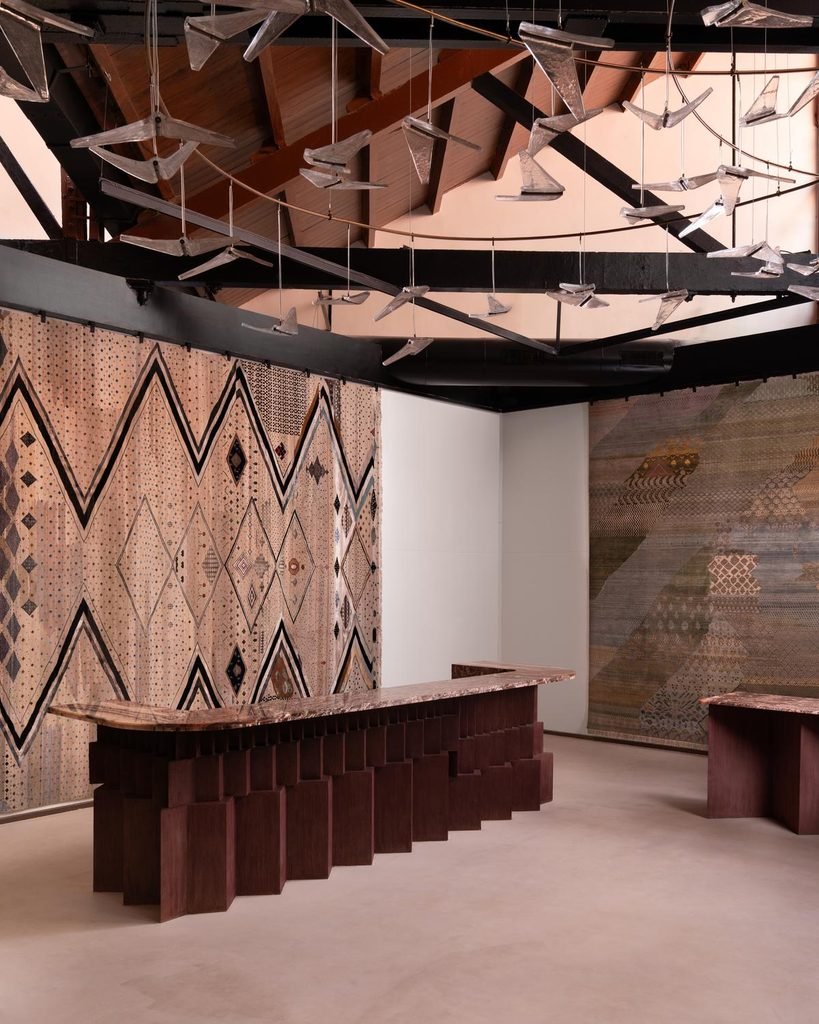
That geometry has a practical purpose. Rugs are unusually large retail objects, and displaying them effectively requires more than a series of hanging samples. The stepped structures allow individual pieces to occupy different positions within the room, while seating gives visitors the opportunity to spend time with the collection rather than simply walk past it.
The layout also creates a connection between the rugs and the history of the building. The former warehouse recalls an industrial period of textile production, while the handmade pieces introduce a very different relationship with labor, time and material. The contrast is not presented as a historical reconstruction. Instead, the old structure becomes a setting for examining how textile craft continues to evolve.
Live weaving is central to that experience. Artisans working inside the flagship make the process visible, from the handling of yarn to the repeated movements required to build a rug. For customers, this provides a more direct understanding of what distinguishes handmade production from an industrially manufactured floor covering.
It also changes the way the product is discussed. The finished rug no longer appears as an isolated object. Its construction becomes part of the conversation, as does the time required to produce it and the expertise involved in maintaining a particular technique.
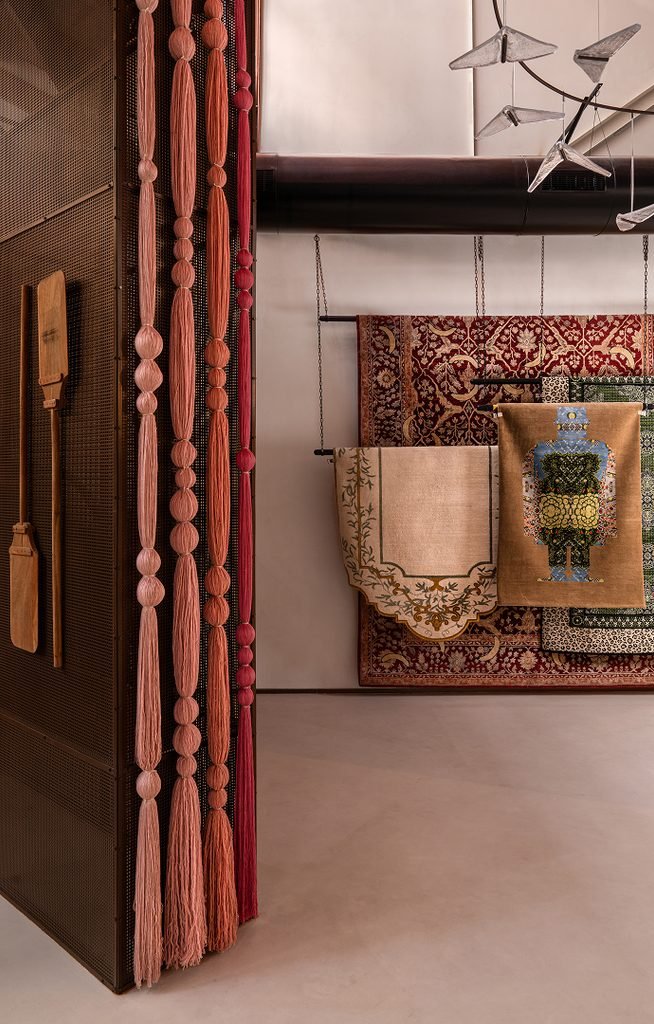
Alongside Manchaha and Freedom Manchaha, the flagship presents Jaipur Rugs’ wider range, including contemporary collections, heritage weaves and collaborations with designers. This allows the store to show the breadth of what can be achieved through traditional rug-making techniques without reducing the medium to a single visual style.
The collaborations are particularly relevant to the brand’s position within contemporary interiors. Working with designers brings different approaches to color, composition, scale and pattern into the medium, while the handmade process remains fundamental to the final object. The result is not simply a designer pattern transferred onto a rug. The characteristics of the weaving process remain visible in the finished piece.
This relationship between design and making is what gives the Mumbai flagship its relevance beyond retail. The store is selling rugs, but it is also presenting a particular argument about how handmade objects should be valued. The artisan is not hidden behind the finished product, and the rug is not treated simply as another decorative surface.
That is especially evident in Manchaha, where the distinction between designer and maker becomes less straightforward. The person working at the loom can also be the person developing the composition. The process therefore produces something closer to individual authorship than standardized manufacture.
The flagship also gives Jaipur Rugs an opportunity to present its archive and continuing collections within one address. Instead of separating heritage from contemporary work, the store allows the two to exist together. A traditional weave can sit alongside an abstract composition, while a one-of-a-kind Manchaha piece can be considered next to a more restrained contemporary rug.
For a customer furnishing a home, this makes the experience less about finding a single decorative solution and more about understanding the range of possibilities within the medium. A rug can be quiet or highly graphic, traditional or contemporary, designed to disappear into an interior or intended to command attention.
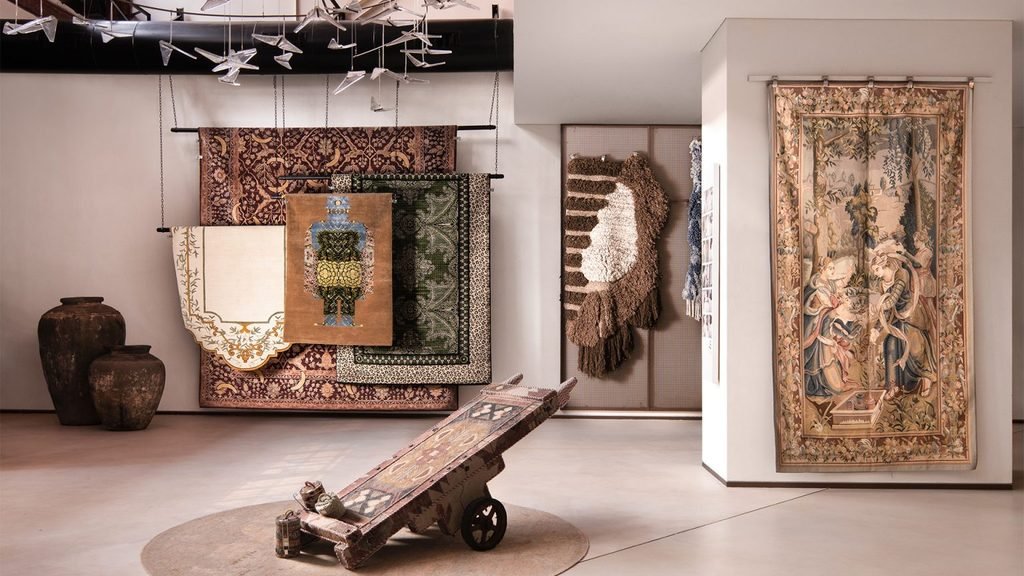
The Mumbai store therefore works best when viewed through the products rather than the architecture alone. Roar has created the framework, but the rugs provide the content. Their materials, techniques and individual stories give the space its character.
There is also a larger shift behind this approach. Handmade objects are increasingly being considered through the same lens as other forms of collectible design, where provenance, process and authorship matter alongside appearance. Rugs are particularly suited to that discussion because they combine significant physical scale with an unusually labor-intensive production process.
Jaipur Rugs’ new flagship makes that process visible without turning the store into a museum. The commercial purpose remains clear, but the environment gives visitors enough information and space to consider the object before deciding what belongs in their own interiors.
At Empire Mills, the company has brought together its current collections, established techniques and newer experiments in one physical address. The result is a flagship that places the rug and the person who makes it at the centre of the experience.
Brand Website: Jaipur Rugs
FACT FILE
Project: Jaipur Rugs Mumbai Flagship
Brand: Jaipur Rugs
Location: Empire Mills, Lower Parel, Mumbai, India
Area: Approximately 20,000 sq ft
Design Studio: Roar
Founder & Creative Director, Roar: Pallavi Dean
Photographer: Avesh Gaur
Design Approach: Adaptive reuse, contemporary retail and textile-focused spatial design
Original Building: Former industrial warehouse
Existing Elements Retained: Victorian steel structure, pitched roof and clerestory glazing
Design References: Weaving, repetition, rhythm, fractal geometry and Rajasthan stepwells
Collections: Manchaha, Freedom Manchaha, contemporary collections and heritage weaves
Experience: Rug gallery, live weaving, vertical rug archive, material displays and lounge areas
Completed: 2026
