
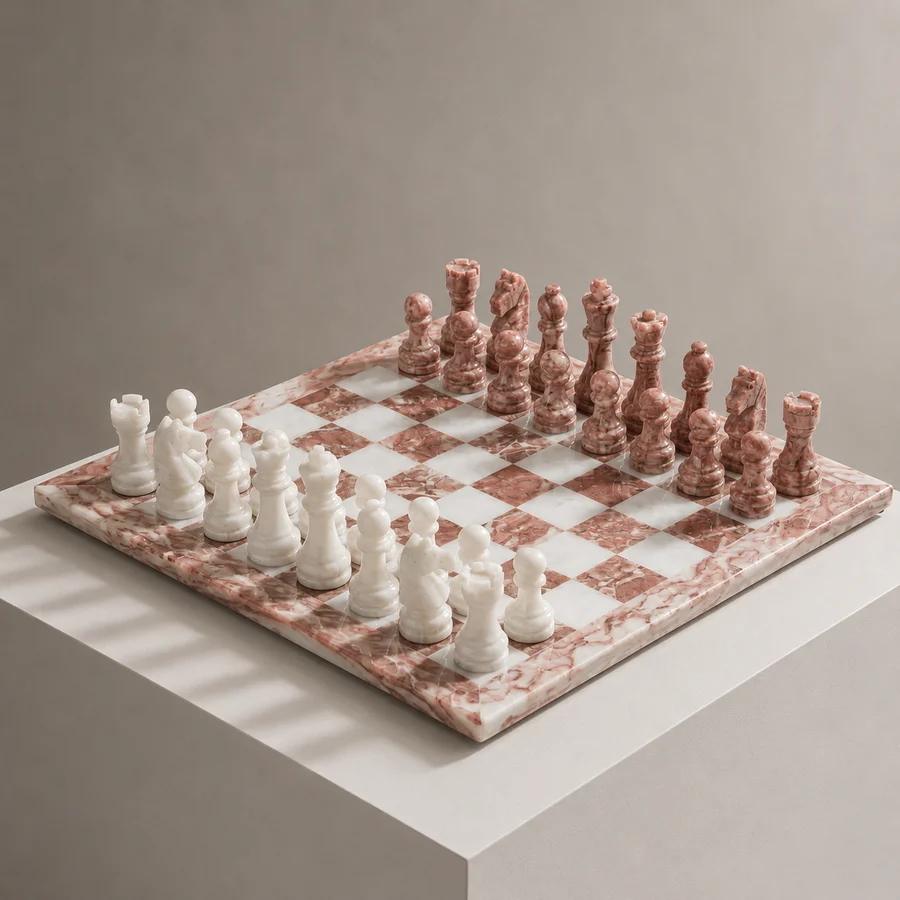
A chess set is already a considered object. Its proportions are fixed, its pieces have familiar forms and the board has remained largely unchanged for centuries. Stone & Game does not attempt to redesign any of that. Instead, the Swedish design brand changes the material, working with marble and onyx to give a familiar domestic object a very different physical presence.
The new collection brings together chess and backgammon sets alongside smaller objects for the home and desk. Produced in small batches, the pieces are built around carefully selected natural stone, with the veining, color and pattern of each slab becoming part of the finished design. It is a relatively quiet intervention, but one that changes the way the games read within an interior.
The chess collection makes the idea particularly clear. Rather than restricting the boards to the conventional dark-and-light combination, Stone & Game works across a range of marble and onyx pairings. Grey, green, pink, red, coral, brown and black appear across the collection, but the color is only one part of the difference. The natural movement within the stone means that each board carries its own pattern.
That distinction is important when the object itself is built on repetition. The chessboard is an exercise in precision, while marble is inherently irregular. Veins move across the surface, colors deepen and recede, and no two sections of stone are exactly alike. The resulting boards retain the discipline of the game while allowing the material to introduce something less predictable.
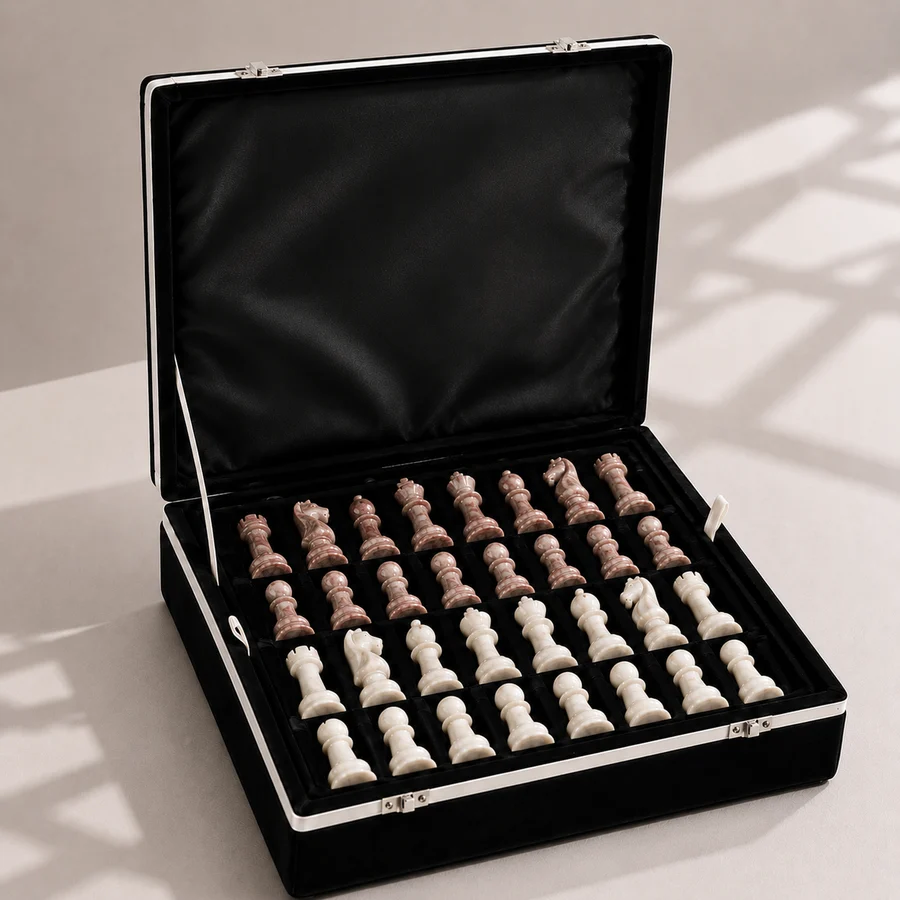
The same principle applies to the pieces. Each set contains 32 hand-carved marble chessmen, retaining the conventional forms that make them immediately recognizable. Stone & Game has not tried to make the pieces into decorative sculptures or reinterpret the game through an abstract design language. The craftsmanship is instead visible through the carving, weight and surface of the stone.
This is where the collection begins to occupy a space beyond the games cabinet. These are objects designed to be played with, but they are equally comfortable being left on a table. A marble board has enough presence to sit within an interior as a design object, particularly when the pieces are stored away in their velvet-lined case. The distinction between something intended for use and something intended for display becomes deliberately less clear.
The idea extends through the rest of the collection. Backgammon, checkers and Tic Tac Toe are treated with the same interest in natural stone, while smaller objects bring the material into more everyday settings. Rather than developing a large vocabulary of decorative details, Stone & Game allows the stone itself to establish the identity of the collection.
Its small-batch approach reinforces that position. The brand is not working towards the visual uniformity expected from mass-produced games. Natural variation is retained, and the handwork involved in carving and finishing the pieces remains part of their character. The result is closer to the way one might approach a collectible design object than a conventional board game.
There is also something practical in bringing these games back into the visible spaces of the home. A chessboard can remain on a coffee table between games; a backgammon set can become part of a study or library; a smaller stone object can function without announcing itself as a decorative accessory. The collection is designed around this idea of objects having more than one role.
For a young brand, it is an interesting place to begin. Stone & Game is not competing through complexity or novelty. It takes games that are already deeply familiar and asks what happens when their material language changes. Marble and onyx introduce weight, natural variation and permanence, while the underlying forms remain almost entirely recognizable.
That restraint is what gives the collection its strength. The games have not been turned into design objects at the expense of their original purpose. They remain games. The difference is that once the playing is over, there is no particular reason to put them away.
Stone & Game: Explore the collection
