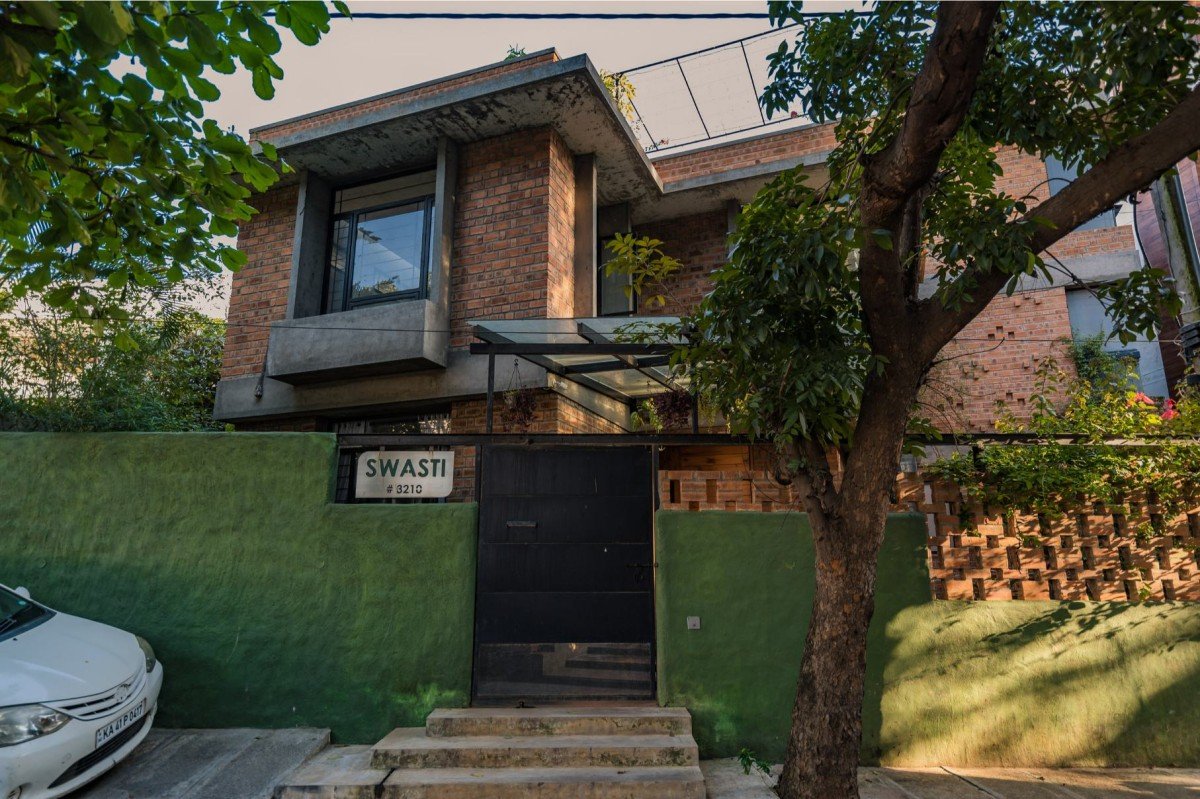
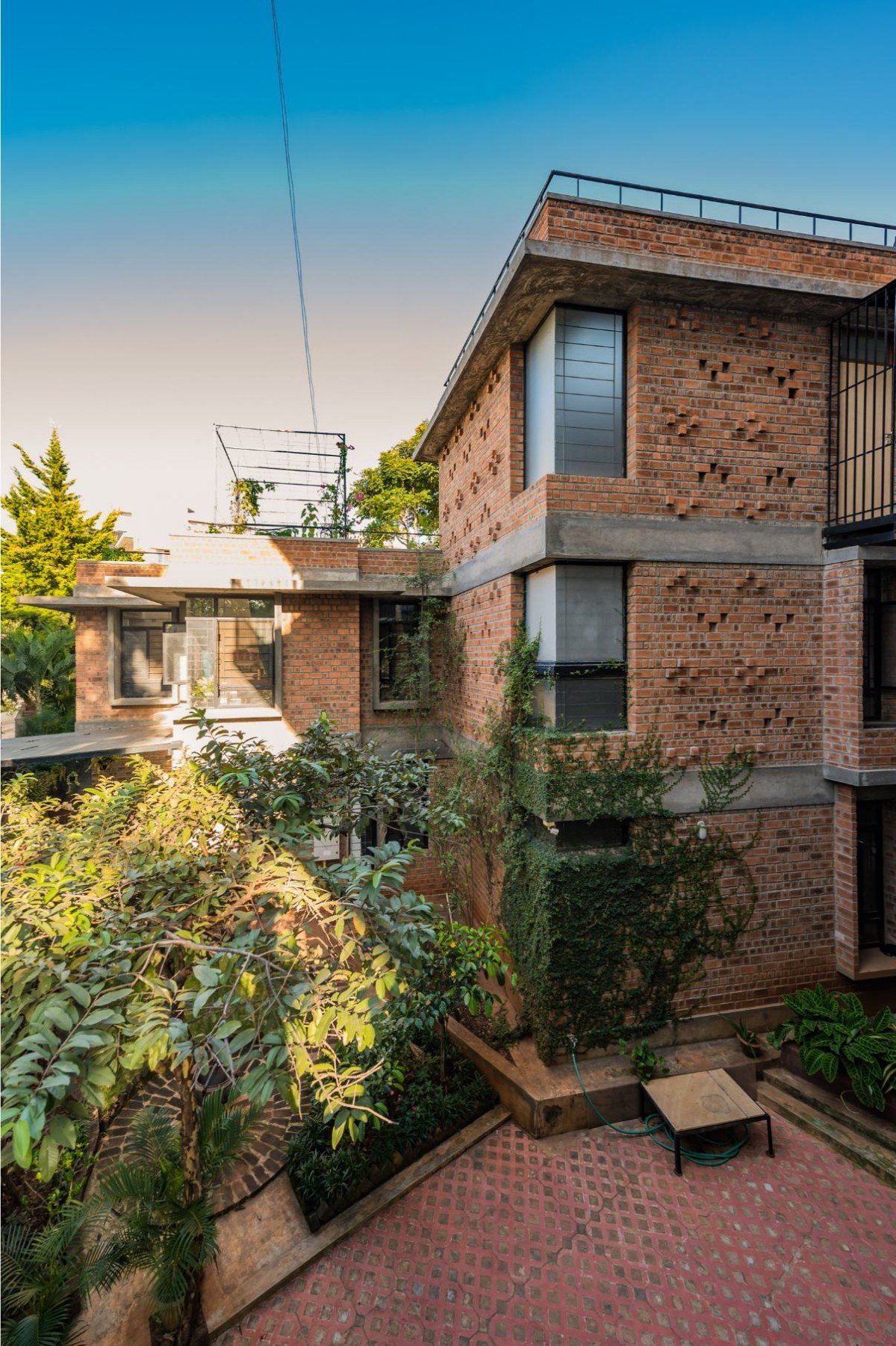
The name on the gate is Swasti, and it sits on a green boundary wall in a Bangalore neighborhood without offering any clue about what lies behind it, which is exactly as it should be for a house designed from the inside out, conceived by Ar. Lavanya Goradia of Studio Alaya built for Roopasri and her children a home that is simultaneously a shelter, a garden, a creative studio, and a declaration of self, built in 3,826 square feet on a nearly square plot of 355 square meters where the building has been placed diagonally so that the residual spaces at the edges become active gardens rather than dead corners.
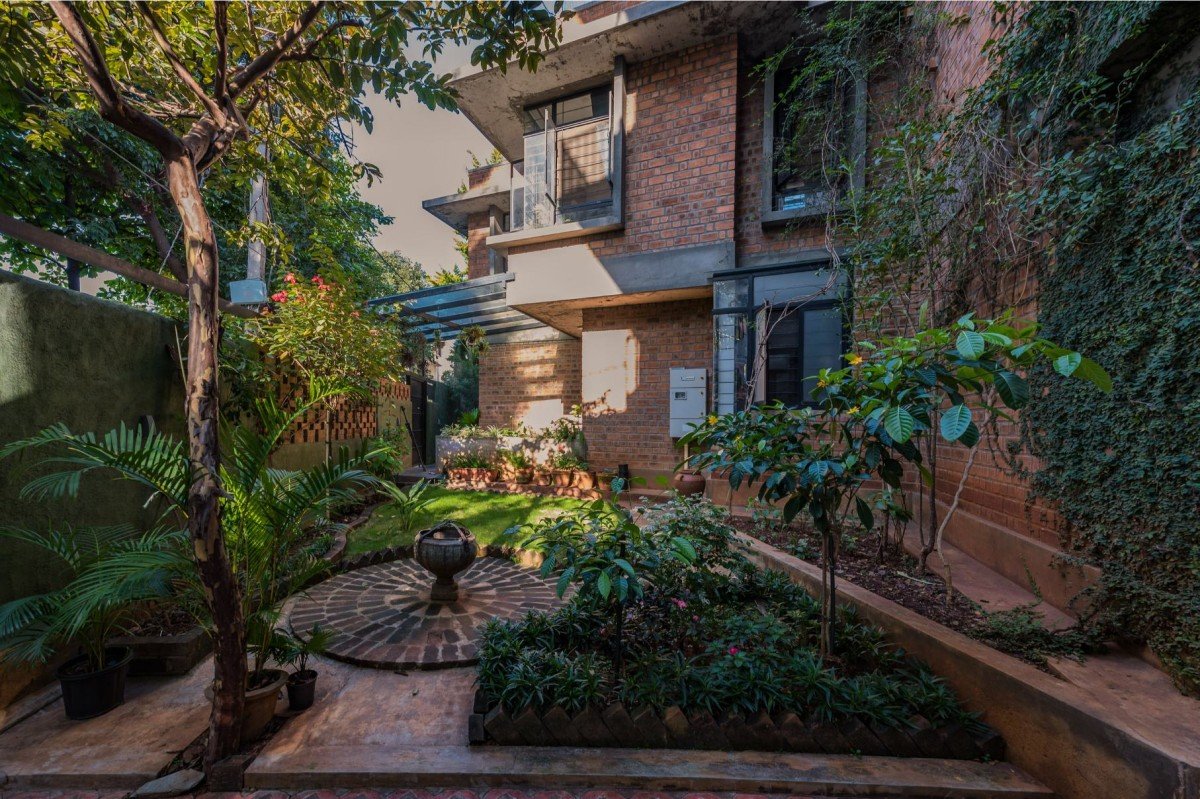
Two existing trees were the first constraints and the first gifts: an African Tulip tree celebrated as the focal point of the front garden, its presence anchoring a composed landscape of circular brick paving, a dark stone urn at the center, lawn and ferns and palms and bougainvillea and terracotta pots, the whole scene framed by the exposed brick facade behind it with vines already climbing and a glass canopy marking the entrance, the house presenting itself from the street as something rooted and patient rather than eager to impress. The second tree, quieter, sits outside a Juliet balcony on the upper floor, establishing a contemplative relationship with the building that takes years to develop and cannot be designed in advance.
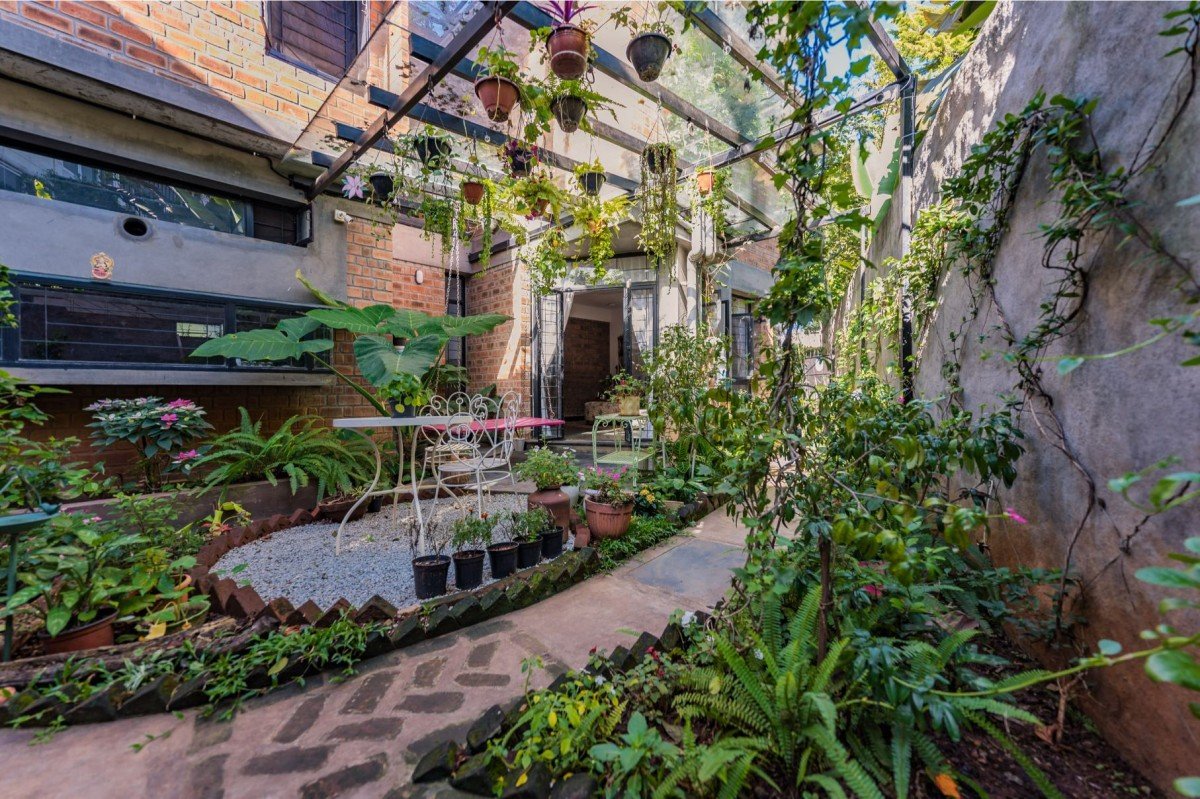
The side courtyard reveals the true nature of this place: a narrow garden passage enclosed between the brick house wall and the boundary, so densely planted with hanging baskets, trailing vines, and terracotta pots that it resembles a greenhouse corridor more than a garden. Above, a steel and glass pergola supports the hanging plants while light filters through. In the middle of it all, a white iron table and two chairs are set in a gravel clearing, creating a lush, slightly untamed, yet entirely deliberate space—one that only a home built for someone who genuinely loves plants could embody.
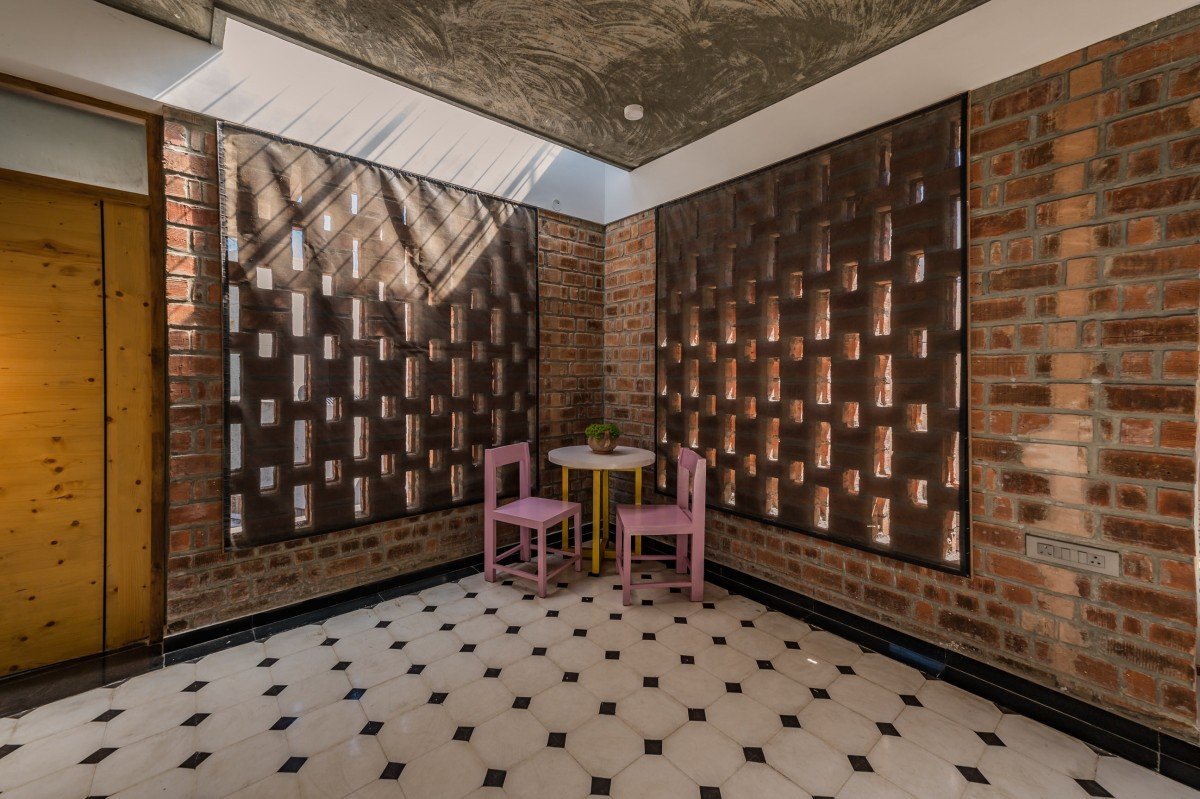
Inside, the entry hall is where the architecture declares itself most forcefully, the ceiling covered in a swirling grey and dark painted texture that moves across the surface like a concrete fresco, a long skylight running along one edge so that a blade of natural light falls diagonally across the wall and floor through the day and shifts with the hours, the classic black and white octagonal tile with diamond inserts underfoot, a full-height mirror panel on one side reflecting the brick wall opposite, and at the far end a brick jali corner where two walls of perforated brick allow light through their rectangular voids in diagonal cutting patterns that shift across the floor and walls as the sun moves, a pink table and two pink chairs placed there with the lightness of an afterthought and the precision of a decision, a space for a child to sit in extraordinary light.
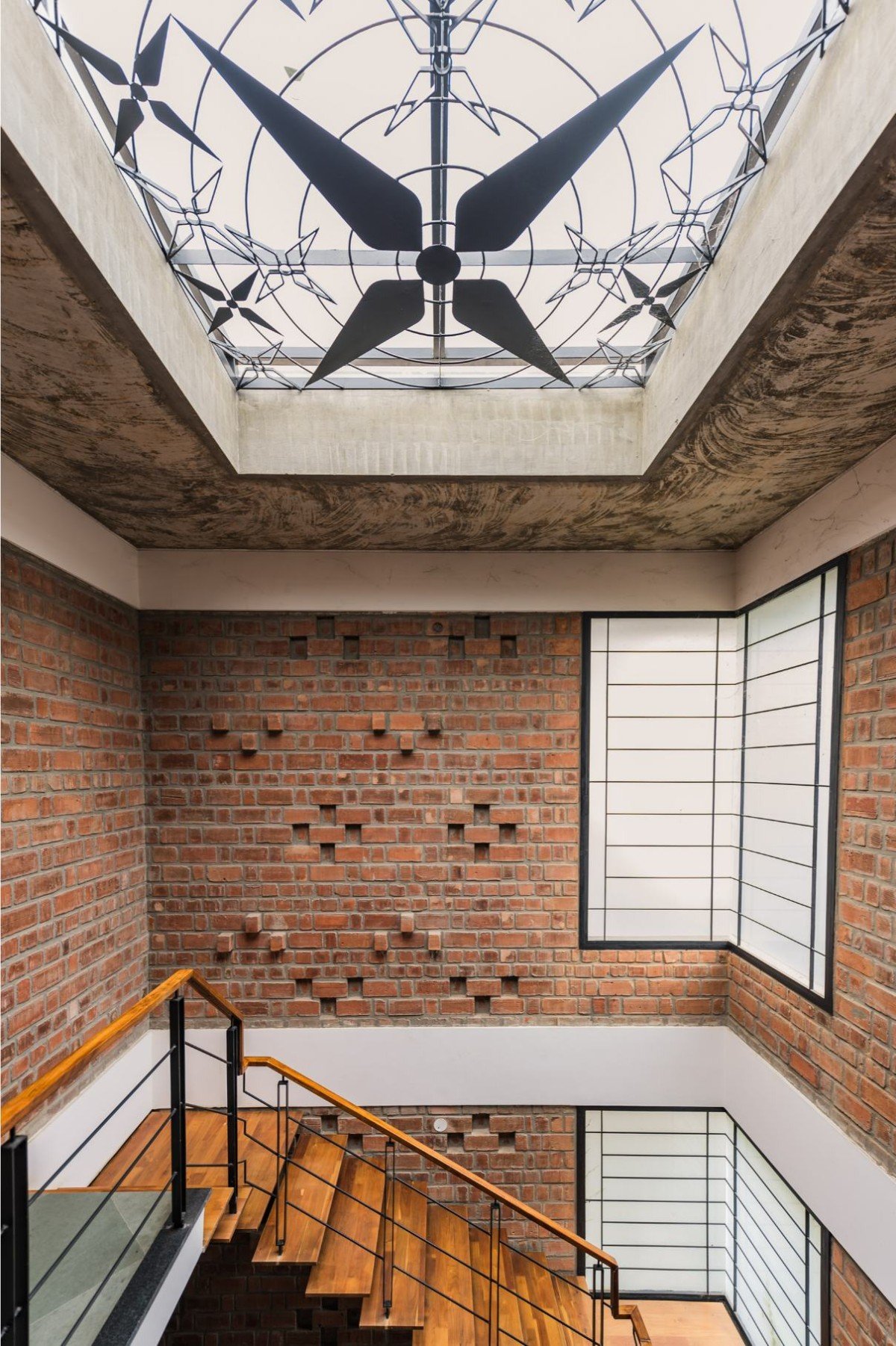
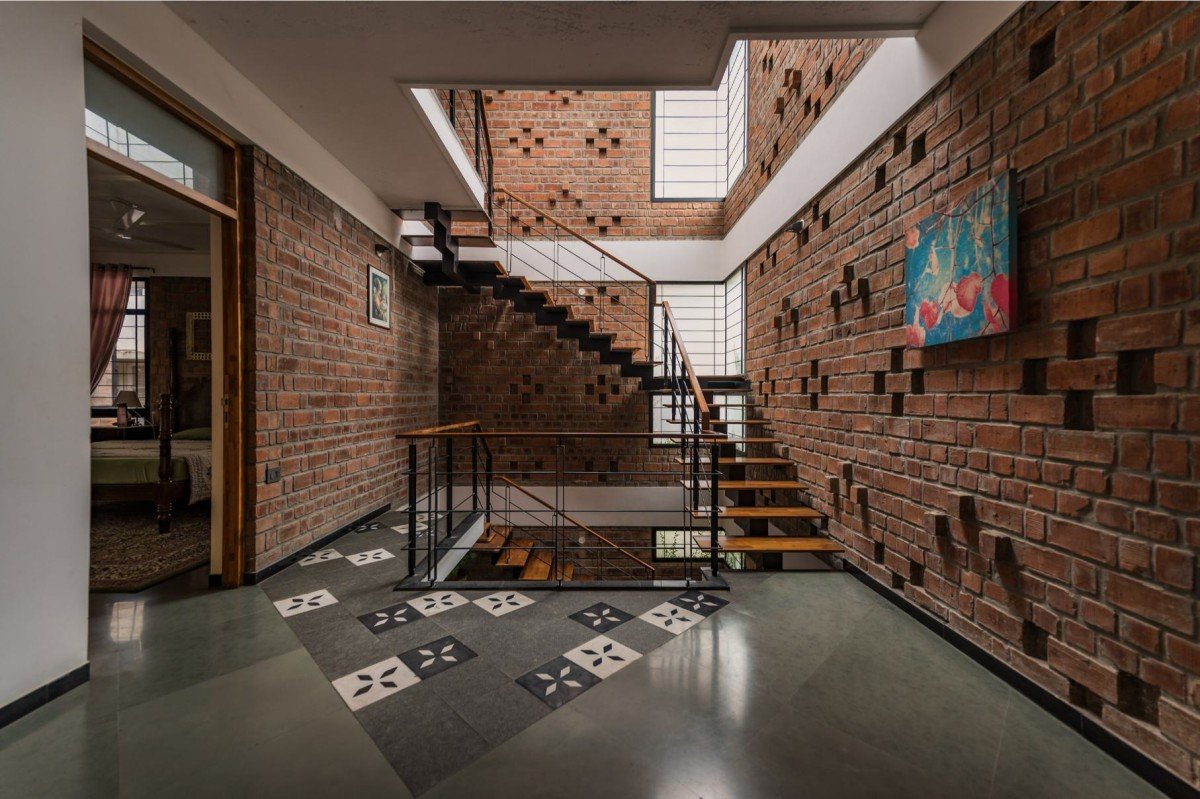
The staircase void is the architectural heart of the house, the black steel open-riser stair with warm timber treads and a wood handrail rising through brick walls whose surface carries deliberately protruding individual bricks in scattered patterns, giving the wall a texture that catches light and shadow at different times of day; and above it all is a skylight with a large black iron grille in a radiating geometric star or compass form, its pattern casting a dramatic shifting shadow down through the void and onto the floors below as the sun moves, a ceiling that functions as a clock for anyone who knows how to read it, and beside the stair on the first floor a brick jali section opens into the exterior so that the movement of light through the house is never static, never resolved, always in process.
The dining area sits at the base of the stair in the double-height space, a round blue table surrounded by carved cane-back French-style chairs with pink candles and green flowers on it, the patterned black, white, and grey tile floor beneath it, the brick walls rising on all sides to the full height of the void with their protruding brick texture running throughout, a small white cane-door cabinet, and a framed artwork and a shelf of objects completing a room that is entirely domestic in its furnishing and entirely architectural in its spatial ambition, the two things coexisting without tension.
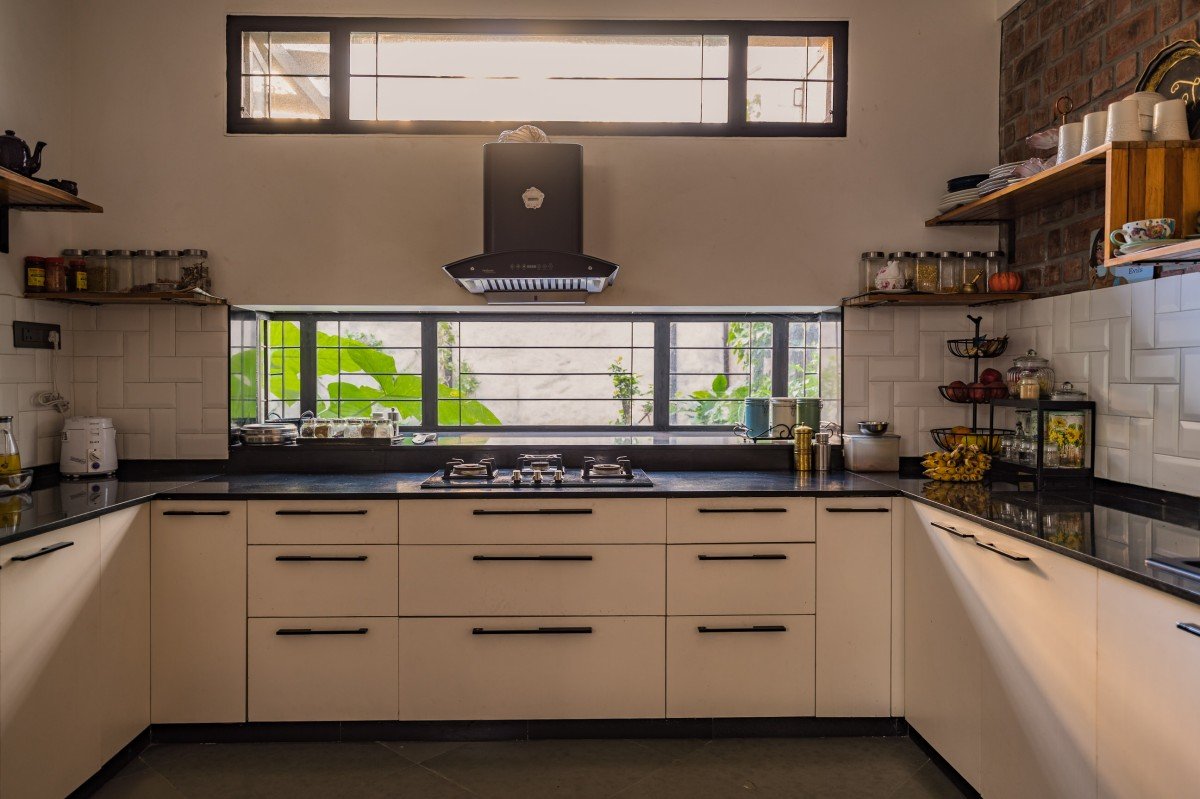
The kitchen opens directly from the dining: white modular cabinets with a white subway tile backsplash, open shelving on the brick wall with a clock and kitchen objects, and the same patterned tile floor running through; the whole thing is practical and undesigned in the best possible way, a kitchen that belongs to someone who cooks in it rather than someone who photographs it.
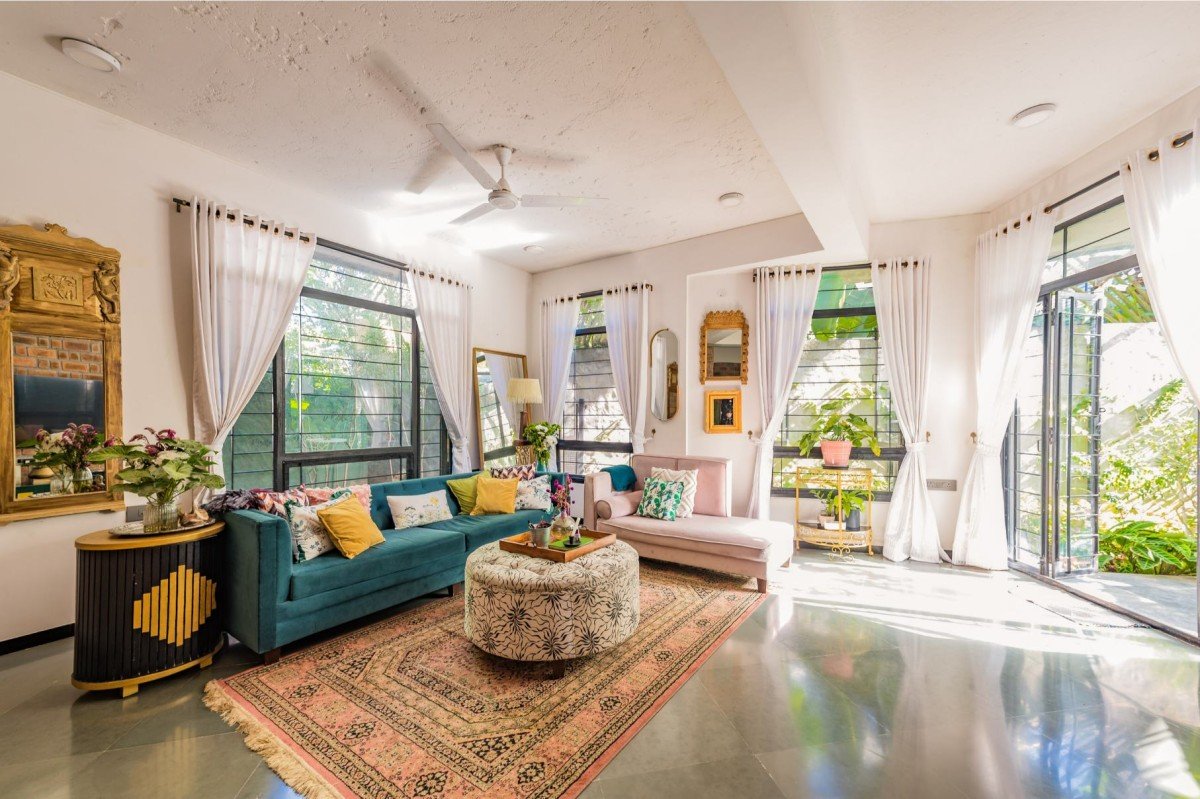
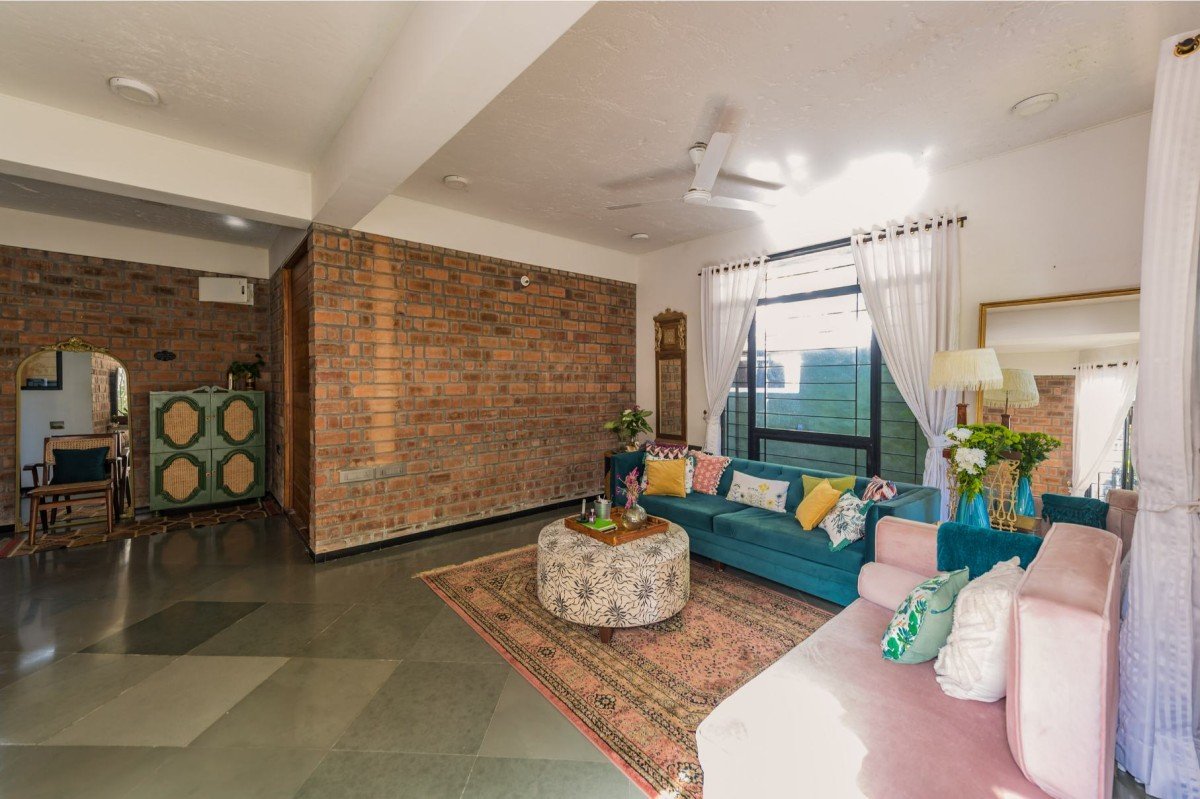
The living room on the ground floor is where the personality of the house becomes most legible: a teal velvet sofa with cushions in yellow and pink and floral prints alongside a blush pink sofa and a round printed fabric ottoman on a faded pink Persian rug over the dark grey polished concrete floor; a green painted antique cabinet with cane panels; a grandfather clock; a large gilded mirror leaning against the wall; a floor lamp; a dark side table; plants coming in through the open folding door from the side garden; the room full of things that have been chosen and accumulated and placed with the particular intelligence of someone who knows what she likes; the garden outside every window and through every curtain so that the boundary between the room and the planting is permanently soft.
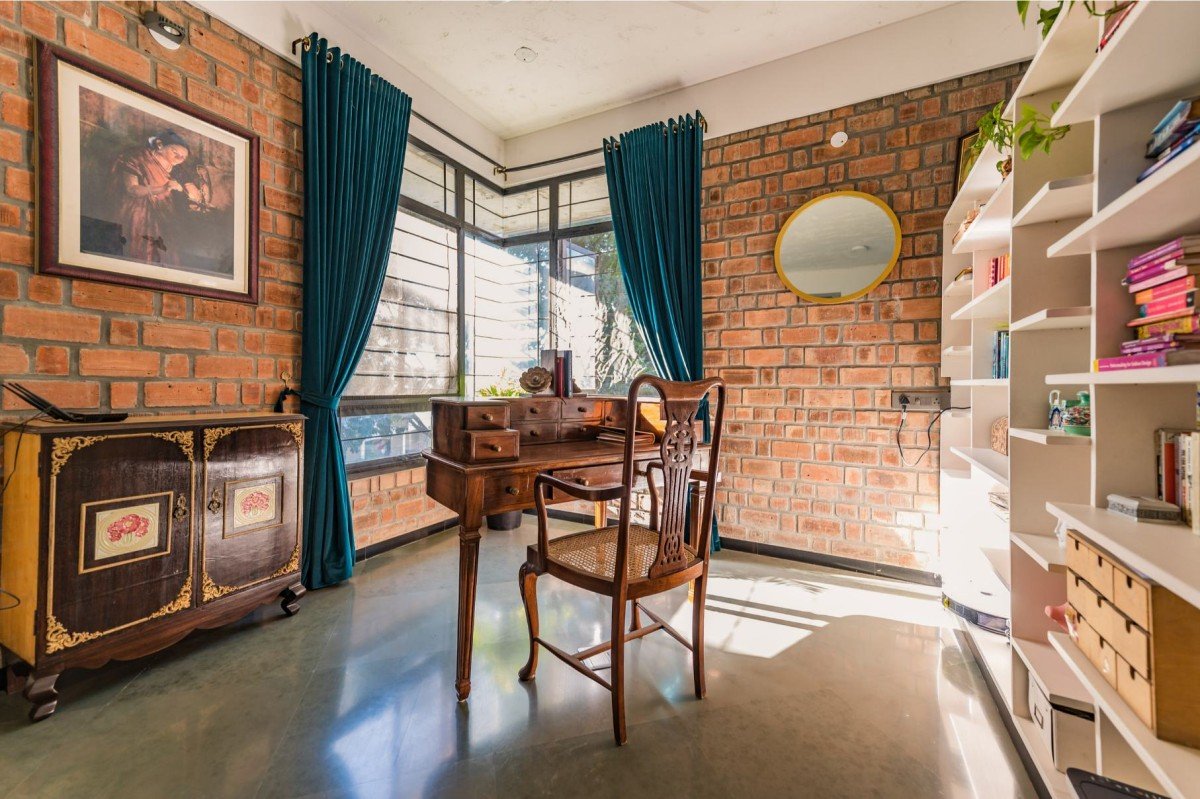
The study carries an antique dark wood writing desk with multiple small drawers, a carved wooden cane-seat chair at the window, teal velvet curtains, a framed painting of a woman on the brick wall, a gold-painted decorative Indian chest, a round yellow-framed mirror, a white bookshelf full of colorful books, and polished concrete floors—all of it personal and readable as a room that belongs to a specific person rather than a designed interior type.
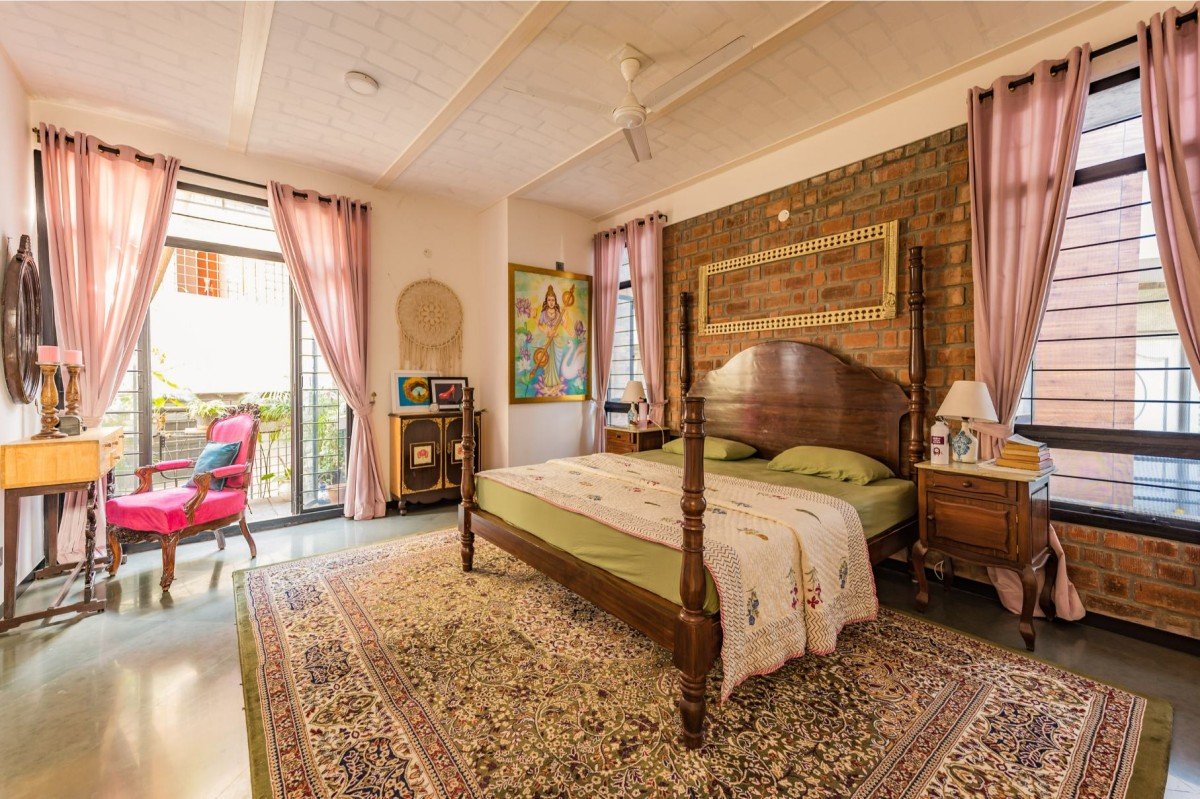
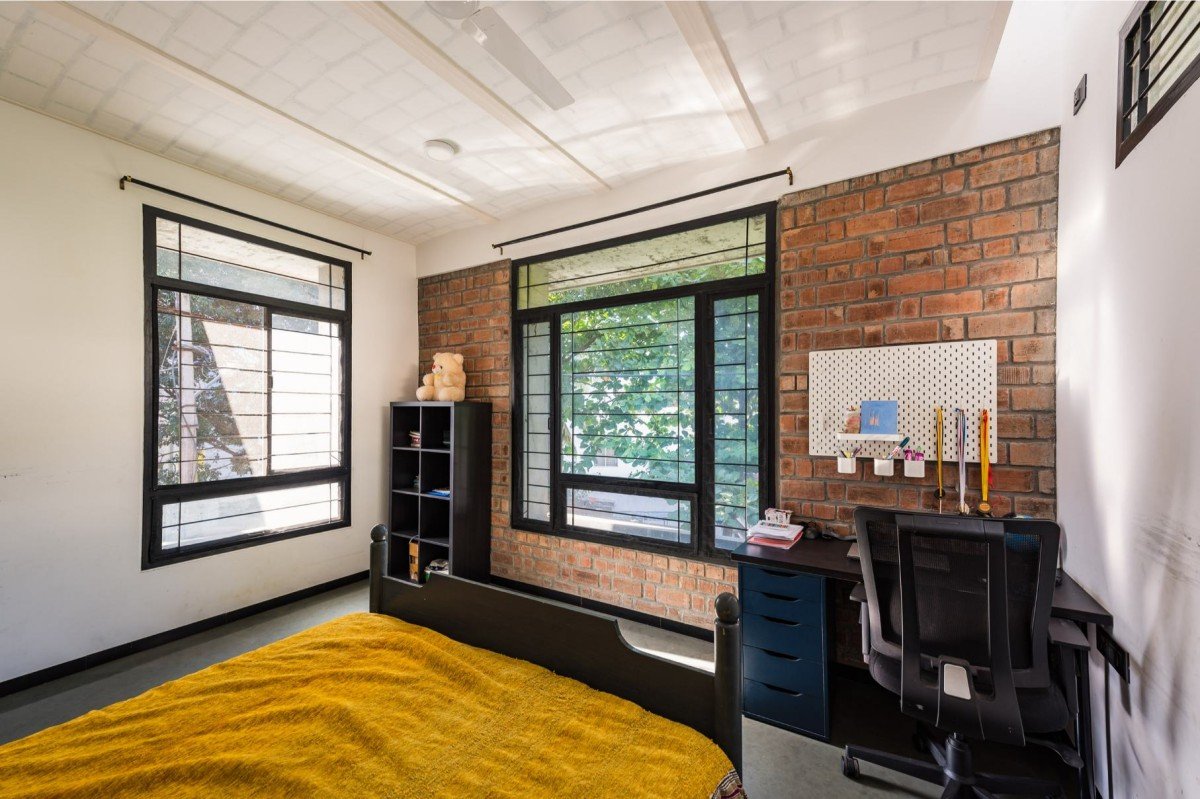
The master bedroom is built around a dark solid wood four-poster bed on a large Persian rug, green linen, a pink velvet armchair by the window, a Saraswati painting on the brick wall, a macrame wall hanging, a gold-framed mirror above the headboard, and pink curtains opening to the balcony and the garden beyond; the white-painted brick ceiling above with its grid pattern from the arch panel roof structure is a room that is eclectic and warm and deeply inhabited, every object present because it means something to the person who lives there, and the child’s bedroom next to it is equally direct: a black bed frame, mustard bedding, a black desk with a blue-drawer pedestal, a pegboard on the brick wall for organizing school things, black-framed windows looking straight into the tree canopy, and the arch panel ceiling grid visible above.
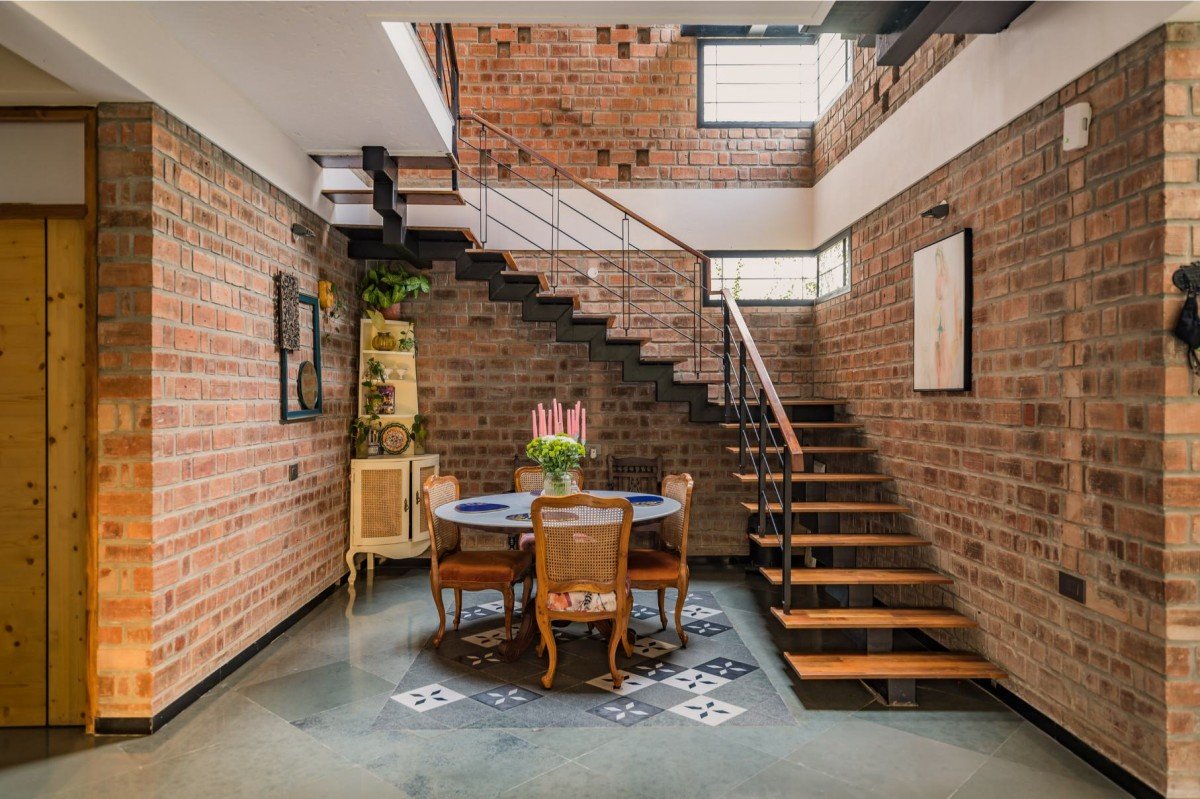
Table-mould bricks in a rat-trap bond reduce material consumption while improving thermal performance throughout the house, with painted exposed RCC slabs and arch panel roofs visible in the ceiling patterns of each room; skylights and controlled openings modulating light and ventilation; and rainwater harvesting, solar energy, composting, and food cultivation integrated into a house that sustains itself as it was designed to sustain the family within it.