
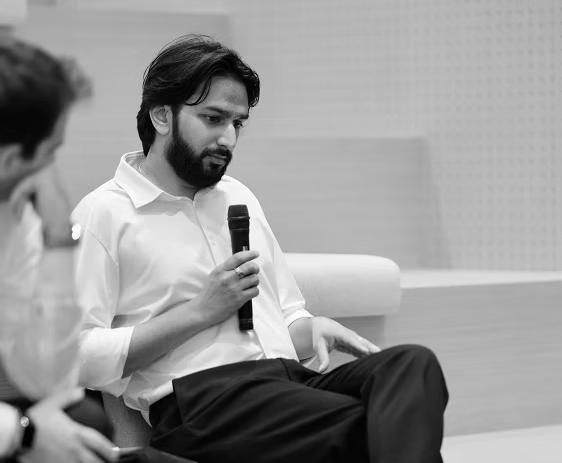
He has designed in Turkey, worked through the realities of Ethiopia, and is currently building what will be the tallest skyscraper in Central Asia. Yet ask Ar. Abhinav Goel, Principal at RMJM’s Milano and Mantova studios, what architecture is really about, and he will tell you, without hesitation, that it is about belonging. Alisha of Design Diary International speaks with him about patience, place, and the long, slow work of building something that lasts.
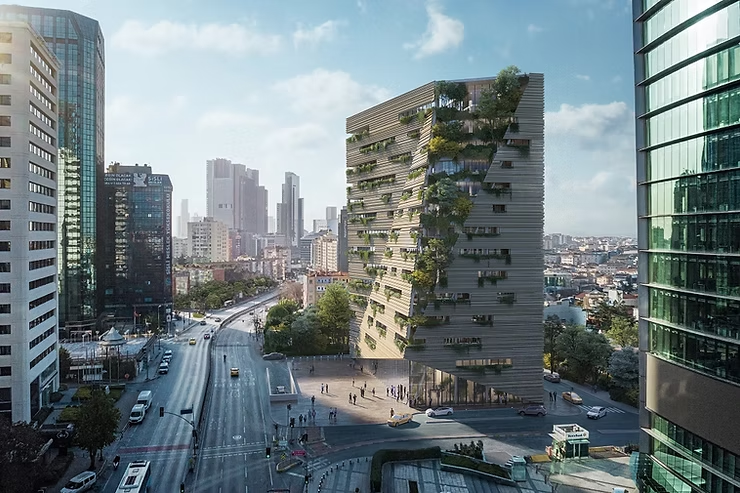
He remembers the fairy chimneys of Cappadocia not as a postcard image but as a spatial idea waiting to be translated. When his studio began working on the Sanko Headquarters in Turkey, that memory became the building’s central logic, a full-height internal atrium carved into the heart of the structure, bringing light and air and a quality of geological depth into a contemporary office building sitting in a business district full of glass. The exterior is clad entirely in stone, quiet and unhurried against the reflective surfaces surrounding it, rooted in the material culture of the region in a way that its neighbors simply are not. The building could not be lifted and placed elsewhere without losing the thing that makes it worth looking at. That, for Goel, is the only measure that matters. Not the rendering, not the award submission, not the press coverage, but whether a building belongs so completely to its place that separation from it would leave both the building and the place diminished.
This is what more than a decade of working across Europe, the Middle East, and Asia has distilled in him: not a formal language or a recognizable signature but a discipline of attention—attention to what a place carries in its memory and how people actually occupy it and what the climate and the cultural context demand of a building before the architect has offered anything at all. Generic architecture, he says, is what happens when that attention slips, when the tools become the ideas and the image begins to substitute for the thinking behind it. The current moment makes this particular failure unusually easy to fall into, and he has thought carefully about how not to.
His path into architecture was not defined by a grand ambition toward authorship. What drew him was quieter than that, an instinct toward service, toward the possibility that design could improve the texture of everyday life in ways that went largely unnoticed by the people it was serving. Architecture revealed itself over time as the medium through which that instinct could take physical form. But the understanding of the profession he carried in the beginning, in which the architect resolved a brief into a building and the building was essentially a finished object with a clear identity, did not survive sustained contact with how practice actually works. Working across different cultures and geographies and scales, he came gradually to understand that a building is not an object in the way he had initially imagined it. It is a framework for relationships between people and place and climate and time, a thing that accommodates life rather than controlling it, that listens before it speaks, that earns its place in a city or a landscape rather than simply occupying it.
Patience arrived not as a conscious choice but as a direct consequence of working in a profession that slows you down whether you intend it or not. Projects run over years and sometimes over decades, shaped by collaboration and constraint and the shifting priorities of clients and planning authorities and economic cycles that have no interest in aligning themselves with anyone’s individual sense of urgency. But Goel is careful to keep patience separate from passivity, because the commercial realities of practice are equally real and carry equal weight in any honest account of how architecture gets made. Time costs money, and clients understand this even when architects occasionally forget it, and the genuine challenge is developing the judgement to know which decisions need sitting with and which demand momentum, a kind of professional intelligence that only becomes reliable within a relationship of genuine trust between architect and client, where both sides are moving together rather than pulling in different directions.
He has learned this the hard way more than once. In his experience, stalled projects, shifting briefs, and unclear client visions are common, not exceptions. They are simply part of it, as ordinary and as recurring as any other condition of the work. What they have taught him is that the architect’s role in those moments extends well beyond the design act itself, that architects often become educators in the most practical sense, holding the clarity of a project steady while the client’s understanding of it is still finding its footing, explaining consequence and process and long-term impact with enough patience and conviction to keep the conversation moving forward productively. A stalled or challenged project approached with this understanding is not a failure but a correction, the kind of pressure that forces a reckoning with what actually matters and produces outcomes more grounded and more honest than an uninterrupted process would have reached.
The trip to Ethiopia for an international competition is the example he returns to when the subject of unlearning comes up, because it was the experience that most directly dismantled a confidence he had not realized he was carrying. He arrived with a design approach and an architectural language he believed in, and both were challenged almost immediately by the reality on the ground. Financial feasibility shaped nearly every decision in that context, and no amount of design conviction could change what cost and availability and construction logistics made possible. Being physically present revealed priorities and constraints and cultural realities that no amount of remote research could have communicated in the same way, and the experience taught him something he has carried ever since, that presence forces architecture to move from confidence to clarity, that unlearning is not a loss of knowledge but a refinement of it, that the building that responds honestly to lived conditions is always more responsible and more meaningful than the one that insists on its ideal version of itself.
His position as Principal within RMJM’s Milano studio places him inside a practice that carries both a strong global legacy and a specific institutional philosophy, and the way he navigates that combination tells you something important about how he understands his own authorship. Legacy, for Goel, offers direction rather than constraint. RMJM’s global outlook and its accumulated technical depth across cultures and scales give individual projects access to a collective intelligence that a smaller practice simply cannot offer in the same way, and the studio’s core conviction that thinking globally and designing locally are not competing positions but the same act performed at different registers aligns closely with how he understands his own practice. His voice within that framework develops through approach rather than through formal signature, through how he reads a place and engages with a team and holds decisions accountable from first concept through to final execution, and individuality sustained through consistency of judgment over time turns out to be more durable than individuality asserted through style.
Within that collaborative structure, leadership operates at a level that is often invisible in exactly the ways that design authorship is visible, and he believes this is correct. Architecture is a collective act, and every project results from many people’s contributions, which usually go uncredited in published works; acknowledging this is accuracy, not modesty. His own role begins with shaping the core concept and continues through the long process of refinement and exchange with engineers and consultants and clients, knowing when to push an idea forward and when to stand back and let it develop through someone else’s intelligence, a form of authorship that is less about controlling outcomes than about maintaining clarity of intent while giving the work room to become more than any single person could have made it.
Some ideas within that process need protecting because they form the structural logic of the project, the spatial and narrative decisions rooted in place without which the building loses its coherence and its reason for being. Others are meant to evolve, and the selection of the collaborators through whom that evolution happens is itself a design decision as consequential as any material or spatial choice. When collaboration is genuinely intentional and built on a shared understanding of what the project is trying to achieve, ideas are strengthened rather than diluted, and the building that results is better than any one person’s initial concept could have produced independently.
Technology sits within this same frame of means and ends. He uses digital tools without reservation and has thought carefully about what they can and cannot do. They manage complexity, speed, and visualization with a power that no previous generation of architects had access to, and that is genuinely useful. The danger arrives when the tools begin to lead rather than assist, when visually compelling renders begin to substitute for actual thinking about how a building will feel to the person standing inside it, when what something looks like in a digital image begins to matter more than what it will be made of and how it will meet the climate and the ground. Architecture ultimately exists beyond the screen, and every digital decision must eventually translate into light and material and human experience, and when technology is treated as a means rather than as an authority, it allows precision and efficiency to coexist with intuition and craft in ways that strengthen the work. When it is treated as anything else, the work begins to drift toward surfaces that look impressive and mean very little.
Sustainability, in his understanding of it, occupies the same territory between the measurable and the felt. While he takes certifications and standards seriously, a building deemed sustainable solely for meeting a checklist overlooks its fundamental purpose. What he is reaching toward is a quality he describes as emotional sustainability, the kind that arrives not in technical audits but in how a building actually feels to inhabit over years and decades, in the comfort that comes from shade available when the day is hot and air moving naturally through a room and a garden integrated into a daily routine and a plaza that draws people together without being engineered to do so. These are forms of sustainability experienced rather than measured, and they are what allow architecture to persist in the memory of the people who use it, which is ultimately the only kind of persistence worth designing for. Alongside these lived qualities, the structural principles remain non-negotiable: orientation, passive comfort, material longevity, and integration with the landscape—decisions he does not compromise on because they are inseparable from the emotional ones. Many vernacular traditions carried this wisdom long before it was formalized as a professional category, and the task today is to bring it into the present without losing either its technical rigor or its deeper human logic.
His Indian background and his European practice have given him a particular kind of double vision that he has come to understand less as a tension to be managed than as a resource to be used. Coming from an Indian context makes him more attuned to density and informality and the layered use of space, to how public and private lives overlap in ways that European spatial traditions tend to keep separate, to how architecture can accommodate the full messiness of life rather than imposing a tidied version of it from above. Working within a European studio has reinforced clarity and structural precision and the discipline of process and rigour. These two perspectives have not cancelled each other out but sharpened each other, producing an awareness of how differently the same space reads depending on who is standing in it and what their life has taught them to expect from the world around them. Within a team this awareness becomes practically useful, because assumptions that feel entirely self-evident in one cultural context can carry completely different meanings in another, and part of his role is to bring those differences into the design conversation early, before they become problems, rather than treating them as complications to be resolved after the important decisions have already been made.
Walking matters to him in the way it matters to people who use it as a form of thinking rather than simply a form of movement, because it reveals at the most immediate human scale how differently cities have been designed for the body and for the life that moves through it every day. European cities that allow walking as a natural and pleasurable part of daily life, with streets scaled and connected and safe enough to be experienced slowly and without anxiety, tell a very different story about civic priorities than the large parts of Asian cities where continuous walking infrastructure still does not exist and pedestrian movement is fragmented and often actively hostile, where the city has been designed for the car and the pedestrian is an afterthought. This contrast, encountered repeatedly across the geographies he has worked in, has deepened his sense of how profoundly the design of the public realm shapes behaviour and dignity, and it feeds into how he thinks about every project at every scale, from a building’s relationship to the street it sits on to the broader question of what the city owes the people moving through it.
The work that draws him most now is defined not by typology or geography or scale but by a quality of intent, and the typologies that compel him most directly are the ones that engage with human experience at its most unguarded and most vulnerable. Education matters to him in particular because a school is an extension of parental care, and the way a child feels stepping into it on the first morning of term carries a significance that goes well beyond any spatial brief or any technical performance metric. Healthcare matters for similar reasons, because the people moving through those buildings are often in the hardest and most frightening moments of their lives, and what architecture can offer them in those moments is not spectacle but dignity and calm and a quality of reassurance that must be designed for rather than left to chance. And the same intelligence that produces that kind of architecture, he insists, can and should be brought to work at any scale and any typology. Stadium projects currently in development for an undisclosed client are being conceived not as single-use venues that sit empty for most of the year but as urban generators, with markets and health facilities and other everyday programmes woven in so that the buildings remain genuinely active and useful to the surrounding city well beyond the handful of days each month when a game is being played. Architecture understood not as an object of power but as a framework for care and continuity and shared civic life, which is the understanding he keeps returning to regardless of the scale or ambition of the project in front of him.
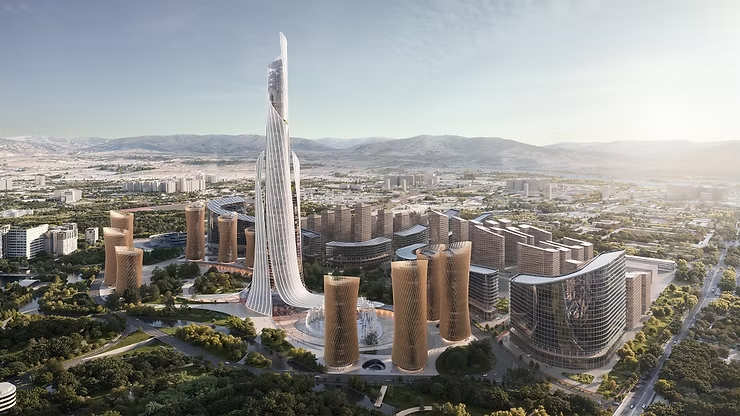
The skyscraper in Dushanbe, which is intended to become the tallest building in Central Asia, is the project that most clearly illustrates what he means when he talks about patience as a condition rather than a virtue. The ambition is significant and the timeline is correspondingly long and demanding, and he has made his peace with this completely, not reluctantly but with a genuine understanding that the length of the journey is not separable from the quality of what is being built at the end of it. Progress inside a project of this scale feels incremental from day to day, but it accumulates over time, and the moment when an idea that has been held and refined and tested across years finally translates into a space that people actually inhabit is the kind of reward that only the sustained commitment produces. Architecture rewards the committed, he says, and he means it not as a motivational sentiment but as a straightforward description of how the work operates.
To young architects looking at international practice from the outside and imagining something defined by speed and glamour and decisive authority, he offers a correction rooted in direct and sometimes difficult experience. International practice is built on patience and on a willingness to carry responsibility in contexts far removed from one’s own, where every decision carries cultural and social consequences that cannot be fully anticipated in advance and must be navigated with humility and care. Greater reach brings greater expectation and the work demands a restraint and a consistency and an acceptance that progress is rarely linear and recognition is rarely prompt. Much of the effort remains invisible, and it is precisely that invisible labour, the sustained discipline and quiet consistency and commitment to getting something right even when no audience is present to notice, that gives architecture its credibility over time and its capacity to endure. The practitioners who last in this profession, he says, are not driven by the desire to be seen. They are driven by the work itself and by a patient engagement with what a building can do for the people who will spend their lives inside it, and by an understanding that architecture which truly matters is not the kind that announces itself. It is built carefully and sustained quietly and understood slowly, over the years that follow its completion, by the people it was always for.
