
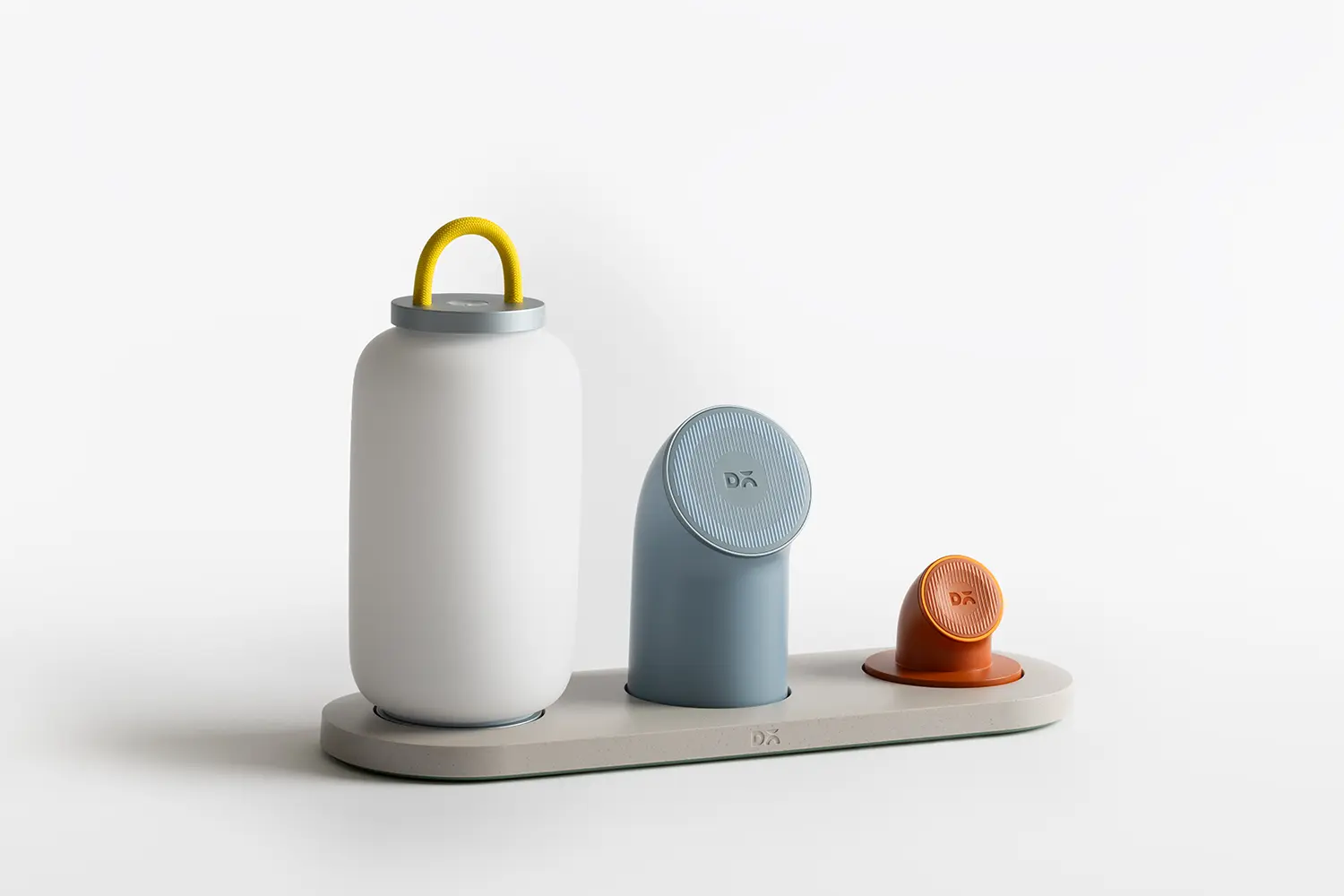
Charging accessories occupy a strange category. They sit on desks and bedside tables permanently, get touched multiple times a day, and are almost never designed with any intention beyond function. LAYER, the London studio founded by Benjamin Hubert, is betting that gap is worth closing. Its new collection for Daily Objects, Node, and Loft treats charging hardware as an object category in its own right rather than an accessory to be tolerated.
Node is the more ambitious of the two. Built around a single-wire base, it accepts four interchangeable modules, a wireless charging phone stand, a charging disk, an Apple Watch stand, and a portable lamp, each usable on its own or docked together. The phone stand carries a 7800mAh battery alongside its 25W charging, so it can be pulled off the base and carried from room to room without losing power. Depending on how many modules are attached, the whole system scales from a minimal single dock to a fuller three-piece setup.
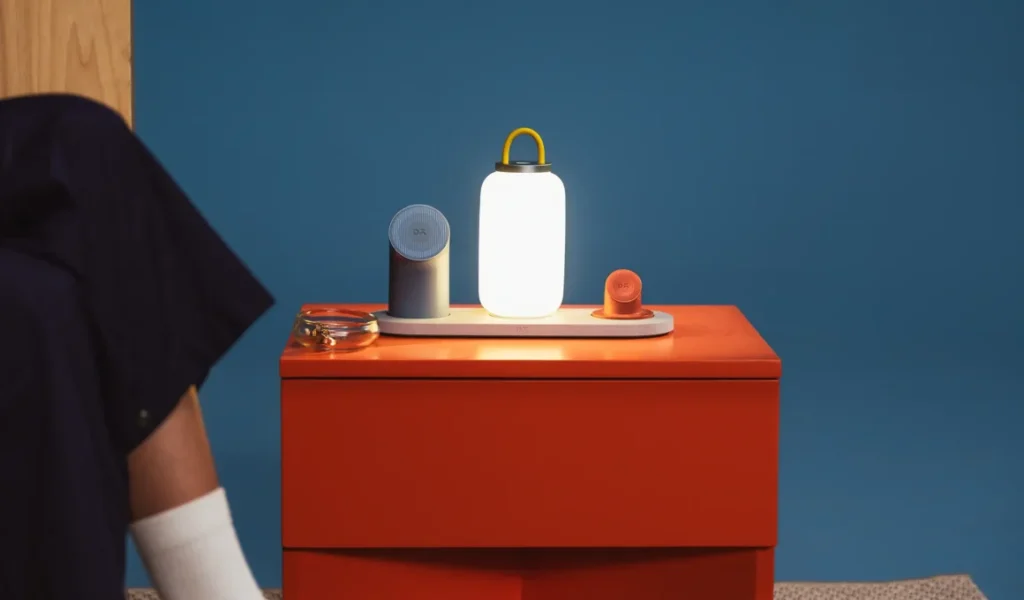
The lamp is the module doing the most interesting work. It has its own glass diffuser, aluminum detailing, three dimming settings, and roughly eight hours of runtime independent of the base. It would function as a standalone lamp regardless of whether it ever touched the charging system, which says something about what LAYER is actually trying to build here: not a charger with extra features bolted on, but a small ecosystem of domestic objects where charging happens to be one of them.
Loft is a simpler proposition. It’s a fixed desktop station rather than a modular one, combining two mains ports and two USB-C ports in a single arched form. The ports face forward at an angle, so plugging in doesn’t require repositioning the unit, and a braided nylon cord with an integrated cable loop keeps the usual mess of wires contained. It’s a smaller idea than Node, but a more immediately useful one for anyone who just wants their desk to look less like a server closet.
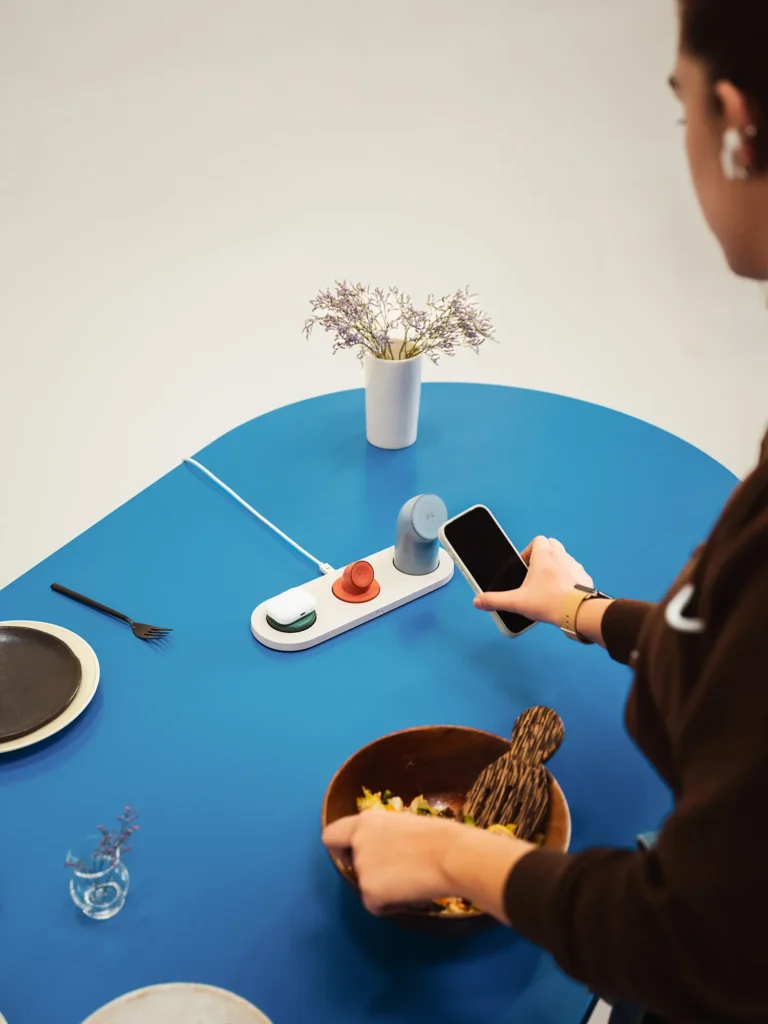
Color does a lot of the positioning here. Loft’s four finishes, Charcoal, Clay, Forest, and Mandarin, sit closer to a furniture or ceramics palette than anything in consumer electronics, and Node’s blue-grey and terracotta modules against a concrete base follow the same logic. This restraint aligns with LAYER’s functional designs, such as Earth Rated and the Mazzu camping mattress, where the studio aims to elevate utilitarian objects.
The bigger claim buried in this collection is about Daily Objects itself. Node and Loft are described as the start of a wider visual identity for the brand, meaning the arch, the circular motif, and the material choices here aren’t one-off decisions but a language meant to carry into future products. That’s a reasonable design strategy. A separate question that design alone won’t answer is whether it actually changes how people think about charging accessories or whether Node and Loft simply become two well-designed products in a category that still reads as clutter to most people.
