
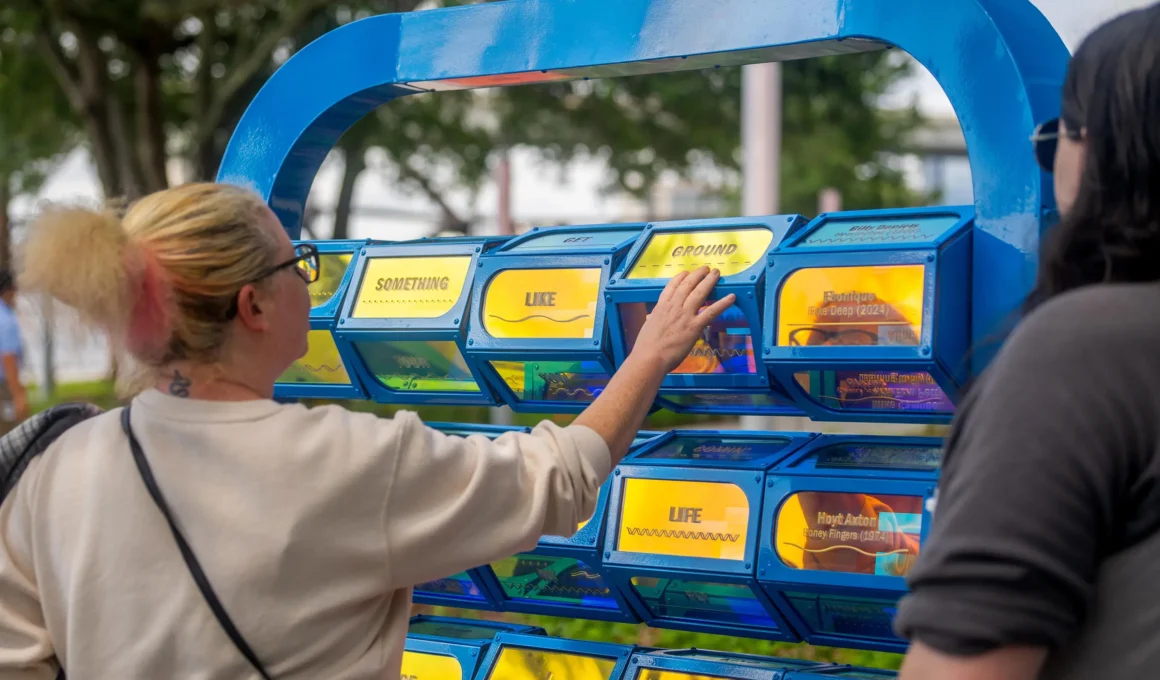
The Urban Conga has completed A Cappella, a public art installation set into the new Jacksonville Riverfront Music Garden along the St. Johns River, drawing on 84 songs by more than 60 local artists across a century of musical history and then handing the result back to whoever turns up. The work sits within a musical note carved into the landscape, next to the Jacksonville Symphony behind the Moran Theater and Jacoby Symphony Hall, and is organized into four sections that mirror the movements of a symphony: motivation, home, love, and freedom. The premise is simple and quietly ambitious, treating Jacksonville’s music not as a canon to be sealed behind glass but as a living conversation that any visitor can extend.
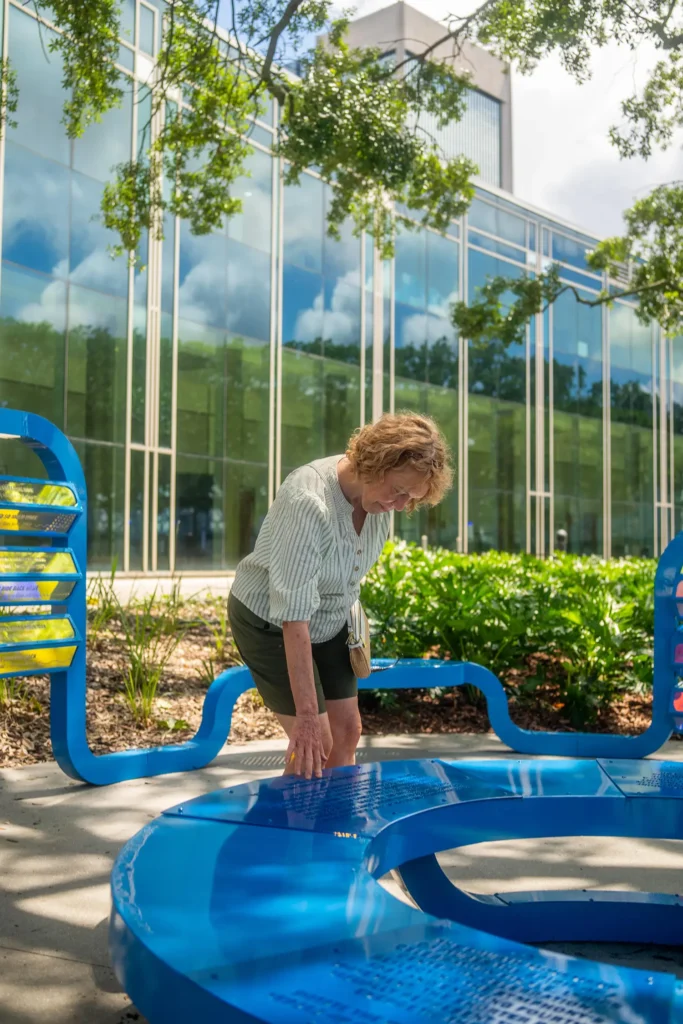
The community assembled this before the studio ever shaped it, since through an extensive public engagement process, Jacksonville residents themselves identified the songs and lyrics that best reflected the city’s character, a collection running from the 1920s through to the 2020s and crossing genres, generations, and neighborhoods. The result is not a curatorial selection imposed from outside but a portrait drawn by the people it represents, and that distinction carries real weight, because interactive public art that begins with community authorship holds a different authority than work that consults a community only after the fact.
The physical form makes that openness tangible since A Cappella is built from a single continuous line of powder-coated aluminum, here finished in a bright cobalt blue, that loops and curves through the landscape to weave together upright panels, archways, and seating into one flowing circular structure. Aluminum was chosen for hard practical reasons too, as a durable material able to take the Florida climate, the extreme heat, and the storms as a permanent outdoor fixture. The blue line reads as playful and almost cartoonish against the greenery, and in the wider shots, it frames the city skyline and the steel-blue Main Street Bridge across the river, tying the artwork firmly to its place.
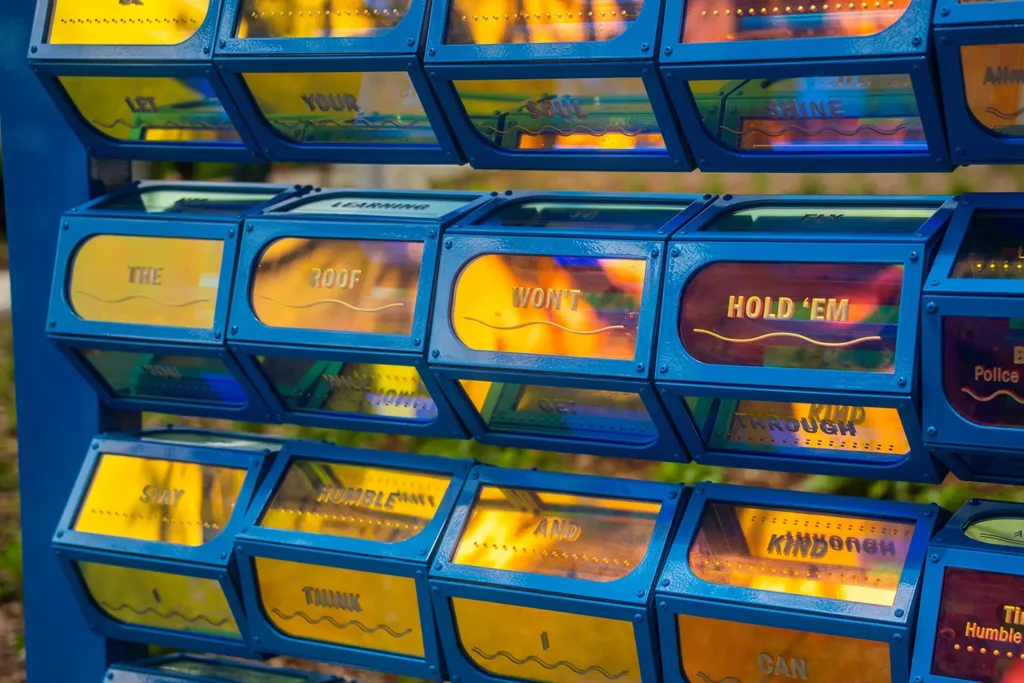
The core mechanism of the work is deconstructive, as selected lyrics were broken down into individual words and short phrases mounted on spinnable units, each face carrying a single fragment so that visitors can flip and rearrange them into entirely new compositions. The panels glow in amber, gold, and shifting dichroic color, with words like “let,” “your,” “soul,” and “shine” sitting in rows ready to be reshuffled, so a Lynyrd Skynyrd line can be threaded through a 1940s blues verse or a contemporary rapper spliced into a Prohibition-era lyric. The recombination is the whole point, surfacing unexpected connections across time and revealing how ideas about home, freedom, and belonging have been sung in Jacksonville for a hundred years without ever being fully resolved.
The visual language is built to refuse permanence, since dichroic and reflective surfaces shift color, light, and shadow across the day as visitors move through the four sections. The panels work as both surface and atmosphere, changing what the installation looks like depending on when you arrive and making every visit formally distinct from the last. It is a familiar move in public art, yet here it reinforces the concept directly, because a work about the instability and recombinability of cultural expression should itself never look quite the same twice.
The communal dimension is anchored by integrated seating and a central circular bench, which does a specific job beyond rest, explaining the relationship between the four symphonic movements and the four sections of the artwork and giving first-time visitors a structural map before they begin. Making that explanatory element a gathering place rather than a wall text or a screen is a deliberate choice, since understanding the work is treated as a social act rather than a private one. The Riverfront Music Garden is conceived as a destination in its own right, and A Cappella operates as its interpretive and participatory core.
The four movements are not equal in mood, since motivation opens the sequence with energy and forward momentum, home settles into something more contemplative, love introduces the most personal register, and freedom closes with the widest emotional range. The progression mirrors the arc of a live performance rather than a static display, a scored experience with a beginning, a development, and a resolution, so visitors who move through in order encounter song lyrics as landscape, each zone carrying its own tempo and emotional weight that shifts the body’s relationship to the space.
The installation is explicitly designed to grow, since its framework can take on new artists as Jacksonville’s musical story keeps unfolding, positioning A Cappella not as a finished archive but as an open score. This assertion is the most rigorous claim the work makes: that a city’s cultural identity is not a fixed object to be commemorated but an ongoing composition future voices will continue to rewrite. The participatory design invites visitors to add their own verses directly, making the boundary between audience and author as permeable as the dichroic panels make the boundary between color and light.
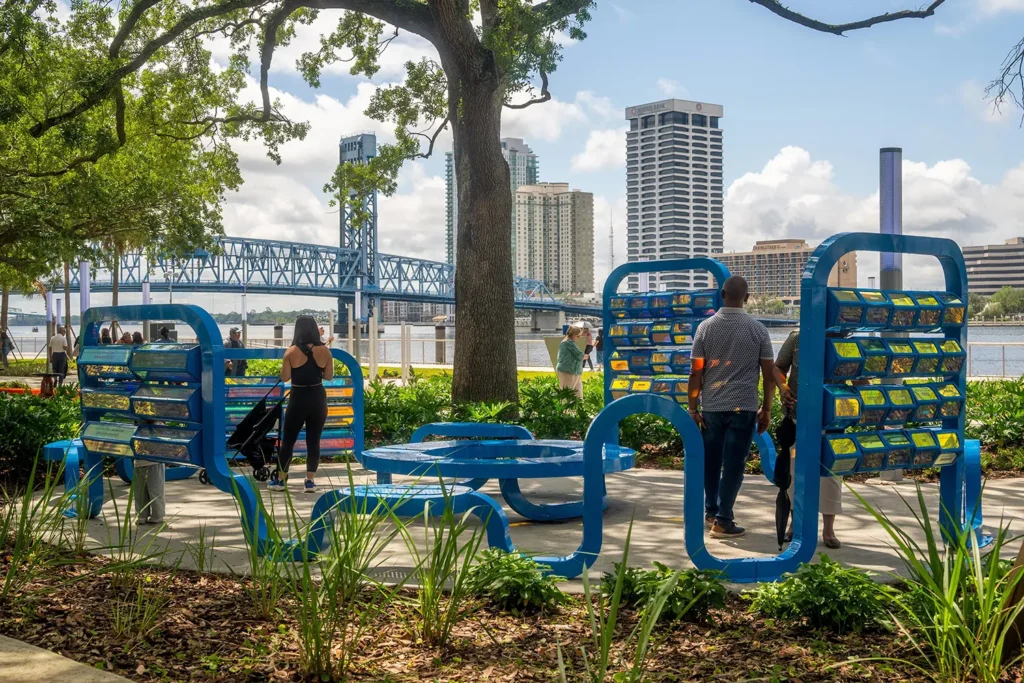
What A Cappella ultimately argues, and this is the claim worth taking seriously, is that the most honest form of cultural commemoration is one that makes itself incomplete by design. The sixty-plus artists already embedded in the work stand for a century of Jacksonville’s voice, while the verses visitors write today stand for the next chapter. A monument that can be rewritten is not a lesser monument. It is a more accurate one and a rarer thing than the public art genre usually produces.
Fact File
Project name: A Cappella
Studio: The Urban Conga
Typology: Public art, interactive participatory installation
Location: Riverfront Music Garden, 300 Water Street, Jacksonville, Florida 32202, United States
Year installed: May 2026
Project size: 437 square feet
Studio leads: Ryan Swanson and Maeghann Coleman
Role: design, fabrication and installation
Source material: 84 songs by more than 60 Jacksonville artists, spanning the 1920s to the 2020s
Key materials: powder-coated aluminium, dichroic and reflective panels
Photography: Christopher Brickman
Studio: Marc Fornes / THEVERYMANY
Typology: Public art, permanent pavilion / civic installation
Location: Wheland Foundry Trailhead, Chattanooga, Tennessee, United States
Commissioned by: Public Art Chattanooga
Structure: self-supporting double-layer aluminium shell
Material: 3mm aluminium strips, hand-riveted
Method: computational form-finding, machine-cut components, hand assembly
Photography: Keith Isaacs
