

Celia Sawyer has designed palaces that fly and salons that sail. In a rare conversation with Shweta for Design Diary International, Britain’s most quietly formidable interior designer talks about the discipline behind the drama and what luxury really means when everything else falls away.
She was fifteen when she walked out of school in Bournemouth with almost nothing on paper and a quiet, unshakeable conviction that she would find her own way. What followed was not a straight line. There was a stint as a dental nurse. A brief, self-described unsuccessful brush with modeling. Then she took on a role that placed photographers’ talent with some of London’s most competitive advertising agencies, including Saatchi and Saatchi, because beautiful things had always pulled at her, and she had always known how to make them matter to other people. The pivot into design came the way the best things often do, sideways and without warning. She bought a London property, transformed it entirely, added a floor, and the people who came to see it left wanting her to do the same for them.
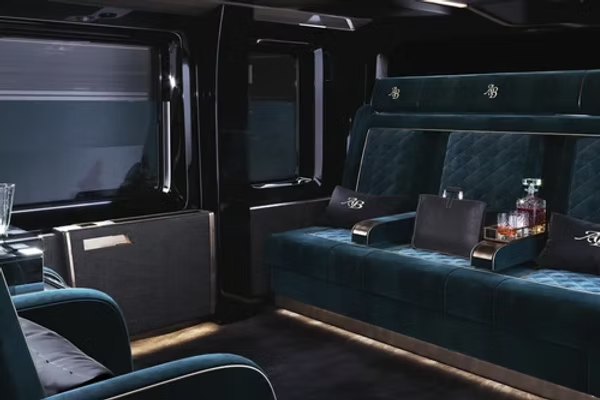
That was the beginning. What came after is a career that follows no template, because none existed.
Today, her Mayfair studio is counted among the most coveted luxury design practices anywhere in the world. Royalty from Saudi Arabia. Global celebrities. Sporting icons. Entrepreneurs whose projects span continents and whose names will never appear in any press release she issues, because discretion is as much a part of what she delivers as the design itself. In 2017, she designed the warrant officer’s mess aboard HMS Queen Elizabeth for the Royal Navy, demonstrating the same seriousness she applies to all her projects, regardless of location. She has been ranked among the top ten interior designers in the world, recognised in the Top 100 Most Influential British Entrepreneurs, listed among the Top 250 Most Powerful Women Leaders, and given the Inspiration Award for Women in 2013. She serves as ambassador for the British Heart Foundation and the Prince’s Trust, patron for Women’s Refuge, and mentor for the British Library.
Television came looking for her too. Channel 4 cast her as one of four dealers on Four Rooms, a role she kept across five series while the show won a Royal Television Society Award in 2014. The BBC followed with her own prime-time series, Your Home in Their Hands, which opened in 2014 to more than three million viewers weekly. All of this happening in parallel with a design practice that was, at that very same moment, operating at the highest levels of the global luxury market.

Her portfolio reads like a wish list. Residences in London, Barbados, Hollywood, New York, and the Emirates. Private superyachts. Helicopter interiors. And aircraft, extraordinary, one-of-a-kind privately owned aircraft, are perhaps where her work reaches its most singular expression. She built it all herself from nothing, and that fact is central to how she works and what she believes.
The world Sawyer operates in requires something beyond taste. It requires a deep, almost intuitive understanding of people who can have anything and have long since stopped being impressed by the expensive. Designing for air and sea, she says, demands a completely different intelligence than designing a home on land. Engineering, physics, and weight distribution all have to live inside the same decisions as emotion and atmosphere. The goal, always, is a space that feels utterly still even when it is moving at six hundred miles an hour.
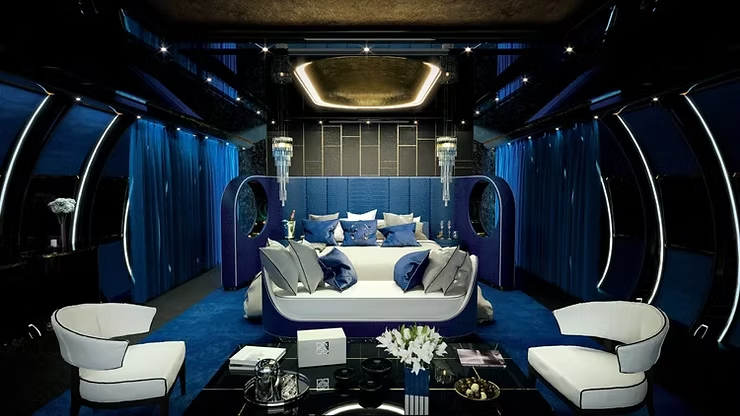
A commission from a Middle Eastern royal illustrates the scale at which she works. He asked her to transform a privately owned Airbus A340 into what he himself called a residence in the sky. The master suite was layered in deep blue, anchored by a king-sized bed with a hand-stitched crocodile leather headboard, flanked by bespoke crystal fixtures that were individually engineered to remain perfectly stable in flight. Gold and crystal moved through the whole interior like a continuous thread. The main bathroom housed a Swarovski crystal and glass washbasin. The bath beside it was carved from midnight-blue marble and fitted with a mirror-faced integrated television. In the salon and lounge, she followed the aircraft’s own curves with gold-plated ceiling sections that opened the space visually, setting them against linear seating in hand-stitched Tuscan leather, silk, and velvet arranged in the majlis tradition, warmth held inside grandeur. Two crystal chandeliers with gold accents hung above a bar that glowed from within. A palace, moving through the sky.
Designing a jet or a yacht, she says, is like writing music inside a set of rules. Excess is not available as a tool. Every curve, every material, every line has to justify being there. When it works, it looks effortless. On water the same principles shift with the medium. Her yacht interiors breathe with the rhythm of the sea, curved cabinetry echoing the horizon, champagne tones spreading across silk and polished wood, and light moving as the water moves beneath the hull. “You design not only for how something looks,” she says, “but for how it moves.”
Her starting point, on any project, whether it flies or sails or stays on solid ground, is never visual. She walks into a space thinking about how it should make someone feel. That feeling becomes the foundation for every decision that follows. Her interiors are cinematic without being theatrical, spaces where light, texture, and reflection have been arranged to produce a specific emotional experience rather than a specific visual impression. Even in the most constrained and technically regulated environments, the intention is to move the person inside them.
Every aircraft and marine commission requires close collaboration with engineers and technical specialists to meet safety and performance standards throughout. She speaks about working within the laws of nature not as a restriction but as the point where the work becomes genuinely interesting. The discipline that physics and regulation impose forces a quality of decision-making that, when it is handled well, produces results that feel inevitable.
Her clients know almost nothing about each other, and she intends to keep it that way. Royalty, global leaders, creative figures, sporting personalities, and entrepreneurs are involved in projects on every continent. She names none of them. Privacy is not a policy for her; it is a principle. Success does not need an audience, she says. It can live quietly inside the confidence of the work itself.
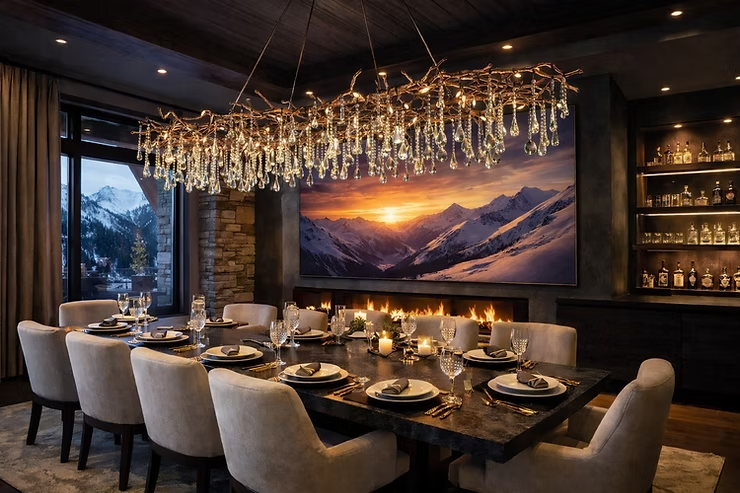
That quietness has come to define her understanding of luxury too, which has moved a long distance from the industry’s old obsession with rarity and price. True luxury, as she lives and practices it now, is calm. It is comfort and silence and beauty that does not announce itself. Technology tucked beneath texture. Light that feels like it arrived naturally. Materials that breathe rather than perform. One beautiful focal point, she says, lets a space breathe. Too many statement pieces just compete with each other. Luxury is no longer about rarity. It is about emotional resonance. It is about how a space understands you.
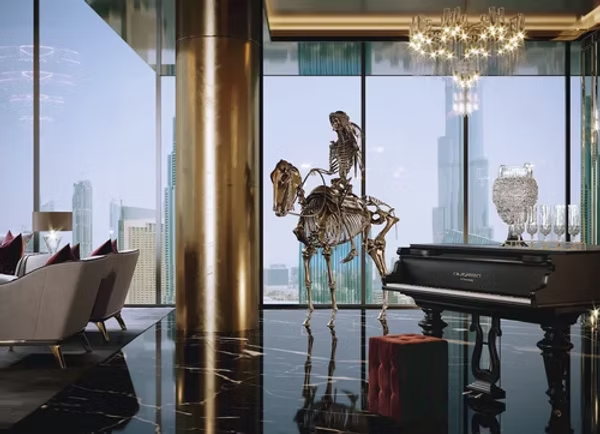
The commission that changed everything came early, a private jet that reframed the whole practice. That was when she understood she was not designing spaces. She was designing experiences, and beneath that, she was designing emotion. It is a distinction she has never let go of, and it is why her work reads as unmistakably hers across environments as different as a superyacht salon and a London townhouse. She always starts with intimacy, regardless of the scale. How will someone sit here? Where will the light fall? How will they feel? Design, she says simply, must always begin with the human being inside it.
Her sense of beauty has shifted alongside everything else. It used to be about perfection. Now it is about harmony, authenticity, and balance. Nature, she says, always shows you how. Whoever decided you cannot pair green and blue has never watched the sky meet the trees. Her clients, wherever in the world they come from, share one quality she recognizes the moment she meets them. People of real taste know authenticity the instant they encounter it. They want things made with intention and things that carry meaning. And the intention behind every commission she takes is the same one it has always been. She wants the work to last, not only in the physical sense but also in the emotional one. Luxury, she says, should endure. It should never simply fade.
