
The Chapelle Expiatoire in Paris’s 8th arrondissement was built in the early nineteenth century on the site where Louis XVI and Marie Antoinette were first buried before their remains were moved to Saint-Denis. It is a building that carries a particular charge around presence and absence and visibility and concealment, and it was into this specific historical weight that Italian artist Emilio Ferro placed Threshold, commissioned by the City of Paris for Nuit Blanche on 6 June 2026.
The premise is architectural before it is artistic. A powerful beam of white light extends through the interior and produces a luminous volume that reads as almost tangible, emerging from a metal structure positioned at the chapel’s entrance. The beam pierces upward through the chapel’s ornate coffered dome, its circular oculus at the apex becoming the point through which the light appears to escape into the night sky above. When the doors open, the beam extends outward toward the surrounding garden. When the space closes, the light retracts and settles onto the interior surfaces. The chapel becomes the instrument. The opening and closing of its doors, the building’s own operational logic, is the primary compositional variable of the work. Ferro does not impose the installation on the monument. He makes the monument’s behaviour visible.
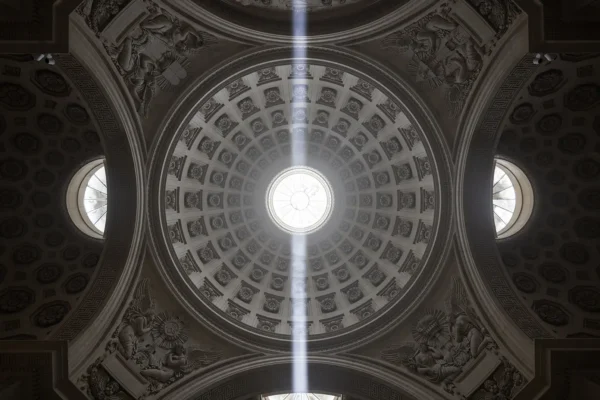
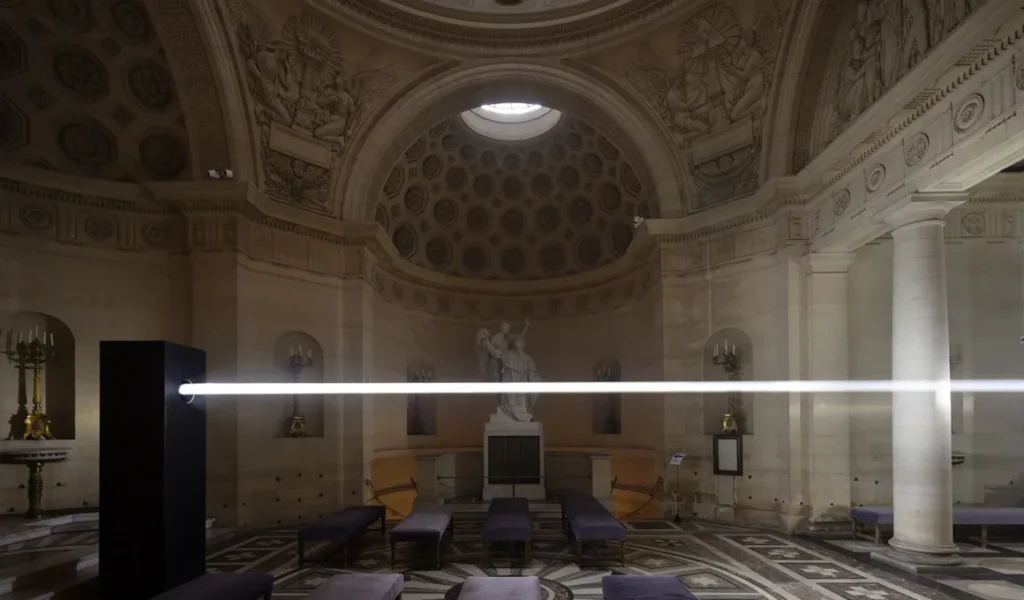
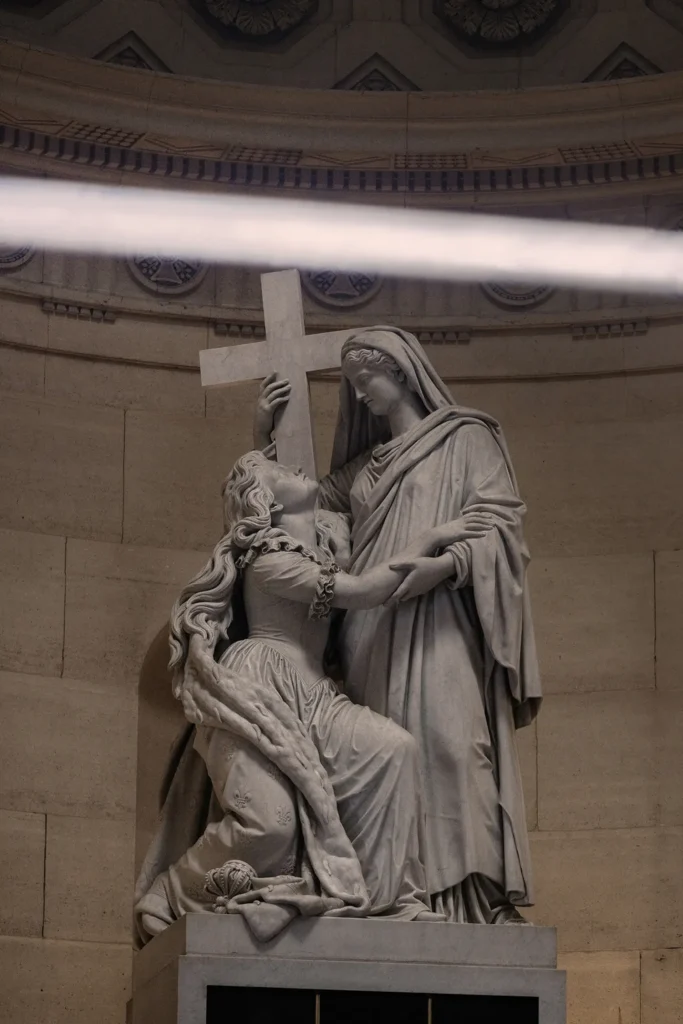
The choice of site carries precise meaning within the work’s formal logic. A light that advances when the space opens and retreats when it closes operates in this building as a spatial metaphor, with the chapel’s own history continually adding meaning. The immaterial beam enacts something about presence and absence that the memorial function of the building has always implied but never made visible. The marble sculpture group inside the chapel, two figures at a cross, is caught in the beam in one of the installation’s most quietly powerful moments, the centuries-old stone and the immaterial light occupying the same space without competing.
Sound extends the installation beyond the visual register. An original composition developed from magnetic field frequencies recorded by Ferro and subsequently reworked accompanies the light, not as an ambient backdrop but as a structural layer that expands the work’s spatial claims. The frequencies sourced from electromagnetic data were never intended to be heard. Ferro renders them audible through an act of artistic translation, the particular quality of data that belongs to no musical convention producing a suspended atmosphere in which the experience of duration slows. Time and space appear to behave differently inside Threshold than outside it.
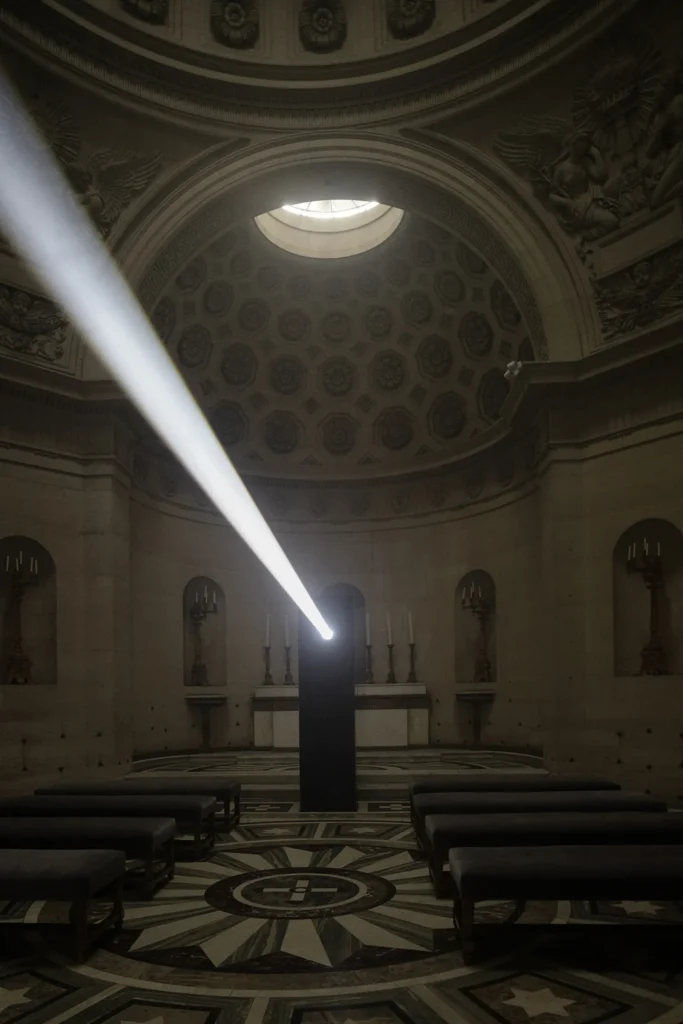
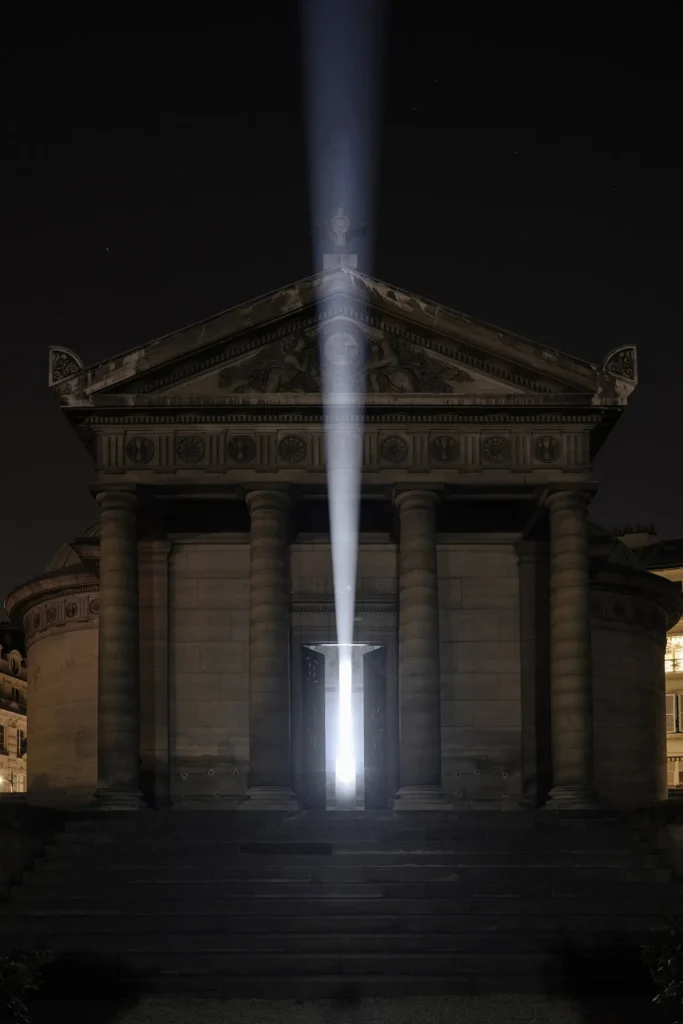
Visitor movement is written into the logic of the piece. Rather than presenting a fixed spectacle, the installation responds continuously to presence, duration, and viewpoint; each body passing through the chapel introduces subtle variations in the light’s behaviour and the sound’s spatial distribution. This is not interactivity in the contemporary digital sense but something closer to the older idea of the responsive environment, a space that registers human presence without translating it into data or spectacle.
Ferro’s technical methodology distinguishes his practice from the broader field of immersive light art. His research integrates custom-developed light and sound systems, hardware experimentation, and spatial acoustics, the technology remaining invisible and subordinated entirely to the perceptual and emotional experience of the visitor. The commission at the Chapelle Expiatoire, a monument managed by the Centre des Monuments Nationaux, places Threshold within a curatorial framework that usually prefers less formally demanding work. It reflects the scale of Ferro’s established practice, which includes the first light art installation at the Giza Pyramids with Portal of Light in 2022 and a permanent installation near the Sanctuary of Vicoforte titled Miracle in 2024, as well as a broader institutional shift in how French cultural heritage sites are beginning to think about contemporary art in historic spaces, not as decoration applied to significance but as a means of making that significance perceptible to audiences who arrive without the historical context to feel it directly.
“All elements were specifically designed for the project,” the studio noted, framing craft as a constructive position rather than an aesthetic preference. For Ferro, the most precise moment in Threshold is also its simplest: when the door of the Chapelle Expiatoire opens, the monument and the installation change state at exactly the same instant. The threshold the work is named for is not a concept being illustrated. It is a door, and what happens when it moves.
Fact File:
Installation: Threshold
Artist: Emilio Ferro
Location: Chapelle Expiatoire, 29 Rue Pasquier, 75008 Paris, France
Event: Nuit Blanche 2026
Date: 6 June 2026 (Concluded)
Typology: Public Art Installation
Commissioner: City of Paris
Venue Management: Centre des Monuments Nationaux
Photography: Roberto Conte
Artist Website: https://www.emilioferro.it/
