
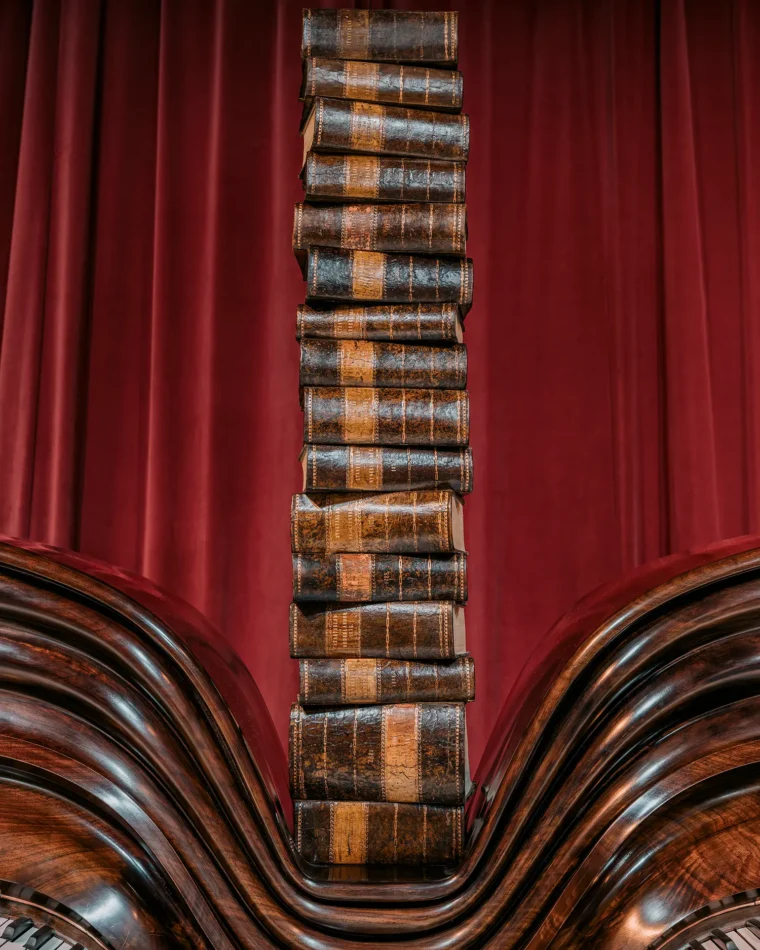
Alex Chinneck’s Bangers and Mash, premiering at the Treasure House Fair at the Royal Hospital Chelsea from 24 to 30 June 2026, is a life-sized grand piano carved entirely from American Black Walnut that has been made to look as though it no longer has any structural integrity at all. A stack of antique 19th-century leather-bound books presses down on the instrument’s body, sending waves and ripples through the case, the keyboard, and every straight line the piano once had. The two-meter-high sculpture does not depict compression as a physical event. It depicts it as a permanent condition, fixed forever in a material that cannot actually bend.
American Black Walnut is dense, dimensionally stable, and resistant to deformation. Chinneck and his collaborator Jonathan Fernhead carved it into a form that reads as the opposite: keyboard keys that curve where they should be flat, a case that ripples where it should be rigid. The vintage Bakelite piano keys embedded in the carved walnut body extend the material contradiction further. Bakelite, an early synthetic plastic prized for its hardness and heat resistance, here occupies a form that implies softness and failure. The books press down with the visual logic of actual weight, spines visible, stacked with the particular authority of 19th-century volumes, and the piano responds as though the weight were real and ongoing, the waves traveling through the instrument’s form as though the process of deformation were still happening and had simply been caught at a particular moment.
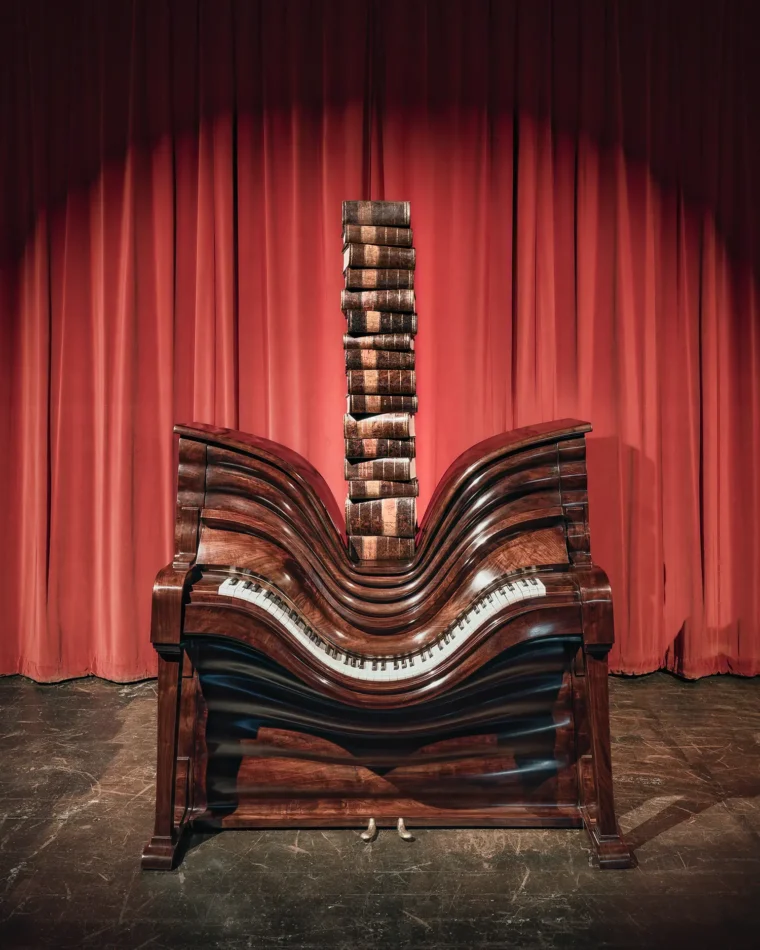
The title is the first signal of what the work is doing. Bangers and Mash, British working-class slang for sausage and mashed potato, applied to a grand piano being systematically flattened by a column of 19th-century books inside a fair that also features works by Picasso, Dalí, Henry Moore, and David Hockney. The register is deliberate. Chinneck’s practice has consistently operated at the intersection of the technically demanding and the visually comic, and the title does in two words what the sculpture does in three dimensions: it punctures the expected solemnity of the object before the viewer has time to supply it.
The context of the Treasure House Fair adds a layer the studio has not foregrounded but which the work makes legible. The fair brings together galleries dealing in antiques and works by canonical twentieth-century figures. The 19th-century books that flatten the piano come from the same period as the antiques surrounding it at the fair; one category is preserved, the other is used as a weapon. The Sculpture Walk within which Bangers and Mash appears was curated by sculpture specialist Flo Horswell, art historian Wilfrid Wright and New York-based interior designer Benjamin Brougham and includes 35 works throughout the fair. Robert Young Antiques, the exhibitor who invited Chinneck to show, has a longstanding engagement with his practice. Robert Young has described the work as challenging perceptions, exploring mediums, pushing boundaries, and defying gravity while redefining the understanding of contemporary sculpture.
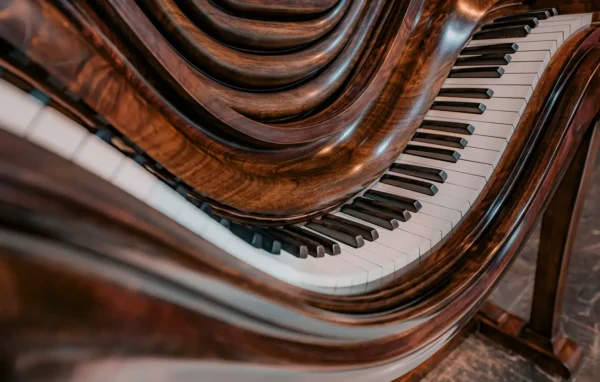
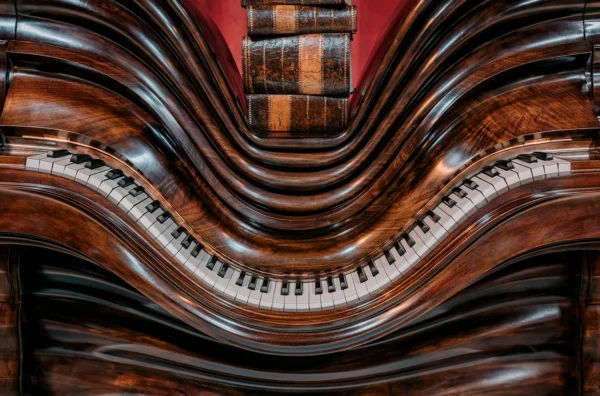
Chinneck’s own framing of the collaboration focuses on process rather than outcome. He has said he has always enjoyed forging working partnerships in places where you would not typically expect to find contemporary artists and that cross-interest, cross-sector, and cross-disciplinary collaborations give birth to surprising outcomes. The statement applies equally to the sculpture’s own internal logic, the cross between furniture and instrument, between collapse and permanence, and between a title that suggests the kitchen table and a material that suggests the concert hall.
The photographs by Charles Emerson, shot at The Astor Theatre in Deal against deep red stage curtains, frame the sculpture as something between an abandoned prop and a stage presence, the theater setting adding a performative quality to an object built around the idea of a performance that can no longer take place. This technique is a recurring approach in Chinneck’s large-scale work, The Arrested Moment, where the impossible material state is presented as evidence of something that could not have occurred. From facades peeling away from buildings to brick walls dissolving mid-collapse, the work is most effective when the viewer’s eye accepts what the mind knows to be structurally impossible. Bangers and Mash applies that method at the scale of a single instrument in a room full of antiques, with a title borrowed from the school canteen.
Fact File
Work: Bangers and Mash
Artist: Alex Chinneck
Collaborator: Jonathan Fernhead
Typology: Public Art Installation
Location: Treasure House Fair, Royal Hospital Chelsea, London
Dates: 24 to 30 June 2026 (concluded)
Exhibitor: Robert Young Antiques
Sculpture Walk Curators: Flo Horswell, Wilfrid Wright, Benjamin Brougham
Photography: Charles Emerson
Artist Website: alexchinneck.com
