
Wooden toys are not a Channapatna invention, or even an Indian one. Turned and lacquered wood has appeared across cultures that developed the tools and techniques to shape it, from Russia and Germany to Japan. What makes Channapatna unusual is not the wooden toy itself, but what happened when a technique associated with another tradition took root in one small town and, over generations, became inseparable from its identity.
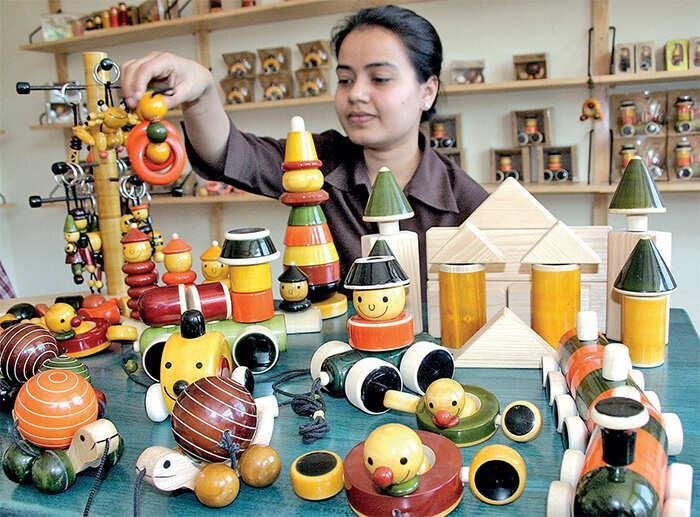
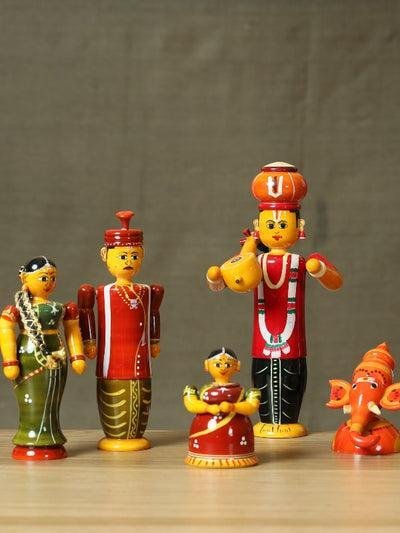
Located roughly sixty kilometres from Bengaluru, Channapatna is known locally as Gombegala Ooru, or Toy Town. Its brightly coloured wooden toys have become one of Karnataka’s most recognisable craft traditions. Yet the story of how the technique arrived in the region is less straightforward than the familiar version suggests.
The most repeated account traces the craft to Tipu Sultan, ruler of Mysore from 1782 to 1799. According to the story, Tipu received a lacquered toy from Persia, was intrigued by the technique and invited Persian artisans to train local craftsmen in wood turning and lacquer work.
The connection, however, is difficult to establish with certainty. Some researchers question whether Tipu personally brought Persian artisans to Mysore, or whether his role was instead connected to the expansion and export of a craft that was already being practised locally. Tipu’s interest in overseas trade and in promoting Mysore’s indigenous goods is well documented, but the precise origins of the Channapatna technique remain less certain.
What is clear is that the technique eventually took root in Channapatna and developed a character of its own.
There is another figure in the story who receives considerably less attention.
Syed Bawa Saheb Miyan, known locally as Bawas Miyan, lived in the early twentieth century, more than a century after Tipu Sultan’s death. He travelled to Japan in 1904 and again in 1909 to study lacquer and toy-making techniques. On returning to Channapatna, he established a school to train unemployed local youth in the craft.
Several artisan families in Channapatna credit Bawas Miyan and his son-in-law, Syed Yedulla, with helping transform the craft into a larger production centre. Their influence is arguably more direct and better documented than the Tipu connection, even if it has received less attention.
The history therefore involves more than a single moment of royal patronage. It is also a story of knowledge travelling between places, being adapted by local craftsmen and eventually becoming part of the identity of a particular region.
The material itself is closely connected to the area. Craftsmen traditionally work with hale mara, or ivory wood, botanically known as Wrightia tinctoria. The wood is valued for being soft enough to turn easily on a lathe while retaining a fine grain that takes colour well.
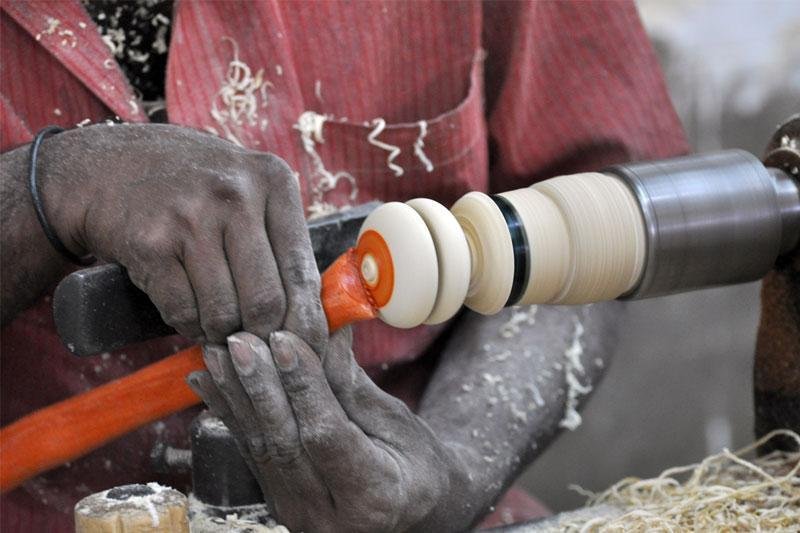
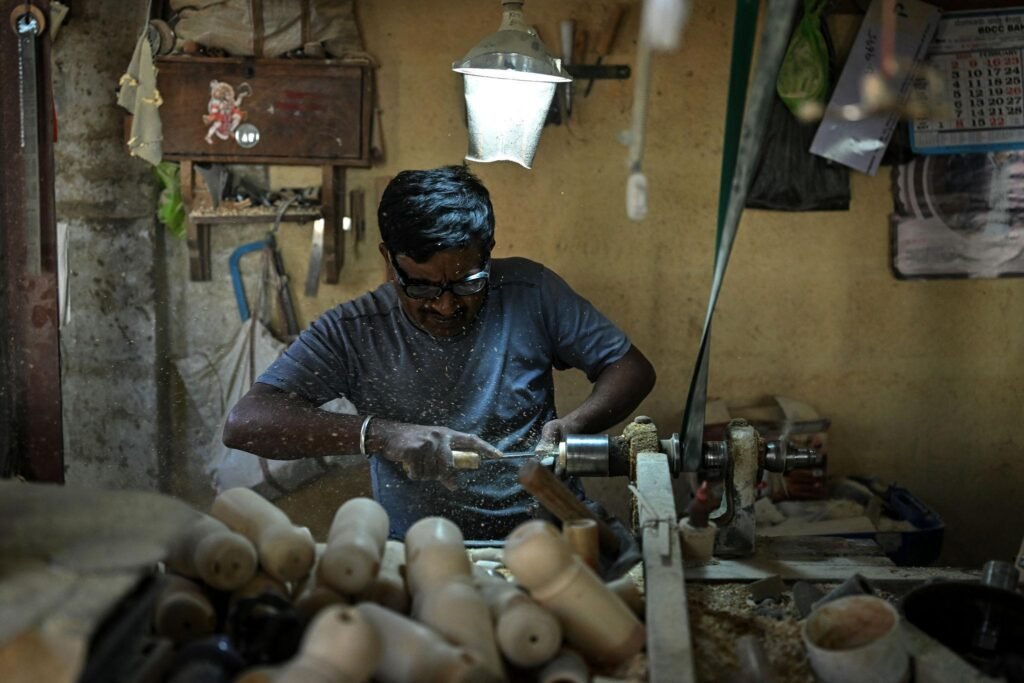
The seasoned wood is shaped on a lathe into the required form, whether a doll, animal, bangle or stacking toy. The colour comes from lac, a resin secreted by the lac insect, historically gathered from trees in the forests around Channapatna. Today, it is largely sourced from other states, including Tamil Nadu.
The lac is heated on a wooden stick until it becomes pliable. It is then blended with colour before being applied to the spinning piece of wood. A final pass with dried palm leaves burnishes the surface and gives the finished object its characteristic sheen.
The process has evolved over time. Some workshops now use motorised equipment alongside traditional foot-powered lathes. The essential relationship between spinning wood, lac and hand skill, however, remains central to the craft.
What makes Channapatna particularly interesting is how completely the technique became part of the place. Whatever its original route into Mysore, it was adapted over generations through local knowledge, materials, tools and ways of working.
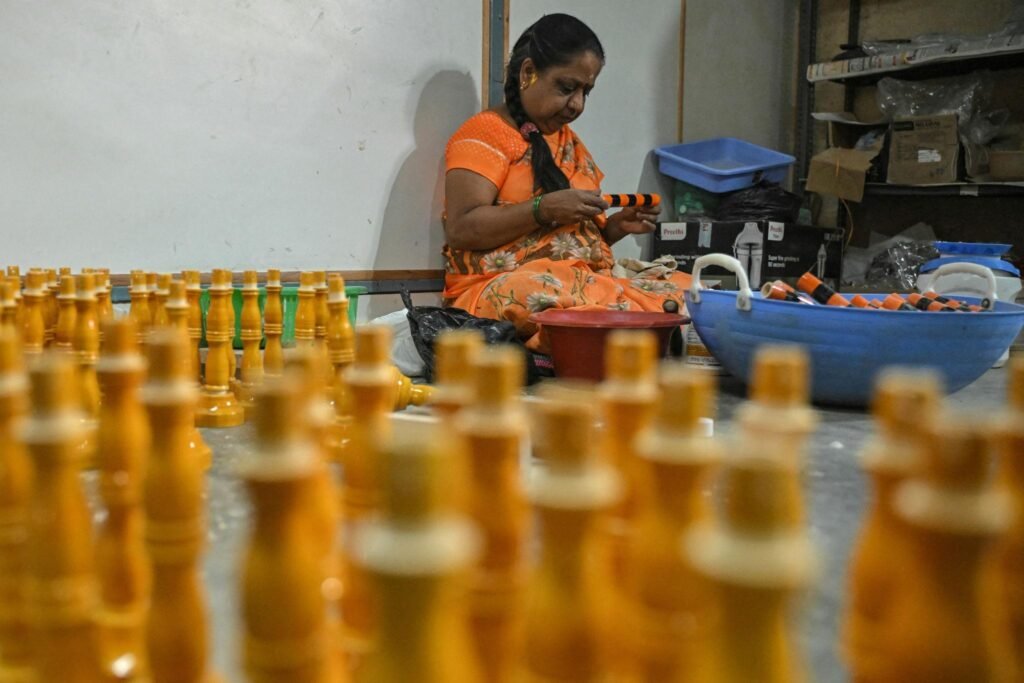
A 2021 study estimated roughly 4,000 artisans working in and around Channapatna, across approximately 250 homes and 50 small manufacturing units. The craft includes independent artisans as well as workers in registered toy-making businesses, with women forming a significant part of the workforce.
The tradition has also faced its share of pressures. Mongabay’s 2024 reporting on the region noted a downward trend in traditional lacquerware as younger generations move away from the trade. Craft researchers have called for continued investment in innovation and market visibility to keep the tradition economically viable for the artisans who continue to practise it.
Channapatna toys carry a Geographical Indication tag recognising their regional identity, but that recognition does not by itself resolve the question of how the craft will move into its next generation.
That may be the more important story today. The challenge is not simply to preserve a technique exactly as it was, but to ensure that the people who possess the knowledge can continue to make a living from it.
Channapatna offers an unusual example of how craft traditions evolve. A technique may arrive from elsewhere, but that does not mean its identity remains elsewhere. Over time, materials change, tools change, markets change and new generations reinterpret what they have inherited.
What remains is a craft so closely associated with one place that its origins have become almost secondary to what happened after it arrived.
The story of Channapatna, then, is not simply about where the technique came from. It is about how a community absorbed it, adapted it and eventually made it its own.
