
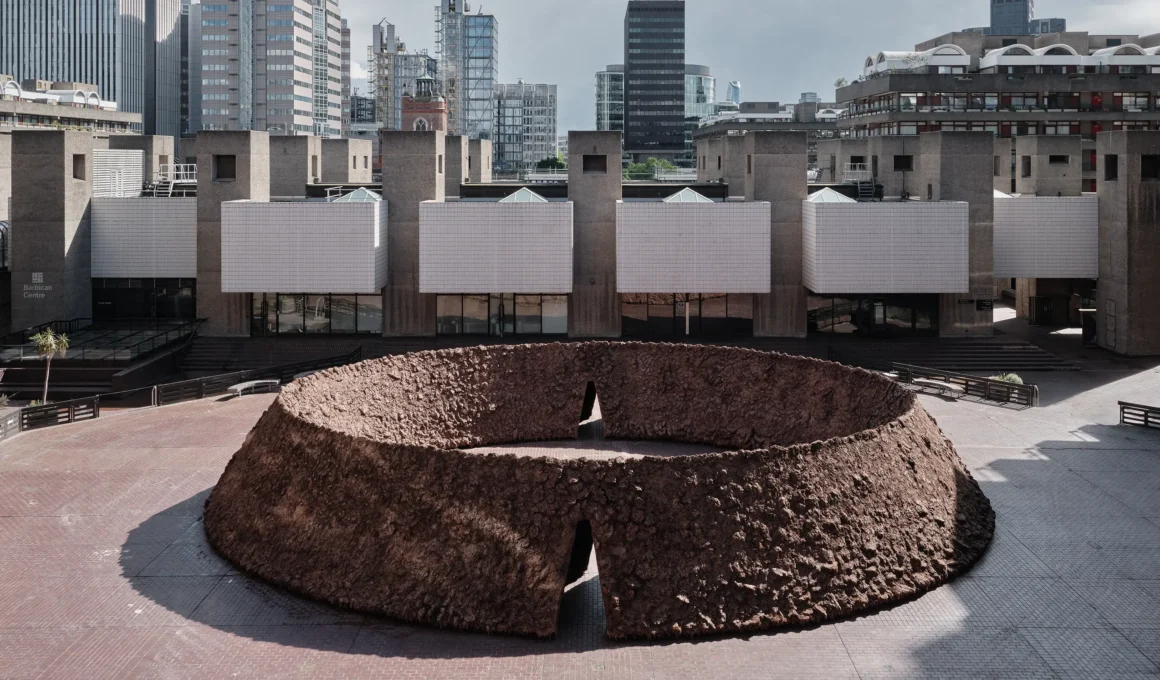
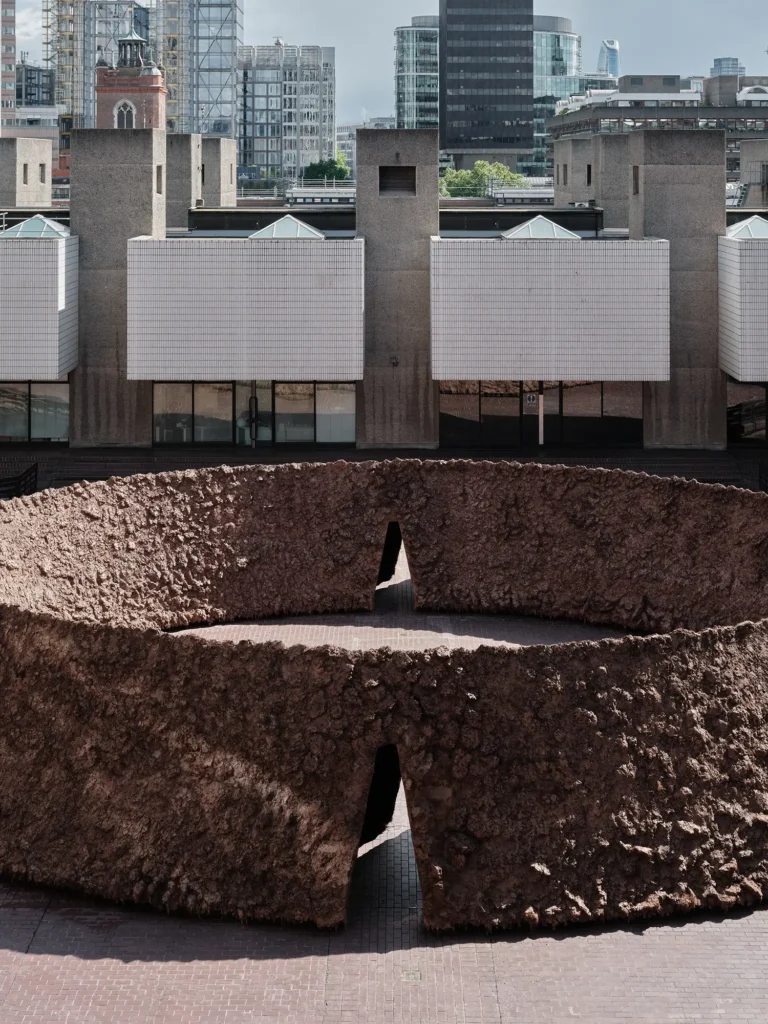
Delcy Morelos has planted thirty tonnes of spice-infused soil in the middle of London’s most uncompromising brutalist complex, and as a result, the Barbican’s Sculpture Court, left unused for its original purpose for a decade, has never felt more alive. Origo, commissioned by the Barbican and on view until 31 July 2026, is the most ambitious outdoor work the Colombian artist has produced to date, a twenty-four by eighteen meter oval earthwork that rises more than three meters from the paved court, hand-built from clay, soil, hay, plant seed, cinnamon, and cloves by Morelos and her team across more than a month of sustained physical labor. It is also, in the way Morelos frames it, a philosophical position rendered into material, since in Andean ancestral traditions the human being is understood as living earth, and the artist speaks of herself as a body and as earth, describing the exhibition space as a place where the earth expresses itself and becomes both the center and the mirror of what we are.
The biography behind the work is inseparable from its material. Born in 1967 in Tierralta, in Colombia’s Córdoba region, an area devastated by armed conflict rooted in illegal land appropriation and large-scale mining throughout the 1990s and early 2000s, Morelos began her practice making paintings from red clay pigments that mapped the entanglements between body, territory, and violence. That origin is not incidental context but rather the conceptual engine of everything she has made since. Soil, for Morelos, is never a sculptural medium in the conventional sense but instead a site-specific material that carries political weight, ecological memory, and ancestral Andean knowledge about the relationship between human bodies and the land they inhabit. The earth, in her reading, does not belong to us, for we belong to it.
The departure from Morelos’ established formal language is significant. Over the last decade she has developed a vocabulary of precise, angular earthen forms; geometric volumes that impose order on organic matter; and Origo breaks that pattern deliberately. The structure takes on a rounded, ovular shape that the artist describes as a response to the Barbican’s own architectural features, its curved residential terraces, its circular towers, and its concentric geometries. The result is something closer to a geological formation than a sculpture, a form that looks as though it might always have been there, pushing up through the paving and somehow preceding the concrete that surrounds it. In certain lights and from certain angles, the soil installation appears older than the building beside which it sits.
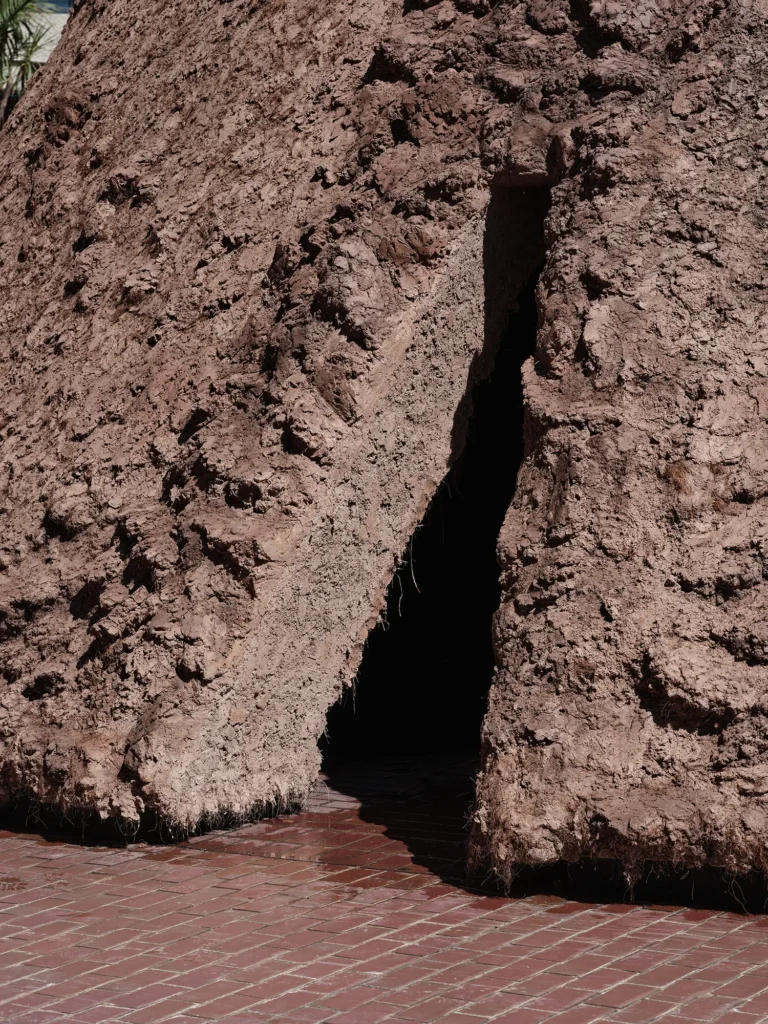
Inside, the logic inverts entirely. A series of openings, hollows carved through the volume and informed by the geometry of ancient burial sites, serve as entry points into internal tunnels that lead towards a central courtyard. Each tunnel has its own symmetry and depth, and each draws light differently depending on the hour and the angle of the sun, so that the movement through the structure becomes one of inward circulation, the body drawn down into the earth rather than moving across its surface. Curator Diego Chocano precisely describes how the monument’s grandeur contrasts with its humble materials and intimate tunnels that invite visitor immersion. The installation asks visitors not to stand before it and look, but to enter it and be absorbed.
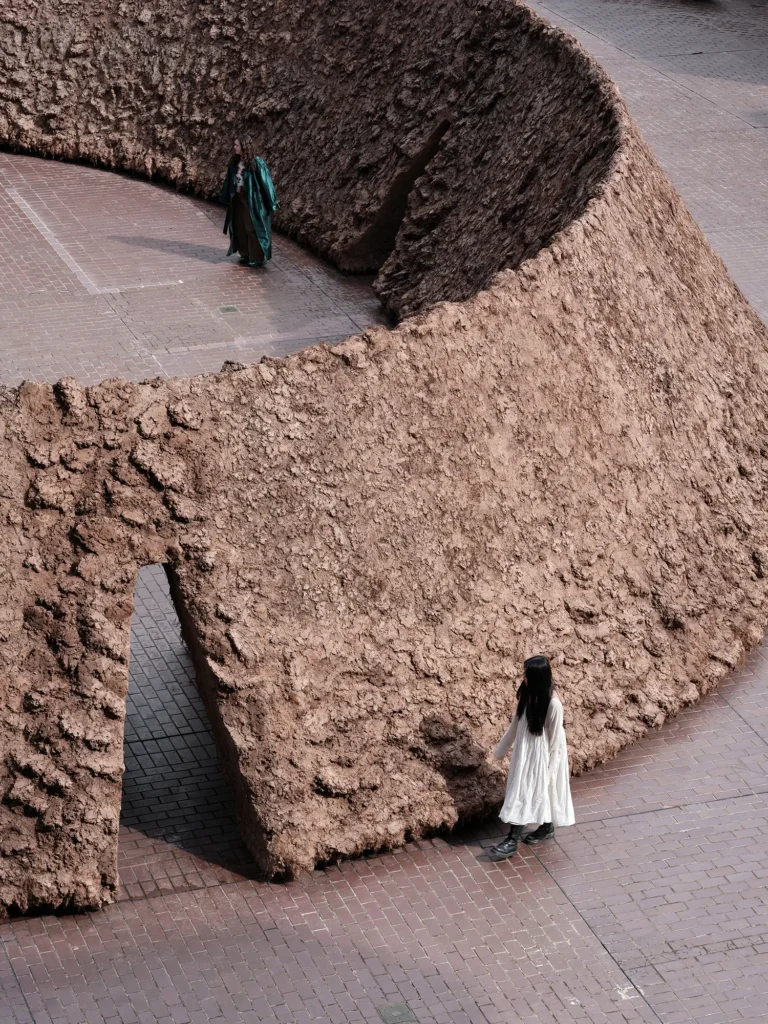
The spices are not decoration. Cinnamon and cloves were mixed into the earthen body of Origo for reasons that are at once functional and philosophical, since both contain antifungal properties essential for maintaining the biological health of the soil over the course of the exhibition, a practical decision that doubles as an argument about the intelligence embedded in ancestral knowledge systems. The heady, warm fragrance that fills the Sculpture Court as a result creates a multisensory encounter that operates below the threshold of conscious analysis, so that visitors who have never read a word about Morelos’ practice will feel the work before they understand it. The smell evokes memory and emotion in ways that visual experience cannot, fostering a more ethical relationship with what Morelos calls the mother of all materials.
The dialogue with the Barbican’s brutalism is the conceptual hinge of the entire project. The Barbican was designed in 1959 by Chamberlin, Powell, and Bon, influenced by Le Corbusier, as a utopian city within a city, combining high-density housing, elevated walkways, integrated cultural infrastructure, and a humanist approach to urban living. Its hand-hewn concrete surfaces are tactile and reflect the labor involved, with the Sculpture Court designed to integrate art into everyday communal life. Origo responds to all of these elements with a precision that feels earned rather than assigned, placing the precarious and malleable in dialogue with the rigid and imposing, and in doing so it highlights the permeability of our bodies and their entanglement with the very material of the earth. Concrete and soil, it turns out, share more than they appear to, since both are composed of the earth, both carry the trace of human hands, and both age in public view.
The shadow gap at the base is the installation’s most restrained formal decision. The volume of Origo perches on a recessed base, creating a thin line of shadow that makes the entire mass appear to float fractionally above the paving. It is a detail so small that it might be missed entirely and yet so precise that once noticed, it changes the reading of the whole, since an earthwork this heavy and this dense should not seem to hover. The gap measures less than a centimeter, but it carries the weight of the installation’s entire tonal argument, insisting that the earth is not anchored here, that it arrived, and that it could just as easily leave. The work makes its temporary status visible in its very foundation.
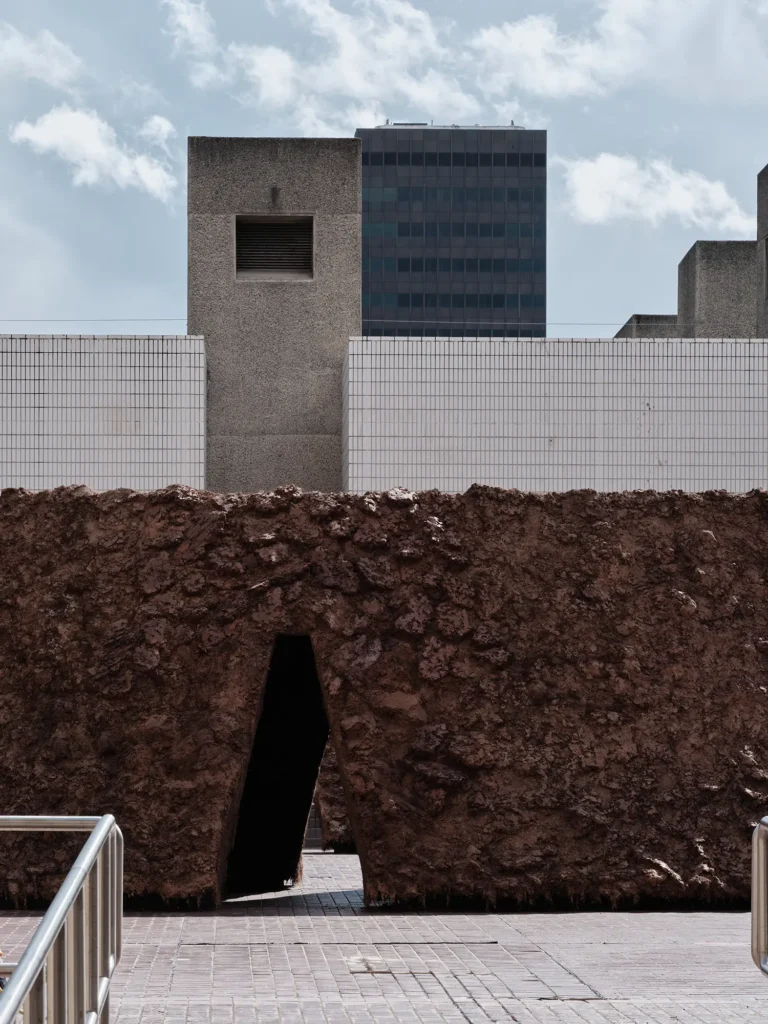
The scale of the physical labor deserves its own paragraph. Morelos and her team applied over thirty tons of soil and clay by hand across more than a month of construction, with no machinery shaping the exterior surface, so that the texture visitors see, rough and organic and alive with irregularity, is the direct record of human touch at monumental scale. Chocano described it as a gargantuan task that was physically and emotionally taxing yet incredibly gratifying. In a field increasingly mediated by digital fabrication and industrial production, Origo insists on the irreducible value of the handmade, not as nostalgia but as argument, carrying the labor of its making as content rather than mere process.
What Origo ultimately proposes, and this is the claim worth taking seriously, is that the most radical act of public art in 2026 is not technological disruption or institutional critique but the placement of thirty tonnes of living earth in the middle of a post-war utopian housing complex, scented with cinnamon, open to the rain and slowly changing as seeds germinate within its walls. Morelos has built something the Barbican’s architects would have recognized as continuous with their own project, not an interruption of the communal space but a deepening of it, expanding the definition of who belongs in that community to include not only the human residents of the estate but also the microorganisms in the soil, the seeds that will or will not germinate, and the spices releasing their fragrance into the London air. Community, as Origo proposes it, occurs beyond our species.
Fact File
Project name: Origo
Artist: Delcy Morelos
Typology: Public art installation, site-specific earthwork
Location: Barbican Sculpture Court, Silk Street, London EC2Y 8DS, United Kingdom
Commissioned by: Barbican
Exhibition dates: 15 May to 31 July 2026
Dimensions: 24 by 18 metres, rising over 3 metres
Materials: clay, soil, hay, plant seeds, cinnamon, cloves
Photography: Thomas Adank / Barbican Art Galleryrol, water
Applications: daylight screens, sun shading, room partitions, wall panels
Published in: Frontiers of Architectural Research
Funding: Swedish Energy Agency
Year: 2026
